
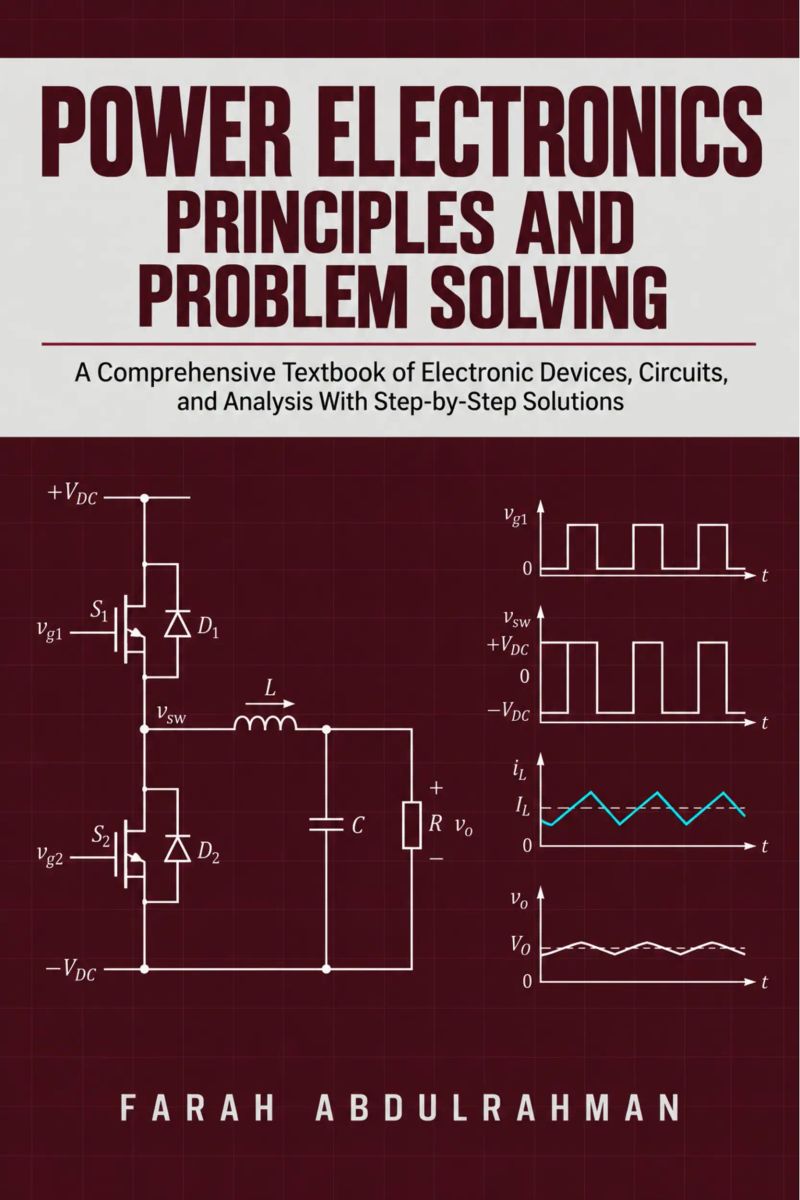
Power Electronics Principles and Problem Solving
A Comprehensive Textbook of Electronic Devices, Circuits, and Analysis With Step-by-Step SolutionsBy Farah Abdulrahman


Length17h 23m
About this audiobook
Duty ratio formulas are easy to memorise and useless when the design does not work. This book shows you where they come from and what they cost.
Power electronics is where circuit theory meets real hardware: switching devices, magnetic components, thermal limits, and control loops all interact. This textbook builds the subject from first principles, deriving every converter relation from inductor volt-second balance and capacitor charge balance. You will not just memorise equations; you will understand their assumptions, their limits, and the design trade-offs they represent.
The book begins with power processing roles and semiconductor devices, then develops steady-state analysis tools and applies them to buck, boost, and buck-boost converters, including discontinuous conduction mode. Isolated topologies such as flyback, forward, push-pull, and bridge are covered in detail, followed by a full chapter on magnetics design so you can select and wind real cores instead of guessing. Rectifier harmonics and power factor correction are treated alongside inverter modulation, dead-time distortion, motor drive control, and regeneration. Later chapters close the loop with averaged small-signal models and compensation, then address thermal design, capacitor life, electromagnetic interference, filtering, and layout. A graded problem set with step-by-step solutions completes the book.
What you will learn:
• Derive duty ratio and conversion relations from volt-second and charge balance
• Analyse buck, boost, and buck-boost converters in continuous and discontinuous conduction mode
• Design isolated converters including flyback, forward, push-pull, and bridge topologies
• Select and design magnetic components, including inductors and transformers
• Handle rectifier harmonics and design power factor correction stages
• Apply sinusoidal and space-vector modulation, and manage dead-time distortion
• Model converter dynamics with averaged small-signal techniques and design compensation
• Address thermal design, capacitor life, EMI, filtering, and PCB layout
• Solve graded problems with fully worked step-by-step solutions
This book is written for undergraduate and graduate students in electrical engineering, as well as practising design engineers who need a rigorous, practical reference. If you want to move beyond memorised formulas and build power converters that work reliably, this text provides the analysis tools, design methods, and problem-solving practice you need.
Audiobook details
GenreTechnology
Length17 hrs 23 mins
Narrated byListen with 1,000+ voices
FormateBook with Audio
Publish dateSep 28, 2026
LanguageEnglish
Table of contents
1Power Electronics Principles and Problem Solving
2Foreword
3Preface
4About This Book
5Important Safety Notice
Mostrar todos os capítulosVer menos
6Chapter 1: Power Processing and Converter Roles
71.1 Energy Conversion Functions and Converter Classification
81.2 Efficiency, Loss Budgets and the Cost of Conversion
91.3 Voltage, Current and Thermal Ratings
101.4 Topology Selection and Design Trade-offs
111.5 The Design Procedure and the Role of Analysis
12Chapter 2: Power Semiconductor Devices
132.1 Diode Characteristics and Reverse Recovery
142.2 MOSFET Structure, On-Resistance and Body Diode
152.3 IGBT and Wide-Bandgap Devices
162.4 Conduction and Switching Loss Models
172.5 Safe Operating Area, Gate Drive and Protection
18Chapter 3: Steady-State Analysis Tools
193.1 The Small-Ripple Approximation
203.2 Inductor Volt-Second Balance
213.3 Capacitor Charge Balance
223.4 Ripple Magnitudes and Component Stress
233.5 Efficiency Modelling with Losses
24Chapter 4: Buck, Boost and Buck-Boost Converters
254.1 Buck Converter in Continuous Conduction
264.2 Boost Converter in Continuous Conduction
274.3 Buck-Boost Converter and Polarity Inversion
284.4 Component Sizing and Stress
294.5 Loss Accounting in the Three Converters
30Chapter 5: Discontinuous Conduction Mode
315.1 Boundary Between Continuous and Discontinuous Conduction
325.2 Conversion Ratios in Discontinuous Conduction
335.3 Ripple, Stress and Component Implications
345.4 Control Implications and Mode Transitions
35Chapter 6: Isolated Converters
366.1 Flyback Converter and Turns Ratio Selection
376.2 Forward Converter with Reset
386.3 Push-Pull, Half-Bridge and Full-Bridge Converters
396.4 Duty Limits, Leakage and Snubbers
406.5 Isolation, Creepage and Safety Requirements
41Chapter 7: Magnetics Design
427.1 Core Materials, Geometries and Saturation Limits
437.2 Flux Density, Turns and Window Utilisation
447.3 Copper Loss, Skin Effect and Proximity Effect
457.4 Core Loss and the Steinmetz Equation
467.5 Magnetics Thermal Design and Verification
47Chapter 8: Rectifiers and Power Quality
488.1 Uncontrolled Rectifiers and Capacitor-Input Behaviour
498.2 Phase-Controlled Rectifiers
508.3 Harmonic Current, Displacement and Distortion Power Factor

When the Heavens Went on SaleAshlee Vance18h 20m4.4 (3K)$40 · $0.00

Everybody Has a Podcast (Except You)Justin McElroy, Travis McElroy, Griffin McElroy5h 9m4.3 (2.3K)$24 · $0.00

Hands of TimeRebecca Struthers8h 8m4.4 (1.3K)$26 · $0.00

Never Lost AgainBill Kilday10h 1m4.4 (805)$29 · $0.00

How the Internet HappenedBrian McCullough13h 28m4.3 (2.7K)$23 · $0.00

Collected Writings of Nikola TeslaNikola Tesla, Thomas Commerford Martin21h 50m4.3 (1.7K)$1 · $0.00
Just AspireAjai Chowdhry9h 13m4.4 (260)$29 · $0.00

The Little Book of AliensAdam Frank8h 20m4.3 (1.3K)$26 · $0.00
The inventions, researches and writings of Nikola Tesla (Annotated)Thomas Commerford Martin16h 59m4.3 (1.3K)$2 · $0.00

KargilV.P. Malik15h 18m4.3 (2K)$24 · $0.00

Experiments with Alternating CurrentsNikola Tesla9h 16m4.3 (874)$1.99 · $0.00

Fire on the HorizonTom Shroder, John Konrad8h 23m4.3 (858)$26 · $0.00

The Smell of Kerosene (Annotated)National Aeronautics and Space Administration, Donald L. Mallick, Peter W. Merlin11h 32m4.3 (523)$2 · $0.00

The Boy Who Harnessed the WindWilliam Kamkwamba, Bryan Mealer10h 5m4.2 (78.9K)$29 · $0.00

Across the Airless WildsEarl Swift10h 8m4.3 (1.3K)$29 · $0.00

Console WarsBlake J. Harris20h 41m4.2 (13.7K)$46 · $0.00

Improvised Munitions HandbookU.S. Department of Defense4h 49m4.3 (1.6K)$1.99 · $0.00

Escaping GravityLori Garver10h 54m4.2 (2.2K)$20 · $0.00

Wireless WarsJonathan Pelson8h 2m4.3 (418)$20 · $0.00

Let There Be WaterSeth M. Siegel8h 36m4.2 (2.3K)$20 · $0.00
You may also like

The Principle of RelativityAlbert Einstein7h 12m4.4 (1.2K)$2.30
Crossing the ChasmGeoffrey A. Moore9h 45m4.1 (37.9K)$29 · $0.00

The Speed of SoundScott Eyman13h 39m4.2 (368)$23

Florida Air A Contractor Exam Study GuideMarie Peterson7h 55m$10

Pass the AWS Solutions ArchitectDaria Whitlock7h 26m$5 · $0.00

Remarks on the Proposed Railway Between Birmingham and LondonAnonymous57m$2 · $0.00

The Recent Revolution in Organ BuildingGeorge Laing Miller4h 27m$2 · $0.00

Linotype ManualVarious57m$1 · $0.00

Pass the AWS DevOps Pro ExamReza Fontaine7h 32m$5 · $0.00

ARDMS SPI Exam Study GuideMarie Peterson10h 44m$10

The Most Ingenious Inventions in Human HistoryBenjamin Recker44m$14 · $0.00

The history of money and bankingKidsChoice54m$12 · $0.00

Opportunities in AviationGordon Lamont, Arthur Sweetser1h 23m$2 · $0.00

Discoveries and Inventions of the Nineteenth CenturyRobert Routledge43h 30m4.2 (38)$1 · $0.00
Object-Oriented C++ You Can Build OnFelix Ibarra7h 52m$5 · $0.00
APIs Developers Love to UseLydia Sandoval7h 53m$5 · $0.00
Concurrent and Parallel C++Noor Abara7h 8m$5 · $0.00

Of the Just Shaping of LettersAlbrecht Dürer2h 24m4.1 (157)$1 · $0.00

Concurrency That PerformsEsther Tanaka7h 37m$5 · $0.00

Pegi-Online Eine Ergänzung Des Pegi-Systems Für Online-SpieleGrit Stephan16m$4 · $0.00