
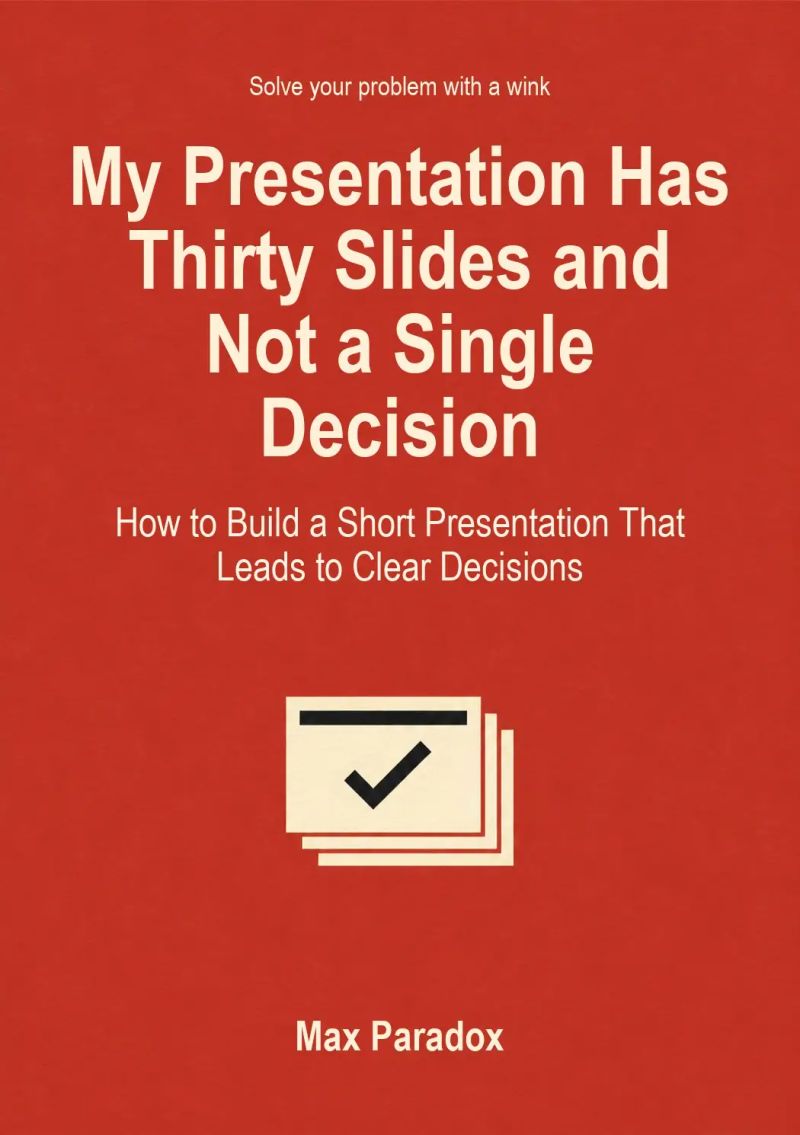
My Presentation Has Thirty Slides and Not a Single Decision - How to Build a Short Presentation That Leads to Clear Decisions
De Max Paradox


Duração6h 14m
Sobre este audiolivro
Thirty slides. Eight participants. One hour wasted. Zero decisions. And another meeting scheduled to discuss what the first meeting was supposed to achieve.
Sound familiar?
Every workplace has experienced the presentation that contains everything except a clear point. There are beautiful charts, impressive statistics, polished animations, and enough background information to qualify as an archaeological expedition. Everyone listens. Everyone nods. Everyone leaves. Then someone asks the question nobody wants to hear:
"So, what exactly did we agree on?"
In My Presentation Has Thirty Slides and Not a Single Decision, Max Paradox takes a humorous yet practical look at one of the most expensive habits of modern professional life: preparing presentations that communicate plenty of information but produce remarkably little action.
This book isn't about mastering fancy transitions or creating slides worthy of a design award. It's about something considerably more useful: turning complex information into clear conversations, responsible decisions, and concrete next steps.
Through recognizable workplace situations, sharp observations, and practical examples, you'll discover why presentations become unnecessarily long, why more data doesn't always mean better understanding, and why the most important slide is often the one that never gets shown.
Inside, you'll learn how to:
Define the decision your presentation should support before opening PowerPoint.
Build a clear narrative around the problem, its consequences, available options, and your recommendation.
Use a practical five-slide structure without treating brevity as an inflexible rule.
Select essential information while keeping important evidence and risks accessible.
Transform complicated charts into understandable arguments.
Compare alternatives fairly without manipulating criteria to favor a predetermined winner.
Present recommendations confidently while acknowledging uncertainty and limitations.
Handle objections, unexpected questions, changing priorities, and difficult participants.
Recognize when additional information is genuinely necessary before making a decision.
Finish meetings with clear agreements, responsibilities, deadlines, and measurable next steps.
You'll also explore what happens after the presentation ends. Why do apparently approved decisions change overnight? How can teams prevent misunderstandings about responsibilities? What should happen when critical information is missing? And how do you stop the same unresolved problem from returning month after month disguised as a brand-new presentation?
Max Paradox approaches these questions with humor, common sense, and a refreshing awareness that workplaces rarely operate under ideal conditions. Managers change their minds. Finance requests another calculation. Someone interrupts halfway through your recommendation. The projector refuses to cooperate. And there is always one colleague who believes the solution to every problem is adding another slide.
Rather than pretending these situations can be eliminated, the book shows how to prepare and communicate more effectively despite them.
This is a practical guide for managers, team leaders, project coordinators, analysts, specialists, consultants, and anyone who regularly needs to explain complicated matters to people who have limited time and important decisions to make.
The central message is simple: a successful presentation isn't measured by how many slides you deliver, but by whether the audience understands what needs to happen next.
Sometimes five slides are enough. Sometimes thirty are justified. And sometimes the best presentation is the one you never create because a short conversation would solve the problem faster.
If you're tired of meetings that end with polite applause and absolutely no progress, this book will help you rethink what your presentations are really for.
Because nobody needs another thirty-slide explanation of why another meeting is necessary.
They need clarity, a decision, and a reason to get back to work.
This publication was prepared using tools that support the creative process, including artificial intelligence solutions. The final concept, structure and editing are the responsibility of the author.
Detalhes do audiolivro
GêneroBusiness and Economics
Duração6 h 14 min
Narrado porOuça com mais de 1.000 vozes
FormatoeBook com áudio
Data de publicação22 de nov. de 2026
IdiomaInglês
Sumário
1INTRO
2Chapter 1 - When the Presentation Becomes the Goal Instead of the Tool
3Chapter 2 - Everyone Was Listening, but Everyone Understood Something Different
4Chapter 3 - Applied Slideology, or Why Everything Seems Important
5Chapter 4 - The Beautiful Presentation Nobody Needed
Mostrar todos os capítulosVer menos
6Chapter 5 - A Meeting Without an Owner, or Who Can Actually Say "Yes"?
7Chapter 6 - Just One More Slide, or How Other People's Requests Take Over Your Presentation
8Chapter 7 - Just a Quick Review, or How a Presentation Devours Meeting Time
9Chapter 8 - The Presentation as a Shield, or Why We're Afraid to Say What We Really Recommend
10Chapter 9 - Decision First, Slides Second: Building a Presentation Backwards
11Chapter 10 - Five Slides That Lead from Problem to Decision
12Chapter 11 - A Chart Is Not an Argument, or How to Present Data That Actually Explains Something
13Chapter 12 - Three Options and One Choice, or How to Compare Without Rigging the Winner
14Chapter 13 - When Someone Says "No": How to Lead a Discussion Instead of Defending Your Slides
15Chapter 14 - The End of the Presentation Is the Beginning of Action: Turning Agreements into Concrete Steps
16Chapter 15 - The Decision Was Made, but Then It Dissolved: What to Do When Everything Changes After the Meeting
17Chapter 16 - When Data Is Missing but the Decision Can't Wait
18Chapter 17 - When Everything Goes Wrong: Presenting in Less-Than-Ideal Conditions
19Chapter 18 - The Presentation That Doesn't Return as the Same Problem
20Chapter 19 - Stop Reinventing Presentations: How to Build Your Own Way of Working
21Chapter 20 - Five Slides and One Decision: The Last Presentation You'll Build the Old Way

Mom Asks for a Transfer. So Does Her Voice - How to Check a Suspicious Money Request When a Scammer Pretends to Be Someone Close to YouMax Paradox8h 20min$7.40

Meine Telefonnummer hat gerade einen neuen Besitzer bekommen - Wie du dich auf einen Nummernwechsel vorbereitest und den Zugang zu deinen wichtigen Konten behältstMax Paradox6h 58min$7.40

I'm Selling a Sofa, So Why Does the Buyer Want My Card? - How to Buy and Sell Safely on Online Classifieds PlatformsMax Paradox6h 8min$7.40

Mój szef kazał zautomatyzować coś, czego nikt nie rozumie - Jak uporządkować proces przed wdrożeniem AI i mierzyć realny zyskMax Paradox5h 35min$7.40

Pan z banku zna moje imię i ma za dużo czasu - Jak rozpoznać fałszywy telefon z banku i samodzielnie zweryfikować rozmówcęMax Paradox5h 30min$7.40

The App Asks About My Health, I Ask About My Privacy - How to Use Health Apps Wisely and Limit the Personal Data You ShareMax Paradox5h 54min$7.40

Mama bittet um eine Überweisung. Ihre Stimme auch. - Wie du eine verdächtige Geldforderung überprüfst, wenn ein Betrüger sich als eine nahestehende Person ausgibtMax Paradox8h$7.40

The Man from the Bank Knows My Name and Has Way Too Much Time - How to Spot a Fake Bank Call and Verify the Caller YourselfMax Paradox5h 41min$7.40

My Address Is Traveling the Internet Without a Suitcase - How to Find Where Your Personal Data Appears and Reduce Its Public VisibilityMax Paradox5h 54min$7.40

Mam pięć paczek i nie pamiętam, którą zamówiłem - Jak śledzić zakupy, reklamacje i zwroty bez polowania na potwierdzeniaMax Paradox5h 52min$7.40

Mój numer telefonu właśnie zmienił właściciela - Jak przygotować się do zmiany numeru i utrzymać dostęp do ważnych kontMax Paradox5h 45min$7.40

Der Mann von der Bank kennt meinen Namen und hat viel zu viel Zeit - Wie du einen gefälschten Bankanruf erkennst und die Identität des Anrufers selbst überprüfstMax Paradox6h 33min$7.40

Wszystko jest w chmurze, tylko nie wiem, w której - Jak uporządkować dokumenty cyfrowe, ich dostępność i kopie zapasoweMax Paradox6h 13min$7.40

Everything Is in the Cloud, I Just Don't Know Which One - How to Organize Your Digital Documents, Keep Them Accessible, and Back Them UpMax Paradox6h 22min$7.40

Zmienił się system, przeciążyłem się ja - Jak przejść przez obowiązkową zmianę narzędzi w pracy bez brania całej migracji na siebieMax Paradox6h 8min$7.40

Ich habe das perfekte Jobangebot gefunden. Offenbar hat es mich zuerst gefunden. - Wie du gefälschte Stellenanzeigen erkennst und deine persönlichen Daten bei der Jobsuche schütztMax Paradox7h 23min$7.40

Alles ist in der Cloud, ich weiß nur nicht, in welcher - Wie du deine digitalen Dokumente organisierst, jederzeit darauf zugreifen kannst und zuverlässige Backups erstellstMax Paradox7h 24min$7.40

AI Summarized the Contract. The Contract Disagrees - How to Compare AI Summaries with the Original Document and Spot Missing ExceptionsMax Paradox5h 58min$7.40

AI streściło umowę. Umowa ma inne zdanie - Jak porównywać streszczenia AI z dokumentem i rozpoznawać pominięte wyjątkiMax Paradox5h 44min$7.40

Never Split the DifferenceChris Voss, Tahl Raz8h 7min4.4 (277.7K)$26 · $0.00
The Intelligent Investor Rev Ed.Benjamin Graham17h 48min4.3 (191.5K)$40 · $0.00

The Hard Thing About Hard ThingsBen Horowitz7h 57min4.2 (134.3K)$26 · $0.00

Boundaries for LeadersHenry Cloud7h 36min4.3 (3.6K)$26 · $0.00

Good to GreatJim Collins9h 59min4.1 (325.2K)$29 · $0.00

The Way of ExcellenceBrad Stulberg6h 46min4.2 (1.1K)$24 · $0.00

Trillion Dollar CoachEric Schmidt, Jonathan Rosenberg, Alan Eagle5h 40min4.1 (22.2K)$24 · $0.00

Be ExceptionalJoe Navarro, Toni Sciarra Poynter9h 11min4.0 (1.3K)$29 · $0.00
The Power of the OtherHenry Cloud5h 52min4.2 (3.5K)$24 · $0.00

Progress and Poverty, Volumes I and II (Annotated)Henry George19h 21min4.6 (574)$1.99 · $0.00

Not Everything Counts but Everything Matters: The powerful and inspirational new book about leadership and achieving success from the visionary multi-premiership winning Panthers coachIvan Cleary6h 1min4.6 (680)$24 · $0.00

BuildTony Fadell11h 5min4.5 (14.3K)$8 · $0.00

The Joys Of CompoundingGautam Baid17h 34min4.5 (2.5K)$18 · $0.00

Basic EconomicsThomas Sowell18h 32min4.5 (29.3K)$28 · $0.00

The Ambuja StoryNarotam Sekhsaria13h 59min4.5 (830)$33 · $0.00

The Secret Door to SuccessFlorence Scovel Shinn2h 25min4.5 (2.1K)$1.20 · $0.00

This Is Going to HurtAdam Kay5h 47min4.4 (444.7K)$24 · $0.00

Big TrustShadé Zahrai, Fayçal Sekkouah8h 36min4.6 (406)$26 · $0.00
The Intelligent Investor Third EditionBenjamin Graham, Jason Zweig20h4.4 (156.6K)$46 · $0.00

Bottle of LiesKatherine Eban14h 25min4.4 (12K)$33 · $0.00
Você também pode gostar
The Problems of PhilosophyBertrand Russell4h 32min4.0 (25.8K)Grátis

On Sense and ReferenceGottlob Frege2h 14min4.1 (484)$1 · $0.00

Tertium OrganumP. D. Ouspensky14h 45min4.4 (633)$1.99 · $0.00

Symbolic LogicLewis Carroll5h 23min4.1 (2.3K)$2

Fundamental Principles of the Metaphysic of Morals Immanuel Kant3h 16min4.0 (48.8K)Grátis

Fallen LeavesWill Durant5h 18min4.2 (2K)$17

The Basis of MoralityArthur Schopenhauer6h 43min4.1 (622)$2

Como Ganar Amigos e Influir Sobre Las Personas (Condensado) [How to Win Friends and Influence People (Abridged)]Dale Carnegie55min4.4 (489)$4 · $0.00

Medieval MedicineJames J. Walsh5h 31min3.7 (30)$1 · $0.00

Unveiling SalesEdivaldo Ascaneo41min$6 · $0.00

Problem SolvedCheryl Strauss Einhorn5h 24min4.0 (200)$20
How to Make Money Flipping Jewelry - How to Test Metals and Stones, Spot Fakes, Value Pieces, and Sell SafelyJACK FLIPWELL8h 7min$7.50

A Color Notation: How to Numerically Describe ColorsA. H. Munsell4h 1min3.8 (159)$1.99 · $0.00

Erotic DrawingsVictoria Charles1h 20min3.5 (28)$13.50 · $0.00
Why Businesses Fail? S01E04Amar Deshpande25min$4 · $0.00
Problem Solving: A Comprehensive Beginner's Guide to Rational Analysis (The Simple, Practical Guide to Creative Problem Solving Using Lateral, Vertical, and Critical Thinking)Martin g, Gerald Eberhardt1h 27min$6.40 · $0.00
The Logic of Human Mind, Self-Awareness & Way We ThinkJohn Dewey40h 51min$1.99 · $0.00

Capital (Das Kapital) (Annotated)Karl Marx103h 48min$1.99 · $0.00
Logic: Deductive and Inductive (Annotated)Carveth Read11h 47min3.7 (110)$1.99 · $0.00

Aestheticism in ArtWilliam Hogarth4h 38min$18