
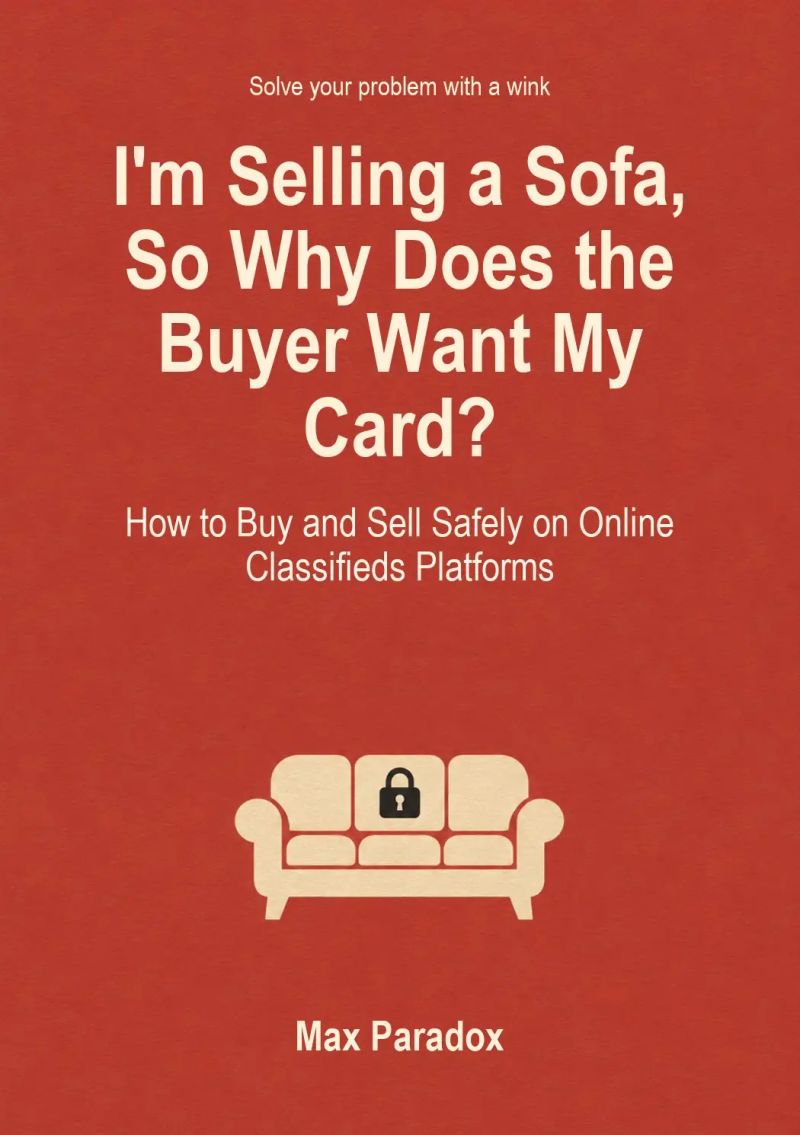
I'm Selling a Sofa, So Why Does the Buyer Want My Card? - How to Buy and Sell Safely on Online Classifieds Platforms
De Max Paradox


Duração6h 7m
Sobre este audiolivro
You're selling a sofa. The buyer is ready to pay. So why do they need your bank card details?
You take a few photographs, write an honest description and publish your listing. Minutes later, someone offers to buy your furniture without negotiating. They even arrange a courier. Everything seems wonderfully convenient.
There's just one tiny formality.
Click the link. Enter your card details. Confirm the payment.
Congratulations. Your ordinary attempt to declutter the living room has suddenly become a potential cybersecurity incident.
Welcome to the surprisingly inventive world of online classifieds scams.
In I'm Selling a Sofa, So Why Does the Buyer Want My Card?, Max Paradox takes you behind the messages, suspicious payment confirmations, fake courier notifications and irresistible bargains that can turn everyday buying and selling into an expensive mistake.
With practical explanations, relatable situations and a healthy dose of humour, this book reveals how scammers exploit trust, urgency, politeness and the simple human desire to finish a transaction without unnecessary complications.
You don't need to become a cybersecurity specialist. You just need to understand what someone is really asking you to do.
Inside, you'll discover:
How to recognise seven warning signs that deserve your attention before you complete a transaction.
Why a professional-looking payment website, familiar logo or convincing screenshot doesn't necessarily prove anything.
How scammers manipulate sellers with fake payments, courier arrangements and requests for confidential banking information.
How buyers can evaluate suspicious bargains, misleading photographs, questionable sellers and demands for advance payments.
What different payment methods can and cannot protect you from.
How to verify listings, transaction details and supposed messages from banks or delivery companies.
Why even established accounts with positive reviews can sometimes be used dishonestly.
How to protect your passwords, banking access and personal information.
What to do if you've clicked a suspicious link, disclosed sensitive information or discovered an unexpected transaction.
How to document disagreements, respond to defective purchases and pursue appropriate complaint procedures.
Why walking away from an uncomfortable deal can be a perfectly sensible decision.
But this isn't another book telling you to distrust everyone on the internet.
Most buyers really do want to buy something. Most sellers genuinely want to sell it. And not every late parcel, awkward conversation or unexpectedly cheap second-hand laptop is evidence of an international criminal conspiracy.
The challenge is learning to distinguish normal inconvenience from genuine danger.
Through twenty accessible chapters, you'll explore the psychology behind online deception, the practical boundaries of safe transactions and the small habits that can help you stay in control even when you're tired, distracted or under pressure.
You'll also learn why making a mistake doesn't mean you should spend the next three days blaming yourself instead of taking useful action.
This book is for anyone who buys, sells or occasionally wonders whether a second-hand coffee machine is worth risking their savings over.
Whether you're clearing out your home, hunting for affordable electronics, buying furniture or helping a family member navigate an unfamiliar platform, you'll find practical ways to evaluate offers without turning every purchase into a criminal investigation.
Because successful online trading should end with an item changing hands and both parties getting what they agreed on.
Not with you explaining to your bank why a stranger supposedly needed your security code to collect a wardrobe.
Sell your sofa. Keep control of your money. And leave the financial experiments to someone else.
This publication was prepared using tools that support the creative process, including artificial intelligence solutions. The final concept, structure and editing are the responsibility of the author.
Detalhes do audiolivro
GêneroTechnology
Duração6 h 7 min
Narrado porOuça com mais de 1.000 vozes
FormatoeBook com áudio
Data de publicação22 de nov. de 2026
IdiomaInglês
Sumário
1INTRO
2Chapter 1 - When an Ordinary Listing Turns Into a Trap
3Chapter 2 - Why Does a Scammer Sound More Convincing Than Your Own Common Sense?
4Chapter 3 - Seven Red Flags That Should Stop Your Transaction
5Chapter 4 - The False Sense of Security: How We Make a Scammer's Job Easier
Mostrar todos os capítulosVer menos
6Chapter 5 - Not Every Bargain Is a Bargain: How to Shop Without Switching Off Your Common Sense
7Chapter 6 - Sellers Need to Be Careful Too: How Not to Give Away Your Money Along With the Item
8Chapter 7 - Safe Payments: Why Money Shouldn't Travel on Trust Alone
9Chapter 8 - You Don't Have to Be Nice at Any Cost: The Art of Ending Suspicious Conversations
10Chapter 9 - Keeping the Transaction Under Control: From the First Message to the Final Confirmation
11Chapter 10 - A Digital Detective Without a Magnifying Glass: How to Check Information Before Believing a Listing
12Chapter 11 - A Link to Your Money or a Link to Trouble? How to Recognise Fake Messages and Payment Websites
13Chapter 12 - Your Account Isn't a Communal Cloakroom: How to Secure Access to Classifieds Platforms and Online Banking
14Chapter 13 - The Parcel Arrived, but Reality Forgot the Description: How to Resolve Disputes After a Purchase
15Chapter 14 - Before the Scammer Disappears With Your Money: What to Do When a Suspicious Transaction Becomes a Real Threat
16Chapter 15 - When a Scam Has Several Layers: Difficult Cases Where Ordinary Caution Isn't Enough
17Chapter 16 - When Caution Loses to Real Life: What to Do When You Have No Time, Knowledge or Ideal Conditions
18Chapter 17 - I Fell for a Scam. Now What? How to Regain Control After the Damage Is Done
19Chapter 18 - Safe Shopping Without Everyday Paranoia: How to Maintain Good Habits
20Chapter 19 - When Common Sense Goes on Holiday: How to Recognise the Return of Old Mistakes
21Chapter 20 - Sell Your Sofa, Not Your Peace of Mind: How to Make Safe Decisions Independently

Mom Asks for a Transfer. So Does Her Voice - How to Check a Suspicious Money Request When a Scammer Pretends to Be Someone Close to YouMax Paradox8h 20min$7.40

Meine Telefonnummer hat gerade einen neuen Besitzer bekommen - Wie du dich auf einen Nummernwechsel vorbereitest und den Zugang zu deinen wichtigen Konten behältstMax Paradox6h 58min$7.40

Mój szef kazał zautomatyzować coś, czego nikt nie rozumie - Jak uporządkować proces przed wdrożeniem AI i mierzyć realny zyskMax Paradox5h 35min$7.40

Pan z banku zna moje imię i ma za dużo czasu - Jak rozpoznać fałszywy telefon z banku i samodzielnie zweryfikować rozmówcęMax Paradox5h 30min$7.40

The App Asks About My Health, I Ask About My Privacy - How to Use Health Apps Wisely and Limit the Personal Data You ShareMax Paradox5h 54min$7.40

Mama bittet um eine Überweisung. Ihre Stimme auch. - Wie du eine verdächtige Geldforderung überprüfst, wenn ein Betrüger sich als eine nahestehende Person ausgibtMax Paradox8h$7.40
The Man from the Bank Knows My Name and Has Way Too Much Time - How to Spot a Fake Bank Call and Verify the Caller YourselfMax Paradox5h 41min$7.40

My Address Is Traveling the Internet Without a Suitcase - How to Find Where Your Personal Data Appears and Reduce Its Public VisibilityMax Paradox5h 54min$7.40

Mam pięć paczek i nie pamiętam, którą zamówiłem - Jak śledzić zakupy, reklamacje i zwroty bez polowania na potwierdzeniaMax Paradox5h 52min$7.40

Mój numer telefonu właśnie zmienił właściciela - Jak przygotować się do zmiany numeru i utrzymać dostęp do ważnych kontMax Paradox5h 45min$7.40

Der Mann von der Bank kennt meinen Namen und hat viel zu viel Zeit - Wie du einen gefälschten Bankanruf erkennst und die Identität des Anrufers selbst überprüfstMax Paradox6h 33min$7.40

Wszystko jest w chmurze, tylko nie wiem, w której - Jak uporządkować dokumenty cyfrowe, ich dostępność i kopie zapasoweMax Paradox6h 13min$7.40
Everything Is in the Cloud, I Just Don't Know Which One - How to Organize Your Digital Documents, Keep Them Accessible, and Back Them UpMax Paradox6h 22min$7.40

Zmienił się system, przeciążyłem się ja - Jak przejść przez obowiązkową zmianę narzędzi w pracy bez brania całej migracji na siebieMax Paradox6h 8min$7.40

Ich habe das perfekte Jobangebot gefunden. Offenbar hat es mich zuerst gefunden. - Wie du gefälschte Stellenanzeigen erkennst und deine persönlichen Daten bei der Jobsuche schütztMax Paradox7h 23min$7.40

Alles ist in der Cloud, ich weiß nur nicht, in welcher - Wie du deine digitalen Dokumente organisierst, jederzeit darauf zugreifen kannst und zuverlässige Backups erstellstMax Paradox7h 24min$7.40
AI Summarized the Contract. The Contract Disagrees - How to Compare AI Summaries with the Original Document and Spot Missing ExceptionsMax Paradox5h 58min$7.40

AI streściło umowę. Umowa ma inne zdanie - Jak porównywać streszczenia AI z dokumentem i rozpoznawać pominięte wyjątkiMax Paradox5h 44min$7.40
The System Changed, and I Got Overloaded - How to Navigate a Mandatory Workplace Tool Migration Without Taking the Entire Transition on Your ShouldersMax Paradox6h 26min$7.40

Collected Writings of Nikola TeslaThomas Commerford Martin, Nikola Tesla19h 42min4.4 (2.8K)$1.99 · $0.00

Operation PedestalMax Hastings12h 29min4.4 (5.2K)$29 · $0.00

When the Heavens Went on SaleAshlee Vance18h 20min4.4 (3K)$40 · $0.00

Everybody Has a Podcast (Except You)Justin McElroy, Travis McElroy, Griffin McElroy5h 9min4.3 (2.3K)$24 · $0.00

Hands of TimeRebecca Struthers8h 8min4.4 (1.3K)$26 · $0.00
Never Lost AgainBill Kilday10h 1min4.4 (805)$29 · $0.00
How the Internet HappenedBrian McCullough13h 28min4.3 (2.7K)$23 · $0.00

Collected Writings of Nikola TeslaNikola Tesla, Thomas Commerford Martin21h 50min4.3 (1.7K)$1 · $0.00

Just AspireAjai Chowdhry9h 13min4.4 (260)$29 · $0.00

The Little Book of AliensAdam Frank8h 20min4.3 (1.3K)$26 · $0.00

The inventions, researches and writings of Nikola Tesla (Annotated)Thomas Commerford Martin16h 59min4.3 (1.3K)$2 · $0.00

KargilV.P. Malik15h 18min4.3 (2K)$24 · $0.00

Experiments with Alternating CurrentsNikola Tesla9h 16min4.3 (874)$1.99 · $0.00

Fire on the HorizonTom Shroder, John Konrad8h 23min4.3 (858)$26 · $0.00

The Smell of Kerosene (Annotated)National Aeronautics and Space Administration, Donald L. Mallick, Peter W. Merlin11h 32min4.3 (523)$2 · $0.00

The Boy Who Harnessed the WindWilliam Kamkwamba, Bryan Mealer10h 5min4.2 (78.9K)$29 · $0.00

Across the Airless WildsEarl Swift10h 8min4.3 (1.3K)$29 · $0.00

Console WarsBlake J. Harris20h 41min4.2 (13.7K)$46 · $0.00
Improvised Munitions HandbookU.S. Department of Defense4h 49min4.3 (1.6K)$1.99 · $0.00

Escaping GravityLori Garver10h 54min4.2 (2.2K)$20 · $0.00
Você também pode gostar

Asking for ItKate Harding8h 55min4.4 (5.3K)$20 · $0.00
HOW TO WIN FRIENDS & INFLUENCE PEOPLEDale Carnegie11h 15min4.2 (1.3M)$2.99 · $0.00
Applied EconomicsThomas Sowell11h 38min4.4 (3.7K)$21
Economic Facts and FallaciesThomas Sowell9h 46min4.3 (9.2K)$20

Trigger PointsMark Follman7h 45min4.3 (876)$26 · $0.00

The Humbugs of the World & The Art of Money GettingP. T. Barnum14h 47min4.4 (12)$1.99 · $0.00

How to Avoid Online Scams and Protect Your MoneyMax Paradox8h 20min$7.50

EconoPowerMark Skousen8h 25min3.9 (88)$17 · $0.00

Every Message Looks Like a Scam - How to Stay Safe Online Without Suspecting Your Own GrandmaMax Paradox6h 49min$7.50
An Introduction to the Principles of Morals and Legislation (Annotated)Jeremy Bentham12h 53min3.9 (905)$2 · $0.00

The Quest for Cosmic JusticeThomas Sowell5h 52min$20

CracklandCleuber S Lima42min$8 · $0.00
Retail Store Operations A Complete Guide - 2021 EditionGerardus Blokdyk4h 37min$78

The Philosophy of Right & The Philosophy of Law (Annotated)Georg Wilhelm Friedrich Hegel15h 22min$1.99 · $0.00

The Positive School of CriminologyEnrico Ferri2h 9min3.7 (18)$2 · $0.00

We Want Shared Tools, Not a Shared Fight Over the Drill - How to Organize Neighborhood Tool Sharing, Arrange Reservations and Repair Responsibilities, and Decide Whether Joint Purchases Are Worth It Without Creating a Library of Lost ItemsMax Paradox6h 24min$5.10

On SuicideWilliam Wynn Westcott5h 41min$1.99 · $0.00
The Man from the Bank Knows My Name and Has Way Too Much Time - How to Spot a Fake Bank Call and Verify the Caller YourselfMax Paradox5h 41min$7.40

I Have a Good Team That's Just Exhausted - How to Manage Overload, Set Priorities, and Rebuild a Sustainable Work Pace Without Motivational Speeches About Giving 120 PercentMax Paradox6h 31min$7.50

Make the Most of Your WorkdayMary A. Camuto5h 16min2.5 (21)$17 · $0.00