
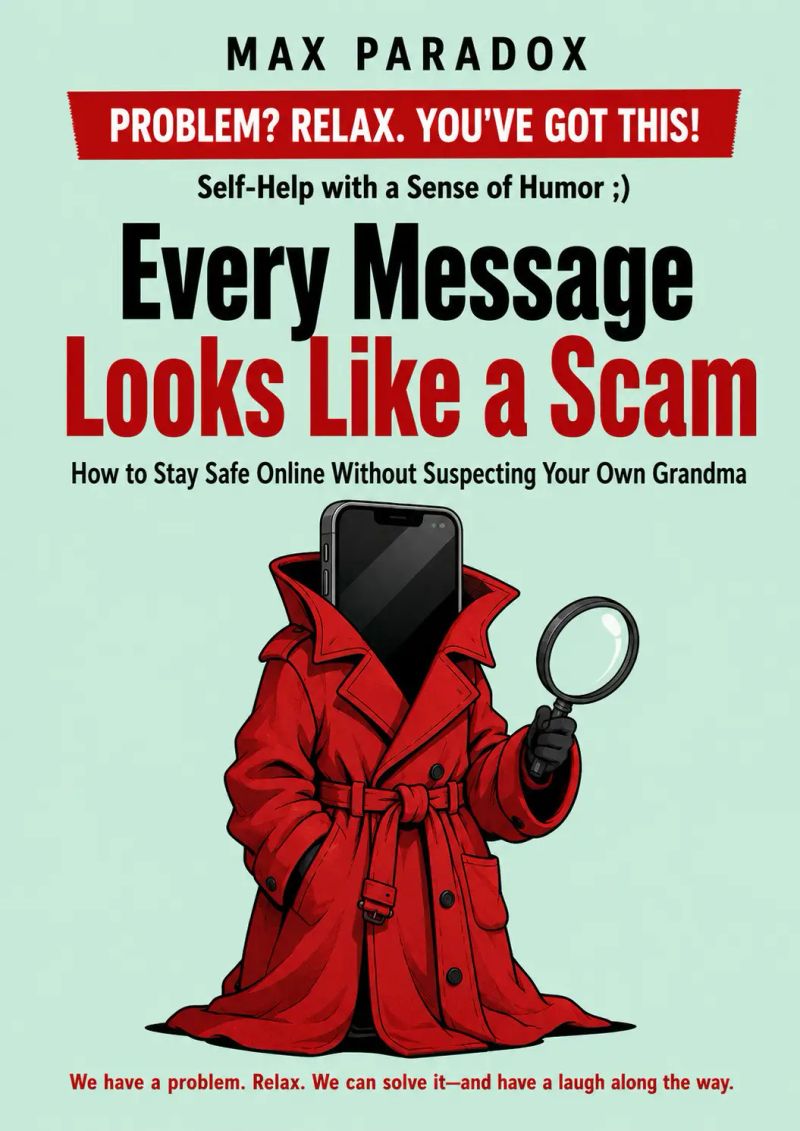
Every Message Looks Like a Scam - How to Stay Safe Online Without Suspecting Your Own Grandma
By Max Paradox


Length6h 49m
About this audiobook
Every text looks suspicious. Every email has a link. Your bank wants you to verify something, your package has apparently entered a crisis, and someone claiming to be your child suddenly has a new phone number and urgently needs money.
Welcome to modern online life, where being cautious is sensible-but suspecting every notification of criminal intent is exhausting.
Every Message Looks Like a Scam is a practical, funny guide to staying safer online without turning yourself into a full-time digital detective. Max Paradox shows you how to stop guessing whether messages “look real” and instead use simple habits that work even when a scam is polished, personalized, and convincing.
You will learn how to:
recognize the pressure tactics scammers use;
judge messages by the risk of the requested action;
handle suspicious links without playing URL detective;
verify bank, family, work, and account messages through trusted channels;
protect passwords, authentication codes, and important accounts;
respond to unusual payment requests and changed banking details;
handle fake support calls and remote-access requests;
verify urgent messages from family members, even when the voice sounds familiar;
know what to do when you cannot immediately verify a request;
react quickly if you already clicked, paid, shared a code, or granted access;
build a simple security system that still works when you are tired, distracted, or busy.
The method is deliberately uncomplicated. You do not need to memorize hundreds of scams or become an expert in phishing domains, deepfakes, browser certificates, and mysterious email headers. Instead, you will learn a repeatable process:
Stop. Leave. Verify.
Stop before the sensitive action. Leave the channel creating the pressure. Verify through an independent route you already trust.
Along the way, you will meet fake delivery notices, suspicious invoices, “urgent” bosses, helpful strangers, fake tech support, compromised accounts, desperate relatives, and more gift-card emergencies than any functioning economy should reasonably contain.
The result is not paranoia.
It is calm competence.
You will know when to slow down, when to ignore something, when to check elsewhere, when to call someone, and what to do if the mistake has already happened.
Because the goal is not to trust everything online.
The goal is not to fear everything either.
The goal is to make good decisions without treating every message from Grandma like evidence in an international cybercrime investigation.
This publication was prepared with the assistance of tools that support the creative process, including artificial intelligence-based solutions. The final concept, structure, and editing belong to the author.
Audiobook details
GenreTechnology
Length6 hrs 49 mins
Narrated byListen with 1,000+ voices
FormateBook with Audio
Publish dateAug 29, 2026
LanguageEnglish
Table of contents
1INTRO
2Chapter 1 - Why Everything Suddenly Looks Suspicious
3Chapter 2 - The Message Wants You to Hurry
4Chapter 3 - The Clues You Trust Too Much
5Chapter 4 - You Can Be Too Suspicious
Mostrar todos os capítulosVer menos
6Chapter 5 - Stop Clicking to Find Out
7Chapter 6 - Your Inbox Is Not Your Boss
8Chapter 7 - Politeness Is Expensive
9Chapter 8 - Stop Memorizing Scams
10Chapter 9 - Use Another Door
11Chapter 10 - The Five-Minute Verification Routine
12Chapter 11 - Codes Are Not Conversation
13Chapter 12 - Money Makes Messages Dangerous
14Chapter 13 - When the Message Sounds Exactly Like Them
15Chapter 14 - Nobody Needs to Control Your Screen
16Chapter 15 - What If You Already Started?
17Chapter 16 - When You Cannot Verify Anything
18Chapter 17 - The Day You Stop Being Careful
19Chapter 18 - Notice When the Old Problem Comes Back
20Chapter 19 - Build a System That Does Not Need You to Be Brilliant
21Chapter 20 - Safe Enough to Live Normally
Just Five More Minutes, Then I'll Sleep - How to Stop Stealing Sleep from Yourself Because Night Is the Only Time That Feels Like YoursMax Paradox6h 35m$7.70 · $0.00
Cleaning Never Ends - How to Keep Your Home in “Livable” Condition Without Becoming Your Own HousekeeperMax Paradox6h 19m$7.70 · $0.00

The Absurdities of Being an Actor - A Quietly Brutal Guide to Waiting Rooms, Almosts, and Still Showing UpMax Paradox3h 24m$7.70 · $0.00

We Keep Having the Same Fight - How to Break a Conflict You Both Know by HeartMax Paradox6h 51m$7.70 · $0.00
Every Ping Runs My Day - How to Take Back Your Attention from Notifications, Messages, and Red BadgesMax Paradox7h 4m$7.70 · $0.00

Jak rozpoznawać dezinformację i nie dać sobą manipulowaćMax Paradox5h 46m$7.70 · $0.00

Za dużo się tłumaczę - Jak przestać pisać trzystronicowe uzasadnienie każdej swojej decyzjiMax Paradox5h 12m$7.70 · $0.00

Jeszcze tylko pięć minut i idę spać - Jak przestać kraść sen samemu sobie, bo noc jest jedynym czasem tylko dla mnieMax Paradox5h 4m$7.70 · $0.00
How to Recognize Workplace Bullying and Defend Yourself EffectivelyMax Paradox6h 59m$7.70 · $0.00
Homeless in America - The Absurd Mathematics of Stability, Dignity, and the Thin Line Between Almost and GoneMax Paradox5h 41m$7.70 · $0.00

I'm Afraid to Change Jobs - How to Leave a Safe Hell for an Unknown WorldMax Paradox6h 8m$7.70 · $0.00

The Absurdities of Being a Teacher - A Quietly Exhausted Guide to Standing in Front of a Room and Pretending This Is FineMax Paradox4h 10m$7.70 · $0.00

The Absurdities of Being an Immigrant in America - A Tired, Honest, and Slightly Bitter Observation of Trying to Belong in a System That Prefers You TemporaryMax Paradox4h 28m$7.70 · $0.00
My Brain Wants Everything in Thirty Seconds - How to Rebuild Your Focus After Years of Reels, Shorts, and TikTokMax Paradox7h 6m$7.70 · $0.00

I Have Money but No Idea What to Do with It - How to Start Saving Without Becoming a Stock Market AnalystMax Paradox7h 38m$7.70 · $0.00

I Can't Stand Being a Beginner - How to Be Bad at Something Long Enough to Finally Get GoodMax Paradox7h 36m$7.70 · $0.00

I Can't Afford an Instagram Life - How to Stop Funding Other People's Standards with Your Own Credit CardMax Paradox7h 2m$7.70 · $0.00

I Don't Know What I Want from Life - How to Find Direction Without a Revelation, a Coach, or a Trip to TibetMax Paradox7h 11m$7.70 · $0.00
I Don't Know If We're Actually Together - How to Get Out of a Situationship Before It Reaches Season ThreeMax Paradox7h 16m$7.70 · $0.00
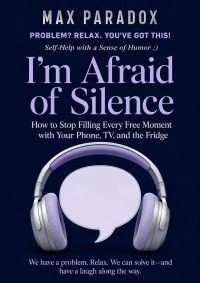
I'm Afraid of Silence - How to Stop Filling Every Free Moment with Your Phone, TV, and the FridgeMax Paradox6h 14m$7.70 · $0.00

Operation PedestalMax Hastings12h 29m4.4 (5.2K)$29 · $0.00

When the Heavens Went on SaleAshlee Vance18h 20m4.4 (3K)$40 · $0.00

Everybody Has a Podcast (Except You)Justin McElroy, Travis McElroy, Griffin McElroy5h 9m4.3 (2.3K)$24 · $0.00

Hands of TimeRebecca Struthers8h 8m4.4 (1.3K)$26 · $0.00

Never Lost AgainBill Kilday10h 1m4.4 (805)$29 · $0.00

How the Internet HappenedBrian McCullough13h 28m4.3 (2.7K)$23 · $0.00

Collected Writings of Nikola TeslaNikola Tesla, Thomas Commerford Martin21h 50m4.3 (1.7K)$1 · $0.00

Just AspireAjai Chowdhry9h 13m4.4 (260)$29 · $0.00

The Little Book of AliensAdam Frank8h 20m4.3 (1.3K)$26 · $0.00

The inventions, researches and writings of Nikola Tesla (Annotated)Thomas Commerford Martin16h 59m4.3 (1.3K)$2 · $0.00

KargilV.P. Malik15h 18m4.3 (2K)$24 · $0.00

Experiments with Alternating CurrentsNikola Tesla9h 16m4.3 (874)$1.99 · $0.00

Fire on the HorizonTom Shroder, John Konrad8h 23m4.3 (858)$26 · $0.00

The Smell of Kerosene (Annotated)National Aeronautics and Space Administration, Donald L. Mallick, Peter W. Merlin11h 32m4.3 (523)$2 · $0.00

The Boy Who Harnessed the WindWilliam Kamkwamba, Bryan Mealer10h 5m4.2 (78.9K)$29 · $0.00

Across the Airless WildsEarl Swift10h 8m4.3 (1.3K)$29 · $0.00

Console WarsBlake J. Harris20h 41m4.2 (13.7K)$46 · $0.00

Improvised Munitions HandbookU.S. Department of Defense4h 49m4.3 (1.6K)$1.99 · $0.00

Escaping GravityLori Garver10h 54m4.2 (2.2K)$20 · $0.00

Wireless WarsJonathan Pelson8h 2m4.3 (418)$20 · $0.00
You may also like

Asking for ItKate Harding8h 55m4.4 (5.3K)$20 · $0.00

The People of the AbyssJack London6h 21m4.1 (15.4K)$1 · $0.00

Silenced No MoreSarah Ransome8h 4m4.1 (1.3K)$26 · $0.00

A Key to Uncle Tom's CabinHarriet Beecher Stowe26h 31m4.0 (637)$2.30

Victims of TradeRuby M. Harris8h 48m$4.10 · $0.00

Street SmartsDannah Eve5h 9m4.2 (124)$24 · $0.00
Prepping For Crises And DisastersAn Urban Prepper54m$5 · $0.00
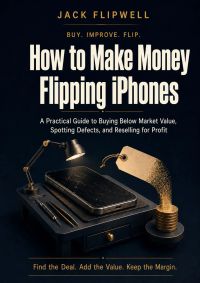
How to Make Money Flipping iPhones - A Practical Guide to Buying Below Market Value, Spotting Defects, and Reselling for ProfitJACK FLIPWELL5h 17m$7.70 · $0.00

OREGON DMV Permit Study Guide-2026 EDITIONLUCAS CRANE6h 59m$10

Online Money BlueprintAnthony Ekanem49m$4 · $0.00

ILLINOIS DMV Permit Study Guide-2026 EDITIONLUCAS CRANE9h 23m$10

Solo Ground RulesImad Muratspahic3h 39m$11 · $0.00

How to Avoid Online Scams and Protect Your MoneyMax Paradox8h 20m$7.70 · $0.00

MICHIGAN DMV Permit Study Guide-2026 EDITIONLUCAS CRANE9h 38m$10

The Safe Home HandbookJaxon R. Stone17h 55m$6.40 · $0.00

Bound and SoldElijah V. Reynolds4h 2m$4.10 · $0.00

Florida Glass and Glazing Contractor Exam Study GuideMarie Peterson9h 26m$13

MINNESOTA DPS Permit Study Guide- 2026 EDITIONLUCAS CRANE9h 33m$10

The Madoffs among UsWilliam M. Francavilla CFP5h 26m$20 · $0.00

ISO27001/ISO27002:2013Alan Calder1h 39m4.2 (76)$14 · $0.00