
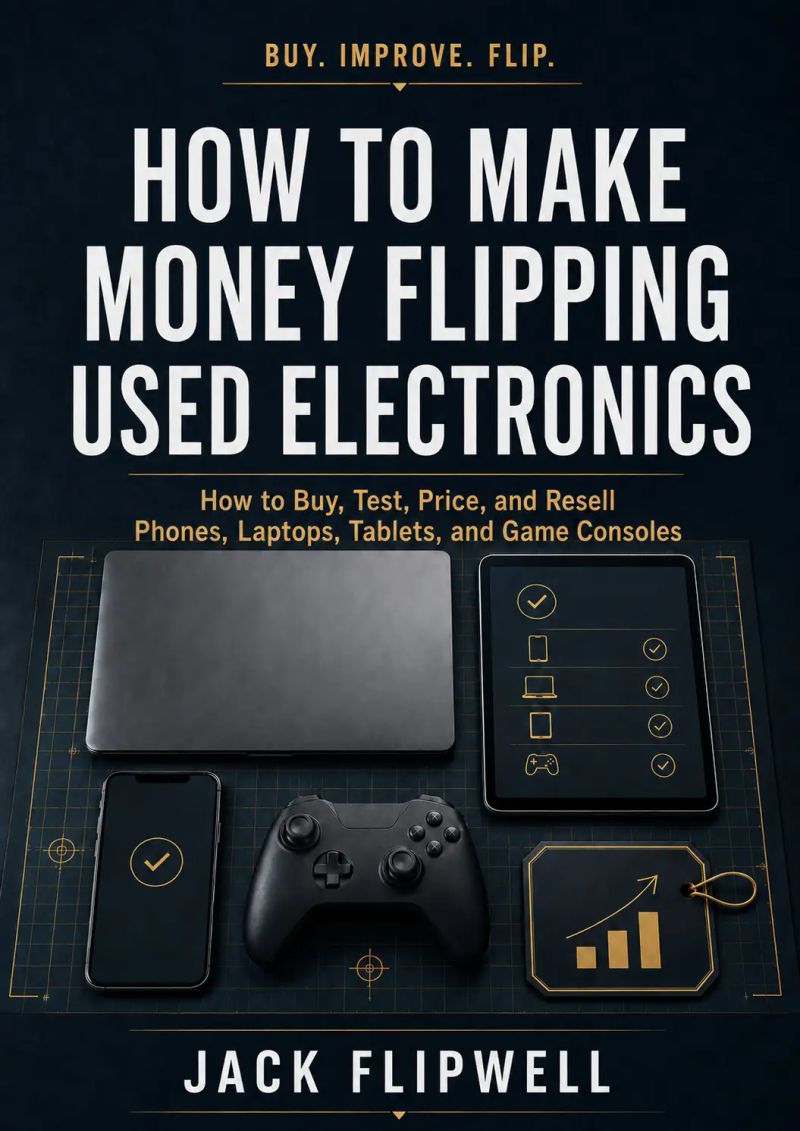
How to Make Money Flipping Used Electronics - How to Buy, Test, Price, and Resell Phones, Laptops, Tablets, and Game Consoles
By JACK FLIPWELL


Length4h 21m
About this audiobook
A phone listed far below similar devices can be a bargain, a problem, or simply a product whose true value you have not calculated correctly yet. The difference comes down to your ability to identify the exact model, understand its condition, test the expensive failure points, calculate every relevant cost, and estimate what a real buyer is likely to pay.
How to Make Money Flipping Used Electronics is a practical guide to buying, testing, pricing, improving, and reselling phones, laptops, tablets, and game consoles. It is not built around lucky scores, unrealistic income promises, or the idea that every cheap device can be flipped for easy profit. Instead, JACK FLIPWELL presents one repeatable system for finding genuine pricing gaps, reducing uncertainty, protecting capital, and turning used electronics back into cash with enough margin left to make the transaction worthwhile.
You will learn why an asking price is not the same thing as market value and how to separate quick-sale value from optimistic pricing. The book shows how to work backward from a realistic exit price, subtract repair costs, accessories, selling fees, shipping, negotiation, and a risk allowance, then arrive at the maximum amount you can safely pay.
The testing chapters cover the major risks in each category. With phones, you will examine displays, batteries, cameras, charging, connectivity, account locks, repair history, and exact variants. With laptops, you will learn to verify configuration, storage, battery, display, keyboard, ports, cooling, charger requirements, and operating-system access. Tablets add large-screen risk, styluses, keyboards, connectivity variants, and battery concerns. Consoles add controllers, optical drives, storage, heat, ports, account handling, games, and bundle economics.
The book also shows how to add value without overinvesting. Cleaning, better presentation, correct resets, useful accessories, selective upgrades, and better bundle structure can all improve a transaction. But every improvement must justify itself through a higher resale price, faster rotation, or stronger buyer confidence. A technically better device is not automatically a more profitable flip.
You will learn how to negotiate from facts instead of emotion, how to use clear walk-away limits, and how to avoid negotiating against yourself. On the selling side, you will build listings that clearly identify the device, document the real condition, answer predictable buyer questions, and position the price within the correct market range.
A major part of the system is capital management. The book explains the difference between gross spread and true net profit, why cash flow matters, how inventory age affects risk, and why a smaller profit earned quickly can sometimes outperform a larger margin tied up for months. You will learn to track direct costs, selling time, return on capital, problem inventory, and the real outcome of each completed deal.
Safety is treated as part of profitability. You will learn how to document condition, record device identifiers, verify payment, remove accounts and activation locks, package electronics properly, handle returns proportionately, and protect yourself against common transaction scams. One avoidable loss can erase the profit from several good deals, so risk control belongs inside the margin calculation.
As your experience grows, the book moves into repeat sellers, sourcing relationships, bulk lots, per-unit valuation, sample testing, concentration risk, and exit capacity. Buying ten devices at a discount can lower sourcing cost, but it can also tie too much capital to one model and overwhelm your ability to test and sell inventory. The system shows you how to decide when quantity improves the business and when it simply multiplies risk.
You will also learn how product launches, retail discounts, seasonality, depreciation, and new-device alternatives can change the used market. Instead of trying to predict the future perfectly, you will build enough safety margin to survive ordinary market movement and adjust your portfolio when fresh data contradicts the original plan.
The final chapters turn everything into a first-30-days plan and the complete JACK FLIPWELL system. You begin with a small number of products, collect your own transaction data, identify what actually works, and increase volume only after the process proves itself.
This is a book for readers who want to approach electronics flipping as a disciplined capital cycle rather than a treasure hunt.
Find the Deal. Add the Value. Keep the Margin.
This publication was prepared with the assistance of tools that support the creative process, including artificial intelligence-based solutions. The final concept, structure, and editing belong to the author.
Audiobook details
GenreBusiness and Economics
Length4 hrs 21 mins
Narrated byListen with 1,000+ voices
FormateBook with Audio
Publish dateSep 25, 2026
LanguageEnglish
Table of contents
1INTRO
2Chapter 1 - Build the System Before You Buy the First Device
3Chapter 2 - Where to Find Deals and How to Separate a Bargain from a Problem
4Chapter 3 - How to Price Used Electronics Without Overpaying
5Chapter 4 - How to Test Used Electronics and Catch Expensive Problems Before You Buy
Mostrar todos os capítulosVer menos
6Chapter 5 - Phones - How to Buy Models That Turn Back Into Cash Quickly
7Chapter 6 - Laptops - Higher Margins, More Variables, and More Expensive Mistakes
8Chapter 7 - Tablets - A Simple Product Only at First Glance
9Chapter 8 - Game Consoles - Products Bought with Emotion but Priced with Numbers
10Chapter 9 - How to Add Value Without Overinvesting in the Device
11Chapter 10 - Negotiations That Protect Your Margin When Buying and Selling
12Chapter 11 - The Listing That Shortens Selling Time and Protects Your Price
13Chapter 12 - Where to Sell, How to Ship, and How to Close Transactions Safely
14Chapter 13 - Real Profit, Capital Rotation, and Control of Your Money
15Chapter 14 - Returns, Disputes, Scams, and Documentation That Protects Your Margin
16Chapter 15 - How to Exit Weak Deals and Avoid Turning Inventory into a Capital Graveyard
17Chapter 16 - How to Scale Electronics Flipping Without Losing Control
18Chapter 17 - How to Build an Edge Other Sellers Do Not See
19Chapter 18 - Seasonality, Product Launches, and a Category Mix That Reduces Risk
20Chapter 19 - Your First 30 Days and the Shift from One Deal to a Repeatable Process
21Chapter 20 - The JACK FLIPWELL System - Buy Deliberately, Improve Intelligently, and Sell with Margin
How to Make Money Reselling Clothes - How to Source, Photograph, Price, and Sell Secondhand Fashion OnlineJACK FLIPWELL5h 4m$7.70 · $0.00

How to Make Money Flipping Houses - How to Find Undervalued Properties, Control Renovation Costs, and Sell at the Right PriceJACK FLIPWELL4h 31m$7.70 · $0.00

Jak zarabiać na samochodach używanych - Jak znajdować okazje, szacować koszty i bezpiecznie sprzedawać auta z zyskiemJACK FLIPWELL4h 45m$7.70 · $0.00

Jak zarabiać na odsprzedaży iPhone’ów - Jak kupować poniżej ceny rynkowej, wykrywać wady i sprzedawać z zyskiemJACK FLIPWELL5h 30m$7.70 · $0.00

Jak zarabiać na flipach mieszkaniowych - Jak znajdować niedoszacowane nieruchomości, kontrolować koszty remontu i sprzedawać we właściwej cenieJACK FLIPWELL4h 54m$7.70 · $0.00

Jak zarabiać na używanej elektronice - Jak kupować, testować, wyceniać i sprzedawać smartfony, laptopy, tablety oraz konsoleJACK FLIPWELL5h4.7 (12)$7.70 · $0.00

How to Make Money Flipping Furniture - Turn Cheap and Forgotten Pieces into Products Buyers WantJACK FLIPWELL4h 26m$7.70 · $0.00

How to Make Money Flipping Almost Anything - A Complete System for Finding Deals, Calculating Margins, and Building Repeatable IncomeJACK FLIPWELL5h 57m$7.70 · $0.00

Jak zarabiać na odsprzedaży sneakersów - Przewodnik po wyszukiwaniu okazji, sprawdzaniu autentyczności i dochodowej sprzedażyJACK FLIPWELL4h 32m$7.70 · $0.00

Jak zarabiać na odsprzedaży niemal wszystkiego - Kompletny system wyszukiwania okazji, obliczania marży i budowania powtarzalnego dochoduJACK FLIPWELL5h 29m$7.70 · $0.00

Jak zarabiać na odnawianiu i sprzedaży mebli - Jak zamieniać tanie i zapomniane przedmioty w produkty, które ludzie chcą kupowaćJACK FLIPWELL4h 49m$7.70 · $0.00

How to Make Money Flipping Watches - How to Spot Valuable Models, Avoid Fakes, and Resell with ConfidenceJACK FLIPWELL5h 45m$7.70 · $0.00

How to Make Money Flipping Used Cars - A Beginner's Guide to Finding Deals, Estimating Costs, and Selling Safely for ProfitJACK FLIPWELL4h 24m$7.70 · $0.00

Jak zarabiać na ubraniach z drugiej ręki - Jak wyszukiwać, fotografować, wyceniać i sprzedawać używaną modę w internecieJACK FLIPWELL4h 49m$7.70 · $0.00
How to Make Money Flipping Collectibles - How to Find Undervalued Toys, Sets, Cards, and Limited-Edition ItemsJACK FLIPWELL6h 30m$7.70 · $0.00

Jak zarabiać na przedmiotach kolekcjonerskich - Jak znajdować niedoszacowane zabawki, zestawy, karty i limitowane przedmiotyJACK FLIPWELL5h 5m$7.70 · $0.00

Jak zarabiać na kupowaniu i sprzedaży zegarków - Jak rozpoznawać wartościowe modele, unikać podróbek i sprzedawać z odpowiednią marżąJACK FLIPWELL4h 56m$7.70 · $0.00
How to Make Money Flipping iPhones - A Practical Guide to Buying Below Market Value, Spotting Defects, and Reselling for ProfitJACK FLIPWELL5h 17m$7.70 · $0.00

Jak zarabiać na kupnie, odnawianiu i sprzedaży łodzi - Jak oceniać kadłub, silnik i instalacje, kontrolować koszty renowacji oraz sprzedawać w sezonieJACK FLIPWELL2h 7m$7.70 · $0.00
Never Split the DifferenceChris Voss, Tahl Raz8h 7m4.4 (277.7K)$26 · $0.00
The Intelligent Investor Rev Ed.Benjamin Graham17h 48m4.3 (191.5K)$40 · $0.00
The Hard Thing About Hard ThingsBen Horowitz7h 57m4.2 (134.3K)$26 · $0.00

Boundaries for LeadersHenry Cloud7h 36m4.3 (3.6K)$26 · $0.00

Not Everything Counts but Everything Matters: The powerful and inspirational new book about leadership and achieving success from the visionary multi-premiership winning Panthers coachIvan Cleary6h 1m4.6 (680)$24 · $0.00
BuildTony Fadell11h 5m4.5 (14.3K)$8 · $0.00

The Joys Of CompoundingGautam Baid17h 34m4.5 (2.5K)$18 · $0.00
Basic EconomicsThomas Sowell18h 32m4.5 (29.3K)$28 · $0.00

Poor Charlie’s AlmanackGrover Gardener, Charles T. Munger13h 9m4.5 (24.7K)$18 · $0.00

The Ambuja StoryNarotam Sekhsaria13h 59m4.5 (830)$33 · $0.00

The Secret Door to SuccessFlorence Scovel Shinn2h 25m4.5 (2.1K)$1.20 · $0.00

This Is Going to HurtAdam Kay5h 47m4.4 (444.7K)$24 · $0.00

Big TrustShadé Zahrai, Fayçal Sekkouah8h 36m4.6 (406)$26 · $0.00
The Intelligent Investor Third EditionBenjamin Graham, Jason Zweig20h4.4 (156.6K)$46 · $0.00

Bottle of LiesKatherine Eban14h 25m4.4 (12K)$33 · $0.00

The Antiracist Business BookTrudi Lebrón6h 10m4.6 (275)$17 · $0.00

The FormulaJoshua Robinson, Jonathan Clegg10h 41m4.4 (6.9K)$29 · $0.00

Let Them LeadJohn U. Bacon7h 10m4.5 (1.4K)$24 · $0.00

Secrets of the Millionaire MindT. Harv Eker5h 11m4.4 (301.4K)$24 · $0.00

The Person You Mean to BeDolly Chugh9h 6m4.4 (7.2K)$29 · $0.00
You may also like

An Introduction to the Principles of Morals and LegislationJeremy Bentham12h 37m3.8 (1K)$1 · $0.00

Systems of SurvivalJane Jacobs9h 23m4.1 (318)$20 · $0.00

The House of the DeadFyodor Dostoevsky11h 21m4.2 (41.6K)$8 · $0.00

Online Money BlueprintAnthony Ekanem49m$4 · $0.00

Counter Sniper Manual - The Official US Army ManualU.S. Department of Defense49m4.0 (39)$2 · $0.00

ILLINOIS DMV Permit Study Guide-2026 EDITIONLUCAS CRANE9h 23m$10

COLORADO DMV Permit Study Guide- 2026 EDITIONLUCAS CRANE9h 15m$10

MICHIGAN DMV Permit Study Guide-2026 EDITIONLUCAS CRANE9h 38m$10
How to Make Money Flipping iPhones - A Practical Guide to Buying Below Market Value, Spotting Defects, and Reselling for ProfitJACK FLIPWELL5h 17m$7.70 · $0.00

OREGON DMV Permit Study Guide-2026 EDITIONLUCAS CRANE6h 59m$10

UTAH MOTORCYCLE PERMIT EXAM PREP 2026–2027Tyler Knox8h 52m$10

Florida Glass and Glazing Contractor Exam Study GuideMarie Peterson9h 26m$13

NEW HAMPSHIRE MOTORCYCLE PERMIT EXAM PREP 2026–2027Tyler Knox9h 9m$10

The Humbugs of the World & The Art of Money GettingP. T. Barnum14h 47m4.4 (12)$1.99 · $0.00

The Criminal & the CommunityJames Devon7h 7m$2 · $0.00

IDAHO DMV Permit Study Guide-2026 EDITIONLUCAS CRANE9h 31m$10

Street SmartsDannah Eve5h 9m4.2 (124)$24 · $0.00

Credit Repair: Proven Methods to Raise Your Credit Score Faster & Secure Your Financial Future (Learn How to Restore, Repair and Improve Your Credit Report and Protect Yourself From Creditors and Banks Using Federal Laws)Todd Moore1h 15m$3.50 · $0.00

The Criminal & the CommunityJames Devon7h 7m$1 · $0.00

SOUTH DAKOTA REAL ESTATE LICENSE EXAM PREP 2026 – 2027 EDITIONDaniel Mercer8h 37m$11.50 · $0.00