
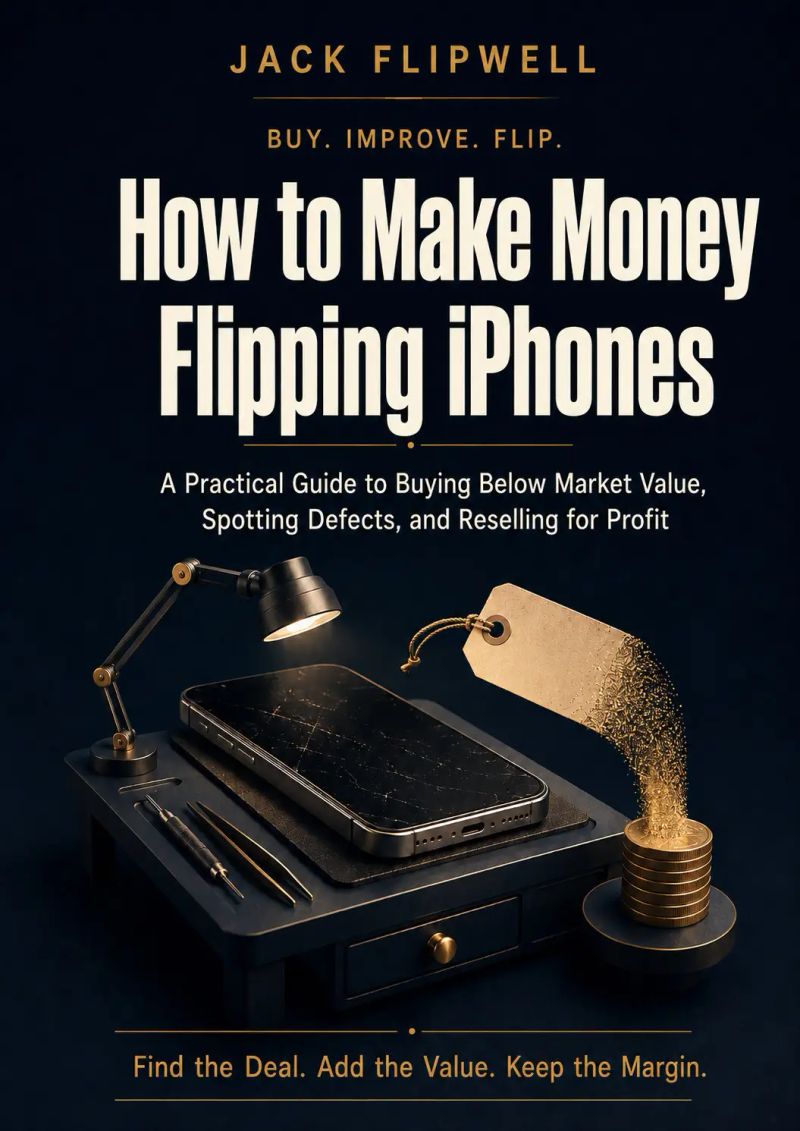
How to Make Money Flipping iPhones - A Practical Guide to Buying Below Market Value, Spotting Defects, and Reselling for Profit
By JACK FLIPWELL


Length5h 16m
About this audiobook
Buy below market value. Inspect better than the average buyer. Add value only where it makes financial sense. Resell with enough margin to make the process worth repeating.
How to Make Money Flipping iPhones is a practical guide to turning used iPhones into controlled, repeatable resale opportunities. It is built for readers who want more than generic advice to "buy low and sell high." The book explains how to value an individual device, calculate the maximum purchase price, identify hidden risks, decide whether repairs make economic sense, and manage the entire transaction from sourcing to final sale.
You will learn how to separate realistic resale value from optimistic asking prices and how to calculate the purchase price backward from your target profit. Instead of seeing a phone listed for $600 and hoping to sell it for $750, you will learn to account for repairs, fees, shipping, preparation, buyer negotiation, return risk, and a safety buffer before you make an offer.
The book explains how to choose models that are worth trading rather than simply chasing the newest or most expensive iPhone. You will learn why turnover speed matters, how storage capacity affects secondhand value, why new-device promotions can change the used market, and how to compare profit with the amount of capital tied up in each phone.
Sourcing is covered in detail, including classifieds, social marketplaces, local groups, repair shops, repeat sellers, company devices, referrals, and bulk opportunities. You will learn why the best deal is not always the lowest-priced listing and how seller motivation, convenience, speed, and better information can create room for margin.
A major section of the book is dedicated to device verification. You will learn how to think about IMEI and serial information, Activation Lock, account transfer, MDM, company-managed devices, and clean activation. The goal is simple: avoid paying for a phone that looks valuable but cannot be transferred safely to the next legitimate owner.
The technical inspection process covers display quality, touch response, battery behavior, cameras, microphones, speakers, charging, wireless functions, buttons, sensors, connectivity, Face ID, Touch ID, and relevant parts history. Defects are not treated as vague negatives. They are translated into repair costs, resale discounts, and risk adjustments.
You will also learn how to interpret repair history. A serviced iPhone is not automatically a bad phone, but the type of repair, part quality, documentation, and current behavior matter. The book shows how to distinguish predictable repairs from devices with uncertain internal histories and explains why board-level problems, liquid exposure, and unresolved biometric faults require much more caution.
Repair economics receive their own practical framework. Not every damaged phone should be repaired. Sometimes spending $100 only increases resale value by $60, while another $80 repair can create $180 of additional value. The correct question is not whether the device can be repaired, but whether the repair improves your final result enough to justify the cost, time, and risk.
Negotiation is treated as an extension of valuation rather than a contest. You will learn how to establish an opening offer, target purchase price, and absolute maximum, how to negotiate around real defects, and how to walk away when the numbers stop working. The book also explains why reliability and same-day convenience can sometimes be more powerful than aggressive bargaining.
The resale process is covered from preparation through completed delivery. You will learn how to clean and grade devices, decide whether accessories add value, take honest photos, write listings that reduce buyer uncertainty, price for realistic negotiation, and respond to market feedback without defending outdated assumptions.
Shipping, returns, and scams are addressed with the same emphasis on process. The book explains why screenshots are not proof of payment, how to document device condition, why serial and IMEI records matter when a phone comes back, and how to protect yourself against substitution, false payment links, shipping disputes, and post-sale confusion.
As inventory grows, the book moves into capital management. You will learn to track each device, monitor inventory age, measure turnover, control exposure by model, and recognize when a shelf full of phones represents growth and when it represents trapped cash. Fast capital rotation can sometimes matter more than maximizing the profit on one device.
This publication was prepared with the assistance of tools that support the creative process, including artificial intelligence-based solutions. The final concept, structure, and editing belong to the author.
Audiobook details
GenreBusiness and Economics
Length5 hrs 16 mins
Narrated byListen with 1,000+ voices
FormateBook with Audio
Publish dateSep 24, 2026
LanguageEnglish
Table of contents
1How to Make Money Flipping iPhones
2INTRO
3Chapter 1 - Where the Profit Really Comes From When Flipping iPhones
4Chapter 2 - Choosing iPhone Models That Are Actually Worth Flipping
5Chapter 3 - Where to Find iPhones to Flip and How to Spot Better Deals
Mostrar todos os capítulosVer menos
6Chapter 4 - How to Value a Specific iPhone and Set Your Maximum Purchase Price
7Chapter 5 - IMEI, Serial Number, Activation Lock, and MDM - How to Avoid Buying a Phone You Cannot Safely Resell
8Chapter 6 - The Full Pre-Purchase iPhone Test - Display, Battery, Cameras, Ports, Sensors, and Biometrics
9Chapter 7 - Parts and Repair History - How to Tell a Good Serviced iPhone from a Problem Device
10Chapter 8 - Repair Economics - When to Improve the Phone and When to Sell It As-Is
11Chapter 9 - Buying Negotiation - How to Lower the Price Without Losing Good Deals
12Chapter 10 - Data Security and Clean Device Transfer - What to Do Before, During, and After Purchase
13Chapter 11 - Preparing an iPhone for Resale - How to Add Value Without Wasting Money
14Chapter 12 - Photos and Listings - How to Sell Faster Without Hiding the Condition
15Chapter 13 - Shipping, Returns, and Scams - How to Protect the Phone, the Money, and the Evidence
16Chapter 14 - Inventory and Capital Control - How to Avoid Turning a Business into a Drawer Full of Phones
17Chapter 15 - Scaling the Flipping Business - How to Increase Volume Without Losing Control
18Chapter 16 - Law, Taxes, and Documentation - When Phone Flipping Becomes a Business
19Chapter 17 - Managing Risk - How to Make Decisions When a Deal Is Not Perfect
20Chapter 18 - Analyzing Results and Improving the Strategy - From Individual Flips to a Predictable Business
21Chapter 19 - The First 30 Days - How to Build the Process Through Your First 10 Flips
22Chapter 20 - The JACK FLIPWELL System - From Finding the Deal to Repeating the Margin

How to Make Money Flipping Watches - How to Spot Valuable Models, Avoid Fakes, and Resell with ConfidenceJACK FLIPWELL5h 45m$7.70 · $0.00

How to Make Money Flipping Used Cars - A Beginner's Guide to Finding Deals, Estimating Costs, and Selling Safely for ProfitJACK FLIPWELL4h 24m$7.70 · $0.00

Jak zarabiać na ubraniach z drugiej ręki - Jak wyszukiwać, fotografować, wyceniać i sprzedawać używaną modę w internecieJACK FLIPWELL4h 49m$7.70 · $0.00

How to Make Money Flipping Collectibles - How to Find Undervalued Toys, Sets, Cards, and Limited-Edition ItemsJACK FLIPWELL6h 30m$7.70 · $0.00

Jak zarabiać na przedmiotach kolekcjonerskich - Jak znajdować niedoszacowane zabawki, zestawy, karty i limitowane przedmiotyJACK FLIPWELL5h 5m$7.70 · $0.00

Jak zarabiać na kupowaniu i sprzedaży zegarków - Jak rozpoznawać wartościowe modele, unikać podróbek i sprzedawać z odpowiednią marżąJACK FLIPWELL4h 56m$7.70 · $0.00

Jak zarabiać na kupnie, odnawianiu i sprzedaży łodzi - Jak oceniać kadłub, silnik i instalacje, kontrolować koszty renowacji oraz sprzedawać w sezonieJACK FLIPWELL2h 7m$7.70 · $0.00

How to Make Money Flipping Boats - How to Assess Hulls, Engines, and Systems, Control Renovation Costs, and Sell in SeasonJACK FLIPWELL2h 1m$7.70 · $0.00

Jak zarabiać na kupnie, odnawianiu i sprzedaży kamperów oraz przyczep kempingowych - Jak oceniać konstrukcję i instalacje, planować opłacalne renowacje oraz bezpiecznie sprzedawaćJACK FLIPWELL2h 5m$7.70 · $0.00

How to Make Money Flipping Motorhomes and Travel Trailers - How to Assess Structure and Systems, Plan Profitable Renovations, and Resell SafelyJACK FLIPWELL2h 2m$7.70 · $0.00

How to Make Money Flipping Used Construction Machinery - How to Verify Mechanical Condition, Work History, Transport Costs, and Resale PotentialJACK FLIPWELL2h 5m$7.70 · $0.00

How to Make Money Flipping Motorcycles and Scooters - How to Assess Mechanical Condition, Estimate Repair Costs, Manage Risk, and Resell for ProfitJACK FLIPWELL8h 9m$7.70 · $0.00

Jak zarabiać na kupnie, naprawie i sprzedaży motocykli oraz skuterów - Jak oceniać stan techniczny, szacować koszty napraw, ograniczać ryzyko i sprzedawać z zyskiemJACK FLIPWELL7h 58m$7.70 · $0.00

Jak zarabiać na kupnie i sprzedaży używanych maszyn budowlanych - Jak weryfikować stan techniczny, historię pracy, koszty transportu i potencjał odsprzedażyJACK FLIPWELL2h 5m$7.70 · $0.00

Jak zarabiać na kupnie i sprzedaży używanych książek - Jak rozpoznawać wartościowe wydania, oceniać stan, tworzyć opłacalne zestawy i sprzedawać właściwym czytelnikomJACK FLIPWELL8h 32m$7.70 · $0.00
How to Make Money Flipping Used Restaurant Equipment - How to Assess Equipment, Transport and Repair Costs, and Resell to Local BusinessesJACK FLIPWELL1h 57m$7.70 · $0.00

Jak zarabiać na kupnie i sprzedaży używanego wyposażenia gastronomicznego - Jak oceniać urządzenia, koszty transportu i napraw oraz sprzedawać wyposażenie lokalnym firmomJACK FLIPWELL2h$7.70 · $0.00

Jak zarabiać na kupnie i sprzedaży sprzętu turystycznego oraz kempingowego - Jak wybierać markowy ekwipunek, sprawdzać jego stan, kompletować zestawy i wykorzystywać sezonowy popytJACK FLIPWELL8h 24m$7.80 · $0.00

How to Make Money Flipping Fishing Gear - How to Evaluate Rods, Reels, and Accessories, Build Complete Kits, and Resell for ProfitJACK FLIPWELL6h 41m$7.80 · $0.00
Never Split the DifferenceChris Voss, Tahl Raz8h 7m4.4 (277.7K)$26 · $0.00
The Intelligent Investor Rev Ed.Benjamin Graham17h 48m4.3 (191.5K)$40 · $0.00
The Hard Thing About Hard ThingsBen Horowitz7h 57m4.2 (134.3K)$26 · $0.00

Boundaries for LeadersHenry Cloud7h 36m4.3 (3.6K)$26 · $0.00

Not Everything Counts but Everything Matters: The powerful and inspirational new book about leadership and achieving success from the visionary multi-premiership winning Panthers coachIvan Cleary6h 1m4.6 (680)$24 · $0.00
BuildTony Fadell11h 5m4.5 (14.3K)$8 · $0.00

The Joys Of CompoundingGautam Baid17h 34m4.5 (2.5K)$18 · $0.00
Basic EconomicsThomas Sowell18h 32m4.5 (29.3K)$28 · $0.00

Poor Charlie’s AlmanackGrover Gardener, Charles T. Munger13h 9m4.5 (24.7K)$18 · $0.00

The Ambuja StoryNarotam Sekhsaria13h 59m4.5 (830)$33 · $0.00

The Secret Door to SuccessFlorence Scovel Shinn2h 25m4.5 (2.1K)$1.20 · $0.00

This Is Going to HurtAdam Kay5h 47m4.4 (444.7K)$24 · $0.00

Big TrustShadé Zahrai, Fayçal Sekkouah8h 36m4.6 (406)$26 · $0.00

The Intelligent Investor Third EditionBenjamin Graham, Jason Zweig20h4.4 (156.6K)$46 · $0.00

Bottle of LiesKatherine Eban14h 25m4.4 (12K)$33 · $0.00

The Antiracist Business BookTrudi Lebrón6h 10m4.6 (275)$17 · $0.00

The FormulaJoshua Robinson, Jonathan Clegg10h 41m4.4 (6.9K)$29 · $0.00

Let Them LeadJohn U. Bacon7h 10m4.5 (1.4K)$24 · $0.00

Secrets of the Millionaire MindT. Harv Eker5h 11m4.4 (301.4K)$24 · $0.00

The Person You Mean to BeDolly Chugh9h 6m4.4 (7.2K)$29 · $0.00
You may also like

Systems of SurvivalJane Jacobs9h 23m4.1 (318)$20 · $0.00

The House of the DeadFyodor Dostoevsky11h 21m4.2 (41.6K)$8 · $0.00

OREGON DMV Permit Study Guide-2026 EDITIONLUCAS CRANE6h 59m$10

ILLINOIS DMV Permit Study Guide-2026 EDITIONLUCAS CRANE9h 23m$10

COLORADO DMV Permit Study Guide- 2026 EDITIONLUCAS CRANE9h 15m$10

Online Money BlueprintAnthony Ekanem49m$4 · $0.00

Counter Sniper Manual - The Official US Army ManualU.S. Department of Defense49m4.0 (39)$2 · $0.00

MICHIGAN DMV Permit Study Guide-2026 EDITIONLUCAS CRANE9h 38m$10

Florida Glass and Glazing Contractor Exam Study GuideMarie Peterson9h 26m$13

NEW HAMPSHIRE MOTORCYCLE PERMIT EXAM PREP 2026–2027Tyler Knox9h 9m$10

UTAH MOTORCYCLE PERMIT EXAM PREP 2026–2027Tyler Knox8h 52m$10

ISO27001/ISO27002:2013Alan Calder1h 39m4.2 (76)$14 · $0.00

ALABAMA DMV LICENSE STUDY GUIDE 2026/2027NATHAN BROOKS8h 7m$11.50 · $0.00

IDAHO DMV Permit Study Guide-2026 EDITIONLUCAS CRANE9h 31m$10

Check Point CCSA, Step by StepLionel Jovanovic7h 52m$5 · $0.00

How Cyber Security Can Protect Your BusinessChristopher Wright1h 30m4.3 (10)$14 · $0.00

Street SmartsDannah Eve5h 9m4.2 (124)$24 · $0.00

TEXAS DMV LICENSE STUDY GUIDE 2026/2027NATHAN BROOKS8h 15m$11.50 · $0.00

Item Not As DescribedImad Muratspahic3h 46m$12 · $0.00

Prepping For Crises And DisastersAn Urban Prepper54m$5 · $0.00