
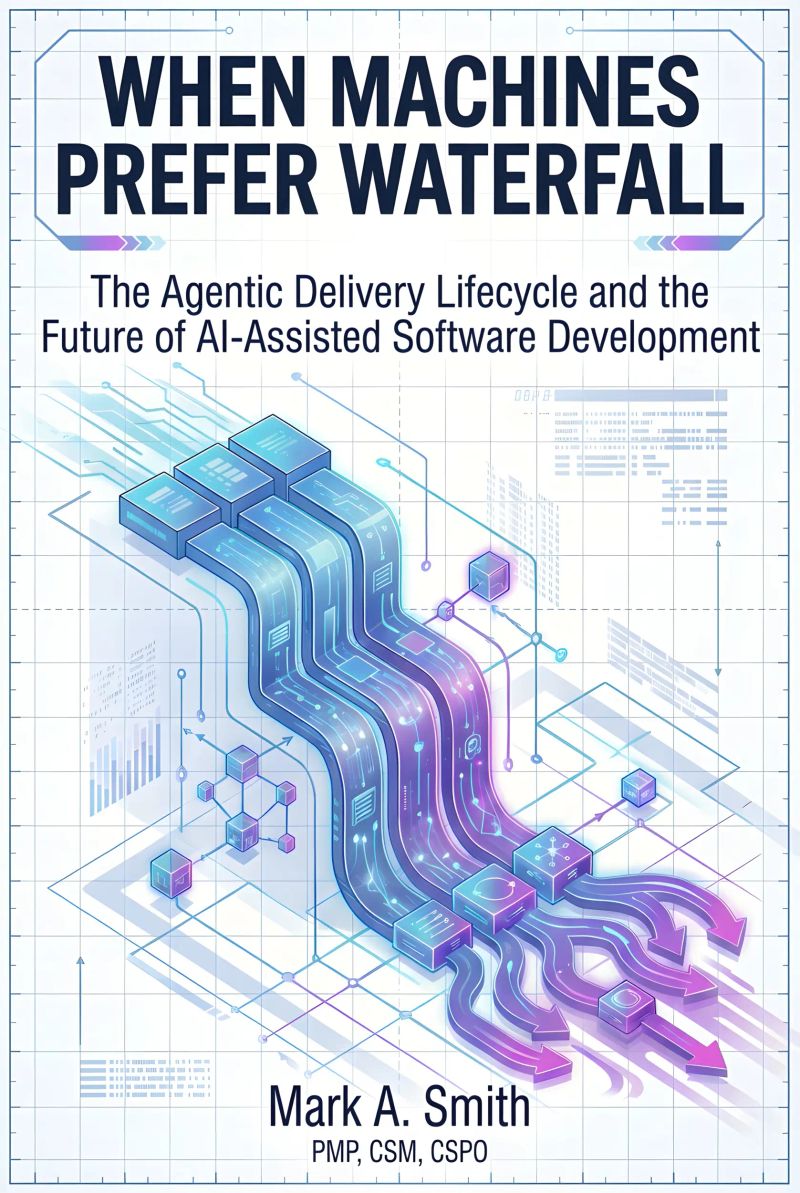
When Machines Prefer Waterfall
The Agentic Delivery Lifecycle and the Future of AI-Assisted Software DevelopmentBy Mark A. Smith


Length7h 40m
About this audiobook
When Machines Prefer Waterfall
When Machines Prefer Waterfall introduces the Agentic Delivery Lifecycle—a complete methodology for the age of AI-assisted development. Based on academic research from Tsinghua University and MIT, real-world case studies, and the patterns now shipping in every major agentic platform, this book shows engineering leaders how to restructure teams, processes, and governance for a world where humans specify intent and machines execute implementation.
Audiobook details
GenreTechnology, Business and Economics
Length7 hrs 40 mins
Narrated byListen with 1,000+ voices
FormateBook with Audio
Publish dateFeb 23, 2026
LanguageEnglish
Table of contents
1When Machines Prefer Waterfall
2The Agentic Delivery Lifecycle and the Future of AI-Assisted Software Development
3By Mark A. Smith, PMP, CSM, CSPO
4Unabridged Audiobook Edition
5A Note to the Listener
Show all chaptersShow less
6Chapter 1: The Velocity Paradox
7The Promise of Infinite Velocity
8The Dip: When More Code Means Less Value
9The Q3 Analysis: A $2.3 Million Sprint to Nowhere
10The Output Trap: When Machines Create Faster Than Humans Can Verify
11When Fast Code Breaks Working Systems
12The Hidden Costs: Technical Debt at Machine Speed
13The Psychology of Machine-Speed Creation
14Quantifying the Paradox: The Numbers Behind the Narrative
15The Economic Reality: When Velocity Becomes Expensive
16The Competitive Dimension: When Everyone is Fast, No One is Fast
17The Way Forward: Embracing the Paradox
18Chapter 2: The $500,000 Meeting
19Practitioner's Framework: Understanding Meeting Costs
20The Hidden Cost: Artificial Latency in Machine-Speed Systems
21Project Velocity: Nexus's Asynchronous Experiment
22The Mathematics of Idle Time: Opportunity Cost at Scale
23The Psychological Trap: Why We Can't Stop Meeting
24Breaking the Meeting Addiction: Industry Examples
25The Async Arsenal: Tools for Machine-Speed Coordination
26From Synchronization to Governance: The New Role of Human Leadership
27The Dangers of Under-Coordination
28The Economic Case: Quantifying the Returns
29The Path Forward: From Coordination Overhead to Continuous Flow
30Chapter 3: The ChatDev Paradox (Why Waterfall Won)
31The Chat Chain: How Rigid Structure Enables Machine Collaboration
32From Research to Reality: MetaGPT and the Production Systems
33Role Specialization: Why Separating Reviewers from Coders Reduces Hallucinations
34The Micro-Waterfall: Executing Classical Methodology at Machine Speed
35Project Meridian: Micro-Waterfall at Nexus
36The Continuous Loop: When Waterfall Never Stops Flowing
37The Limits of Structure: What Waterfall Can't Solve
38The New Human Role: From Coder to Conductor
39The Convergent Evolution: Why All AI Development Systems Look Like Waterfall
40The Waterfall Renaissance: Structure as Liberation
41Chapter 4: The Constitution (Requirements as Code)
42The Death of the User Story: Why Agile's Lingua Franca Fails AI
43The Shopify Reckoning: When Ambiguity Met Automation
44Spec-Driven Development: The Return of the Document
45The System Constitution: Encoding Organizational Knowledge
46The Influence Topology: Who Decides When Agents Disagree?
47Scope of Agency: Hard Constraints on Agent Autonomy
48The Nexus Constitution: A Case Study in Completeness
49The Living Constitution: Evolution and Maintenance
50The Psychological Shift: From Code as Primary to Spec as Primary
More from Mark A. Smith

Operation PedestalMax Hastings12h 29m4.4 (5.2K)$29 · $0.00

When the Heavens Went on SaleAshlee Vance18h 20m4.4 (3K)$40 · $0.00

Everybody Has a Podcast (Except You)Justin McElroy, Travis McElroy, Griffin McElroy5h 9m4.3 (2.3K)$24 · $0.00

Hands of TimeRebecca Struthers8h 8m4.4 (1.3K)$26 · $0.00
Never Lost AgainBill Kilday10h 1m4.4 (805)$29 · $0.00

How the Internet HappenedBrian McCullough13h 28m4.3 (2.7K)$23 · $0.00

Collected Writings of Nikola TeslaNikola Tesla, Thomas Commerford Martin21h 50m4.3 (1.7K)$1 · $0.00
Just AspireAjai Chowdhry9h 13m4.4 (260)$29 · $0.00

The Little Book of AliensAdam Frank8h 20m4.3 (1.3K)$26 · $0.00
The inventions, researches and writings of Nikola Tesla (Annotated)Thomas Commerford Martin16h 59m4.3 (1.3K)$2 · $0.00

KargilV.P. Malik15h 18m4.3 (2K)$24 · $0.00
Experiments with Alternating CurrentsNikola Tesla9h 16m4.3 (874)$1.99 · $0.00

Fire on the HorizonTom Shroder, John Konrad8h 23m4.3 (858)$26 · $0.00

The Smell of Kerosene (Annotated)National Aeronautics and Space Administration, Donald L. Mallick, Peter W. Merlin11h 32m4.3 (523)$2 · $0.00

The Boy Who Harnessed the WindWilliam Kamkwamba, Bryan Mealer10h 5m4.2 (78.9K)$29 · $0.00

Across the Airless WildsEarl Swift10h 8m4.3 (1.3K)$29 · $0.00

Console WarsBlake J. Harris20h 41m4.2 (13.7K)$46 · $0.00

Improvised Munitions HandbookU.S. Department of Defense4h 49m4.3 (1.6K)$0.99 · $0.00
Escaping GravityLori Garver10h 54m4.2 (2.2K)$20 · $0.00

Wireless WarsJonathan Pelson8h 2m4.3 (418)$20 · $0.00
Never Split the DifferenceChris Voss, Tahl Raz8h 7m4.4 (277.7K)$26 · $0.00
The Intelligent Investor Rev Ed.Benjamin Graham17h 48m4.3 (191.5K)$40 · $0.00
The Hard Thing About Hard ThingsBen Horowitz7h 57m4.2 (134.3K)$26 · $0.00
Boundaries for LeadersHenry Cloud7h 36m4.3 (3.6K)$26 · $0.00

Not Everything Counts but Everything Matters: The powerful and inspirational new book about leadership and achieving success from the visionary multi-premiership winning Panthers coachIvan Cleary6h 1m4.6 (680)$24 · $0.00
BuildTony Fadell11h 5m4.5 (14.3K)$8 · $0.00
The Joys Of CompoundingGautam Baid17h 34m4.5 (2.5K)$18 · $0.00
Basic EconomicsThomas Sowell18h 32m4.5 (29.3K)$28 · $0.00

Poor Charlie’s AlmanackGrover Gardener, Charles T. Munger13h 9m4.5 (24.7K)$18 · $0.00

The Ambuja StoryNarotam Sekhsaria13h 59m4.5 (830)$33 · $0.00

The Secret Door to SuccessFlorence Scovel Shinn2h 25m4.5 (2.1K)$1.20 · $0.00

This Is Going to HurtAdam Kay5h 47m4.4 (444.7K)$24 · $0.00

Big TrustShadé Zahrai, Fayçal Sekkouah8h 36m4.6 (406)$26 · $0.00
The Intelligent Investor Third EditionBenjamin Graham, Jason Zweig20h4.4 (156.6K)$46 · $0.00

Bottle of LiesKatherine Eban14h 25m4.4 (12K)$33 · $0.00

The Antiracist Business BookTrudi Lebrón6h 10m4.6 (275)$17 · $0.00
The FormulaJoshua Robinson, Jonathan Clegg10h 41m4.4 (6.9K)$29 · $0.00

Let Them LeadJohn U. Bacon7h 10m4.5 (1.4K)$24 · $0.00

Secrets of the Millionaire MindT. Harv Eker5h 11m4.4 (301.4K)$24 · $0.00

The Person You Mean to BeDolly Chugh9h 6m4.4 (7.2K)$29 · $0.00
You may also like
The Problem of Increasing Human Energy (Annotated)Nikola Tesla6h 44m4.2 (3.2K)$2 · $0.00

Tesla: The Problem of Increasing Human EnergyNikola Tesla5h 38m4.2 (1.9K)$1.99 · $0.00

12 BytesJeanette Winterson9h4.0 (2.5K)$20
The Body BuildersAdam Piore12h 55m4.2 (423)$33 · $0.00
Me, My Customer, and AIHenrik Werdelin, Nicholas Thorne3h 41m3.3 (16)$20
The Essential Works of Nikola TeslaNikola Tesla48h 48m4.5 (33)$1.99 · $0.00

The AI RevolutionTorsten J. Koerting3h 11m$5 · $0.00
IntelligenceSteve Pavlina2h 51m$8 · $0.00
The Future Ready OrganizationGyan Nagpal7h 44m4.3 (35)$26 · $0.00
Think, Focus, Grow RichRobert4h 38m$6 · $0.00
Giant Brains, or, Machines That ThinkEdmund Callis Berkeley9h 21m$2.30
Human Work in the Age of Smart MachinesJamie Merisotis6h 30m3.9 (164)$15 · $0.00

AI-Proof Your Career: Navigating the Future with ConfidenceJasper Livingstone7h 11m$6.90

Automate Real Work with AILena Devlin7h 30m$5 · $0.00
The Evolution Of AIJasper Livingstone10h 56m$9
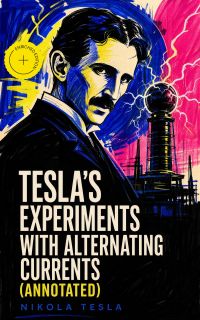
Tesla's Experiments with Alternating Currents (Annotated)Nikola Tesla10h 30m$2 · $0.00
Reprogramming The American DreamKevin Scott, Greg Shaw8h 31m3.9 (687)$26 · $0.00
Robot RightsDavid J. Gunkel10h 58m4.1 (122)$23 · $0.00

The Last Skill You'll Ever NeedDr. Josh Harari2h 5m$7.90 · $0.00
The True Creator of EverythingMiguel Nicolelis14h 41m3.9 (314)$23 · $0.00