
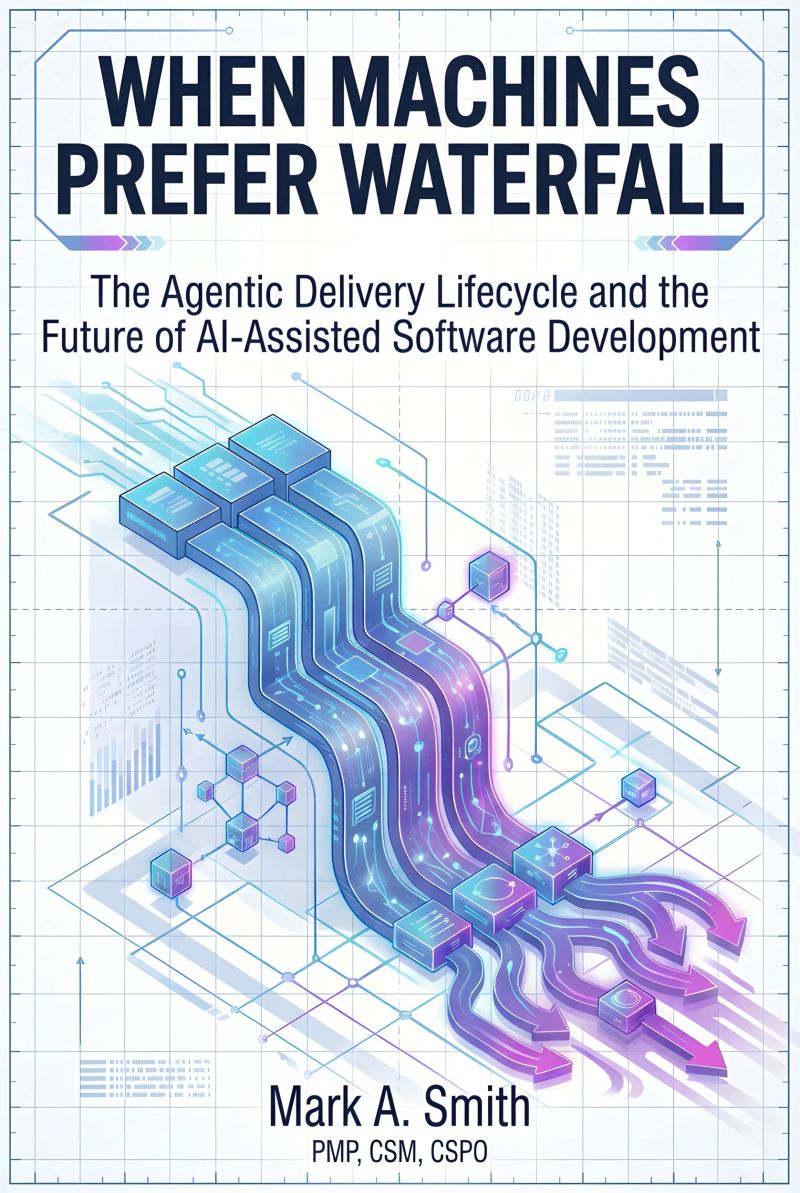
When Machines Prefer Waterfall (Abridged Edition)
The Agentic Delivery Lifecycle and the Future of AI-Assisted Software DevelopmentBy Mark A. Smith

Length3h 20m
About this audiobook
When Machines Prefer Waterfall introduces the Agentic Delivery Lifecycle—a complete methodology for the age of AI-assisted development. Based on academic research from Tsinghua University and MIT, real-world case studies, and the patterns now shipping in every major agentic platform, this book shows engineering leaders how to restructure teams, processes, and governance for a world where humans specify intent and machines execute implementation.
Audiobook details
GenreTechnology, Business and Economics
Length3 hrs 20 mins
Narrated byListen with 1,000+ voices
FormateBook with Audio
Publish dateJul 21, 2023
LanguageEnglish
Table of contents
1When Machines Prefer Waterfall
2The Agentic Delivery Lifecycle and the Future of AI-Assisted Software Development
3By Mark A. Smith, PMP, CSM, CSPO
4Abridged Audiobook Edition
5A Note to the Listener
Show all chaptersShow less
6Chapter 1: The Velocity Paradox
7The Promise of Infinite Velocity
8The Dip: When More Code Means Less Value
9The $2.3 Million Sprint to Nowhere
10The Output Trap
11Technical Debt at Machine Speed
12The Psychology of Machine-Speed Creation
13The Competitive Dimension
14The Way Forward
15Chapter 2: The $500,000 Meeting
16The Hidden Cost: Artificial Latency
17Project Velocity: The Asynchronous Experiment
18The Psychological Trap: Why We Can't Stop Meeting
19Breaking the Meeting Addiction
20From Synchronization to Governance
21The Dangers of Under-Coordination
22The Path Forward
23Chapter 3: The ChatDev Paradox (Why Waterfall Won)
24The Chat Chain: Why Structure Enables Machine Collaboration
25MetaGPT and the SOP Revolution
26Why Separating Reviewers from Coders Reduces Hallucinations
27The Micro-Waterfall
28Project Meridian: Micro-Waterfall at Nexus
29The Continuous Loop
30The Limits of Structure
31The Convergent Evolution
32Structure as Liberation
33Chapter 4: The Constitution (Requirements as Code)
34The Death of the User Story
35The Shopify Reckoning
36Spec-Driven Development
37The System Constitution
38The Influence Topology
39The Psychological Shift
40The Economics of Specification
41Chapter 5: The Blueprint (Design Before Code)
42When Agents Skip Design
43Treefinement: Teaching Agents to Think in Alternatives
44Context Engineering: The New Architect's Role
45The Design Paradox: Slowing Down to Speed Up
46What Good Design Looks Like
47Chapter 6: Swarm Patterns for Complex Software
48From Assembly Line to Swarm Intelligence
49The Three Tiers of Swarm Execution
50Agentic AppSec: Security as Continuous Adversarial Testing
More from Mark A. Smith

Operation PedestalMax Hastings12h 29m4.4 (5.2K)$29 · $0.00

When the Heavens Went on SaleAshlee Vance18h 20m4.4 (3K)$40 · $0.00

Everybody Has a Podcast (Except You)Justin McElroy, Travis McElroy, Griffin McElroy5h 9m4.3 (2.3K)$24 · $0.00

Hands of TimeRebecca Struthers8h 8m4.4 (1.3K)$26 · $0.00
Never Lost AgainBill Kilday10h 1m4.4 (805)$29 · $0.00

How the Internet HappenedBrian McCullough13h 28m4.3 (2.7K)$23 · $0.00
Collected Writings of Nikola TeslaNikola Tesla, Thomas Commerford Martin21h 50m4.3 (1.7K)$1 · $0.00
Just AspireAjai Chowdhry9h 13m4.4 (260)$29 · $0.00

The Little Book of AliensAdam Frank8h 20m4.3 (1.3K)$26 · $0.00
The inventions, researches and writings of Nikola Tesla (Annotated)Thomas Commerford Martin16h 59m4.3 (1.3K)$2 · $0.00

KargilV.P. Malik15h 18m4.3 (2K)$24 · $0.00
Experiments with Alternating CurrentsNikola Tesla9h 16m4.3 (874)$1.99 · $0.00

Fire on the HorizonTom Shroder, John Konrad8h 23m4.3 (858)$26 · $0.00

The Smell of Kerosene (Annotated)National Aeronautics and Space Administration, Donald L. Mallick, Peter W. Merlin11h 32m4.3 (523)$2 · $0.00

The Boy Who Harnessed the WindWilliam Kamkwamba, Bryan Mealer10h 5m4.2 (78.9K)$29 · $0.00

Across the Airless WildsEarl Swift10h 8m4.3 (1.3K)$29 · $0.00

Console WarsBlake J. Harris20h 41m4.2 (13.7K)$46 · $0.00

Improvised Munitions HandbookU.S. Department of Defense4h 49m4.3 (1.6K)$0.99 · $0.00
Escaping GravityLori Garver10h 54m4.2 (2.2K)$20 · $0.00

Wireless WarsJonathan Pelson8h 2m4.3 (418)$20 · $0.00

Never Split the DifferenceChris Voss, Tahl Raz8h 7m4.4 (277.7K)$26 · $0.00
The Intelligent Investor Rev Ed.Benjamin Graham17h 48m4.3 (191.5K)$40 · $0.00
The Hard Thing About Hard ThingsBen Horowitz7h 57m4.2 (134.3K)$26 · $0.00
Boundaries for LeadersHenry Cloud7h 36m4.3 (3.6K)$26 · $0.00

Not Everything Counts but Everything Matters: The powerful and inspirational new book about leadership and achieving success from the visionary multi-premiership winning Panthers coachIvan Cleary6h 1m4.6 (680)$24 · $0.00
BuildTony Fadell11h 5m4.5 (14.3K)$8 · $0.00
The Joys Of CompoundingGautam Baid17h 34m4.5 (2.5K)$18 · $0.00
Basic EconomicsThomas Sowell18h 32m4.5 (29.3K)$28 · $0.00

Poor Charlie’s AlmanackGrover Gardener, Charles T. Munger13h 9m4.5 (24.7K)$18 · $0.00

The Ambuja StoryNarotam Sekhsaria13h 59m4.5 (830)$33 · $0.00

The Secret Door to SuccessFlorence Scovel Shinn2h 25m4.5 (2.1K)$1.20 · $0.00

This Is Going to HurtAdam Kay5h 47m4.4 (444.7K)$24 · $0.00

Big TrustShadé Zahrai, Fayçal Sekkouah8h 36m4.6 (406)$26 · $0.00
The Intelligent Investor Third EditionBenjamin Graham, Jason Zweig20h4.4 (156.6K)$46 · $0.00

Bottle of LiesKatherine Eban14h 25m4.4 (12K)$33 · $0.00

The Antiracist Business BookTrudi Lebrón6h 10m4.6 (275)$17 · $0.00
The FormulaJoshua Robinson, Jonathan Clegg10h 41m4.4 (6.9K)$29 · $0.00

Let Them LeadJohn U. Bacon7h 10m4.5 (1.4K)$24 · $0.00

Secrets of the Millionaire MindT. Harv Eker5h 11m4.4 (301.4K)$24 · $0.00

The Person You Mean to BeDolly Chugh9h 6m4.4 (7.2K)$29 · $0.00
You may also like
Tesla: The Problem of Increasing Human EnergyNikola Tesla5h 38m4.2 (1.9K)$1.99 · $0.00

The Creativity CodeMarcus du Sautoy9h 54m4.0 (2.2K)$20 · $0.00
Making SenseSam Harris22h 27m4.1 (3K)$46 · $0.00
The NumeratiStephen Baker7h 55m3.6 (2K)$17 · $0.00

The Collected Works of Nikola Tesla (Annotated)Nikola Tesla48h 48m4.4 (430)$0.99 · $0.00

Sex Robots and Vegan MeatJenny Kleeman10h 9m4.0 (2K)$20
Some RemarksNeal Stephenson11h 36m3.9 (2.4K)$29 · $0.00

The MANIACBenjamín Labatut9h 51m4.3 (32.8K)$26 · $0.00
The Problem of Increasing Human Energy (Annotated)Nikola Tesla6h 44m4.2 (3.2K)$2 · $0.00

I Am Not a RobotJoanna Stern8h 2m4.0 (403)$28 · $0.00
Robot RightsDavid J. Gunkel10h 58m4.1 (122)$23 · $0.00

In Our Own ImageGeorge Zarkadakis13h 48m3.8 (341)$23 · $0.00
Me, My Customer, and AIHenrik Werdelin, Nicholas Thorne3h 41m3.3 (16)$20
Think, Focus, Grow RichRobert4h 38m$6 · $0.00
The Essential Works of Nikola TeslaNikola Tesla48h 48m4.5 (33)$1.99 · $0.00

We Radiant ThingsFranny Choi6h 8m$24 · $0.00
Tesla's Experiments with Alternating Currents (Annotated)Nikola Tesla10h 30m$2 · $0.00
AI Tools for TeachersProf. Angelina Joel Adams2h 25m$6.50 · $0.00

Prompt Your LifeDorian Frinch29m$14 · $0.00
The Future Ready OrganizationGyan Nagpal7h 44m4.3 (35)$26 · $0.00