
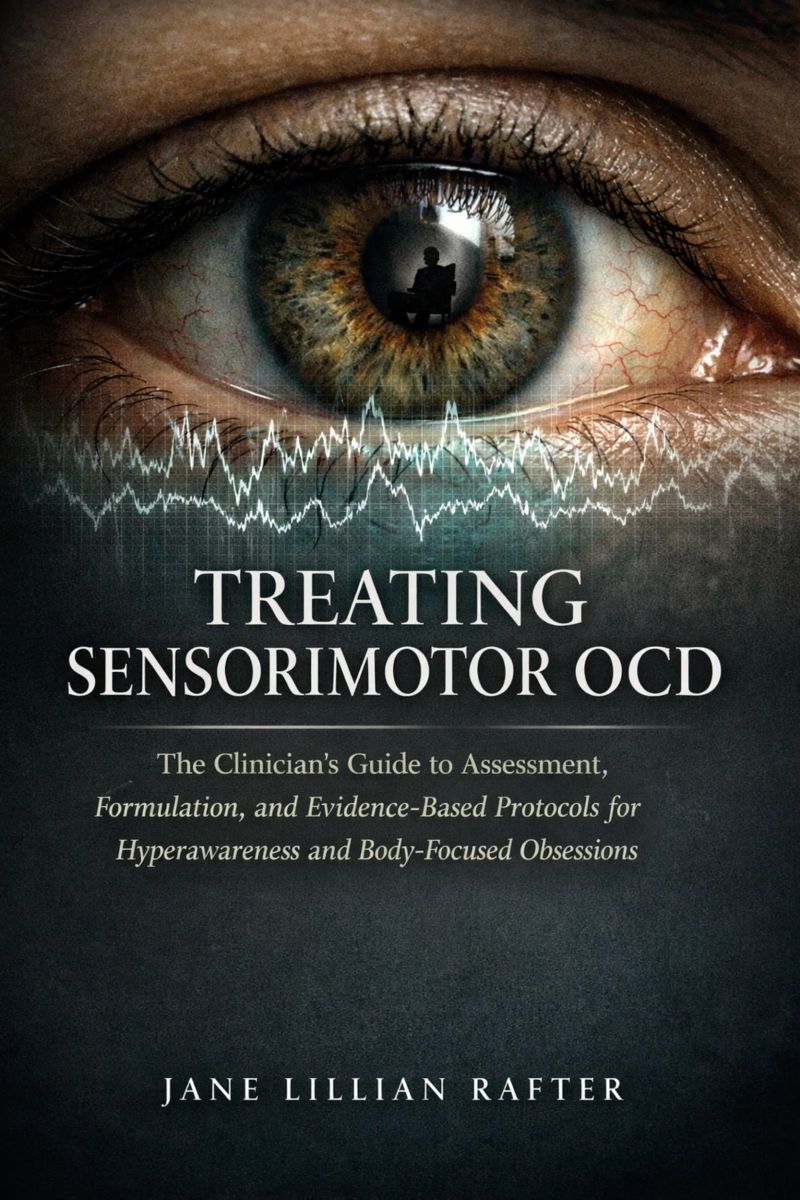
Treating Sensorimotor OCD
The Clinician's Guide to Assessment, Formulation, and Evidence-Based Protocols for Hyperawareness and Body-Focused ObsessionsBy Jane Lillian Rafter


Length3h 31m
About this audiobook
Sensorimotor OCD is one of the most misdiagnosed and undertreated subtypes in clinical practice. Clients present with persistent, distressing hyperawareness of normal bodily functions, including breathing, swallowing, blinking, heartbeat, and tongue position, and they cycle through providers who mistake the presentation for health anxiety, panic disorder, somatic symptom disorder, or generalized anxiety. Standard exposure and response prevention protocols often fail because they target the sensation rather than the monitoring behavior that maintains the cycle. Until now, clinicians have had no single resource dedicated to the assessment, formulation, and treatment of this specific OCD subtype.
A Complete Clinical Framework for an Underserved Subtype
This professional guide provides mental health clinicians with everything needed to recognize, accurately diagnose, and effectively treat sensorimotor and hyperawareness obsessions. Beginning with a comprehensive overview of how body-focused OCD presentations differ from other anxiety-related conditions, the book walks through a systematic differential diagnosis protocol, collaborative case formulation models, and realistic treatment planning that sets appropriate expectations from session one.
Four Evidence-Based Treatment Protocols in One Volume
The core of the guide delivers detailed, session-by-session treatment protocols across four modalities: modified exposure and response prevention redesigned for unavoidable triggers, inference-based cognitive behavioral therapy targeting obsessional doubt and inferential confusion, metacognitive therapy with attention training technique integration, and acceptance and commitment therapy for clients who need a values-based approach. Each protocol includes case examples with clinical dialogue, specific adaptation guidance for sensorimotor presentations, and clear decision frameworks for matching clients to the right modality.
Advanced Clinical Guidance for Real-World Complexity
Treatment rarely unfolds in a vacuum. Dedicated chapters address comorbidity management when sensorimotor OCD co-occurs with generalized anxiety, depression, ADHD, autism spectrum conditions, and additional OCD subtypes. A pharmacological considerations chapter provides structured guidance on medication options, augmentation strategies, prescriber collaboration, and intensive treatment referral pathways. The final chapter delivers reproducible client handouts, session worksheets, daily monitoring forms, exposure planning tools, and family psychoeducation materials ready for immediate clinical use.
Built for the Practicing Clinician
Every chapter opens with a narrative clinical vignette, includes research spotlights with verifiable citations, and closes with a Monday Morning Application section containing five actionable steps that can be implemented in the next clinical session. This is not a theoretical overview. It is a practice-ready manual grounded in current evidence and written for therapists, psychologists, counselors, psychiatric nurse practitioners, and clinical social workers who want to deliver effective treatment for a population that has been underserved for too long.
Audiobook details
GenreOther
Length3 hrs 31 mins
Narrated byListen with 1,000+ voices
FormateBook with Audio
Publish dateFeb 25, 2026
LanguageEnglish
Table of contents
1TREATING SENSORIMOTOR OCD
2Preface
3PART I: CLINICAL FOUNDATIONS
4Chapter 1.0: The Sensation That Won't Stop Talking
51.1 What Sensorimotor OCD Actually Is
Show all chaptersShow less
61.2 Prevalence and the Recognition Gap
71.3 The Clinical Presentation You're Missing
81.4 Why Standard Diagnoses Fail
91.5 The Monitoring Trap
101.6 Common Targets and Variations
111.7 Monday Morning Application
121.8 Key Takeaways
13Chapter 2.0: When Everything Looks Like Anxiety
142.1 The Differential Diagnosis Challenge
152.2 The Five Question Framework
162.3 Validated Assessment Measures
172.4 The Differential Decision Matrix
182.5 Common Assessment Pitfalls
192.6 Monday Morning Application
202.7 Clinical Implications
21Chapter 3.0: Mapping the Loop That Keeps Them Stuck
223.1 Why Formulation Changes Everything
233.2 The CBT Formulation Model
243.3 Building the CBT Formulation Collaboratively
253.4 The I-CBT Formulation Model
263.5 Formulation Across Targets
273.6 Monday Morning Application
283.7 Integration and Application
29Chapter 4.0: The Goals That Actually Move the Needle
304.1 The Expectations Trap
314.2 Goal Setting That Works
324.3 The Three Phase Treatment Structure
334.4 Measuring Progress Without Reinforcing Monitoring
344.5 When to Adjust the Plan
354.6 Monday Morning Application
364.7 Concluding Thoughts
37PART II: TREATMENT PROTOCOLS
38Chapter 5.0: Exposure When the Trigger Lives Inside You
395.1 Why Standard ERP Misses the Mark
405.2 The Modified ERP Framework
415.3 Designing Exposures That Work
425.4 The Inhibitory Learning Model in Practice
435.5 Response Prevention for Invisible Compulsions
445.6 Case Application Across Targets
455.7 Monday Morning Application
465.8 Chapter Summary
47Chapter 6.0: The Doubt That Builds Its Own Evidence
486.1 Why I-CBT Fits This Subtype
496.2 The Session by Session Protocol
506.4 When I-CBT Is the First Line Treatment

Mere ChristianityC. S. Lewis7h 7m4.4 (519.7K)$24 · $0.00

Her Daily BreadKate Wood12h 57m4.6 (153)$33 · $0.00

The Holy Bible - 1 SamuelKing James2h 13m4.8 (1.6K)$3 · $0.00

The American Standard Bible — The Gospel of MatthewMatthew3h 56m4.7 (3K)$2 · $0.00

Bad Fat Black GirlSesali Bowen6h 32m4.7 (2.8K)$24 · $0.00

The King James Audio Bible New Testament CompleteChristopher Glyn20h 2m4.7 (2.6K)$12 · $0.00

Faiths CheckbookCharles Spurgeon12h 44m4.7 (3.2K)$11 · $0.00

Ten Things I Wish You Knew About Your Child's Mental HealthDr. Billy Garvey4h 53m4.7 (2.4K)$20 · $0.00

Designing Terry Pratchett’s DiscworldPaul Kidby3h 52m4.7 (343)$20 · $0.00

The Chosen Book OneAmanda Jenkins, Kristen Hendricks, Dallas Jenkins3h 8m4.6 (4.9K)$10 · $0.00
The Lives of BrianBrian Johnson9h 45m4.6 (3.5K)$29 · $0.00

Expository Thoughts on the Gospel of LukeJ.C. Ryle27h 13m4.7 (536)$18 · $0.00

CrossroadsKaleb Dahlgren7h 56m4.6 (4.9K)$26 · $0.00

Across the RiverKent Babb11h 40m4.6 (927)$29 · $0.00
Brain Training for RidersAndrea Monsarrat Waldo5h 56m4.7 (550)$19 · $0.00

My Effin' LifeGeddy Lee17h 11m4.6 (13.1K)$40 · $0.00

Kings and PawnsHoward Bryant10h 9m4.6 (678)$29 · $0.00

The Elementia Chronicles #2: The New OrderSean Fay Wolfe11h 17m4.6 (841)$29 · $0.00

The ActsLuke2h 55m4.6 (19.7K)$12 · $0.00

New Testament - Easy NavigationWorld English Bible19h 35m4.6 (1.3K)$1.30 · $0.00
You may also like

Brain EnergyChristopher M. Palmer MD12h 18m4.3 (5.8K)$23
Stress Less, Accomplish MoreEmily Fletcher7h 22m3.9 (6.4K)$24 · $0.00

The Edinburgh Lectures on Mental Science (Annotated)Thomas Troward4h 9m4.4 (2.8K)$2 · $0.00

A pleasant pregnancy: Subliminal-programMichael Bauer53m$35 · $0.00

Animal Relaxation SubliminalMiss Smilla1h$2 · $0.00

Why Does My Cat Attack Me?Imad Muratspahic3h 53m$11 · $0.00

Unveiling StressEdivaldo Ascaneo32m$6 · $0.00
Speed-hypnosis for achieving more joy of life and cheerfulnessMichael Bauer29m$35 · $0.00
Gut ReactionsSimon Quellen Field7h 29m3.9 (770)$20

Guided Hypnosis for Anxiety, Heart Racing & Panic AttacksInstitute for Applied Hypnosis57m$20 · $0.00
ResonanceLukas Åkerberg Lundh1h 5m$6 · $0.00

Achieving Prosperity - Ultimate CollectionNiccolò Machiavelli, Elbert Hubbard, James Allen, William Walker Atkinson, Orison Swett Marden, Benjamin Franklin, William Crosbie Hunter, Harry A. Lewis, Thorstein Veblen, Kahlil Gibran, P. T. Barnum, Marcus Aurelius, Wallace D. Wattles, Lao Tzu, Russell Conwell, Henry Harrison Brown, Florence Scovel Shinn, Émile Coué, Charles F. Haanel, B. F. Austin, Robert Collier144h 34m4.3 (11)$1 · $0.00

The Little MeditationPhilip Permutt1h$10

Keep HappyEustace Miles54m$1 · $0.00

Thomas Troward: Ultimate Collection (Annotated)Thomas Troward29h 30m4.6 (124)$2 · $0.00
Heart Breath MindLeah Lagos7h 58m3.8 (280)$26 · $0.00
Dopamine Detox: Rewire Your Mind for Optimal Clarity and Mental Strength (Your Practical Step-by-step Guide to Reduce Distractions, Beat Addiction, and Boost Productivity and Focus)Mason g, Edward Hatfield3h 29m$15 · $0.00
The Anxiety GetawayDr. Craig April5h 35m3.8 (108)$17

Emotional Eating: How to Beat Binge and Emotional Eating for Life (How to Stop Emotional Eating Instantly - by Finding out what you’re really Hungry for!)Garry Larsen4h 13m$3.50 · $0.00

Anxiety Without MedicationDr. Beatrice Anand4h 24m$9 · $0.00