
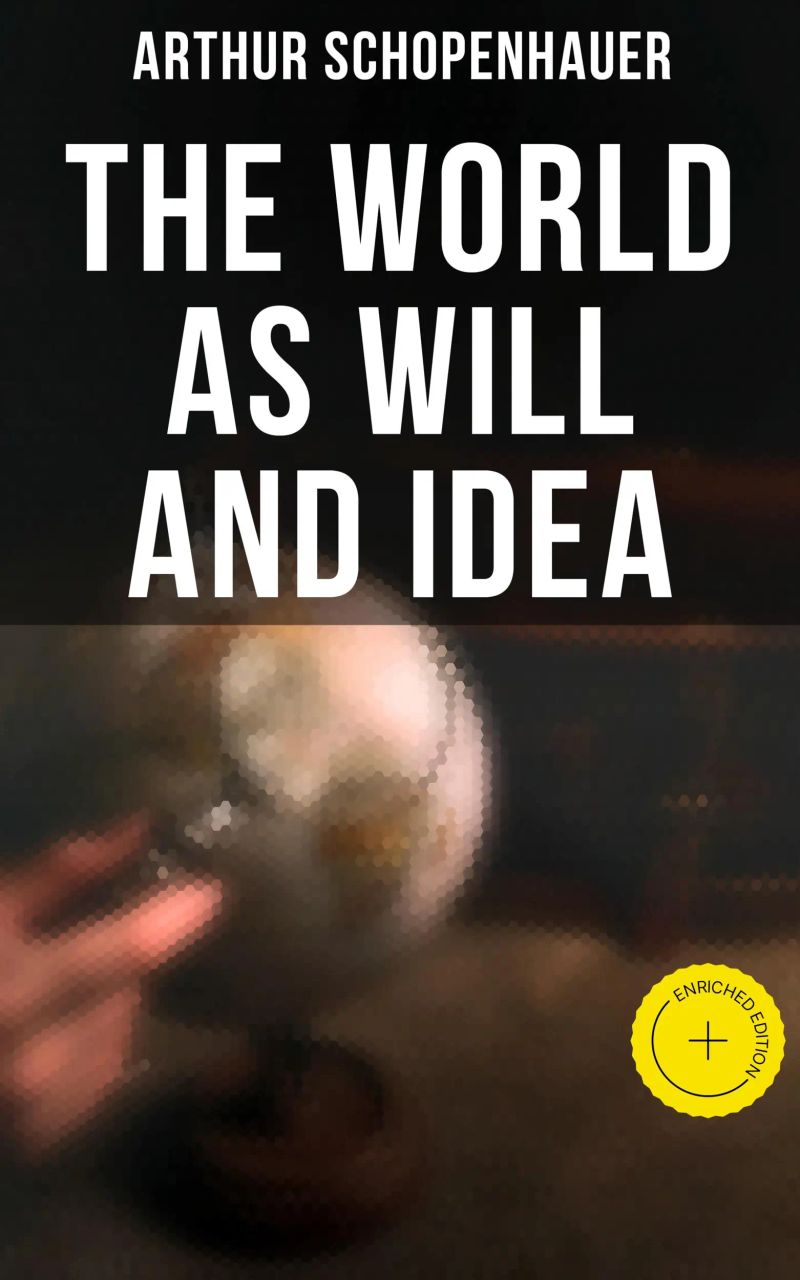
The World as Will and Idea
Enriched edition. Metaphysics, Aesthetics, and Ethics on Will, Representation, and the Nature of RealityBy Arthur Schopenhauer

Length57h 54m
About this audiobook
In 'The World as Will and Idea' by Arthur Schopenhauer, the author delves into the concept of the world as representation and will, exploring metaphysics, aesthetics, and ethics. Schopenhauer's writing style is profound and philosophical, echoing the works of Kant and Nietzsche. His insights on the nature of reality and human existence make this book a seminal work in the realm of Western philosophy. The intricate balance of logical argumentation with poetic language creates a mesmerizing and thought-provoking read. Schopenhauer challenges readers to question their perceptions and contemplate the underlying essence of the world. Arthur Schopenhauer, a German philosopher influenced by Eastern philosophies, drew from his own struggles and contemplations to produce 'The World as Will and Idea'. His pessimistic view of human nature and emphasis on the power of the will shaped his unique perspective on existence. This seminal work reflects Schopenhauer's intellectual depth and his desire to uncover the fundamental truths of the universe. For readers interested in profound philosophical reflections on life, reality, and the human experience, 'The World as Will and Idea' is a must-read. Schopenhauer's timeless observations and engaging writing style make this book a valuable addition to any philosophical library.
In this enriched edition, we have carefully created added value for your reading experience:
- A succinct Introduction situates the work's timeless appeal and themes.
- The Synopsis outlines the central plot, highlighting key developments without spoiling critical twists.
- A detailed Historical Context immerses you in the era's events and influences that shaped the writing.
- An Author Biography reveals milestones in the author's life, illuminating the personal insights behind the text.
- A thorough Analysis dissects symbols, motifs, and character arcs to unearth underlying meanings.
- Reflection questions prompt you to engage personally with the work's messages, connecting them to modern life.
- Hand‐picked Memorable Quotes shine a spotlight on moments of literary brilliance.
- Interactive footnotes clarify unusual references, historical allusions, and archaic phrases for an effortless, more informed read.
Audiobook details
Rating★★★★ 4.3 (8.4K)
Includes Goodreads, Amazon, LibraryThing, StoryGraph
GenrePhilosophy
Length57 hrs 54 mins
Narrated byListen with 1,000+ voices
FormateBook with Audio
Publish dateDec 17, 2020
LanguageEnglish
Table of contents
1Time and Free Will
2Introduction
3Synopsis
4Historical Context
5Author Biography
Show all chaptersShow less
6Volume 1
7Translators' Preface.
8Preface To The First Edition.
9Preface To The Second Edition.
10First Book. The World As Idea.
11First Aspect. The Idea Subordinated To The Principle Of Sufficient Reason[5]: The Object Of Experience And Science. (pt. 1)
12First Aspect. The Idea Subordinated To The Principle Of Sufficient Reason[5]: The Object Of Experience And Science. (pt. 2)
13Second Book. The World As Will.
14First Aspect. The Objectification Of The Will. (pt. 1)
15First Aspect. The Objectification Of The Will. (pt. 2)
16Third Book. The World As Idea.
17Second Aspect. The Idea Independent Of The Principle Of Sufficient Reason: The Platonic Idea: The Object Of Art. (pt. 1)
18Second Aspect. The Idea Independent Of The Principle Of Sufficient Reason: The Platonic Idea: The Object Of Art. (pt. 2)
19Fourth Book. The World As Will.
20Second Aspect. The Assertion And Denial Of The Will To Live, When Self-Consciousness Has Been Attained. (pt. 1)
21Second Aspect. The Assertion And Denial Of The Will To Live, When Self-Consciousness Has Been Attained. (pt. 2)
22Second Aspect. The Assertion And Denial Of The Will To Live, When Self-Consciousness Has Been Attained. (pt. 3)
23Volume 2
24Appendix: Criticism of the Kantian Philosophy. (pt. 1)
25Appendix: Criticism of the Kantian Philosophy. (pt. 2)
26Appendix: Criticism of the Kantian Philosophy. (pt. 3)
27Supplements to the First Book[137].
28First Half. The Doctrine Of The Idea Of Perception. (To § 1–7 of the First Volume.)
29Chapter I. The Standpoint of Idealism.
30Chapter III. On The Senses.
31Chapter IV. On Knowledge A Priori.
32Second Half. The Doctrine of the Abstract Idea, or Thinking.
33Chapter V. On The Irrational Intellect.
34Chapter IX. On Logic In General.
35Chapter X. On The Syllogism.
36Chapter XI. On Rhetoric.
37Chapter XII. On The Doctrine Of Science. (pt. 1)
38Chapter XII. On The Doctrine Of Science. (pt. 2)
39Supplements to the Second Book.
40Chapter XVIII.29 On The Possibility Of Knowing The Thing In Itself.
41Chapter XIX.30 On The Primacy Of The Will In Self-Consciousness.
42Chapter XX.34 Objectification Of The Will In The Animal Organism.
43Note On What Has Been Said About Bichat.
44Volume 3
45Supplements To The Second Book.
46Chapter XXII.1 Objective View of the Intellect.
47Chapter XXIII.3On The Objectification Of The Will In Unconscious Nature.
48Chapter XXIV. On Matter.
49Chapter XXV. Transcendent Considerations Concerning The Will As Thing In Itself.
50Chapter XXVI.4 On Teleology[216].

Aphorismen zur LebensweisheitArthur Schopenhauer8h 28m4.3 (22K)$12 · $0.00

Die Welt als Wille und Vorstellung — Erster BandArthur Schopenhauer28h 37m4.4 (14.1K)$24 · $0.00

Die Welt als Wille und VorstellungArthur Schopenhauer57h 54m4.3 (14.1K)$1 · $0.00

Aphorismen zur LebensweisheitArthur Schopenhauer8h 35m4.2 (20.8K)$1 · $0.00

Versuch über Geistersehn und was damit zusammenhängtArthur Schopenhauer5h 27m4.0 (115)$1 · $0.00

Arthur Schopenhauer: L'Art d'avoir toujours raisonArthur Schopenhauer2h 55m3.8 (23K)$1.99 · $0.00

Vorlesungen und Abhandlungen Schopenhauer'sArthur Schopenhauer7h 16m4.3 (405)$1 · $0.00

Parerga und Paralipomena (Band 1&2) (Kommentiert)Arthur Schopenhauer51h 45m4.4 (1.1K)$1 · $0.00

Über die vierfache Wurzel des Satzes vom zureichenden Grunde (Kommentiert)Arthur Schopenhauer8h 24m4.6 (12)$1 · $0.00

Über die Weiber (Kommentiert)Arthur Schopenhauer2h 18m3.8 (166)$1 · $0.00

Gesammelte Schriften zur Geschichte der Philosophie (Kommentiert)Arthur Schopenhauer6h 19m4.4 (12)$1 · $0.00

Aphorismen zur Lebensweisheit (Kommentiert)Arthur Schopenhauer10h 15m4.5 (1.4K)$1 · $0.00

The Essays of Arthur Schopenhauer; the Art of Controversy (Annotated)Arthur Schopenhauer4h 28m3.8 (19.7K)$2 · $0.00

Métaphysique de l'amour (L'édition intégrale) (Annoté)Arthur Schopenhauer62h 4m4.0 (1K)$1.99 · $0.00

Essai sur les femmes (L'édition intégrale) (Annoté)Arthur Schopenhauer2h 1m3.7 (1.5K)$1.99 · $0.00

Parerga und Paralipomena (Kommentiert)Arthur Schopenhauer51h 51m4.3 (777)$2 · $0.00

Die wichtigen Werke von Arthur Schopenhauer (Kommentiert)Arthur Schopenhauer123h 14m4.4 (10)$2 · $0.00

The Essays of Arthur Schopenhauer; Counsels and MaximsArthur Schopenhauer5h 57m4.4 (977)$1 · $0.00

Über die WeiberArthur Schopenhauer36m3.5 (2.3K)$1 · $0.00

That Bird Has My WingsJarvis Jay Masters9h 49m4.4 (13.7K)$29 · $0.00

Tâo Teh KingLaozi2h 34m4.4 (230.9K)$2 · $0.00
SymposiumPlato3h 26m4.4 (97.9K)$1.20 · $0.00

Buddhist Boot CampTimber Hawkeye2h 39m4.4 (8.4K)$18 · $0.00
Enchiridion & The Discourses of Epictetus (Annotated)Arrian Epictetus18h 9m4.4 (3.5K)$2 · $0.00

The Meditations of the Emperor Marcus Aurelius AntoninusEmperor of Rome Marcus Aurelius5h 41m4.4 (1.8M)$1 · $0.00

Crime and PunishmentFyodor Dostoevsky23h 11m4.4 (1.3M)$12 · $0.00

MeditationsMarcus Aurelius5h 52m4.4 (433.7K)$1 · $0.00

Everyday DharmaSuneel Gupta5h 2m4.5 (761)$20 · $0.00

The Joyful Wisdom ("La Gaya Scienza")Friedrich Wilhelm Nietzsche11h 37m4.4 (26.6K)$1 · $0.00
The Art of LivingEpictetus, Sharon Lebell3h 16m4.4 (50.1K)$18 · $0.00
MeditationsEmperor Of Rome Marcus Aurelius7h 23m4.3 (477.5K)$1.20 · $0.00

The Imitation of ChristThomas à Kempis6h 27m4.3 (84.6K)$21 · $0.00

Sadhana: the realisation of lifeRabindranath Tagore3h 49m4.4 (8.6K)$6 · $0.00
SapiensYuval Noah Harari15h 18m4.3 (1.4M) · 1216$33 · $0.00

You BelongSebene Selassie8h 35m4.4 (2.7K)$26 · $0.00

The Song Celestial; Or, Bhagavad-Gîtâ (from the Mahâbhârata)Anonymous2h 18m4.4 (3.2K)$2 · $0.00

The KybalionThe Three Initiates3h 47m4.3 (58.7K)$20 · $0.00

Chuang Tzu: Mystic, Moralist, and Social ReformerZhuangzi14h 42m4.4 (1.2K)$1 · $0.00

High-RisersBen Austen13h 33m4.4 (2.8K)$33 · $0.00
You may also like

On the SoulAristotle3h 26m4.2 (8.1K)$1.80 · $0.00

The World as Will and Idea (Vol. 1-3) (Annotated)Arthur Schopenhauer57h 59m4.4 (1.9K)$2 · $0.00

The Private Papers of Henry RyecroftGeorge Gissing6h 20m4.0 (2.3K)$2.30 · $0.00

The Essays of Arthur SchopenhauerArthur Schopenhauer3h 15m4.3 (398)$2.30 · $0.00

The Essential Writings of Ralph Waldo EmersonRalph Waldo Emerson10h 1m4.4 (6.5K)$12 · $0.00

Strength and How to Obtain It (Annotated)Eugen Sandow4h 17m4.3 (1.4K)$2 · $0.00

The Expression of the Emotions in Man and Animals (Annotated)Charles Darwin9h 27m4.1 (13.5K)$1.99 · $0.00

The Birthmark (Psychological Thriller)Nathaniel Hawthorne4h 46m3.9 (7.4K)$2 · $0.00
A Handbook for New StoicsMassimo Pigliucci, Gregory Lopez10h 45m4.2 (2.6K)$23

On the SoulAristotle3h 25m4.1 (8K)$1.20 · $0.00

Stoicism: The Ultimate Guide of Stoicism to Make Your Everyday Modern Life Calm (A Practical and Soulful Guide to Inner Peace and Emotional Clarity for Navigating Today’s Challenges With Stoic Wisdom)Michael Torres1h 37m$3.50 · $0.00

The Enlightened ManagerVishwanath Alluri6h 7m$24 · $0.00

Accept Criticism - Hypnosis and Guided MeditationJohn Flatcher14m$4 · $0.00

Ontological Catastrophe: Žižek and the Paradoxical Metaphysics of German IdealismJoseph Carew13h 45m4.1 (14)$1.99 · $0.00

The Play of Man (Annotated)Karl Groos13h 51m$1.99 · $0.00

The Lady and Her HorseT. A. Jenkins1h 12m$2 · $0.00

The Exhausted MindFarah Zidan1h 58m$5.70 · $0.00

Little Seashell 小贝壳, TheMeina Yang7m$6 · $0.00

California and the CaliforniansDavid Starr Jordan38m3.9 (11)$1 · $0.00

Beauty: Illustrated Chiefly by an Analysis and Classificatin of Beauty in WomanAlexander Walker12h 11m$2 · $0.00