
Audio only
Length1h 1m
About this audiobook
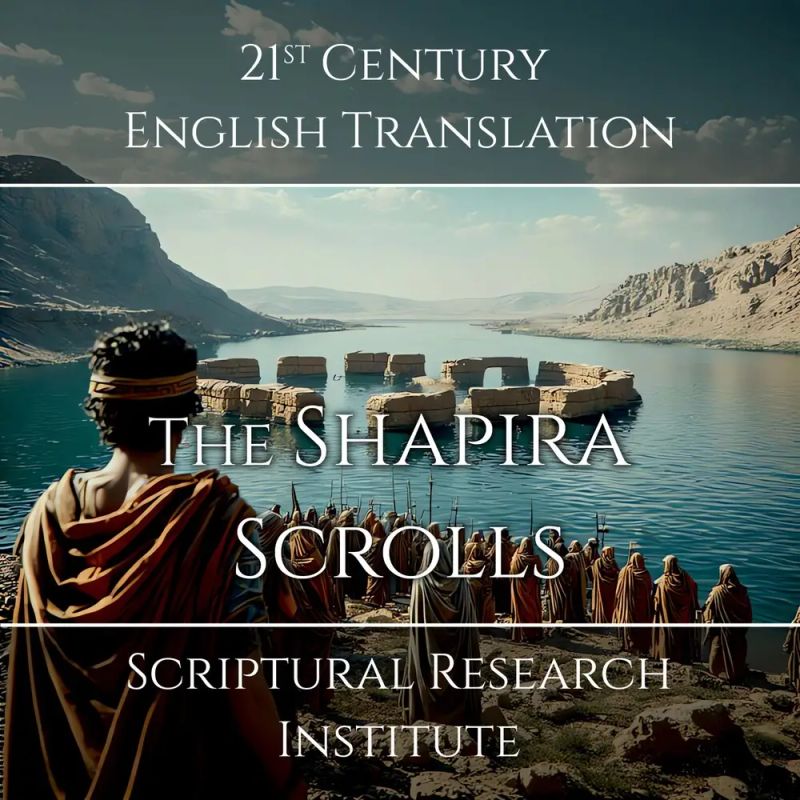
The Shapira scrolls, also known as the Shapira manuscript or Moabite Deuteronomy, are a collection of leather strips supposedly discovered in the Arnon Valley of modern Jordan in the 1860s. While they were initially accepted as authentic by the Jewish antiquities dealer Moses Shapira, they were later discredited as forgeries by German and British biblical scholars. Since the discovery of the Dead Sea scrolls in the 1940s, there have been several scholars who have called into question the claims that the leather strips were a forgery, however, their whereabouts is unknown, and therefore no modern analysis of the leather strips is possible.
Several reasons were given for the initial claims that the strips were a forgery, including the script, language, and content. The script is a form of Phoenician, similar to the Moabite script of the 800s BCE, however, the language includes Imperial Aramaic terms not used until the Persian era, several centuries later. The content is not a match for any surviving translation of Deuteronomy, however, it does include many parallel statements. Some of the statements are somewhat heretical, however, they do seem similar to the beliefs of the Hasidian and Tobian sects reported to have been living in the region under Greek rule between 330 and 240 BCE.
Moses Shapira had previously been involved in the discovery and authentication of both authentic and fraudulent artifacts for the museums and universities of Europe, including five scrolls inscribed on leather sold in 1870, that were later assumed to be forgeries in 1884 and have subsequently disappeared. His biggest ‘swindle’ was thousands of fake Moabite artifacts labeled as Moabitica, which were apparently dug up at a site in the Arnon Valley of modern Jordan. These artifacts included stone heads, and clay vessels inscribed with Moabite text, and were dug up by both Shapira’s workers and German scholars, who later assumed Shapira’s people hid the artifacts there for them to find. The Altes Museum in Berlin bought the largest collection of these artifacts, at 1700, however, there were additional sales to other institutions and individuals across Europe, and the total number of artifacts is unknown.
Audiobook details
Rating★★★★ 4.3 (14)
Includes Amazon
GenreSpirituality and Religion
Length1 hr 1 min
Narrated byGoogle's Archie
FormatAudiobook
Publish dateMay 6, 2026
LanguageEnglish
Table of contents
1section-0001
10section-0010
2section-0002
11section-0011
3section-0003
12section-0012
4section-0004
13section-0013
5section-0005
14section-0014
Show all chaptersShow less
6section-0006
15section-0015
7section-0007
16section-0016
8section-0008
17section-0017
9section-0009
Tale of SinuheScriptural Research Institute1h 18m$4.10 · $0.00

Septuagint - ObadiahScriptural Research Institute24m$3.50 · $0.00
Septuagint - DeuteronomyScriptural Research Institute3h 19m4.8 (11)$5.80 · $0.00
Septuagint - AmosScriptural Research Institute1h 48m$3.50 · $0.00

Greek Apocalypse of EzraScriptural Research Institute27m4.6 (11)$3.50 · $0.00
Septuagint - JoelScriptural Research Institute45m$3.50 · $0.00
Septuagint - NahumScriptural Research Institute51m$3.50 · $0.00
Septuagint - ZakharianScriptural Research Institute1h 21m$3.50 · $0.00
Septuagint - DodekaScriptural Research Institute10h 14m$29 · $0.00
Septuagint - ZephaniahScriptural Research Institute1h 6m$3.50 · $0.00

Judahite Apocalypse of EzraScriptural Research Institute2h 52m$4.10 · $0.00
Ge'ez 1st MaccabeesScriptural Research Institute4h 28m$4.70 · $0.00
Septuagint - NahumScriptural Research Institute34m$4.10 · $0.00

Words of AhikarScriptural Research Institute2h 21m$5.80 · $0.00

The Life of WeniScriptural Research Institute29m$4.10 · $0.00
Septuagint - ShadrachScriptural Research Institute1h 4m$3.50 · $0.00
Septuagint - HoseaScriptural Research Institute1h 53m$3.50 · $0.00

Tale of the Shipwrecked SailorScriptural Research Institute26m4.3 (12)$3.50 · $0.00

Septuagint - ZakharianScriptural Research Institute56m$4.10 · $0.00

Septuagint - JoelScriptural Research Institute33m$4.10 · $0.00

Proud Police WifeRebecca Lynn4h 52m4.8 (14K)$10 · $0.00

I Hear His Whisper 365 Daily Devotions (Gift Edition)Brian Simmons, Gretchen Rodriguez9h 23m4.8 (2K)$10 · $0.00

A Little God Time for Women Morning & Evening DevotionalBroadStreet Publishing Group LLC15h 15m4.9 (1.2K)$10 · $0.00

The Chosen Presents: A Blended Harmony of the GospelsSteve Laube, Amanda Jenkins, Dallas Jenkins7h 8m4.9 (823)$10 · $0.00

Prayers from the Throne RoomBrian Simmons8h 55m4.9 (256)$10 · $0.00

31 Decrees of Blessing for Your LifePatricia King2h 38m4.8 (1.4K)$10 · $0.00

Loved BabySarah Philpott4h 51m4.8 (1.4K)$10 · $0.00

The QuranAllah23h 7m4.7 (136.1K)$1 · $0.00

The Secret of the RosaryLouis de Montfort6h 1m4.7 (16K)$2 · $0.00

The Holy Qur-an: Text, Translation and CommentaryAbdullah Yusuf Ali22h 16m4.7 (133K)$1 · $0.00

All of Grace (Annotated)Charles Spurgeon5h 1m4.7 (1.3K)$1.99 · $0.00

Steps to ChristEllen G. White3h 12m4.7 (13.8K)$2 · $0.00

The Doctrine and Selected CovenantsJoseph Smith13h 53m4.7 (10.4K)$1.99 · $0.00

Sinners in the Hands of an Angry God & Other Sermons (Annotated)Jonathan Edwards7h 51m4.7 (1.5K)$2 · $0.00

Swayam Ki AwaazPrem Rawat8h 34m4.7 (1.1K)$26 · $0.00

Behind the BadgeAdam Davis10h 18m4.7 (2.7K)$10 · $0.00

The New Human Revolution, vol. 1Daisaku Ikeda7h 46m4.7 (669)$12 · $0.00

You Are Worth ItKyle Carpenter, Don Yaeger8h 53m4.7 (4.8K)$29 · $0.00

Praying GraceDavid A. Holland3h 2m4.7 (658)$10 · $0.00

Evidence Not SeenDarlene Deibler Rose11h 11m4.6 (11.9K)$29 · $0.00
You may also like

A Lethal LegacyHeather Graham9h 17m4.0 (2.7K)$25 · $0.00

The Mysteries and Secrets of Freemasons RevealedWilliam Morgan12h 27m3.6 (1.1K)$2 · $0.00
The Adventure of the Egyptian TombAgatha Christie31m4.0 (4.1K)$2 · $0.00
Murder in the ChurchRoy Lewis7h 45m4.3 (1.2K)$17

Summer of the DragonElizabeth Peters2h 50m4.1 (3.8K)$17

Murder in the FieldRoy Lewis8h 5m4.5 (638)$20

EffigiesMary Anna Evans11h 9m4.1 (954)$17

The Man in Lower TenMary Roberts Rinehart7h 12m3.7 (3K)$2 · $0.00

God Sees the Truth, but WaitsLeo Tolstoy19m4.1 (2.8K)$2.30

BadlandsPeter Bowen5h 55m4.2 (568)$17
Legend of the DeadMicah S. Hackler6h 7m4.2 (1.3K)$17

The Greatest Works of Arthur MachenArthur Machen197h 5m4.4 (16)$2 · $0.00
Forged Egyptian AntiquitiesT. G. Wakeling2h 58m3.8 (45)$1 · $0.00

The Mysteries and Secrets of Freemasons Revealed (Annotated)William Morgan13h 18m$2 · $0.00
For Better or MurderSimon R. Green6h 27m4.1 (67)$23

The Necromancer: or The Tale of the Black ForestCarl Friedrich Kahlert, Ludwig Flammenberg8h 12m3.5 (334)$1 · $0.00

How to Make Money Flipping Jewelry - How to Test Metals and Stones, Spot Fakes, Value Pieces, and Sell SafelyJACK FLIPWELL8h 7m$7.90 · $0.00
Stone CertaintySimon R. Green6h 15m4.0 (245)$23

Turning Points in Indian Cricket. E7Amit Varma, Prem Panicker38m$4
The Chase, Vol. 1Black Eye Entertainment7h 52m4.4 (45)$20