
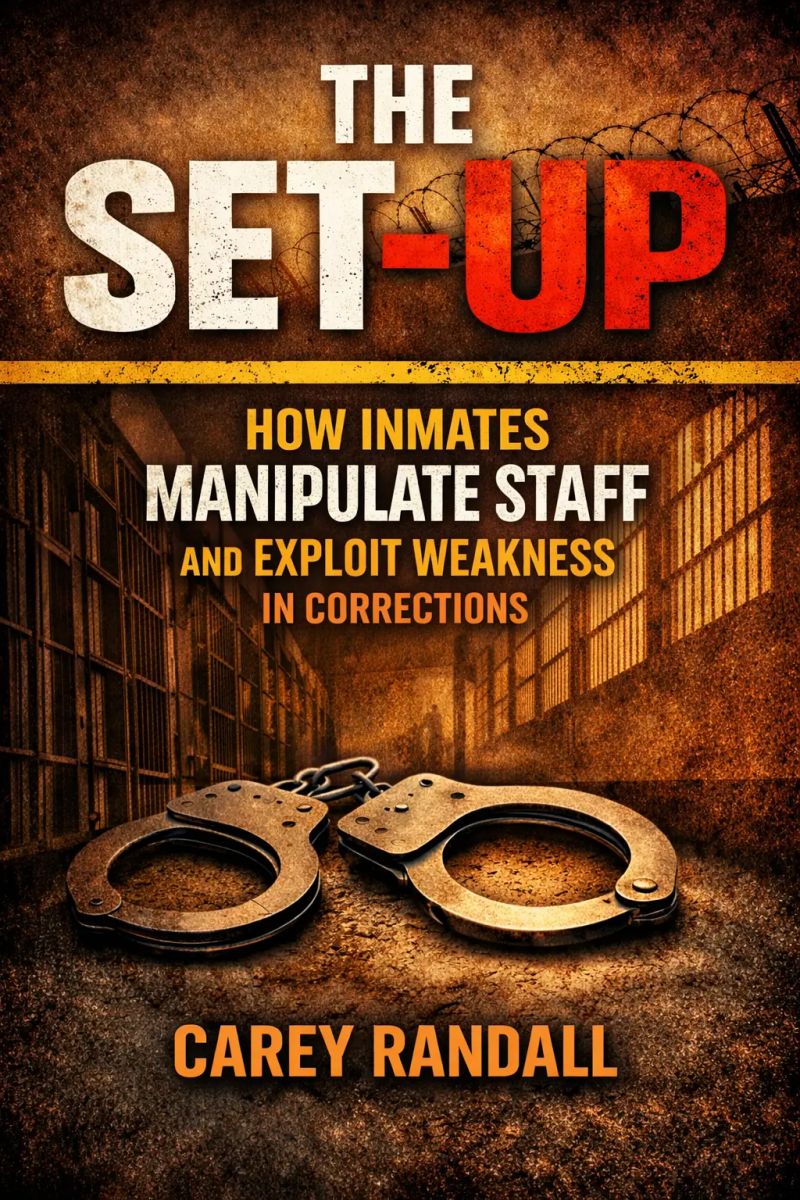
The Set-Up
How Inmates Manipulate Staff in CorrectionsBy Carey Randall


Length4h 11m
About this audiobook
The Set-Up is a powerful breakdown of inmate manipulation in corrections and how easily small tests can grow into serious compromise. In this audiobook, correctional officer Carey Randall explains how inmates study staff, build leverage, exploit weakness, and use routine interactions to slowly move officers off professional ground.
Through practical examples, clear lessons, and real-world corrections insight, this book shows how manipulation begins, why it works, what warning signs staff miss, and how officers and supervisors can stop it before it turns into a safety, career, or integrity issue.
Written for correctional officers, supervisors, recruits, and anyone serious about staff safety behind the walls, The Set-Up is both a training tool and a wake-up call. It is a direct, no-nonsense guide to recognizing the setup early, protecting professional boundaries, and staying sharp in one of the toughest environments in public service.
Audiobook details
GenreEducation and Learning, Self-Help
Length4 hrs 11 mins
Narrated byListen with 1,000+ voices
FormateBook with Audio
Publish dateApr 3, 2026
LanguageEnglish
Table of contents
1Title
2Dedication
3Introduction
4Chapter 1: What Inmate Manipulation Really Is
5Chapter 2: Why Manipulation Works
Show all chaptersShow less
6Chapter 3: The First Test
7Chapter 4: Building the Hook
8Chapter 5: Divide and Conquer
9Chapter 6: Common Types of Inmate Manipulation
10Chapter 7: When Staff Start Sliding
11Chapter 8: The Cost of Compromise
12Chapter 9: Warning Signs Staff Must Never Ignore
13Chapter 10: Professional Boundaries That Protect You
14Chapter 11: What Supervisors Must Watch For
15Chapter 12: Training New Officers to Survive the Set-Up
16Chapter 13: Real-World Scenarios and Lessons
17Chapter 14: Staying Sharp Over a Career
18Chapter 15: Recovering After a Boundary Slip
19Chapter 16: Manipulation and Contraband Pathways
20Chapter 17: How Male Staff and Female Staff May Be Targeted Differently
21Chapter 18: Leadership Failures That Help Manipulation Grow
22Chapter 19: Manipulation During Transport, Medical Runs, and Outside Movement
23Chapter 20: Manipulation Through Grievances, Complaints, and Policy Games
24Chapter 21: When Burnout at Home Becomes Vulnerability at Work
25Chapter 22: Staff Warning Stories - How Careers Start Falling Apart
26Chapter 23: Lessons for Academy Trainers and Field Training Officers
27Chapter 24: How Inmates Manipulate Entire Teams, Not Just Individuals
28Chapter 25: How Manipulation Changes in Dorms, Close Custody, and Segregation
29Chapter 26: Rebuilding Trust After Compromise or Drift
30Chapter 27: Case Studies of How Small Mistakes Become Major Incidents
31Chapter 28: Manipulation in Intake, Classification, and Early Housing Placement
32Chapter 29: Red Flags in Staff Culture That Invite Manipulation
33Chapter 30: Manipulation During Use of Force, Cell Extractions, and High-Stress Incidents
34Chapter 31: How Inmates Test New Sergeants, Lieutenants, and Command Staff
35Chapter 32: Manipulation Through Phones, Mail, and Communication Channels
36Chapter 33: When Officers Ignore Their Own Gut Feeling
37Chapter 34: Advanced Staff-Compromise Case Studies
38Chapter 35: Building a Manipulation-Resistant Culture
More from Carey Randall

Florida’s Final Sentence Wrongful Convictions, Executions,...Carey Randall1h 43m Only with Ultra

Behind the Walls of StressCarey Randall1h 35m Only with Ultra

Complacency Kills Carey Randall2h 44m Only with Ultra

Complacency Kills: The Silent Threat to Correctional Officer SafetyCarey Randall2h 44m$9.99

Behind the Walls of Stress Correctional Officer and LEOCarey Randall1h 36m$9.99

Florida’s Final SentenceCarey Randall1h 43m$4.99

A Brief History of IntelligenceMax S. Bennett12h 18m4.6 (6.6K)$29 · $0.00

HomeschooledStefan Merrill Block7h 10m3.6 (18.5K)$28 · $0.00

The Call of the Wild and FreeAinsley Arment9h 7m4.4 (21.2K)$29 · $0.00
The Freelance WayRobert Vlach19h 48m4.5 (528)$40 · $0.00

Race to the BottomLuke Rosiak9h 20m4.5 (600)$29 · $0.00

They Came for the SchoolsMike Hixenbaugh9h 5m4.5 (2.6K)$8 · $0.00

Find Me UnafraidKennedy Odede, Jessica Posner11h 11m4.5 (2.7K)$29 · $0.00

Asking for ItKate Harding8h 55m4.4 (5.3K)$20 · $0.00
Defining Moments in Black HistoryDick Gregory7h 37m4.4 (6K)$26 · $0.00

The Emerald Tablets of Thoth the AtlanteanMaurice Doreal3h 4m4.4 (8.8K)$6 · $0.00

Learning AmericaLuma Mufleh6h 37m4.4 (564)$24 · $0.00

Math-ishJo Boaler7h 21m4.4 (588)$24 · $0.00

Daddy-Long-LegsJean Webster12h 18m4.2 (91K)$1.99 · $0.00
It Worked For MeColin Powell7h 42m4.3 (9.8K)$26 · $0.00

Little SoldiersLenora Chu11h 30m4.3 (3.1K)$29 · $0.00

Grammar-land; Or, Grammar in Fun for the Children of Schoolroom-shireM. L. Nesbitt2h 36m4.4 (488)$1 · $0.00

Financial FeministTori Dunlap8h 3m4.2 (22.2K)$8 · $0.00

DarkwaterWilliam Edward Burghardt Du Bois6h 40m4.3 (1.4K)$11 · $0.00

The Highway Code UKDepartment for Transport3h 33m4.2 (36.6K)$11 · $0.00

He'll Be OKCelia Lashlie6h 32m4.3 (1.1K)$24 · $0.00
Learning to PrayJames Martin13h 24m4.5 (3.4K)$33 · $0.00

Finding MeViola Davis9h 15m4.6 (256.4K)$29 · $0.00

Spiritual AnatomyDaaji Kamlesh D. Patel9h 47m4.7 (319)$29 · $0.00

The Dangerous Truth about Today’s MarijuanaLaura Stack CSP, MBA9h 57m4.7 (385)$20 · $0.00

The Gospel according to Spiritualism (Translated)Allan Kardec14h 39m4.6 (3.9K)$5.70 · $0.00

Birdie & HarlowTaylor Wolfe7h 50m4.6 (6.5K)$26 · $0.00

CrossroadsKaleb Dahlgren7h 56m4.6 (4.9K)$26 · $0.00

Life on the BridgeKaelynn Partlow5h 40m4.6 (1.1K)$24 · $0.00

Keep Your Love OnDanny Silk9h 4m4.6 (8.1K)$10 · $0.00

The Tao of Joy Every DayDerek Lin10h 24m4.6 (762)$20 · $0.00
UndividedVicky Beeching9h 2m4.6 (1.3K)$29 · $0.00

HE CAN WHO THINKS HE CAN & OTHER BOOKS ON SUCCESSOrison Swett Marden5h 54m4.6 (1.2K)$1.99 · $0.00
Level UpRob Dial7h 42m4.6 (3.3K)$26 · $0.00

Burn the HaystackJennie Young, PhD9h 30m4.6 (543)$29 · $0.00

ACRES OF DIAMONDS: Our Every-day Opportunities (Wisdom & Empowerment Series) (Annotated)Russell Conwell2h 26m4.6 (1K)$2 · $0.00

Good InsideBecky Kennedy9h 55m4.5 (59.3K)$29 · $0.00

The Lost VoiceGreta Morgan8h 30m4.7 (285)$26 · $0.00

Stripped DownBunnie Xo8h 25m4.5 (32.9K)$26 · $0.00

UnthinkableJamie Raskin15h 8m4.5 (9.3K)$8 · $0.00

Wallace D. Wattles Ultimate Collection Wallace D. Wattles16h 53m4.6 (1.3K)$1 · $0.00
You may also like

Win at All CostsMatt Hart13h 38m4.2 (3.2K)$33 · $0.00
Perversion of JusticeJulie K. Brown13h 43m4.4 (5.5K)$33 · $0.00
The Good RatJimmy Breslin6h 53m3.7 (2.2K)$20 · $0.00

Eight Men OutEliot Asinof11h 26m4.2 (13.2K)$20
The Great Crash 1929John Kenneth Galbraith6h 33m4.1 (9.3K)$24 · $0.00

The Cask of AmontilladoEdgar Allan Poe23m4.4 (118.6K)$2

The Unarmed TruthJohn Dodson8h 55m4.4 (369)$20 · $0.00

Love of a CowboyJennifer Ryan9h 18m4.1 (1.6K)$29 · $0.00

The Real Anthony FauciKennedy Jr., Robert F27h 50m4.4 (34.2K)Free

The Catiline ConspiracySallust3h 17m4.0 (4.9K)$1 · $0.00

After the FactJeff Cooper7h 29m4.1 (842)$17

Awful Disclosures of the Hotel Dieu Nunnery of Montreal (Annotated)Maria Monk10h 33m4.1 (12)$1.99 · $0.00

Forbes Greatest Investing StoriesRichard Phalon8h 59m3.3 (52)$20 · $0.00

Get Money ChicksAnna J.6h 56m4.3 (219)$20

Addicted to DesignMia R. Wellington4h 12m$4.10 · $0.00

Snow on the Headlight, A Story of the Burlington StrikeCyrus Warman4h 18m$2.30

I Did ItGina Champion-Cain, Neil Senturia, Barbara Bry8h 51m3.7 (39)$20

The Queen Versus Billy, and Other StoriesLloyd Osbourne8h 22m$2 · $0.00

Drug Smuggling and Taking in India and BurmaRoy K. Anderson2h 39m$2.30

No Ring, No RoofCarla Vance7h 54m$5