
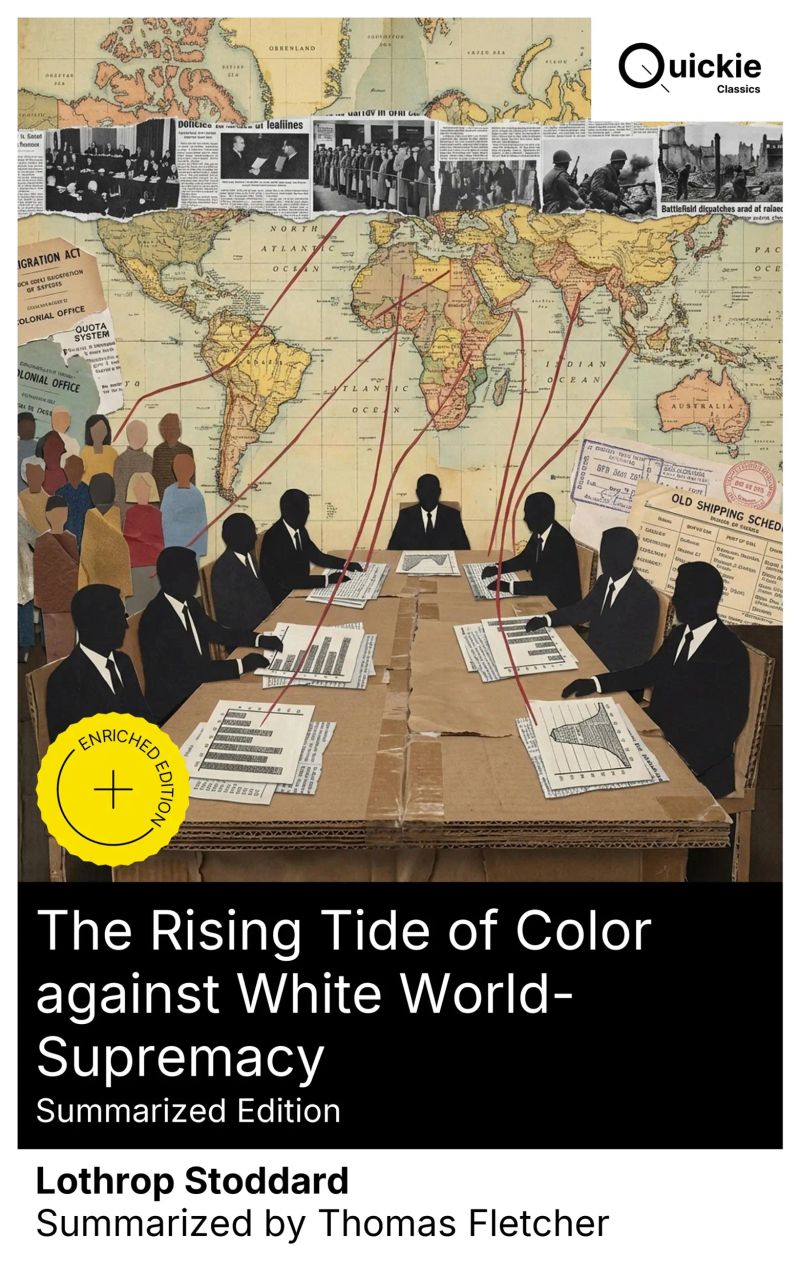
The Rising Tide of Color against White World-Supremacy (Summarized Edition)
Enriched edition. Primary source on interwar racial geopolitics, empire, eugenics, and immigration restrictionBy Lothrop Stoddard


Length3h 31m
About this audiobook
Published in 1920, The Rising Tide of Color Against White World-Supremacy is a polemical synthesis of geopolitics, demography, and eugenic pseudo-science. Stoddard surveys the post–World War I order, anti-colonial unrest, and differential birth rates to argue that so-called colored populations imperil European and American dominance. In cool, bureaucratic prose with maps, typologies, and tables, he advances a taxonomy of supposed races and urges immigration restriction, colonial consolidation, and policing of miscegenation. The book aligns with Madison Grant's The Passing of the Great Race and reflects interwar anxieties about empire and modernity. Harvard-trained historian and journalist Lothrop Stoddard (1883–1950) moved in eugenics and immigration-restriction circles, writing popular syntheses that gave a veneer of social-scientific authority to racial hierarchy. His early scholarship on the Haitian Revolution and later travels shaped his preoccupation with demographic pressure, imperial retreat, and Bolshevism. The book distills that milieu, translating elite nativist discourse for a broad audience. Recommended as a primary source, not an authority: readers in intellectual history, race science, empire studies, and policy history will find it illuminating for understanding how statistical rhetoric and fear-mongering buttressed white supremacist projects. Read with critical frameworks and scholarship that dismantle its premises and document ensuing harms.
Quickie Classics summarizes timeless works with precision, preserving the author's voice and keeping the prose clear, fast, and readable—distilled, never diluted. Enriched Edition extras: Introduction · Synopsis · Historical Context · Brief Analysis · 4 Reflection Q&As · Editorial Footnotes.
Audiobook details
Rating★★★★ 3.6 (3.9K)
Includes Goodreads, Amazon, LibraryThing
GenrePsychology
Length3 hrs 31 mins
Narrated byListen with 1,000+ voices
FormateBook with Audio
Publish dateJan 10, 2026
LanguageEnglish
Table of contents
1Introduction
2Introduction
3Synopsis
4Historical Context
5The Rising Tide of Color Against White World-Supremacy (pt. 1)
Show all chaptersShow less
6The Rising Tide of Color Against White World-Supremacy (pt. 2)
7Analysis
8Reflection
More from Lothrop Stoddard

What to Make of a LifeJim Collins13h 31m4.4 (794)$33 · $0.00

Bad Fat Black GirlSesali Bowen6h 32m4.7 (2.8K)$24 · $0.00

Invisible StormJason Kander6h 48m4.7 (3.2K)$24 · $0.00

I Am The StormJanice Dean9h4.6 (1.5K)$8 · $0.00

On Democracies and Death CultsDouglas Murray10h 38m4.6 (6.5K)$29 · $0.00

TerraformPropaganda5h 39m4.7 (594)$24 · $0.00

Southern Horrors: Lynch Law in All Its Phases (Annotated)Ida B. Wells-Barnett2h 44m4.6 (1.3K)$2 · $0.00

Hour of the HeartIrvin D. Yalom, Benjamin Yalom8h 19m4.6 (2.3K)$26 · $0.00

Braving the TruthRachel Held Evans11h 31m4.7 (359)$29 · $0.00
Level UpRob Dial7h 42m4.6 (3.3K)$26 · $0.00

As a JewSarah Hurwitz8h 36m4.6 (1.2K)$26 · $0.00

Saint Joan (Annotated)George Bernard Shaw6h 20m4.6 (1.2K)$1.20 · $0.00

Burn the HaystackJennie Young, PhD9h 30m4.6 (543)$29 · $0.00

Woman and the New Race (Annotated)Margaret Sanger6h 30m4.6 (1K)$0.99 · $0.00

Good InsideBecky Kennedy9h 55m4.5 (59.3K)$29 · $0.00

The Mis-Education of the NegroCarter Godwin Woodson5h 4m4.5 (29.4K)$1.20 · $0.00

Du Bois: EssaysW.E.B. Du Bois6h 22m4.6 (1.5K)$1 · $0.00

The North American Indian (Illustrated Edition)Edward S. Curtis, Frederick Webb Hodge5h 59m4.6 (1.4K)$2 · $0.00

Valley of the BirdtailAndrew Stobo Sniderman, Douglas Sanderson10h 1m4.6 (2.4K)$29 · $0.00

Lies My Therapist Told MeGreg E. Gifford9h 3m4.6 (503)$29 · $0.00
You may also like

Darkwater: Voices from Within the Veil (Unabridged)W.E.B. Du Bois9h 7m4.4 (1.9K)$1.99 · $0.00

On RevolutionHannah Arendt10h 56m4.3 (3.4K)$23

The Rising Tide of Color Against White World-Supremacy: Views of Eugenicist & Ku Klux Klan HistorianLothrop Stoddard9h 54m4.0 (456)$1.99 · $0.00

Vienna on Fire: A WWII Story of SurvivalDon Gabor9h 34m4.4 (1.1K)$23

Age Of Pandemics (1817-1920)Chinmay Tumbe7h 31m4.2 (375)$26 · $0.00

After AmericaSteyn, Mark15h 10m4.2 (3.2K)Free

Marked for DeathGeert Wilders8h 22m4.5 (530)$20 · $0.00

How to Survive AmericaD. L. Hughley, Doug Moe4h 4m4.3 (1K)$20 · $0.00

The voice of an oppressed peopleTomáš Garrigue Masaryk, Jaroslav František Smetánka1h 43m$1 · $0.00

The West’s Last ChanceTony Blankley6h 25m3.6 (259)$14 · $0.00

KafkaesqueMaïa Hruska5h 18m4.1 (60)$29 · $0.00

With the Turks in PalestineAlexander Aaronsohn1h 59m3.1 (79)$2.30

America FirstDanny Toma9h 12m$20 · $0.00

"Speaking of Prussians--"Irvin S. Cobb1h 21m$2 · $0.00

Vietnam, Protest, and a Nation in CrisisSantiago Machain6h 1m$21 · $0.00

Constitution of the Commonwealth of Puerto RicoGovernment of Puerto Rico1h 50m$1 · $0.00

The Critical Writings (Annotated)George Orwell38h 58m$2 · $0.00

Menace in EuropeClaire Berlinski9h 21m3.8 (195)$20

The Canadian Dominion: A Chronicle of Our Northern NeighborOscar D. Skelton4h 21m3.4 (12)$1 · $0.00

King of the JewsLeslie Epstein10h 29m3.8 (295)$21