
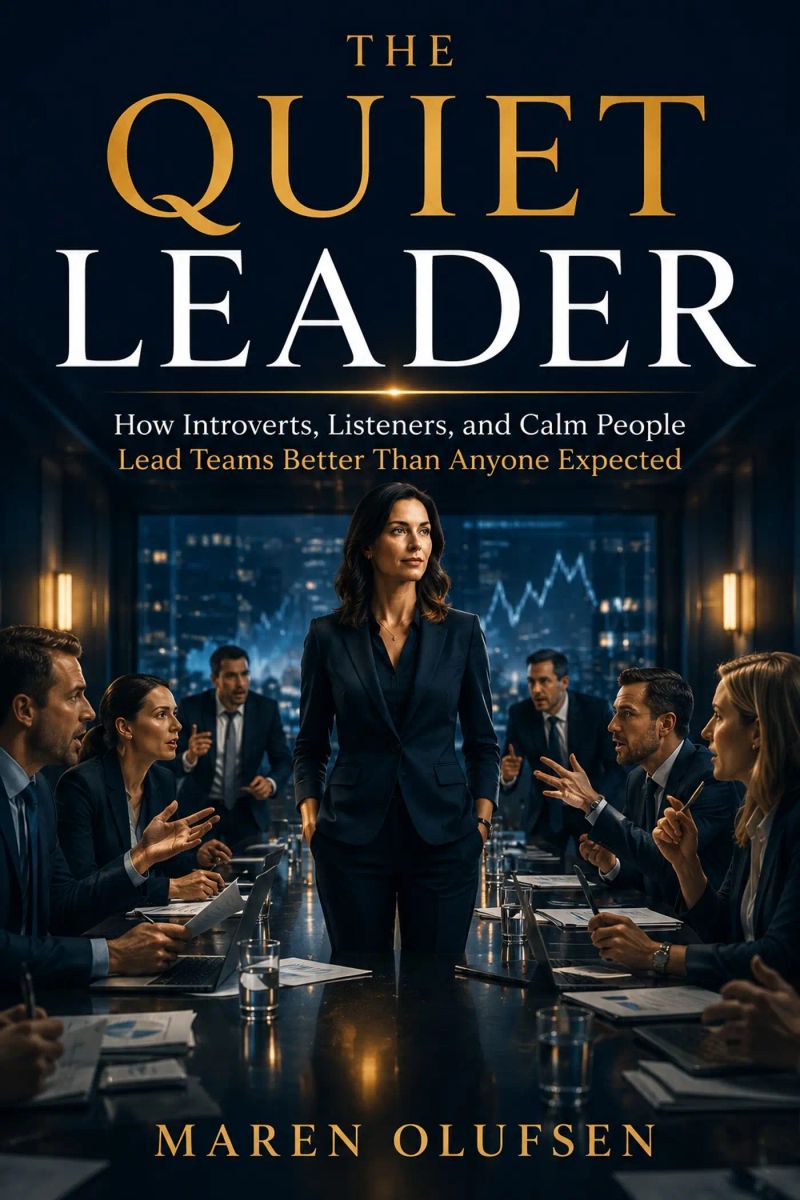
The Quiet Leader
How Introverts, Listeners, and Calm People Lead Teams Better Than Anyone ExpectedBy Maren Olufsen


Length9h 31m
About this audiobook
The quiet leader's playbook: leadership for introverts, a management book for listeners, and a field guide to leading teams without performing — for thoughtful managers told they should be louder, more visible, more something.
The first time the author sat in on a leadership offsite as a coach, the most effective person in the room said almost nothing for ninety minutes. A vice president named Priya listened, wrote down two short phrases, and then asked one clean question: "I think we're solving the wrong problem. Can I ask you something?" Forty minutes later the team had rewritten its plan for the quarter. After thirteen years coaching heads of operations, engineering directors, and founders who think before they speak, Maren Olufsen has watched this scene play out again and again. Their quiet style is not a workaround. It is, in many of the situations that matter most, the thing that is actually working.
This is not the introvert-as-secret-hero pep talk. It is a working field guide for the manager who wants to lead in their own way and still get better at it. The book argues that influence is not volume, that listening is a trainable skill rather than a personality trait, and that calm is a strategic asset rather than a temperament defect. Across twenty-two chapters and seventeen appendices, this leadership for introverts manual covers the one-on-one that other managers skip, feedback that lands without crushing, hiring quietly, managing up to a loud boss, staying steady under pressure, and building a quiet-friendly team culture. Every chapter ends with a concrete "Try this:" practice you can run this week.
Inside this quiet leadership and management book:
• Speak less, say more — Why share of voice is a poor proxy for influence, and the three-rule method one engineering VP used to go from invisible to "the most useful person in the room" without speaking more
• The one-on-one that other managers skip — How to run the single most underused leadership format, the home court of the quiet manager, including the five-minute carry-over habit that flipped a team's view of a director who "didn't listen"
• Feedback that lands without crushing — The three-part structure (observation, impact, question) that makes hard feedback specific instead of vague, because specificity is the kindness and vagueness is the cruelty disguised as kindness
• The hard conversation you keep postponing — How to have it while it is still small, and how to walk into the large version with one frame and two anchors instead of a six-month grievance
• Hiring quietly — Why introverts run better interviews, the silence move that surfaces a candidate's most honest sentence, and the "walk me through your week" question candidates cannot rehearse
• Managing up to a loud boss — How to name how you work as operating information, and win arguments in writing that you would lose in real time
• The quiet leader under pressure — Why steadiness reads as steadiness, not indifference, and how to communicate calm instead of performing it through a crisis, layoff, or acquisition
This is leadership for introverts that does not ask you to fake a personality. It asks you to build a method that fits the way your mind and body actually work, and to sustain it over a thirty- or forty-year career without burning out or losing yourself. The promise is not a transformation into someone on a stage. It is a version of you that fits, that produces strong teams and durable trust, and that, as the author writes, makes the loud-leader picture irrelevant.
For…
Audiobook details
Rating★★★★ 3.8 (20)
Includes Goodreads
GenreBusiness and Economics
Length9 hrs 31 mins
Narrated byListen with 1,000+ voices
FormateBook with Audio
Publish dateSep 29, 2026
LanguageEnglish
Table of contents
1Introduction
2Chapter 1 — The Leader You Thought You Had to Be
3Chapter 2 — The Hidden Strengths of the Quiet Manager
4Chapter 3 — Speaking Less, Saying More
5Chapter 4 — Running Meetings Without Performing
Show all chaptersShow less
6Chapter 5 — The One-on-One That Other Managers Skip
7Chapter 6 — Feedback That Lands Without Crushing
8Chapter 7 — The Hard Conversation You Keep Postponing
9Chapter 8 — Hiring Quietly: How Introverts Run Better Interviews
10Chapter 9 — Letting Someone Go With Dignity Intact
11Chapter 10 — Cross-Functional Influence Without the Volume
12Chapter 11 — Managing Up to a Loud Boss
13Chapter 12 — Speaking in Big Rooms When You’d Rather Not
14Chapter 13 — The Email Cadence That Maintains Trust
15Chapter 14 — Conflict on the Team: Spotting It Before It Festers
16Chapter 15 — The Quiet Leader Under Pressure
17Chapter 16 — Leading Through a Layoff or Acquisition
18Chapter 17 — When the Quiet Style Stops Working
19Chapter 18 — The Loud Coworker, the Loud Stakeholder, the Loud Board
20Chapter 19 — Building a QuietFriendly Team Culture
21Chapter 20 — Recharging: The Quiet Leader’s Energy Practice
22Chapter 21 — Mentoring Other Quiet Leaders
23Chapter 22 — The Long Career: Quiet Leadership Across Decades
24Conclusion
25About the Author
26Appendix A — A Field Guide for the First-Time Manager
27Appendix B — Three Long Case Studies
28Appendix C — Templates for the Conversations That Matter Most
29Appendix D — Frequently Asked Questions from First-Time Quiet Managers
30Appendix E — Sample One-onOne Documents and Working Templates
31Appendix F — Detailed Walkthroughs of Common Management Scenarios
32Appendix G — A Year in the Practice: Month-by-Month Habits
33Appendix H — Reading and References
34Appendix I — Closing Notes from the Author
35Appendix J — A Glossary of the Terms I Have Used
36Appendix K — Last Thoughts on the Long Practice
37Appendix L — Twelve Conversations from the Coaching Room
38Appendix M — A Closing Letter to the Reader
39Appendix N — A Workbook of Reflective Exercises
40Appendix O — A Few Things I Do Not Believe
41Appendix P — A Short Catalog of Small Practices
42Appendix Q — One Final Note
More from Maren Olufsen

Never Split the DifferenceChris Voss, Tahl Raz8h 7m4.4 (277.7K)$26 · $0.00
The Intelligent Investor Rev Ed.Benjamin Graham17h 48m4.3 (191.5K)$40 · $0.00
The Hard Thing About Hard ThingsBen Horowitz7h 57m4.2 (134.3K)$26 · $0.00
Boundaries for LeadersHenry Cloud7h 36m4.3 (3.6K)$26 · $0.00

Eat It!Jordan Syatt, Michael Vacanti4h 40m4.6 (1.5K)$20 · $0.00

Progress and Poverty, Volumes I and II (Annotated)Henry George19h 21m4.6 (574)$1.99 · $0.00

Not Everything Counts but Everything Matters: The powerful and inspirational new book about leadership and achieving success from the visionary multi-premiership winning Panthers coachIvan Cleary6h 1m4.6 (680)$24 · $0.00
BuildTony Fadell11h 5m4.5 (14.3K)$8 · $0.00
The Joys Of CompoundingGautam Baid17h 34m4.5 (2.5K)$18 · $0.00

Basic EconomicsThomas Sowell18h 32m4.5 (29.3K)$28 · $0.00

Poor Charlie’s AlmanackGrover Gardener, Charles T. Munger13h 9m4.5 (24.7K)$18 · $0.00

The Ambuja StoryNarotam Sekhsaria13h 59m4.5 (830)$33 · $0.00

The Secret Door to SuccessFlorence Scovel Shinn2h 25m4.5 (2.1K)$1.20 · $0.00

This Is Going to HurtAdam Kay5h 47m4.4 (444.7K)$24 · $0.00

Big TrustShadé Zahrai, Fayçal Sekkouah8h 36m4.6 (406)$26 · $0.00
The Intelligent Investor Third EditionBenjamin Graham, Jason Zweig20h4.4 (156.6K)$46 · $0.00

Bottle of LiesKatherine Eban14h 25m4.4 (12K)$33 · $0.00

The Antiracist Business BookTrudi Lebrón6h 10m4.6 (275)$17 · $0.00

The FormulaJoshua Robinson, Jonathan Clegg10h 41m4.4 (6.9K)$29 · $0.00

Let Them LeadJohn U. Bacon7h 10m4.5 (1.4K)$24 · $0.00
You may also like

The Wisdom of MorrieMorrie Schwartz, Rob Schwartz7h 33m3.9 (1K)$17

A Return to LoveMarianne Williamson2h 40m4.3 (52.7K)$18 · $0.00

Never Play It SafeChase Jarvis7h 17m4.3 (514)$7 · $0.00

The Person You Mean to BeDolly Chugh9h 6m4.4 (7.2K)$29 · $0.00

Me and White SupremacyLayla F. Saad5h 20m4.4 (41.6K)$17 · $0.00

The Beautiful NoSheri Salata6h 40m3.9 (2.3K)$24 · $0.00
Mental ToughnessEric Holt1h 43m4.2 (268) Only with Ultra

Brain LockJeffrey M. Schwartz1h 38m4.1 (5.8K)$16 · $0.00
Twelve and a HalfGary Vaynerchuk5h 7m4.2 (10.4K)$7 · $0.00
Fool’s TalkOs Guinness10h 16m4.3 (2K)$20

The Core 4Stephanie Gaudreau6h 11m4.3 (553)$24 · $0.00
It’s Not about the CoffeeHoward Behar4h 23m3.9 (2.6K)$12
Velvet ElvisRob Bell4h3.9 (27.3K)$20 · $0.00
Speaking ChristianMarcus J. Borg6h 39m4.2 (1.8K)$24 · $0.00

SabotageEmma Gannon1h 50m3.9 (1.8K)$15
How to Live on 24 Hours a Day (A Classic Guide to Self-Improvement) (Annotated)Arnold Bennett2h 16m3.8 (16.6K)$2 · $0.00
Extreme YouSarah Robb O'Hagan9h 14m3.9 (718)$29 · $0.00

Let Your Clients Close All on Their OwnFrank Witthoff33m$10 · $0.00
How to Thrive Without Self-Discipline Marc Reklau2h 53m5.0 (2) Only with Ultra
Control Your HabitsSara Melo2h 54m$1.80 · $0.00