
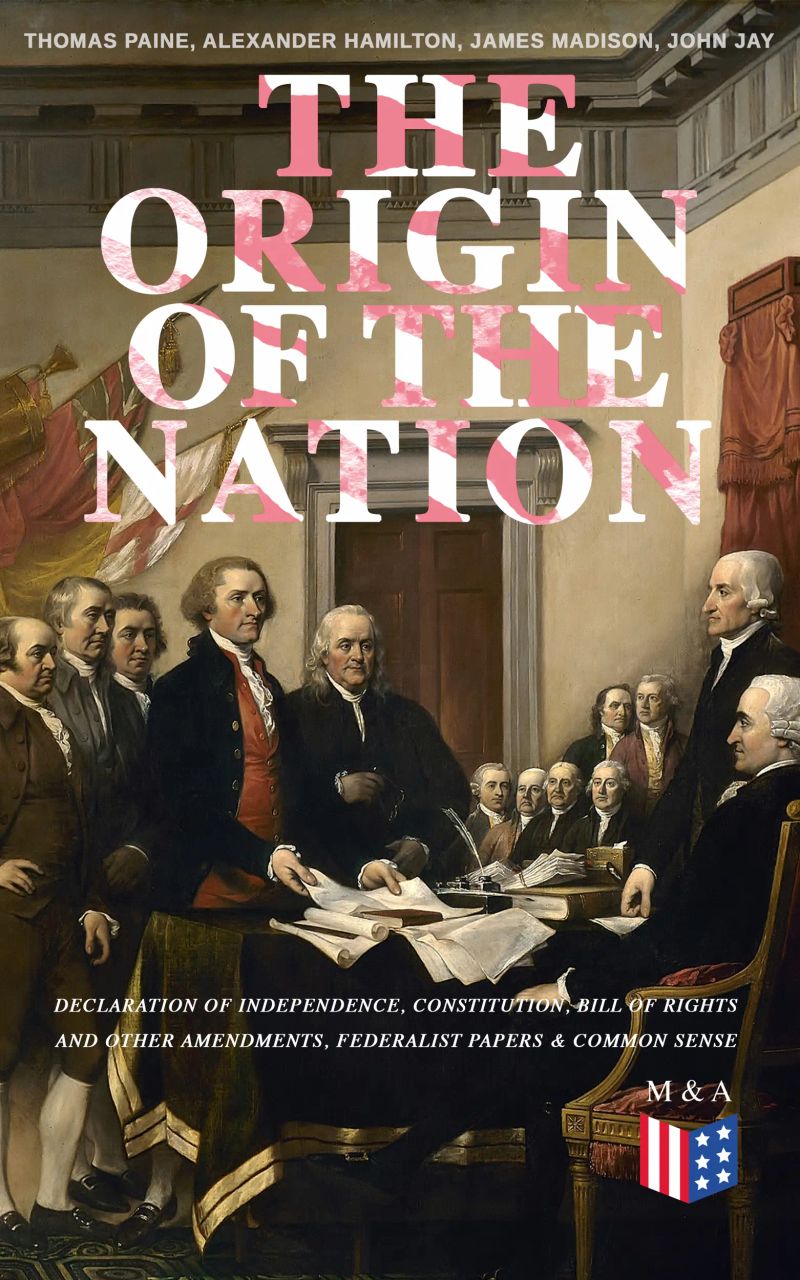
The Origin of the Nation: Declaration of Independence, Constitution, Bill of Rights and Other Amendments, Federalist Papers & Common Sense
Creating America - Landmark Documents that Shaped a New NationBy Thomas Paine, Alexander Hamilton, James Madison, John Jay

Length25h 22m
About this audiobook
"The Origin of the Nation" is an essential collection for all those who want to learn about the core of American democracy and its principles. This collection is comprised of the most important legal documents in early American history: United States Declaration of Independence, the Constitution, and the Bill of Rights. Beside these landmark documents, through the words of Federalist Papers and Common Sense you will understand how American identity was shaped, what were the principles upon which the government of the United States was established.
Audiobook details
GenreHistory, Politics and Government
Length25 hrs 22 mins
Narrated byListen with 1,000+ voices
FormateBook with Audio
Publish dateMar 15, 2017
LanguageEnglish
Table of contents
1On the Origin and Design of Government in General, with Concise Remarks on the English Constitution
2Of Monarchy and Hereditary Succession
3Thoughts on the Present State of American Affairs
4Of the Present Ability of America: with some Miscellaneous Reflections
5The Federalist Papers (1787-1788)
Show all chaptersShow less
6FEDERALIST I: General Introduction
7FEDERALIST II: Concerning Dangers From Foreign Force and Influence
8FEDERALIST III: The Same Subject Continued: Concerning Dangers From Foreign Force and Influence
9FEDERALIST IV: The Same Subject Continued: Concerning Dangers From Foreign Force and Influence
10FEDERALIST V: The Same Subject Continued: Concerning Dangers From Foreign Force and Influence
11FEDERALIST VI: Concerning Dangers From Dissensions Between the States
12FEDERALIST VII: The Same Subject Continued: Concerning Dangers From Dissensions Between the States
13FEDERALIST VII: The Consequences of Hostilities Between the States
14FEDERALIST IX: The Union as a Safeguard Against Domestic Faction and Insurrection
15FEDERALIST X: The Same Subject Continued: The Union as a Safeguard Against Domestic Faction and Insurrection
16FEDERALIST XI: The Utility of the Union in Respect to Commercial Relations and a Navy
17FEDERALIST XII: The Utility of the Union in Respect to Revenue
18FEDERALIST XIII: Advantage of the Union in Respect to Economy in Government
19FEDERALIST XIV: Objections to the Proposed Constitution From Extent of Territory Answered
20FEDERALIST XV: The Insufficiency of the Present Confederation to Preserve the Union
21FEDERALIST XVI: The Same Subject Continued: The Insufficiency of the Present Confederation to Preserve the Union
22FEDERALIST XVII: The Same Subject Continued: The Insufficiency of the Present Confederation to Preserve the Union
23FEDERALIST XVIII: The Same Subject Continued: The Insufficiency of the Present Confederation to Preserve the Union
24FEDERALIST XIX: The Same Subject Continued: The Insufficiency of the Present Confederation to Preserve the Union
25FEDERALIST XX: The Same Subject Continued: The Insufficiency of the Present Confederation to Preserve the Union
26FEDERALIST XXI: Other Defects of the Present Confederation
27FEDERALIST XXII: The Same Subject Continued: Other Defects of the Present Confederation
28FEDERALIST XXIII: The Necessity of a Government as Energetic as the One Proposed to the Preservation of the Union
29FEDERALIST XXIV: The Powers Necessary to the Common Defense Further Considered
30FEDERALIST XXV: The Same Subject Continued: The Powers Necessary to the Common Defense Further Considered
31FEDERALIST XXVI: The Idea of Restraining the Legislative Authority in Regard to the Common Defense Considered
32FEDERALIST XXVII: The Same Subject Continued: The Idea of Restraining the Legislative Authority in Regard to the Common Defense Considered
33FEDERALIST XXVIII: The Same Subject Continued: The Idea of Restraining the Legislative Authority in Regard to the Common Defense Considered
34FEDERALIST XXIX: Concerning the Militia
35FEDERALIST XXX: Concerning the General Power of Taxation
36FEDERALIST XXXI: The Same Subject Continued: Concerning the General Power of Taxation
37FEDERALIST XXXII: The Same Subject Continued: Concerning the General Power of Taxation
38FEDERALIST XXXIII: The Same Subject Continued: Concerning the General Power of Taxation
39FEDERALIST XXXIV: The Same Subject Continued: Concerning the General Power of Taxation
40FEDERALIST XXXV: The Same Subject Continued: Concerning the General Power of Taxation
41FEDERALIST XXXVI: The Same Subject Continued: Concerning the General Power of Taxation
42FEDERALIST XXXVII: Concerning the Difficulties of the Convention in Devising a Proper Form of Government
43FEDERALIST XXXVIII: The Same Subject Continued, and the Incoherence of the Objections to the New Plan Exposed
44FEDERALIST XXXIX: The Conformity of the Plan to Republican Principles
45FEDERALIST XL: The Powers of the Convention to Form a Mixed Government Examined and Sustained
46FEDERALIST XLI: General View of the Powers Conferred by the Constitution
47FEDERALIST XLII: The Powers Conferred by the Constitution Further Considered
48FEDERALIST XLIII: The Same Subject Continued: The Powers Conferred by the Constitution Further Considered
49FEDERALIST XLIV: Restrictions on the Authority of the Several States
50FEDERALIST XLV: The Alleged Danger From the Powers of the Union to the State Governments Considered

The American CrisisThomas Paine39h 12m4.3 (995)$1.99 · $0.00

The Foundation of one NationThomas Paine, Alexander Hamilton, James Madison, John Jay26h 31m$1.99 · $0.00

Common SenseThomas Paine31h 40m4.1 (67.7K)$1.99 · $0.00

The Greatest Works of Thomas Paine: 39 Books in One EditionThomas Paine77h 14m4.6 (1.2K)$1.99 · $0.00
Common Sense (Unabridged)Thomas Paine2h 38m4.1 (74.8K)$10 · $0.00

The Collected WorksThomas Paine77h 16m4.4 (291)$0.99 · $0.00

THE RIGHTS OF MAN: The French Revolution – Ideals, Arguments & Motives (Political Classic) (Annotated)Thomas Paine11h 39m$2 · $0.00

Common SenseThomas Paine2h 22m4.2 (59K)$14 · $0.00

The Essential Works of Thomas Paine (Annotated)Thomas Paine77h 19m4.3 (2.4K)$2 · $0.00

The American CrisisThomas Paine38h 2m4.3 (2.1K)$2 · $0.00

A Letter Addressed to the Abbe Raynal, on the Affairs of North AmericaThomas Paine2h 52m4.0 (40)$2 · $0.00

The Greatest Works of Thomas Paine: 39 Books in One EditionThomas Paine77h 13m$2 · $0.00

THE RIGHTS OF MAN: The French Revolution – Ideals, Arguments & MotivesThomas Paine11h 37m4.1 (26.5K)$1.99 · $0.00

Common Sense & The Rights of Man - The Voice of the American RevolutionThomas Paine41h 39m4.2 (18.9K)$1 · $0.00

Common Sense & The Rights of ManThomas Paine41h 48m4.3 (18.7K)$1.99 · $0.00

The Collected WorksThomas Paine78h 17m4.3 (1.8K)$2 · $0.00

The Age of ReasonThomas Paine36h 41m4.2 (14.4K)$2 · $0.00

The American CrisisThomas Paine38h 18m4.3 (13.9K)$2 · $0.00

The American CrisisThomas Paine38h 16m4.3 (13.6K)$2 · $0.00

A Brief History of IntelligenceMax S. Bennett12h 18m4.6 (6.6K)$29 · $0.00

The Happiest Man on EarthEddie Jaku3h 48m4.6 (178K)$7 · $0.00

MotherlandJulia Ioffe17h 52m4.7 (2.5K)$40 · $0.00

Where Cowards Go to DieBenjamin Sledge8h 42m4.7 (351)$20 · $0.00

RevolutionariesSanjeev Sanyal11h 23m4.6 (2.6K)$29 · $0.00

We Crossed a Bridge and It TrembledWendy Pearlman6h4.6 (5.2K)$24 · $0.00

Unbroken Bonds of BattleJohnny Joey Jones8h 31m4.6 (2.6K)$8 · $0.00

The Daughter of AuschwitzTova Friedman, Malcolm Brabant7h 54m4.6 (16.7K)$26 · $0.00

Lily's PromiseLily Ebert, Dov Forman8h 54m4.6 (16.1K)$29 · $0.00

On Democracies and Death CultsDouglas Murray10h 38m4.6 (6.5K)$29 · $0.00

Across the RiverKent Babb11h 40m4.6 (927)$29 · $0.00

Balcony Over Jerusalem: A Middle East Memoir - Israel, Palestine and BeyondJohn Lyons12h 37m4.6 (1.4K)$33 · $0.00

BeyondStephen Walker15h 39m4.6 (3.2K)$33 · $0.00

Kings and PawnsHoward Bryant10h 9m4.6 (678)$29 · $0.00

No EscapeNury Turkel9h 30m4.6 (809)$28 · $0.00

Jubal Stone: U.S. Marshal: Blood Trail To Hell: A Western Adventure NovelCasey Nash3h 42m4.6 (3.2K)$18 · $0.00

Fall and RiseMitchell Zuckoff17h 23m4.6 (9.8K)$40 · $0.00

The SurvivorJosef Lewkowicz, Michael Calvin9h 22m4.6 (2.5K)$29 · $0.00

Always FaithfulThomas Schueman, Zainullah Zaki12h 12m4.6 (977)$29 · $0.00

The State of Society in France Before the Revolution of 1789 (Annotated)Alexis de Tocqueville17h 25m4.6 (1.2K)$2 · $0.00

The Gulag Archipelago Volume 3Aleksandr I. Solzhenitsyn21h 56m4.7 (8.9K)$46 · $0.00
MotherlandJulia Ioffe17h 52m4.7 (2.5K)$40 · $0.00

HostageEli Sharabi5h 25m4.6 (10.8K)$24 · $0.00

KrantikariSanjeev Sanyal11h 44m4.6 (1.3K)$16 · $0.00
Unbroken Bonds of BattleJohnny Joey Jones8h 31m4.6 (2.6K)$8 · $0.00
On Democracies and Death CultsDouglas Murray10h 38m4.6 (6.5K)$29 · $0.00
Balcony Over Jerusalem: A Middle East Memoir - Israel, Palestine and BeyondJohn Lyons12h 37m4.6 (1.4K)$33 · $0.00

RiggedMollie Hemingway12h 48m4.6 (4.2K)$23 · $0.00

SledgehammerDavid Friedman8h 21m4.7 (589)$26 · $0.00

Citizenship in a Republic (Annotated)Theodore Roosevelt2h 44m4.6 (1.4K)$2 · $0.00
No EscapeNury Turkel9h 30m4.6 (809)$28 · $0.00
Always FaithfulThomas Schueman, Zainullah Zaki12h 12m4.6 (977)$29 · $0.00

UnthinkableJamie Raskin15h 8m4.5 (9.3K)$8 · $0.00

My Fourth Time, We DrownedSally Hayden13h 59m4.6 (2.9K)$23 · $0.00

A Revolution of Common SenseScott Jennings9h 29m4.6 (528)$29 · $0.00

Statement From the Dock at the Rivonia TrialNelson Mandela2h 18m4.6 (1.3K)$1 · $0.00

Lessons from the EdgeMarie Yovanovitch17h 11m4.5 (5.9K)$40 · $0.00

To Rescue the American SpiritBret Baier10h 12m4.5 (2.7K)$8 · $0.00

StonewalledSharyl Attkisson15h 19m4.5 (4.3K)$33 · $0.00

The World According to Orwell: 1984 & Animal FarmGeorge Orwell15h 42m4.6 (1.1K)$1 · $0.00
You may also like

The History of the French Revolution and Napoleonic Wars (1789-1815)Charles Downer Hazen9h 32m4.1 (544)$1 · $0.00

The Greatest Works of Karl MarxKarl Marx127h 53m4.4 (417)$0.99 · $0.00
Common SenseThomas Paine2h 22m4.2 (59K)$14 · $0.00

The Elections That Changed the WorldDana Bash9h 59m4.0 (1.2K)$29 · $0.00

The Conscience of a ConservativeBarry Goldwater, CC Goldwater4h 7m4.0 (14.7K)$20

The Histories & The AnnalsTacitus29h 25m4.3 (1.5K)$1.99 · $0.00
Common SenseThomas Paine2h 37m4.1 (250.4K)$3 · $0.00

Critique of the Gotha Programme (Annotated)Karl Marx2h 44m4.3 (12.1K)$0.99 · $0.00
The Collected WorksThomas Paine77h 16m4.4 (291)$0.99 · $0.00

The Princess Casamassima (The Unabridged Edition) (Annotated)Henry James24h 45m3.8 (1K)$2 · $0.00

The State of Society in France Before the Revolution of 1789Alexis de Tocqueville15h 47m4.3 (12.1K)$2 · $0.00

CAPITAL (All 3 Books)Karl Marx92h 37m4.5 (16.5K)$2.99 · $0.00

The History of the French Revolution and Napoleonic Wars (1789-1815)Charles Downer Hazen9h 25m4.2 (555)$2 · $0.00

The PrinceNiccolò Machiavelli3h 24m4.0 (451.2K)$3 · $0.00

The historians' history of the world: Russia and PolandVarious33h 39m$1 · $0.00
Julius CaesarJ. F. C. Fuller14h 6m3.9 (677)$25 · $0.00

North Africa 2030Karim Mezran, Armando Sanguini5h 29m$8 · $0.00

France in the Eighteenth CenturyJohn Morley51m$2 · $0.00

Should the Working Class support the Liberal Party?the Socialist Party of Great Britain1h 25m$2 · $0.00

THE THEORY OF BUSINESS ENTERPRISE (Nature, Causes, Utility & Drift of Business Enterprise) (Annotated)Thorstein Veblen11h 28m4.4 (11)$2 · $0.00