
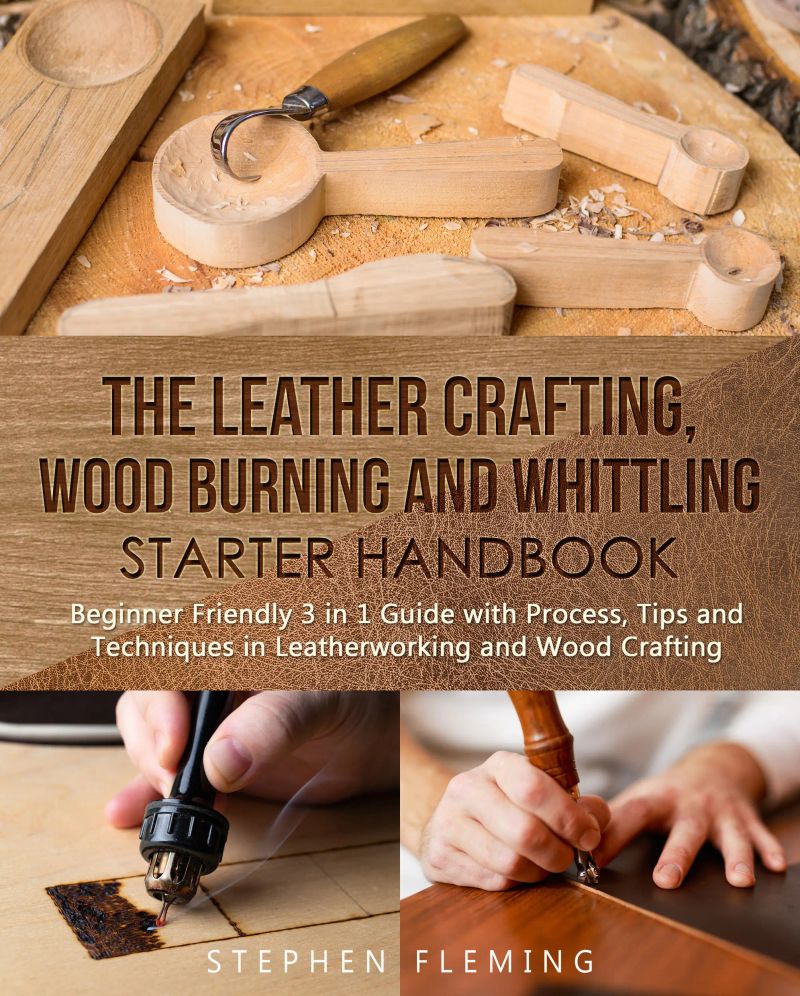
The Leather Crafting, Wood Burning and Whittling Starter Handbook
By Stephen Fleming


Length7h 20m
About this audiobook
Are you looking for hobbies that can be a favorite weekend pastime for young, old, and teens alike?
Well, you can get 3 of them in a single book:
Leather Crafting
Wood Burning
Whittling
We all need few hobbies to unwind, relax, and cut off from the routine chores and excessive technology (Digital Detox).
Also, whether you are young, old, or teen, across all age groups, these activities are required for different reasons.
Like for older lot, it’s about being active and busy, and for a younger lot, it’s about spending some time not thinking about work. For kids, it’s about cultivating a focused work ethic in one activity in the times of million distractions and longer screen times!
This book would present you with minimalistic and value-packed information on these three crafts, which would enable you to start and finish your first project.
About the Author
I am a Technology Consultant by profession and started my leathercraft and woodcraft journey in the year 2014. I started by going through multiple YouTube videos, courses, Facebook groups, and finally completed my first project after four months.
I was confused and was lost in the magnitude of information available online. I firmly believe that while starting, you need exact, necessary, minimalistic information to start your first project, pardon: Complete your first project!
So I started writing this book to provide a minimalistic approach to information required to start your first leather project. It covers:
Leather Crafting
History of Leather
Basics Tools and their usage
Making Patterns
Cutting Patterns
Gluing
Beveling, Embossing, Stamping
Stitching basics
Coloring and Finishing
Tips, Techniques for the beginner
Appendix: List of online resources available for free patterns, tips, and techniques
Wood Burning/Pyrography
Introduction to the art: The history and steps involved
Tools: All about tools required: Detailed instructions on using Wood Burner including different tips
Designing, Tracing, and Shading: I must say the shading part only comes by practicing!
Coloring, Polishing, and Finishing
Safety Instructions: Very important and highlighted all through the book
Step by Step instructions on 10 starter projects with pictures
Frequently Asked Questions (All the ones I could remember and not covered in other chapters)
Sample Designs: Mandala, Tiger, Dragon, and more.
Whittling
Introduction: History of Whittling, how it started and became part of popular culture.
Wood: All about the type of wood, grains, and tips for starting.
Tools: All about pocket and carving knives
Techniques: All type of cuts
Safety: Gloves, Thumb pads, duct tape, and other innovative options.
Starter projects with photos and step by step instructions
Frequently asked questions: 22 beginner questions as answered by experts: Multiple solutions to a single problem
List of online resources for patterns
Well, if you ever wanted to start your Journey in these crafts, this would be the perfect enabler and a guide for you.
Why?
Because I genuinely believe in the saying, “The best person to guide you is the one few steps ahead of you.”
So, what are you waiting for? Get this updated book and start your Journey Today!
Audiobook details
GenreOther, General Fiction
Length7 hrs 20 mins
Narrated byListen with 1,000+ voices
FormateBook with Audio
Publish dateMar 23, 2020
LanguageEnglish
Table of contents
1Beginner’s Roadmap
2TOP 3 BEGINNER PITFALLS: DON'T FALL INTO THEM!
3History of Leather Crafting
4Leather Categories
5Leather Kinds
Show all chaptersShow less
6Hide Dimension as well as Component
7Picking a Veg Tanned Leather/Leather Grading
8Introduction to Basic Tools
9List of basic tools required for a beginner:
10Sample Tools
11Setting Up a Leather Workstation
12A sample workstation illustration
135 Tools for the Beginner Leather Crafter
14A Good Knife
15Job Surfaces
16Rulers
17Burnishers
18How to make leather Patterns
19Patterning in Two Dimensions
20Patterning in Three Dimensions
21Sample Pattern Design for Leather Money Holder
22CUTTING LEATHER
23Cutting Leather with Scissors
24Cutting With X-Acto, Utility, or Craft Knives
25Using a Cutting Wheel
26Cutting straight lines freehand
27GOUGING AND FOLDING NATURAL LEATHER
28Gouging
29Folding
30HOW TO THREAD A NEEDLE FOR STITCHING NATURAL LEATHER
31Saddle Stitch
32COMPLETING SADDLE STITCH THROUGH BACKSTITCHING
33NATURAL LEATHER HARDWARE: RIVETS
34RINGS
35BUCKLES AND HOLDS
36Grommets
37Among the first things you need to do is find out just how to get it sharp and also maintain it sharpness. Keep it polished to make sure that when you're working, it's not dragging in the leather and making it harder to manage.
38Natural leather is tanned with a range of oils and minerals, which can cause an accumulation on the knife and create rubbing when attempting to pull the swivel knife along the leather. By stropping the knife consistently with jeweler's rouge, you are brightening the blade to keep it working efficiently.
39The thing to note is that this is a fingertip-controlled device. When you're holding this device, what we teach to beginners is how to hold it; you hold it with just your fingertips. You position your forefinger right into the yoke with the very first knuckle and your thumb on one side. Your other fingers get on the opposite side. I have my ring finger on the side of the blade here. That's pretty much the grasp.
40I let the side of my hand rest on the table or on the leather so that I obtain excellent equilibrium with it. You make the cuts by sticking just the corner of the blade right into the natural leather and drawing the knife in towards you. It gets its name, swivel knife because the body of the knife turns. That's what helps you in making nice, smooth, curving cuts. When you're making these swivel cuts, you do all of the revolving with your fingers that are along the side of the knife, and then you do all the lowering with the yoke, with the first finger that remains in the yoke.
41I wish someone had told me that early, too. I've practiced a lot over the months, but if I’d had put in a lot of time and effort into practicing just how to use this tool properly, it sure would have made it a lot simpler. It would have made my projects better. It would have saved me a lot of frustration if I had practiced much more regularly on some scrap leather. Earlier leather instructors would have their trainees exercise swivel knife control as much as 30 minutes a day. After some experience, I understand why they began their trainees this way.
42If you’re not experienced enough, then work at it until you can make the knife cut the design it’s supposed to. The technique of holding a swivel knife is more important than the quality of the device itself. You have to invest time practicing.
43Swivel Knife Maintenance
44Now let’s take an example of embossing an elephant picture:
45Dyeing
46Using Antique Finishes
47Ending Up Natural Leather Edges
48What should be my first project/ which factors should I consider for my first project?
49My First Project: Knife Sheath Explained
50Start the stitching by using two-needle saddle stitches. In saddle stitch, a needle is held in both the hands, and it passes each time you make a stitch. This creates a very strong stitch. Before we fold it, we give the welt loop area special attention and apply burnishing gum to the flesh side of the welt loop. Then buff it with a cloth and burnish it again to look cleaner and polished.

Pacific Northwest Foraging Starter HandbookStephen Fleming1h 37m4.3 (799)$5

The Medicinal Mushroom Starter HandbookStephen Fleming1h 47m$5

Manual de ebanistería para principiantesStephen Fleming1h 56m4.6 (11)$5

The Mushroom Cultivation GuideStephen Fleming3h 39m4.5 (30)$5
Manual de carpintería para principiantesStephen Fleming2h 4m$4

Marroquinería, Tallado y Pirograbado para PrincipiantesStephen Fleming7h 58m$7
Manual de tallado para principiantesStephen Fleming1h 58m$6

Manual de pirograbado para principiantesStephen Fleming2h 29m4.2 (10)$6

Woodworking and Whittling for Kids, Teens and ParentsStephen Fleming3h 30m$7

Weekend Woodworking For Kids, Teens and ParentsStephen Fleming1h 34m4.1 (10)$5

Weekend Whittling For Kids And ParentsStephen Fleming1h 17m3.7 (20)$5
Cabinet Making for Beginners HandbookStephen Fleming1h 39m4.2 (69)$5

The Woodworking, Wood Joinery and Woodturning Starter HandbookStephen Fleming4h 59m$8.60
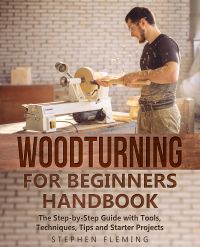
Woodturning for Beginners HandbookStephen Fleming1h 36m3.7 (110)$6
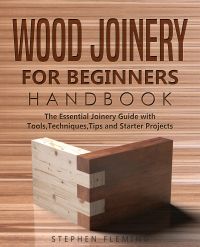
Wood Joinery for Beginners HandbookStephen Fleming1h 33m3.9 (134)$5
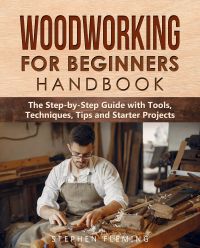
Woodworking for Beginners HandbookStephen Fleming1h 48m4.0 (127)$6
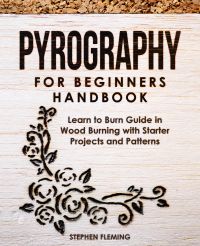
Pyrography for Beginners HandbookStephen Fleming2h 21m4.5 (294)$7
The Leatherworking Starter HandbookStephen Fleming2h 54m4.4 (561)$8

Kubernetes HandbookStephen Fleming1h 16m3.4 (20)$3.60

Mere ChristianityC. S. Lewis7h 7m4.4 (519.7K)$24 · $0.00

Her Daily BreadKate Wood12h 57m4.6 (153)$33 · $0.00

The Holy Bible - 1 SamuelKing James2h 13m4.8 (1.6K)$3 · $0.00

The American Standard Bible — The Gospel of MatthewMatthew3h 56m4.7 (3K)$2 · $0.00

Bad Fat Black GirlSesali Bowen6h 32m4.7 (2.8K)$24 · $0.00

The King James Audio Bible New Testament CompleteChristopher Glyn20h 2m4.7 (2.6K)$12 · $0.00

Faiths CheckbookCharles Spurgeon12h 44m4.7 (3.2K)$11 · $0.00

Ten Things I Wish You Knew About Your Child's Mental HealthDr. Billy Garvey4h 53m4.7 (2.4K)$20 · $0.00

Designing Terry Pratchett’s DiscworldPaul Kidby3h 52m4.7 (343)$20 · $0.00

The Chosen Book OneAmanda Jenkins, Kristen Hendricks, Dallas Jenkins3h 8m4.6 (4.9K)$10 · $0.00

The Lives of BrianBrian Johnson9h 45m4.6 (3.5K)$29 · $0.00

Expository Thoughts on the Gospel of LukeJ.C. Ryle27h 13m4.7 (536)$18 · $0.00
CrossroadsKaleb Dahlgren7h 56m4.6 (4.9K)$26 · $0.00

Across the RiverKent Babb11h 40m4.6 (927)$29 · $0.00

Brain Training for RidersAndrea Monsarrat Waldo5h 56m4.7 (550)$19 · $0.00

My Effin' LifeGeddy Lee17h 11m4.6 (13.1K)$40 · $0.00

Kings and PawnsHoward Bryant10h 9m4.6 (678)$29 · $0.00

The Elementia Chronicles #2: The New OrderSean Fay Wolfe11h 17m4.6 (841)$29 · $0.00

The ActsLuke2h 55m4.6 (19.7K)$12 · $0.00

New Testament - Easy NavigationWorld English Bible19h 35m4.6 (1.3K)$1.30 · $0.00

WhistlerAnn Patchett10h 45m4.6 (4.6K)$29 · $0.00

Demon CopperheadBarbara Kingsolver21h 3m4.5 (949.4K)$46 · $0.00

To Kill a MockingbirdHarper Lee12h 18m4.5 (7.4M)$29 · $0.00

Remarkably Bright CreaturesShelby Van Pelt11h 17m4.4 (1.7M)$29 · $0.00

The Old Man and the Sea (Annotated)Ernest Hemingway4h 27m4.6 (1.4K)$2 · $0.00

White HotIlona Andrews13h 18m4.5 (136.9K)$5 · $0.00

The Ghost by the Billabong (The Matilda Saga, #5)Jackie French14h 58m4.6 (773)$33 · $0.00

Cast in BloodMichelle Sagara16h 35m4.6 (607)$33 · $0.00

The Captain Blood Trilogy (Annotated)Rafael Sabatini29h 20m4.6 (1K)$3 · $0.00

Ship of the Line (Annotated)Cecil Louis Troughton Smith11h 13m4.6 (1K)$2 · $0.00

The George Orwell CollectionGeorge Orwell24h 46m4.5 (14.4K)$12 · $0.00

Time RegainedMarcel Proust15h 38m4.5 (9.2K)$2 · $0.00

Driving ForceElle James4h 58m4.6 (407)$20 · $0.00

When God Calls the HeartBrian Bird, Michelle Cox3h 24m4.6 (439)$10 · $0.00

Five Little IndiansMichelle Good10h 34m4.5 (64.5K)$29 · $0.00

Lolth's WarriorR. A. Salvatore13h 20m4.6 (2.4K)$33 · $0.00

The Things We Cannot SayKelly Rimmer13h 48m4.5 (359.1K)$33 · $0.00

The Love Songs of W.E.B. Du BoisHonoree Fanonne Jeffers29h 49m4.5 (58K)$8 · $0.00

Going PostalTerry Pratchett11h 23m4.5 (189.9K)$29 · $0.00

Glen AffricKarine Giebel22h 51m4.5 (3.2K)$46 · $0.00
You may also like

Woodcraft & CampingGeorge Washington Sears2h 37m4.2 (1.5K)$2 · $0.00

A Lady's Life In The Rocky MountainsIsabella L. Bird7h 30m4.1 (6.2K)Free

The Road of a Thousand WondersSouthern Pacific Company. Passenger Department1h 10m$1 · $0.00

Wild Northern Scenes; Or, Sporting Adventures with the Rifle and the RodS. H. Hammond9h 1m$1 · $0.00

A-Birding on a BroncoFlorence A. Merriam4h 37m3.8 (34)$10 · $0.00

Memoranda on Tours and TouraineJ. H. Holdsworth3h 42m$1 · $0.00

Among the TibetansIsabella L. Bird2h 58m3.7 (347)$1.20 · $0.00

Down the Mackenzie and up the Yukon in 1906Elihu Stewart4h 48m$2 · $0.00

Travels in North America, From Modern WritersWilliam Bingley11h 34m$2 · $0.00

Leaves of KnowledgeElma MacGibbon2h 19m$2 · $0.00

Norman's New Orleans and EnvironsBenjamin Moore Norman5h 14m$2 · $0.00

Round the WorldAndrew Carnegie9h 54m4.3 (36)$1 · $0.00

Travels Into North America, Volume 1 (of 3)Pehr Kalm9h 44m4.0 (23)$2.40

Discourses: Biological & GeologicalThomas Henry Huxley7h 3m4.0 (57)$2 · $0.00

Makers of British Botany; a collection of biographies by living botanistsGeorge Massee, F. W. Oliver, R. Lloyd Praeger, Isaac Bayley Balfour, W. H. Lang, Sydney Howard Vines, Agnes Arber, Francis Darwin, T. G. Hill, J. B. Farmer, F. O. Bower, George Henslow, Frederick Keeble, W. B. Bottomley, Dukinfield H. Scott, William Thiselton-Dyer13h 29m$2 · $0.00

Fishing with the FlyVarious6h 30m4.4 (44)$2 · $0.00

An Expedition to Mount St. Elias, Alaska (Illustrated Edition)Israel C. Russell6h 31m$1 · $0.00

The zoology of the voyage of H.M.S. Beagle: MammaliaG. R. Waterhouse4h 53m$2 · $0.00

Cruise of the Revenue-Steamer Corwin in Alaska and the N.W. Arctic Ocean in 1881: Botanical NotesJohn Muir33m$2 · $0.00

KashmirFrancis Edward Younghusband6h 10m3.5 (28)$2.30