
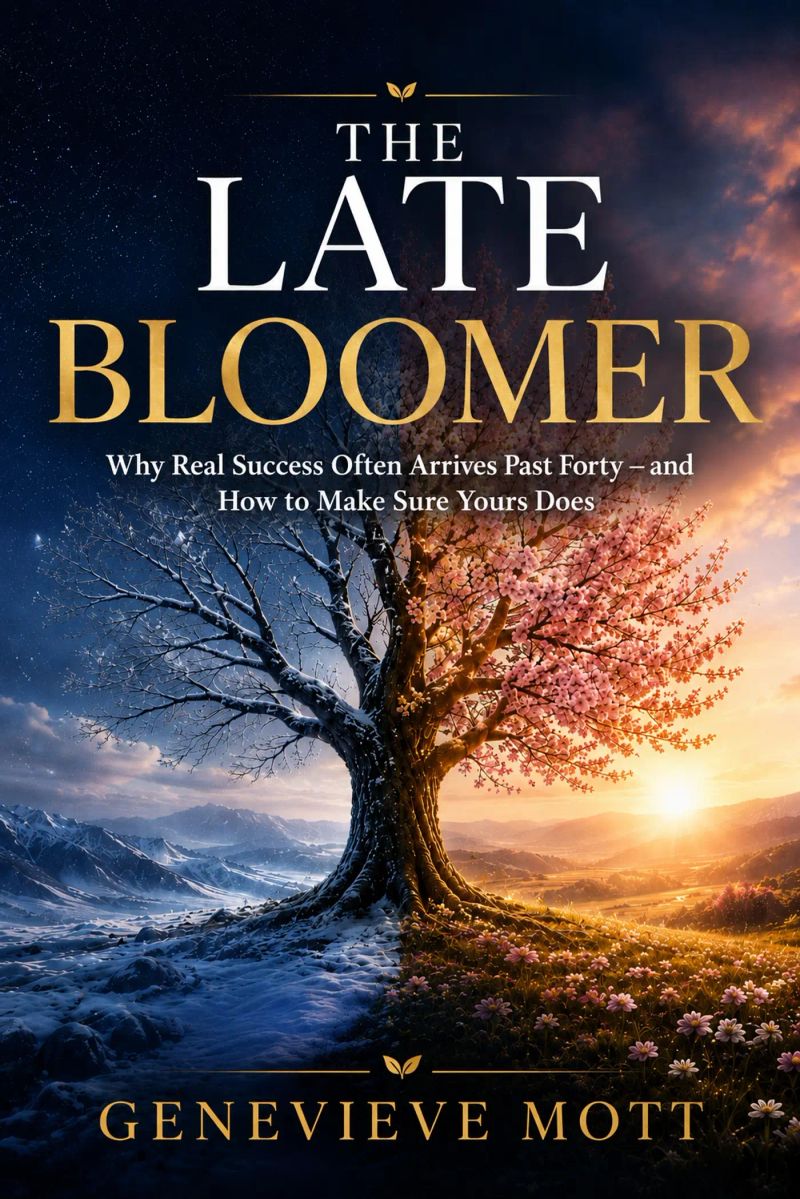
The Late Bloomer
Why Real Success Often Arrives Past Forty — and How to Make It YoursBy Genevieve Mott


Length9h 4m
About this audiobook
Late bloomer success after 40: why real achievement, career reinvention, financial recovery, and second-act fulfillment arrive later -- and how to stop measuring yourself against the wrong timeline.
In the fall of 2019, a woman named Margaret sold her first novel at age fifty-three. When Genevieve Mott asked how it felt, Margaret looked out at the slush on Forbes Avenue and said, "It feels like I finally caught up to myself." That sentence is the engine of this book -- a 22-chapter investigation into why the dominant cultural story about who succeeds, and when, is statistically wrong, and what the people who bloom after forty actually do differently.
Mott, a former paralegal who spent fifteen years as a journalist before writing her first book in her early forties, argues across research, composite portraits, and hard data that late bloomer success is not a consolation category -- it is the typical case. The average age of successful startup founders is around forty-five. Nobel laureates' prize-winning work comes overwhelmingly in their late forties and beyond. Most novels that reach real readership are written by people over forty. The "wunderkind narrative" -- the thirty-under-thirty list, the teenage chess prodigy, the hooded founder -- is a media distortion, not a description of how achievement actually unfolds. This is a book about second-act career change, financial late starts, creative late blooming, love after forty, fitness comebacks at sixty, and the particular kind of patience that compounds into a life.
Inside this late bloomer and midlife reinvention book:
• The two-timeline problem -- why you have felt behind since your thirtieth birthday, and how switching from the cultural timeline to the actual human development timeline dissolves decades of low-grade anxiety
• The compounding principle -- skill, judgment, reputation, and capital all compound slowly; Chapter 3 shows exactly what this looks like across twenty years of unglamorous practice
• Late entrepreneurship data -- Chapter 6 presents the research showing a fifty-year-old is roughly twice as likely as a thirty-year-old to build a high-growth company that lasts
• Financial late start recovery -- Chapter 9 addresses the honest arithmetic of starting serious retirement savings at forty-five, what is genuinely harder, and what the late starter gets right that the early starter rarely does
• Career reinvention and second acts -- Chapters 4, 17, and 20 map the most successful second-act pattern: not the dramatic pivot, but a substantial reorientation that draws on everything already built
• Failure at midlife -- Chapter 16 rejects both the toxic positivity version of failure-as-teacher and the shame spiral, offering instead the specific relationship to setback that late bloomers develop
• The "Try this" experiments -- every chapter ends with a small practical exercise, deliberately sized for an afternoon or a week, because most of what changes a life is too small to feel like it's changing a life while it's happening
This is not a hustle book. It is not a passion-discovery book. Mott is explicit that some doors close, and she does not pretend otherwise. What she argues -- across career late bloomers, creative late bloomers, financial late starters, love after forty, fitness comebacks, and the long late life -- is that the doors most people actually care about are almost always still open, and that walking through them in your forties, fifties, or sixties is not the exception. In aggregate, across real data and real composite lives, it is the…
Audiobook details
GenreSelf-Help
Length9 hrs 4 mins
Narrated byListen with 1,000+ voices
FormateBook with Audio
LanguageEnglish
Table of contents
1Introduction: The Long Way Around
2Chapter 1: The Lateness Problem That Isn’t
3Chapter 2: Why the Wunderkind Narrative Was Always Wrong
4Chapter 3: What Compounds Slowly
5Chapter 4: The Career Late Bloomer
Show all chaptersShow less
6Chapter 5: The Creative Late Bloomer
7Chapter 6: The Entrepreneur Who Started at Forty-Five
8Chapter 7: The Parent Who Became a Parent Late
9Chapter 8: The Academic Who Finished the PhD at Fifty-Two
10Chapter 9: The Financial Late Bloomer
11Chapter 10: Love After Forty
12Chapter 11: Fitness as a Late Bloomer
13Chapter 12: The Body That Has to Come Back
14Chapter 13: The Friendships That Compound
15Chapter 14: Mentors Who Appear Late
16Chapter 15: The Rest You Should Have Taken (and Didn’t)
17Chapter 16: Failure at Midlife
18Chapter 17: Quitting Late (and What Comes Next)
19Chapter 18: Generosity as the Late Bloomer’s Superpower
20Chapter 19: Staying Ambitious Without Ego
21Chapter 20: The Second Act
22Chapter 21: The Third Act
23Chapter 22: Preparing for the Long Late Life
24Conclusion: Catching Up to Yourself
25Appendix A: A Practical Reading List for the Long Late Life
26Appendix B: A Short Glossary of Terms Used in This Book
27Appendix C: Brief Notes on Methodology
28Appendix D: Ten Conversations, Lightly Reconstructed
29Appendix E: A Field Guide to the Lateness Anxieties
30Appendix F: A Year of Practice
31Appendix G: Eight Letters I Did Not Send
32Appendix H: A Brief List of Things I Have Come to Believe
33Appendix I: Questions People Have Asked Me
34Appendix J: A Postscript on Writing This Book
35Appendix K: A Walk Through Twelve Misconceptions
36Appendix L: The Long Conversation, Continued
37Appendix M: A Closing Miscellany
38About the Author
More from Genevieve Mott
Learning to PrayJames Martin13h 24m4.5 (3.4K)$33 · $0.00
Truth Without ApologyAcharya Prashant6h 41m4.8 (2.2K)$18 · $0.00

Autism Out Loud: the instant New York Times Bestseller. Moving Stories and Parenting Lessons Learned from Three Mothers of Children with AutismKate Swenson, Carrie Cariello, Adrian Wood8h 41m4.8 (2.1K)$26 · $0.00
The StepsSylvester Stallone9h 4m4.8 (635)$29 · $0.00

Swayam Ki AwaazPrem Rawat8h 34m4.7 (1.1K)$26 · $0.00
Forever BoyKate Swenson9h 27m4.7 (5K)$29 · $0.00

You Are Worth ItKyle Carpenter, Don Yaeger8h 53m4.7 (4.8K)$29 · $0.00

The Happiest Man on EarthEddie Jaku3h 48m4.6 (178K)$7 · $0.00
Finding MeViola Davis9h 15m4.6 (256.4K)$29 · $0.00

Spiritual AnatomyDaaji Kamlesh D. Patel9h 47m4.7 (319)$29 · $0.00

The Dangerous Truth about Today’s MarijuanaLaura Stack CSP, MBA9h 57m4.7 (385)$20 · $0.00
The Gospel according to Spiritualism (Translated)Allan Kardec14h 39m4.6 (3.9K)$5.70 · $0.00

Birdie & HarlowTaylor Wolfe7h 50m4.6 (6.5K)$26 · $0.00

CrossroadsKaleb Dahlgren7h 56m4.6 (4.9K)$26 · $0.00

Life on the BridgeKaelynn Partlow5h 40m4.6 (1.1K)$24 · $0.00

Keep Your Love OnDanny Silk9h 4m4.6 (8.1K)$10 · $0.00

The Tao of Joy Every DayDerek Lin10h 24m4.6 (762)$20 · $0.00
UndividedVicky Beeching9h 2m4.6 (1.3K)$29 · $0.00

HE CAN WHO THINKS HE CAN & OTHER BOOKS ON SUCCESSOrison Swett Marden5h 54m4.6 (1.2K)$1.99 · $0.00
Level UpRob Dial7h 42m4.6 (3.3K)$26 · $0.00
You may also like
The Story of YouSteve Chandler5h 15m4.2 (793)$20 · $0.00
How to Live on 24 Hours a DayArnold Bennett1h 22m3.8 (16.6K)$1.20 · $0.00
Intuitive Eating, 4th Edition, Revised and UpdatedEvelyn Tribole MS, RDN, CEDRD-S, Elyse Resch MS, RDN, CEDRD-S, FAND13h 42m4.4 (18.6K)$23
How to Live on 24 Hours a Day (A Classic Guide to Self-Improvement) (Annotated)Arnold Bennett2h 16m3.8 (16.6K)$2 · $0.00

Sex Plus: Learning, Loving, and Enjoying Your BodyLaci Green13h 6m4.1 (277)$33 · $0.00
The Goals ProgramZig Ziglar4h 34m4.6 (2.3K)$20
Where the Light Gets InBen Crowe10h 21m4.5 (480)$29 · $0.00
ConfidenceRoxie Nafousi6h 13m4.0 (921)$24 · $0.00
Do OverJon Acuff6h 46m4.2 (6.9K)$20 · $0.00
This Is About Running. This Is Not About Running.Chris Bennett6h 54m4.5 (429)$24 · $0.00
Abundance NowLisa Nichols, Janet Switzer12h 28m4.3 (2.8K)$29 · $0.00

Weird in a World That's NotJennifer Romolini8h 11m4.0 (1.6K)$26 · $0.00
Attitude Is EverythingJeff Keller3h 43m4.2 (37.6K)$18 · $0.00
The Case for QuittingLindsay Crouse7h 14m$24 · $0.00

The Badass LifeChristmas Abbott5h 55m4.0 (537)$24 · $0.00

The Work Stress CycleAntonio Montes Orozco1h 58m$6 · $0.00
How to Master 30-Day ChallengesSteve Pavlina1h 19m$6 · $0.00

The View from the HillAllison Tyra16h 7m$30
The 60-Something CrisisBarbara L. Pagano9h 3m3.9 (201)$20

Rock and a Heart PlaceKen Mansfield, Marshall Terrill13h 58m4.1 (52)$10 · $0.00