
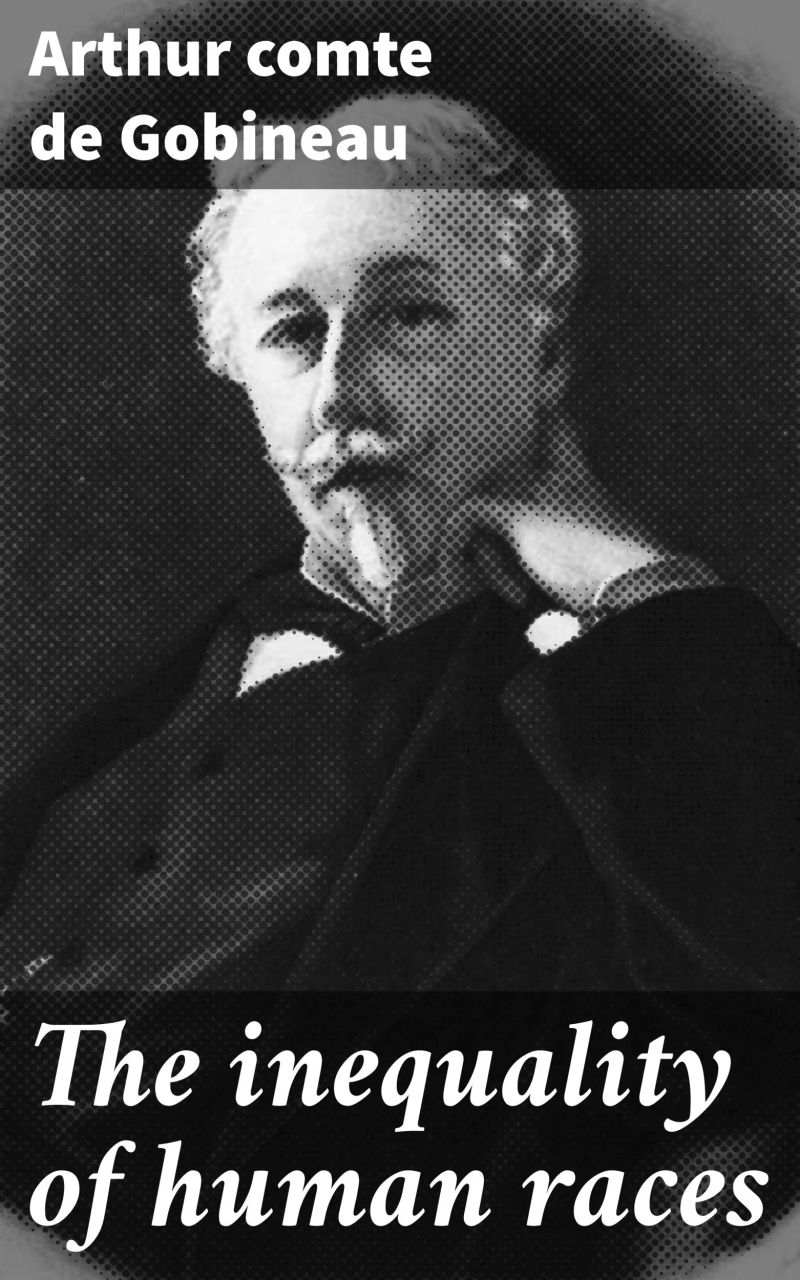
The inequality of human races
Exploring Racial Hierarchies and Cultural Criticism in the 19th CenturyBy Arthur comte de Gobineau


Length9h
About this audiobook
In "The Inequality of Human Races," Arthur comte de Gobineau presents a controversial examination of racial hierarchies that posits a deterministic view on human societies. Composed in the mid-19th century, the text weaves together a combination of historical analysis, ethnography, and philosophical discourse, reflecting the emerging ideas of racial theories prevalent during that period. Gobineau's literary style is characterized by an eloquent, yet polemic tone, arguing that the supposed innate inequalities among races are foundational to the evolution of civilizations, thereby laying the groundwork for later racialist ideologies. Arthur comte de Gobineau, a French aristocrat, diplomat, and writer, was profoundly influenced by the socio-political turmoil of his time, including the upheavals of the French Revolution and rising nationalism. His extensive travels and keen observations on varying cultures enriched his perspective, leading him to articulate a vision of racial superiority that would resonate controversially for decades to come. Gobineau'Äôs erudition and social critique expose the underlying tensions of his era, exposing the dangers of pseudoscientific racial constructs. This book is essential for readers interested in the histories of race, sociology, and anthropology, as it not only provides insight into the ideological foundations of racial thought but also serves as a cautionary tale against reductionist views of human diversity. Scholars and students alike will benefit from engaging with Gobineau's work to understand the complexities and ramifications of racial theories that have shaped modern discourse.
Audiobook details
Rating★★★ 3.4 (205)
Includes Goodreads
GenrePsychology
Length9 hrs
Narrated byListen with 1,000+ voices
FormateBook with Audio
Publish dateJul 10, 2023
LanguageEnglish
Table of contents
1INTRODUCTION TO GOBINEAU’S “INEQUALITY OF HUMAN RACES”
2FROM THE AUTHOR’S DEDICATION (1854)[2] TO HIS MAJESTY GEORGE V, KING OF HANOVER
3CHAPTER I THE MORTAL DISEASE OF CIVILIZATIONS AND SOCIETIES PROCEEDS FROM GENERAL CAUSES COMMON TO THEM ALL
4CHAPTER II FANATICISM, LUXURY, CORRUPTION OF MORALS, AND IRRELIGION DO NOT NECESSARILY LEAD TO THE FALL OF SOCIETIES
5CHAPTER III THE RELATIVE MERIT OF GOVERNMENTS HAS NO INFLUENCE ON THE LENGTH OF A NATION’S LIFE
Show all chaptersShow less
6CHAPTER IV THE MEANING OF THE WORD “DEGENERATION”; THE MIXTURE OF RACIAL ELEMENTS; HOW SOCIETIES ARE FORMED AND BROKEN UP
7CHAPTER V RACIAL INEQUALITY IS NOT THE RESULT OF INSTITUTIONS
8CHAPTER VI NATIONS, WHETHER PROGRESSING OR STAGNATING, ARE INDEPENDENT OF THE REGIONS IN WHICH THEY LIVE
9CHAPTER VII CHRISTIANITY NEITHER CREATES NOR CHANGES THE CAPACITY FOR CIVILIZATION
10CHAPTER VIII DEFINITION OF THE WORD “CIVILIZATION”; SOCIAL DEVELOPMENT HAS A TWOFOLD ORIGIN
11CHAPTER IX DEFINITION OF THE WORD “CIVILIZATION” (continued); DIFFERENT CHARACTERISTICS OF CIVILIZED SOCIETIES; OUR CIVILIZATION IS NOT SUPERIOR TO THOSE WHICH HAVE GONE BEFORE
12CHAPTER X SOME ANTHROPOLOGISTS REGARD MAN AS HAVING A MULTIPLE ORIGIN[47]
13CHAPTER XI RACIAL DIFFERENCES ARE PERMANENT
14CHAPTER XII HOW THE RACES WERE PHYSIOLOGICALLY SEPARATED, AND THE DIFFERENT VARIETIES FORMED BY THEIR INTER-MIXTURE. THEY ARE UNEQUAL IN STRENGTH AND BEAUTY
15CHAPTER XIII THE HUMAN RACES ARE INTELLECTUALLY UNEQUAL; MANKIND IS NOT CAPABLE OF INFINITE PROGRESS
16CHAPTER XIV PROOF OF THE INTELLECTUAL INEQUALITY OF RACES (continued). DIFFERENT CIVILIZATIONS ARE MUTUALLY REPULSIVE. HYBRID RACES HAVE EQUALLY HYBRID CIVILIZATIONS
17CHAPTER XV THE DIFFERENT LANGUAGES ARE UNEQUAL, AND CORRESPOND PERFECTLY IN RELATIVE MERIT TO THE RACES THAT USE THEM
18CHAPTER XVI RECAPITULATION; THE RESPECTIVE CHARACTERISTICS OF THE THREE GREAT RACES; THE SUPERIORITY OF THE WHITE TYPE, AND, WITHIN THIS TYPE, OF THE ARYAN FAMILY

What to Make of a LifeJim Collins13h 31m4.4 (794)$33 · $0.00

Invisible StormJason Kander6h 48m4.7 (3.2K)$24 · $0.00

I Am The StormJanice Dean9h4.6 (1.5K)$8 · $0.00

On Democracies and Death CultsDouglas Murray10h 38m4.6 (6.5K)$29 · $0.00

TerraformPropaganda5h 39m4.7 (594)$24 · $0.00

Southern Horrors: Lynch Law in All Its Phases (Annotated)Ida B. Wells-Barnett2h 44m4.6 (1.3K)$2 · $0.00

Hour of the HeartIrvin D. Yalom, Benjamin Yalom8h 19m4.6 (2.3K)$26 · $0.00

Braving the TruthRachel Held Evans11h 31m4.7 (359)$29 · $0.00
Level UpRob Dial7h 42m4.6 (3.3K)$26 · $0.00

As a JewSarah Hurwitz8h 36m4.6 (1.2K)$26 · $0.00

Saint Joan (Annotated)George Bernard Shaw6h 20m4.6 (1.2K)$1.20 · $0.00

Burn the HaystackJennie Young, PhD9h 30m4.6 (543)$29 · $0.00

Woman and the New Race (Annotated)Margaret Sanger6h 30m4.6 (1K)$0.99 · $0.00

Good InsideBecky Kennedy9h 55m4.5 (59.3K)$29 · $0.00

The Mis-Education of the NegroCarter Godwin Woodson5h 4m4.5 (29.4K)$1.20 · $0.00

Du Bois: EssaysW.E.B. Du Bois6h 22m4.6 (1.5K)$1 · $0.00

The North American Indian (Illustrated Edition)Edward S. Curtis, Frederick Webb Hodge5h 59m4.6 (1.4K)$2 · $0.00

Valley of the BirdtailAndrew Stobo Sniderman, Douglas Sanderson10h 1m4.6 (2.4K)$29 · $0.00

Lies My Therapist Told MeGreg E. Gifford9h 3m4.6 (503)$29 · $0.00

Disturbed in Their NestsAlephonsion Deng, Judy A. Bernstein11h 22m4.6 (595)$23 · $0.00
You may also like
The Theory of the Leisure ClassThorstein Veblen10h 42m4.0 (14.5K)$10 · $0.00

Capital and IdeologyThomas Piketty48h 57m4.4 (7.2K)$40

LEVIATHAN (Complete Edition)Thomas Hobbes23h 49m3.9 (69.8K)$1.99 · $0.00

LeviathanThomas Hobbes23h3.9 (68.7K)$2.30

The Social Contract & DiscoursesJean-Jaques Rousseau13h 19m4.1 (5.8K)$2.30

Federalist vs. Anti-Federalist: ALL Essays and Articles in One EditionAlexander Hamilton, James Madison, John Jay, Samuel Bryan, Patrick Henry20h 50m4.5 (266)$1.99 · $0.00

NehruAdeel Hussain, Tripurdaman Singh9h 54m4.1 (336)$29 · $0.00

The Politically Incorrect Guide to CatholicismJohn Zmirak13h 8m4.1 (333)$23

See No EvilJoel B. Pollak9h 14m4.1 (616)$20

On The Duty of Civil DisobedienceDavid Thoreau1h 6m4.0 (115K)$1 · $0.00

The True BelieverEric Hoffer5h 17m4.3 (18.7K)$24 · $0.00

Shooting an Elephant and other essaysEric Arthur Blair13h 12m4.2 (16.5K)$2 · $0.00

The War on the WestDouglas Murray12h 42m4.3 (15.4K)$33 · $0.00
On the Duty of Civil DisobedienceHenry David Thoreau52m4.1 (27.5K)$5

The Complete Works of Plato (Annotated)Plato141h 48m4.5 (3.1K)$2 · $0.00

The Relations of the Advanced and the Backward Races of MankindJames Bryce2h 3m$2 · $0.00

The Truth about Church ExtensionAnonymous1h 21m$2 · $0.00

The Conquest of the American Continent (Annotated)Madison Grant11h 4m$2 · $0.00

Cotton is King, and Pro-Slavery ArgumentsVarious32h 50m3.3 (10)$1 · $0.00

1620Peter W. Wood7h 32m3.9 (960)$17 · $0.00