
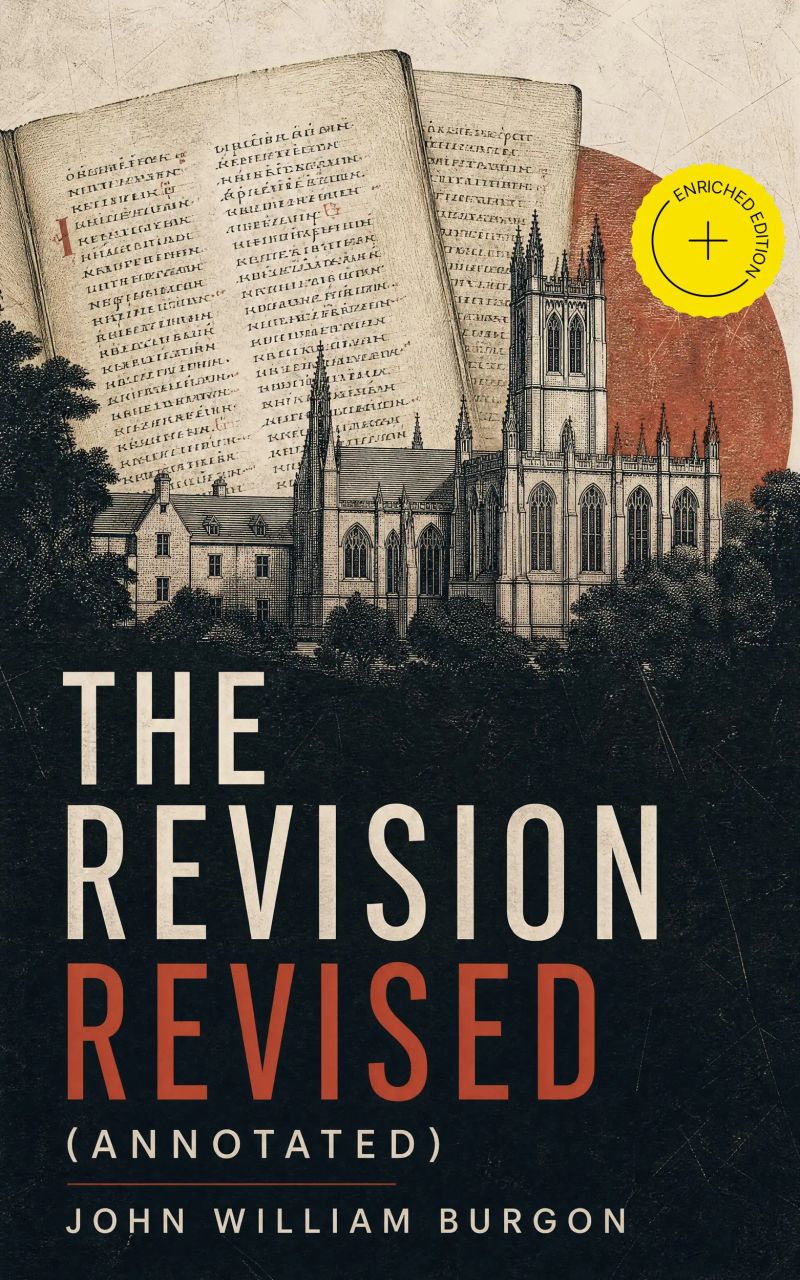
The Revision Revised (Annotated)
Enriched Edition. A Victorian Critique of New Testament Revision, Greek Manuscripts, and Bible TranslationBy John William Burgon


Length18h 26m
About this audiobook
The Revision Revised is John William Burgon's vigorous and learned assault on the English Revised Version of the New Testament and on the Greek textual principles that undergirded it. Written in a polemical, densely annotated, and forensic style, the work combines theological argument, close philological scrutiny, and manuscript evidence. Situated within the late-nineteenth-century controversy over biblical revision, it challenges the authority accorded to Codex Vaticanus and Codex Sinaiticus and defends the ecclesiastically received text as preserved in the Church's continuous usage. Burgon, an Anglican clergyman, biblical scholar, and later Dean of Chichester, wrote from within a tradition that valued both patristic testimony and the devotional authority of the Authorized Version. His years at Oxford, his antiquarian habits, and his deep attachment to the liturgical and doctrinal life of the Church shaped his suspicion of what he regarded as speculative textual innovation. The book reflects not mere conservatism, but a learned conviction about providence, transmission, and ecclesial witness. This volume is recommended to readers interested in the history of New Testament textual criticism, Victorian theology, and debates over Bible translation. Even where modern scholarship may dissent, Burgon's erudition, rhetorical force, and historical importance make the book indispensable for understanding the controversy surrounding the Revised Version.
This enriched edition has been carefully crafted to add value to your reading experience.
- A succinct Introduction situates the work's timeless appeal and themes.
- The Synopsis outlines the central plot, highlighting key developments without spoiling critical twists.
- A detailed Historical Context immerses you in the era's events and influences that shaped the writing.
- A thorough Analysis dissects symbols, motifs, and character arcs to unearth underlying meanings.
- Reflection questions prompt you to engage personally with the work's messages, connecting them to modern life.
- Hand‐picked Memorable Quotes shine a spotlight on moments of literary brilliance.
- Interactive footnotes clarify unusual references, historical allusions, and archaic phrases for an effortless, more informed read.
Audiobook details
Rating★★★★ 4.4 (150)
Includes Amazon, Goodreads
GenreSpirituality and Religion
Length18 hrs 26 mins
Narrated byListen with 1,000+ voices
FormateBook with Audio
Publish dateDec 12, 2023
LanguageEnglish
Table of contents
1Introduction
2Introduction
3Synopsis
4Historical Context
5Preface.
Show all chaptersShow less
6Article I. The New Greek Text. (pt. 1)
7Article I. The New Greek Text. (pt. 2)
8Article II. The New English Version. (pt. 1)
9Article II. The New English Version. (pt. 2)
10Article III. Westcott And Hort's New. Textual Theory. (pt. 1)
11Article III. Westcott And Hort's New. Textual Theory. (pt. 2)
12Letter To Bishop Ellicott, In Reply To His Pamphlet.
13[1] Preliminary Statement.
14[2] The Bishop's pamphlet was anticipated and effectually disposed. of, three weeks before it appeared, by the Reviewer's. Third Article.
15[3] Bp. Ellicott remonstrated with for his unfair method of. procedure.
16[4] (Which be “ the recognized principles of Textual Criticism ” ?—a. question asked in passing.)
17[5] Bp. Ellicott's and the Reviewer's respective methods, contrasted.
18[6] Bp. Ellicott in May 1870, and in May 1882.
19[7] “ The fabric of modern Textual Criticism ” (1831-81). rests on an insecure basis.
20[8] Bp. Ellicott's strange notions about the “ Textus Receptus. ”
21[9] The Reviewer vindicates himself against Bp. Ellicott's misconceptions.
22[10] Analysis of contents of Bp. Ellicott's pamphlet.
23[11] Bp. Ellicott's account of the “ Textus Receptus . ”
24[12] Bp. Ellicott derives his estimate of the “ Textus Receptus ” from Westcott and Hart's fable of a “ Syrian Text . ”
25[13] Bp. Ellicott has completely adopted Westcott and Hort's. Theory.
26[14] The Question modestly proposed,—Whether Bp. Ellicott's. adoption of Westcott and Hort's “ new Textual Theory ” does. not amount to (what lawyers call) “ Conspiracy ” ?
27[15] Proofs that the Revisers have outrageously exceeded the. Instructions they received from the Convocation of the Southern. Province.
28[16] The calamity of the “ New Greek Text ” traced to its source.
29[17] Bp. Ellicott's defence of the “ New Greek Text, ” in sixteen. particulars, examined.
30[18] Bp. Ellicott's claim that the Revisers were guided by “ the. consentient testimony of the most ancient Authorities, ” —disproved. by an appeal to their handling of S. Luke ii. 14 and. of S. Mark xvi. 9-20. The self-same claim,—(namely, of. abiding by the verdict of Catholic Antiquity,) —vindicated,. on the contrary, for the “ Quarterly Reviewer. ”
31[19] “ GOD was manifested in the flesh ” Shown To Be The True Reading Of 1 Timothy III. 16. (pt. 1)
32[19] “ GOD was manifested in the flesh ” Shown To Be The True Reading Of 1 Timothy III. 16. (pt. 2)
33Appendix Of Sacred Codices.
34Index I, of Texts of Scripture,—quoted, discussed, or only referred to in. this volume.
35Footnotes
36Analysis
37Reflection
38Memorable Quotes
More from John William Burgon


Prayers from the Throne RoomBrian Simmons8h 55m4.9 (256)$10 · $0.00
31 Decrees of Blessing for Your LifePatricia King2h 38m4.8 (1.4K)$10 · $0.00

Loved BabySarah Philpott4h 51m4.8 (1.4K)$10 · $0.00

The QuranAllah23h 7m4.7 (136.1K)$1 · $0.00

The Secret of the RosaryLouis de Montfort6h 1m4.7 (16K)$2 · $0.00
The Holy Qur-an: Text, Translation and CommentaryAbdullah Yusuf Ali22h 16m4.7 (133K)$1 · $0.00
All of Grace (Annotated)Charles Spurgeon5h 1m4.7 (1.3K)$1.99 · $0.00

Steps to ChristEllen G. White3h 12m4.7 (13.8K)$2 · $0.00

The Doctrine and Covenants of the Church of Jesus Christ of Latter Day Saints (Annotated)Joseph Smith13h 57m4.7 (575)$2 · $0.00
Sinners in the Hands of an Angry God & Other Sermons (Annotated)Jonathan Edwards7h 51m4.7 (1.5K)$2 · $0.00
Swayam Ki AwaazPrem Rawat8h 34m4.7 (1.1K)$26 · $0.00

Behind the BadgeAdam Davis10h 18m4.7 (2.7K)$10 · $0.00
The New Human Revolution, vol. 1Daisaku Ikeda7h 46m4.7 (669)$12 · $0.00

You Are Worth ItKyle Carpenter, Don Yaeger8h 53m4.7 (4.8K)$29 · $0.00
Praying GraceDavid A. Holland3h 2m4.7 (658)$10 · $0.00

Evidence Not SeenDarlene Deibler Rose11h 11m4.6 (11.9K)$29 · $0.00

The Christ KeyChad Bird, Chad Bird7h 33m4.7 (592)$17.40 · $0.00
He and IGabrielle Bossis10h 12m4.7 (554)$17 · $0.00

Your Body Already KnowsNidhi Pandya Bhanshali9h 7m4.7 (360)$16 · $0.00

The Complete WorksFlorence Scovel Shinn7h 59m4.6 (6.6K)$2 · $0.00
You may also like

The Seven Lamps of ArchitectureJohn Ruskin8h 15m3.8 (1.7K)$2.30

NehruAdeel Hussain, Tripurdaman Singh9h 54m4.1 (336)$29 · $0.00

See No EvilJoel B. Pollak9h 14m4.1 (616)$20
The Politically Incorrect Guide to CatholicismJohn Zmirak13h 8m4.1 (333)$23

Pinheads and PatriotsBill O'Reilly5h 37m3.7 (5.2K)$24 · $0.00

Capital and IdeologyThomas Piketty48h 57m4.4 (7.2K)$40

Europe and the Faith "Sine auctoritate nulla vita" (Annotated)Hilaire Belloc6h 4m4.3 (478)$2 · $0.00
The Principles of Masonic LawAlbert Gallatin Mackey8h 50m4.1 (258)$1 · $0.00
Gita Press and the Making of Hindu IndiaAkshaya Mukul20h 7m4.2 (1.6K)$21

The Conquest of the American Continent (Annotated)Madison Grant11h 4m$2 · $0.00

JFK, ConservativeIra Stoll10h 12m4.0 (291)$20 · $0.00
SplinteredJonathan Butcher6h 53m$17
The inequality of human racesArthur comte de Gobineau9h 1m3.4 (205)$2 · $0.00
The Relations of the Advanced and the Backward Races of MankindJames Bryce2h 3m$2 · $0.00
The Origins of WokeRichard Hanania10h 16m3.9 (453)$8 · $0.00

The Conquest of the American Continent (Summarized Edition)Madison Grant4h$2

1620Peter W. Wood7h 32m3.9 (960)$17 · $0.00

AP Comparative Government and Politics Exam Study GuideMarie Peterson9h 19m$10

The Conquest of the American ContinentMadison Grant10h 53m3.9 (64)$2.99 · $0.00
The Truth about Church ExtensionAnonymous1h 21m$2 · $0.00