
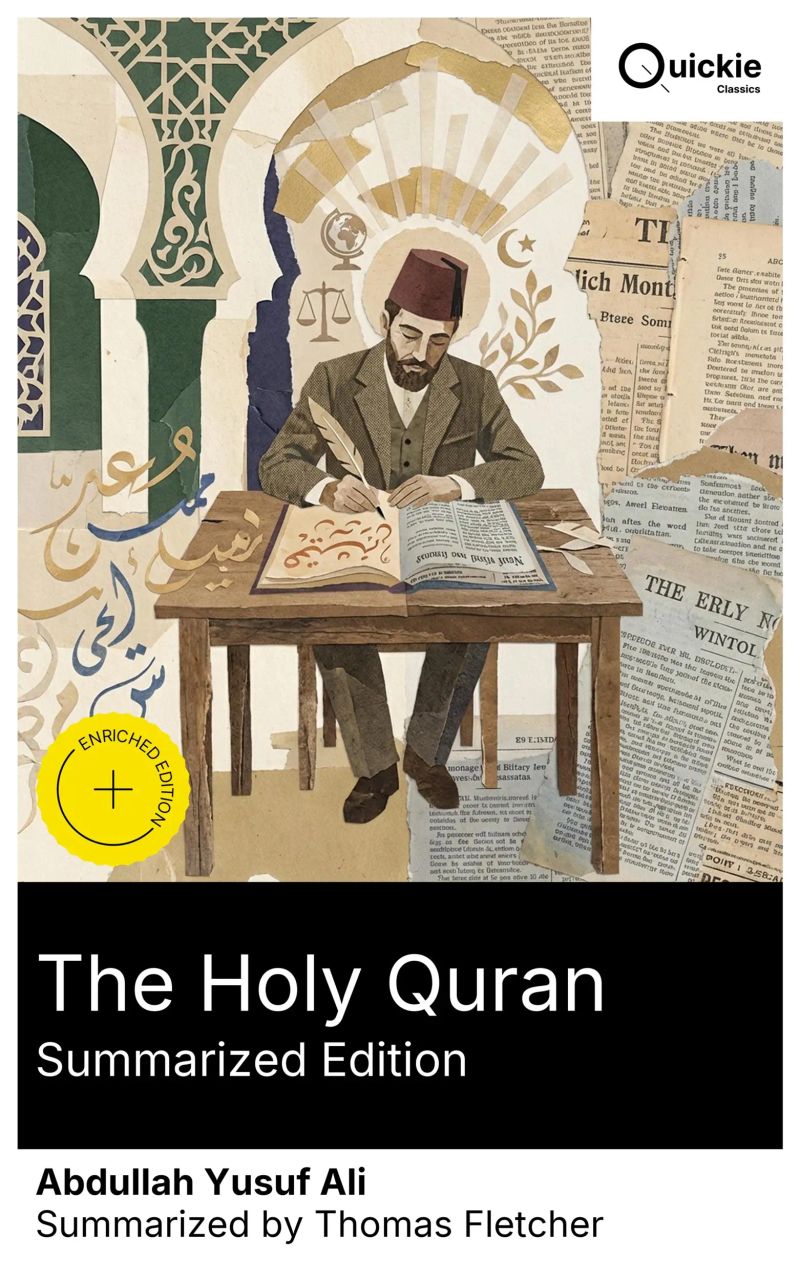
The Holy Quran (Summarized Edition)
Enriched edition. Quranic translation and exegesis with Arabic literary nuance, spiritual-historical context, and themes of faith, unity, and cultural understandingBy Abdullah Yusuf Ali


Length5h 10m
About this audiobook
Abdullah Yusuf Ali's The Holy Quran is both an English translation and an ambitious exegetical project. Rendering the Arabic into elevated, quasi-biblical English, Ali pairs verses with numbered notes on legal, historical, and linguistic nuance, plus surah introductions and cross-references. Written amid early twentieth‑century debates on modernity, it converses with classical tafsir—Tabari, Razi, Baydawi—while engaging Western scholarship and the Bible, preserving cadence yet supplying a compact compendium of commentary. An Indian Muslim scholar and civil servant educated at Aligarh and Cambridge, Ali moved between administration and pedagogy in Lahore and London. Training in classics and law, exposure to comparative religion, and concern for an English-speaking readership shaped his method: philological care, moral universalism tinged with Sufi sensibility, and a bid to reconcile traditional exegesis with the ethical and scientific idioms of his age. Indispensable for students of religion and literature, interfaith practitioners, and general readers, this work rewards guided reading. Treat its notes as both resource and historical artifact; used critically and appreciatively, Ali's translation and commentary illuminate text, texture, and the living hermeneutic tradition.
Quickie Classics summarizes timeless works with precision, preserving the author's voice and keeping the prose clear, fast, and readable—distilled, never diluted. Enriched Edition extras: Introduction · Synopsis · Historical Context · Author Biography · Brief Analysis · 4 Reflection Q&As · Editorial Footnotes.
Audiobook details
GenreSpirituality and Religion
Length5 hrs 10 mins
Narrated byListen with 1,000+ voices
FormateBook with Audio
Publish dateJan 10, 2026
LanguageEnglish
Table of contents
1Introduction
2Introduction
3Synopsis
4Historical Context
5Author Biography
Show all chaptersShow less
6The Holy Qur-an: Text, Translation and Commentary (pt. 1)
7The Holy Qur-an: Text, Translation and Commentary (pt. 2)
8Analysis
9Reflection
More from Abdullah Yusuf Ali
The Qur'an (Annotated)Abdullah Yusuf Ali22h 1m$2 · $0.00
The Holy Quran (Annotated)Abdullah Yusuf Ali22h 47m4.6 (81.4K)$2 · $0.00
The Holy Qur-an: Text, Translation and CommentaryAbdullah Yusuf Ali22h 16m4.7 (133K)$1 · $0.00
The Quran (Annotated)Abdullah Yusuf Ali21h 54m4.5 (81.6K)$1.99 · $0.00
The Holy Qur-an: Text, Translation and Commentary (Annotated)Abdullah Yusuf Ali22h 48m4.5 (76.7K)$1.49 · $0.00
31 Decrees of Blessing for Your LifePatricia King2h 38m4.8 (1.4K)$10 · $0.00
Loved BabySarah Philpott4h 51m4.8 (1.4K)$10 · $0.00
The QuranAllah23h 7m4.7 (136.1K)$1 · $0.00
The Secret of the RosaryLouis de Montfort6h 1m4.7 (16K)$2 · $0.00
The Holy Qur-an: Text, Translation and CommentaryAbdullah Yusuf Ali22h 16m4.7 (133K)$1 · $0.00
All of Grace (Annotated)Charles Spurgeon5h 1m4.7 (1.3K)$0.99 · $0.00
Steps to ChristEllen G. White3h 12m4.7 (13.8K)$2 · $0.00
The Doctrine and Selected CovenantsJoseph Smith13h 53m4.7 (10.4K)$1.99 · $0.00
Sinners in the Hands of an Angry God & Other Sermons (Annotated)Jonathan Edwards7h 51m4.7 (1.5K)$2 · $0.00
Swayam Ki AwaazPrem Rawat8h 34m4.7 (1.1K)$26 · $0.00

Behind the BadgeAdam Davis10h 18m4.7 (2.7K)$10 · $0.00
The New Human Revolution, vol. 1Daisaku Ikeda7h 46m4.7 (669)$12 · $0.00

You Are Worth ItKyle Carpenter, Don Yaeger8h 53m4.7 (4.8K)$29 · $0.00
Praying GraceDavid A. Holland3h 2m4.7 (658)$10 · $0.00
Evidence Not SeenDarlene Deibler Rose11h 11m4.6 (11.9K)$29 · $0.00
The Christ KeyChad Bird, Chad Bird7h 33m4.7 (592)$17.40 · $0.00
He and IGabrielle Bossis10h 12m4.7 (554)$17 · $0.00
Your Body Already KnowsNidhi Pandya Bhanshali9h 7m4.7 (360)$16 · $0.00

The Complete WorksFlorence Scovel Shinn7h 59m4.6 (6.6K)$2 · $0.00
Driven by EternityJohn Bevere3h 50m4.6 (3.2K)$10 · $0.00
You may also like
The Quran (Annotated)Abdullah Yusuf Ali21h 54m4.5 (81.6K)$1.99 · $0.00
Strong and CourageousBroadStreet Publishing Group LLC9h 20m4.7 (269)$10 · $0.00
The Sonship of ChristTy Gibson4h 29m4.7 (287)$24

Pray the RosaryJ. M. Lelen24m4.5 (4.5K)$1 · $0.00
Gospel Doctrine: Selections from the Sermons and Writings of Joseph F. SmithJoseph F. Smith21h 40m4.6 (524)$1 · $0.00
The Doctrine and Selected CovenantsJoseph Smith13h 53m4.7 (10.4K)$1.99 · $0.00
The Palace of IllusionsChitra Banerjee Divakaruni12h 21m4.2 (104.4K)$23
The Freedom of the Will (Vol. 1-4)Jonathan Edwards13h 53m4.3 (2.2K)$2 · $0.00
The Antiquities of the JewsFlavius Josephus58h 14m4.2 (708)$1 · $0.00
The King James BibleVarious Authors82h 12m4.5 (452.5K)$2 · $0.00
Antiquities of the JewsFlavius Josephus54h 46m4.3 (3.3K)Free
The Bible and Polygamy: Does the Bible Sanction Polygamy?George Q. Cannon, Orson Pratt, John Philip Newman, George Albert Smith5h 10m4.5 (11)$1 · $0.00
The Religion of the KoranArthur N. Wollaston1h 25m$3.50 · $0.00
Pyar Ki Moti Pearls Of loveBrahma Khumaris1h 9m$4 · $0.00
Patriarchal Blessings by Joseph Smith Sr., Dated 1834-1840Sr. Joseph Smith14h 49m$1 · $0.00
The Articles of Faith (Annotated)James E. Talmage20h 9m4.7 (39)$2 · $0.00

Address to the First Graduating Class of Rutgers Female CollegeHenry M. Pierce34m$2 · $0.00
BEYOND THE DREAM Dr Manoah McClendon 2h 28m4.9 (19)$19.99
The Theology of HolinessDougan Clark4h 8m4.1 (16)$1 · $0.00

The True WomanJustin D. Fulton4h 53m$1 · $0.00