
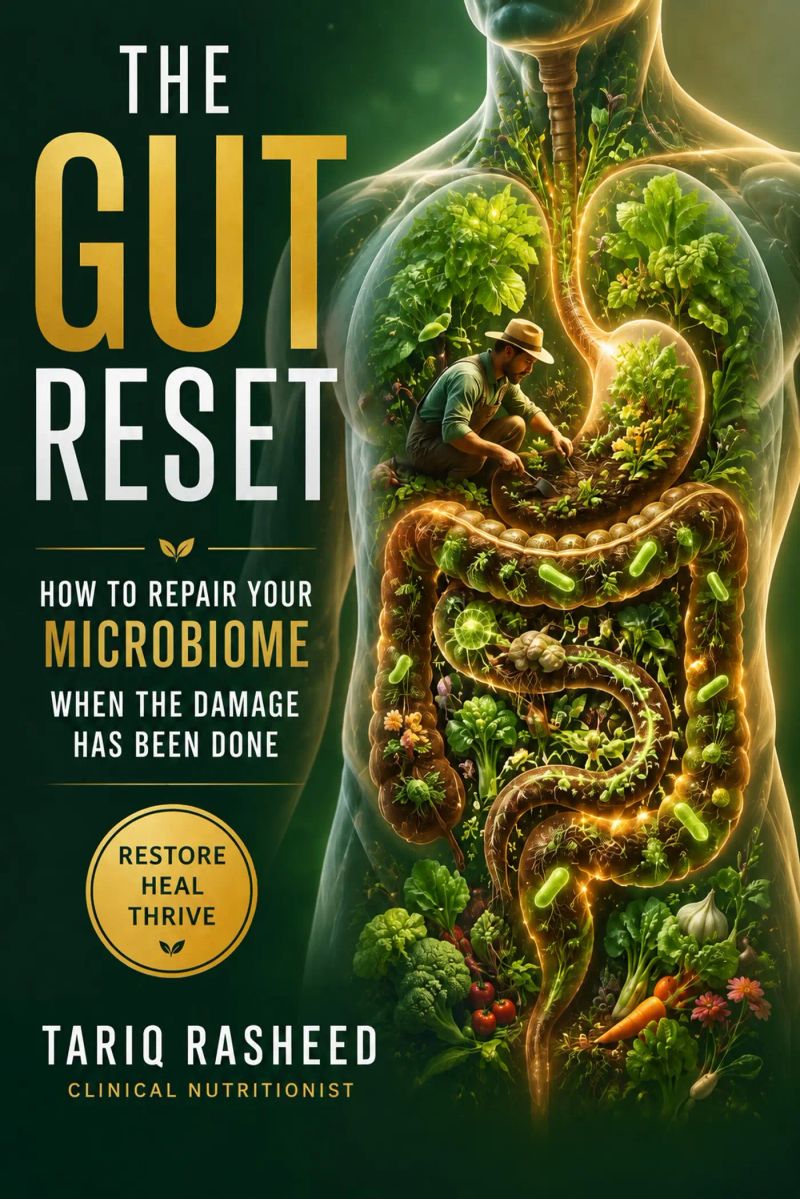
The Gut Reset
How to Repair Your Microbiome When the Damage Has Been DoneBy Tariq Rasheed


Length8h 11m
About this audiobook
Gut reset plan, microbiome repair, IBS relief, and digestive healing — a 60-day evidence-based protocol for when the damage has already been done, from an 18-year registered dietitian.
Lina was thirty-four, bloated every day for two years, and had spent seven hundred dollars on a stool test that told her nothing useful. She had shrunk her safe-food list to nine items. Her doctor's advice: "manage stress." That is not a treatment plan, writes Tariq Rasheed — "it is a shrug in a white coat." The Gut Reset is what Rasheed tells his patients in the first three or four clinic visits, written down: not a fad, not a supplement protocol, not a seven-day miracle. It is a structured 60-day repair plan for a gut that has already been disrupted by antibiotics, food poisoning, chronic stress, or simply the slow ecological narrowing of the modern Western diet.
The book opens with the biology your doctor skipped: why a single-cell-thick gut lining matters, how short-chain fatty acids produced from fiber feed colon cells and regulate inflammation, and why the average American's 15 grams of daily fiber leaves gut bacteria "effectively hungry for decades." It moves through fermented foods, probiotics (when they help and when they do not), elimination diets without disordered eating, the stress-sleep-gut axis, and specific conditions including IBS, SIBO, and the gut-brain connection. The 60-Day Reset delivers a week-by-week layering protocol: fiber in week 2, fermented foods in week 3, sleep and stress in week 4, 30 distinct plant species in week 5, and a targeted elimination only in week 6 — after the foundation is solid. This sequencing is the core differentiator: repair before restriction, always.
Inside this gut health and microbiome repair book:
• The 60-Day Reset protocol — a week-by-week layering plan that builds fiber, fermented foods, sleep, and plant diversity in the correct order before any elimination is attempted
• Why elimination diets usually fail — most patients have done phase one (cut foods) but never phase two (reintroduce); their food list keeps shrinking, making gut health worse over time
• Evidence-based probiotic guidance — "the science of which specific strain helps which specific person is in its infancy"; the chapter tells you when a probiotic is worth trying and when it is not
• Fiber as the most underused gut health tool — with the target of 30 distinct plant species per week, rising to 35 grams of fiber daily by week 7, explained through the Akkermansia-mucus-barrier mechanism
• IBS, SIBO, IBD, histamine intolerance, and the aging gut — dedicated chapters on each condition, including the gut-hormone connection for women in perimenopause and menopause
• The gut-brain and gut-immunity connections — how gut dysbiosis affects mood, weight regulation, skin, and the roughly 70 percent of immune cells that live in and around your intestine
• No supplements required — the plan does not recommend buying anything from a link in the back; it is built on food, sleep, and stress reduction alone
The strongest predictor of long-term gut health Rasheed has found after 18 years of practice "is not adherence to a specific diet — it is whether someone has built a relationship with food that they can keep up for the rest of their life." If your digestive health stopped cooperating after antibiotics, illness, or nothing you can point to at all, this gut reset and microbiome repair guide gives you a patient, sequential, evidence-based path back.
For readers of Justin Sonnenburg's The Good Gut and…
Audiobook details
GenreHealth and Wellness, Science and Nature
Length8 hrs 11 mins
Narrated byListen with 1,000+ voices
FormateBook with Audio
Publish dateSep 30, 2026
LanguageEnglish
Table of contents
1Introduction
2Chapter 1: The Gut-Health Problem Most People Have
3Chapter 2: What the Microbiome Actually Is
4Chapter 3: Signs Your Gut Needs a Reset
5Chapter 4: Antibiotics and What They Really Did
Show all chaptersShow less
6Chapter 5: Fiber — The Most Underused Tool
7Chapter 6: Fermented Foods — Which Ones, How Much
8Chapter 7: Probiotics — When They Help, When They Don’t
9Chapter 8: Prebiotics Worth Caring About
10Chapter 9: Elimination Diets Without Disordered Eating
11Chapter 10: Reintroduction Protocols
12Chapter 11: The Role of Stress and Sleep on Gut
13Chapter 12: Inflammation and the Gut
14Chapter 13: Food Sensitivities vs Allergies vs Intolerances
15Chapter 14: Specific Conditions — IBS, SIBO, IBD Basics, Candida
16Chapter 15: Gut and Brain Connection
17Chapter 16: Gut and Immunity
18Chapter 17: Gut and Weight Regulation
19Chapter 18: Travel and the Gut
20Chapter 19: Pregnancy and the Gut
21Chapter 20: Children’s Gut Health
22Chapter 21: The 60-Day Reset
23Chapter 22: The Long Practice
24Conclusion: A Calmer Relationship with Your Gut
25Appendix A: The 60-Day Reset at a Glance
26Appendix B: High-Fiber Foods Reference
27Appendix C: Fermented Food Reference
28Appendix D: Recipes for Gut Health
29Appendix E: When to See a Specialist
30Appendix F: Common Myths Debunked
31Appendix G: Suggested Reading and Resources
32Chapter 23: The Questions I Get Most Often
33Chapter 24: Six Patients In Depth
34Chapter 25: A Week in the Kitchen
35Chapter 26: SIBO, Up Close
36Chapter 27: IBS Subtypes, Up Close
37Chapter 28: Crohn’s, Colitis, and Living with IBD
38Chapter 29: Histamine, Mast Cells, and the Gut
39Chapter 30: Reflux, the Upper Gut, and the Limits of Gut-Health Talk
40Chapter 31: The Aging Gut
41Chapter 32: The Gut and Hormones — Women’s Cycles, Perimenopause, Menopause
42Chapter 33: The Gut and Skin
43Chapter 34: When You Have a Family to Feed
44Chapter 35: Common Mistakes I See
45Chapter 36: A Day in the Clinic
46Chapter 37: Tools, Tests, and What’s Worth Doing
47Chapter 38: A Final Word
48About the Author
More from Tariq Rasheed
How to Make Disease DisappearRangan Chatterjee5h 26m4.5 (3.5K)$24 · $0.00

The Complete Herbal (Annotated)Nicholas Culpeper29h 8m4.5 (1.4K)$2 · $0.00

A Plague Upon Our HouseScott W. Atlas MD10h 37m4.5 (3.4K)$20 · $0.00

The Cancer CodeDr. Jason Fung10h 48m4.5 (5.3K)$29 · $0.00

The Gift of TherapyIrvin Yalom7h 39m4.5 (38.8K)$26 · $0.00

EarlySarah DiGregorio9h 47m4.5 (1.3K)$29 · $0.00

Bottle of LiesKatherine Eban14h 25m4.4 (12K)$33 · $0.00
The 36-Hour DayNancy L. Mace, Peter V. Rabins17h 13m4.4 (9.2K)$28 · $0.00

FlooredSara Reardon10h 36m4.5 (1K)$29 · $0.00

Radical RemissionKelly A. Turner9h 26m4.4 (8.1K)$29 · $0.00
The Sinatra SolutionStephen T. Sinatra MD9h4.5 (899)$20 · $0.00

The Songaminute ManSimon McDermott6h 12m4.5 (280)$24 · $0.00
Sometimes BrilliantLarry Brilliant12h 27m4.5 (954)$29 · $0.00

Live Your LifeAmanda Kloots, Anna Kloots10h 54m4.4 (13.7K)$29 · $0.00

All in Her HeadElizabeth Comen13h 25m4.4 (18.2K)$33 · $0.00
The Wisdom of Your BodyHillary McBride9h 14m4.4 (6.7K)$29 · $0.00

The Alzheimer's SolutionDean Sherzai, Ayesha Sherzai9h 47m4.4 (1.9K)$29 · $0.00
Rewire Your MindsetBrian Keane6h 49m4.5 (896)$23 · $0.00

Tuning The Human Biofield: Healing With Vibrational MedicineCENTER FOR SOUND THERAPY13h 28m4.4 (2.5K)$35 · $0.00

VaccinatedPaul A. Offit8h 30m4.4 (3.7K)$26 · $0.00

A Brief History of IntelligenceMax S. Bennett12h 18m4.6 (6.6K)$29 · $0.00
The Story of BirdsSteve Brusatte11h 49m4.6 (401)$29 · $0.00
How Stella Learned to TalkChristina Hunger7h4.5 (10.9K)$24 · $0.00

Craig & FredCraig Grossi8h 6m4.5 (9.6K)$26 · $0.00

Celebrating BirdsNatalia Rojas, Ana Maria Martinez6h 47m4.6 (330)$24 · $0.00

Saving JemimaJulie Zickefoose4h 59m4.5 (749)$20 · $0.00

Will's Red CoatTom Ryan8h 23m4.5 (2.3K)$26 · $0.00

Of Time and TurtlesSy Montgomery10h 34m4.5 (5K)$29 · $0.00

Zen and the Art of Saving the PlanetThich Nhat Hanh9h 20m4.5 (3.9K)$29 · $0.00

BLACK BEAUTY (With Original Illustrations)Anna Sewell7h 31m4.5 (1.3K)$1.99 · $0.00
Bottle of LiesKatherine Eban14h 25m4.4 (12K)$33 · $0.00
IngrainedCallum Robinson8h 10m4.5 (1.1K)$26 · $0.00

The Lion Tracker's Guide To LifeBoyd Varty3h 1m4.4 (4.8K)$18 · $0.00

Born for LoveBruce D. Perry, Maia Szalavitz11h 42m4.4 (4K)$29 · $0.00

The Mountains of California (With Original Drawings & Photographs) (Annotated)John Muir11h 35m4.5 (1.1K)$2 · $0.00

The New GuysMeredith Bagby16h 50m4.4 (1.2K)$40 · $0.00

Blue PasturesMary Oliver3h 23m4.4 (3.8K)$18 · $0.00
The Rise and Reign of the MammalsSteve Brusatte13h 26m4.4 (11.1K)$33 · $0.00
VaccinatedPaul A. Offit8h 30m4.4 (3.7K)$26 · $0.00

The Light EatersZoë Schlanger10h 57m4.4 (22.8K)$29 · $0.00
You may also like
Joy on DemandChade-Meng Tan7h 8m4.0 (2.9K)$24 · $0.00
Life Without DiabetesRoy Taylor7h 18m4.3 (2K)$24 · $0.00
Eat to Beat Depression and AnxietyDrew Ramsey6h 28m4.2 (2.1K)$24 · $0.00

It's Not Just About the RibbonsJane Savoie6h 58m4.4 (328)$20 · $0.00

How To Stop Worrying And Start LivingDale Carnegie13h 17m4.2 (149.2K)$1 · $0.00
Aging Backwards: Updated and Revised EditionMiranda Esmonde-White6h 44m4.1 (2.5K)$24 · $0.00

A Year of MiraclesMarianne Williamson6h 36m4.5 (2.4K)$24 · $0.00

HOW TO STOP WORRYING & START LIVINGDale Carnegie13h 6m4.2 (146.5K)$1 · $0.00
Success AffirmationsJack Canfield4h 42m4.4 (963)$20

How to Get What You Want (Annotated)Wallace D. Wattles1h 24m4.3 (266)$1.99 · $0.00

How to RelaxThich Nhat Hanh1h 16m4.3 (9.2K)$15 · $0.00

The SourceTara Swart, MD, PhD6h 42m4.1 (6.1K)$7 · $0.00

When the Heart WaitsSue Monk Kidd6h 56m4.3 (6.4K)$24 · $0.00

Nuggets of the New ThoughtWilliam Walker4h 16m4.2 (252)$3.50 · $0.00

The Science of BreathWilliam Walker2h 37m4.1 (4K)$4.70 · $0.00

The 28-Day Fascia Reset Protocol for SeniorsClara M. Linwood2h 36m4.8 (19)$10
Perseverance Through PatienceElijah C.3h 10m$6.40 · $0.00

The High-Performance BrainDanniel Silva3h 25m$1.80 · $0.00

Cuando Tu Mente No Te Deja DormirElena M. Valdora6h 26m$7

Tai Chi for Arthritis ReliefLaura Chen6h 33m$5