
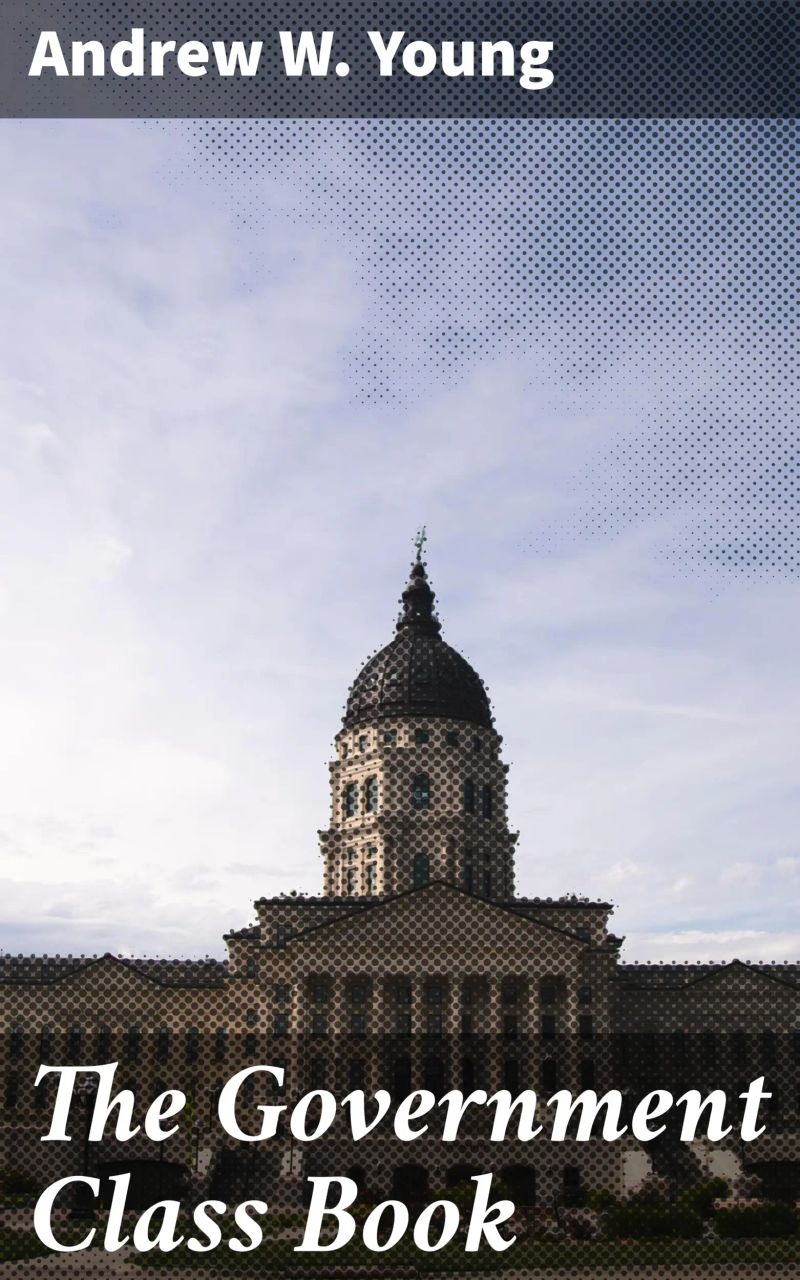
The Government Class Book
Designed for the Instruction of Youth in the Principles / of Constitutional Government and the Rights and Duties of / CitizensBy Andrew W. Young


Length11h 45m
About this audiobook
In 'The Government Class Book,' Andrew W. Young presents a meticulously crafted examination of the principles and practices of governance through a lens suitable for both educational settings and public discourse. Young employs a clear, didactic style that facilitates understanding of complex political concepts, making it accessible to a wide range of readers. The book is not merely an academic treatise; it exists within a broader literary context that seeks to promote civic education and democratic engagement during a time when such discourse is increasingly necessary. Andrew W. Young's rich background in political science and education undoubtedly informs his approach to this work. His experience as an educator and advocate for informed citizenship is reflected in the book's structure and content, which encourages active participation in government. Young has long been an advocate for educational reform, believing that a well-informed populace is vital for the sustenance of democracy, a perspective that underpins the work'Äôs objectives. I highly recommend 'The Government Class Book' to educators, students, and civic-minded individuals alike. This book serves not only as a foundational text for learning about government but also as a vital resource for fostering an engaged and informed citizenry.
Audiobook details
GenrePolitics and Government
Length11 hrs 45 mins
Narrated byListen with 1,000+ voices
FormateBook with Audio
Publish dateDec 24, 2019
LanguageEnglish
Table of contents
1State Governments.
2Chapter V.: The Nature and Objects of a Constitution, and the Manner in which it is made.
3Chapter VI.: Qualifications of Electors; or, by whom Political Power is exercised in the States of this Union.
4Chapter VII.: Elections.
5Chapter VIII.: Division of the Powers of Government.
Show all chaptersShow less
6Chapter IX.: State Legislatures--how constituted.
7Chapter X.: Meetings and Organization of the Legislature.
8Chapter XI.: Manner of Enacting Laws.
9Chapter XII.: Executive Department. Governor and Lieutenant-Governor.
10Chapter XIII.: Assistant Executive State Officers.
11Chapter XIV.: Counties ind County Officers. Powers and Duties of County Officers.
12Chapter XV.: Towns and Town Officers. Powers and Duties of Town Officers.
13Chapter XVI.: Incorporation and Government of Cities, Villages, &c.
14Chapter XVII.: Judicial Department. Justices' Courts.
15Chapter XVIII.: Trial by Jury; Execution; Attachment; Appeals; Arrest of Offenders.
16Chapter XIX.: Courts other than Justices' Courts; Grand and Petit Juries, &c.
17Chapter XX.: Chancery or Equity Courts; Probate Courts; Court of Impeachment.
18Chapter XXI.: Assessment and Collection of Taxes.
19Chapter XXII.: Education. School Funds; Schools, &c.
20Chapter XXIII.: Canals and Rail-Roads.
21Chapter XXIV.: Banks and Insurance Companies.
22Chapter XXV.: The Militia.
23Government of the United States.
24Chapter XXVI.: Causes of the Revolution.
25Chapter XXVII.: Nature of the Union under the Confederation.
26Chapter XXVIII.: Nature of the Union under the Constitution.
27Chapter XXIX.: Legislative Department. House of Representatives.
28Chapter XXX.: The Senate.
29Chapter XXXI.: Power of Congress to lay Taxes, Duties, &c.; Power to Borrow Money.
30Chapter XXXII.: Power of Congress to Regulate Commerce. Commerce with Foreign Nations.
31Chapter XXXIII.: Power to regulate Commerce, continued. Navigation; Commerce among the States, and with the Indian Tribes.
32Chapter XXXIV.: Powers of Congress in relation to Naturalization; Bankruptcy; Coining Money; Weights and Measures; Punishment of Counterfeiting.
33Chapter XXXV.: Powers of Congress in relation to Post-Offices, Copy-Rights, and Patents, and Inferior Courts.
34Chapter XXXVI.: Powers of Congress in relation to Piracy and Offenses against the Law of Nations; War; Marque and Reprisal, Public Defense, District of Columbia; Implied Powers.
35Chapter XXXVII.: Prohibitions on Congress.
36Chapter XXXVIII.: Prohibitions on the States.
37Chapter XXXIX.: Executive Department. President and Vice-President; their Election, Qualifications, &c.
38Chapter XL.: Powers and Duties of the President; Treaties; Public Ministers; Appointments and Removals.
39Chapter XLI.: Auxiliary Executive Departments. Departments of State, of the Treasury, of the Interior, of War, of the Navy, of the Post-Office; Attorney-General.
40Chapter XLII.: Judicial Department.
41Chapter XLIII.: Treason, defined; its Punishment.
42Chapter XLIV.: State Records; Privilege of Citizens; Fugitives; Admission of New States; Power over Territory; Guaranty of Republican Government.
43Chapter XLV.: Provision for Amendments; Assumption of Public Debts; Supremacy of the Constitution, &c.; Oaths and Tests; Ratification of the Constitution.
44Chapter XLVI.: Amendments to the Constitution.
45Common and Statutory Law.
46Chapter XLVII.: Rights of Persons. Personal Security; Personal Liberty; Religious Liberty; Liberty of Speech, and of the Press; Right of Property.
47Chapter XLVIII.: Domestic Relations. Husband and Wife.
48Chapter XLIX.: Domestic Relations, continued. Parent and Child; Guardian and Ward; Minors; Masters, Apprentices, and Servants.
49Chapter L.: Right of Property. How Title to property is acquired; Wills and Testaments Title to Property by Descent.
50Chapter LI.: Deeds and Mortgages.

RiggedMollie Hemingway12h 48m4.6 (4.2K)$23 · $0.00

SledgehammerDavid Friedman8h 21m4.7 (589)$26 · $0.00

Citizenship in a Republic (Annotated)Theodore Roosevelt2h 44m4.6 (1.4K)$2 · $0.00

No EscapeNury Turkel9h 30m4.6 (809)$28 · $0.00

Always FaithfulThomas Schueman, Zainullah Zaki12h 12m4.6 (977)$29 · $0.00

UnthinkableJamie Raskin15h 8m4.5 (9.3K)$8 · $0.00

My Fourth Time, We DrownedSally Hayden13h 59m4.6 (2.9K)$23 · $0.00

A Revolution of Common SenseScott Jennings9h 29m4.6 (528)$29 · $0.00

Statement From the Dock at the Rivonia TrialNelson Mandela2h 18m4.6 (1.3K)$1 · $0.00

Lessons from the EdgeMarie Yovanovitch17h 11m4.5 (5.9K)$40 · $0.00

To Rescue the American SpiritBret Baier10h 12m4.5 (2.7K)$8 · $0.00

StonewalledSharyl Attkisson15h 19m4.5 (4.3K)$33 · $0.00

The World According to Orwell: 1984 & Animal FarmGeorge Orwell15h 42m4.6 (1.1K)$1 · $0.00
Basic EconomicsThomas Sowell18h 32m4.5 (29.3K)$28 · $0.00

To Rescue the RepublicBret Baier, Catherine Whitney11h 42m4.5 (8.6K)$29 · $0.00

Modern WarriorsPete Hegseth7h 10m4.5 (4.7K)$24 · $0.00

Philosophy and Opinions of Marcus Garvey (Annotated)Marcus Mosiah Garvey4h 42m4.5 (1.7K)$0.99 · $0.00

A Plague Upon Our HouseScott W. Atlas MD10h 37m4.5 (3.4K)$20 · $0.00

One Bright MoonAndrew Kwong12h 21m4.5 (813)$29 · $0.00
CredibleDeborah Tuerkheimer8h 5m4.6 (551)$26 · $0.00
You may also like

Losing GroundCharles Murray9h 27m4.0 (1.2K)$25

MY OWN STORY (Illustrated) (Annotated)Emmeline Pankhurst11h 58m4.2 (4.6K)$0.99 · $0.00

EuthyphroPlato1h 1m4.1 (17.3K)$2.30
Slouching towards GomorrahRobert H. Bork13h 8m3.9 (1.4K)$23 · $0.00

Anarchism and Other EssaysEmma Goldman4h 38m4.2 (9.8K)$2.30

CritoPlato35m4.3 (12.1K)$1.80 · $0.00

Woman, Church & StateMatilda Joslyn Gage21h 8m4.4 (650)$2 · $0.00

A Woman Like HerSanam Maher9h 22m3.8 (1.7K)$20

Barnaby RudgeCharles Dickens29h 31m3.8 (22.2K)$1 · $0.00

Clotel, or The President's DaughterWilliam Wells Brown6h 2m3.7 (3.4K)$2.30

The Heart of Mid-LothianSir Walter Scott25h 23m3.9 (4K)$21 · $0.00

The Kantian Ethics: Metaphysics of MoralsImmanuel Kant23h 30m4.1 (5.1K)$1.99 · $0.00

Ruby RidgeJess Walter16h 29m4.2 (1.7K)$40 · $0.00

AstorAnderson Cooper, Katherine Howe8h 19m4.1 (22.3K)$5 · $0.00
Not For SaleDavid Batstone9h 22m4.2 (2.1K)$29 · $0.00

TabooWilfred Reilly8h 43m4.1 (1.6K)$20

The Rougon-Macquart: Complete 20 Book CollectionÉmile Zola327h 3m4.7 (275)$1.99 · $0.00

The Legal Subjection of Men (Annotated)E. Belfort Bax3h 11m3.5 (13)$2 · $0.00

The Chronicles of Crime (Annotated)Camden Pelham80h 5m$2 · $0.00

Legally YoursManasi Chaudhari8h 52m4.7 (223)$29 · $0.00