
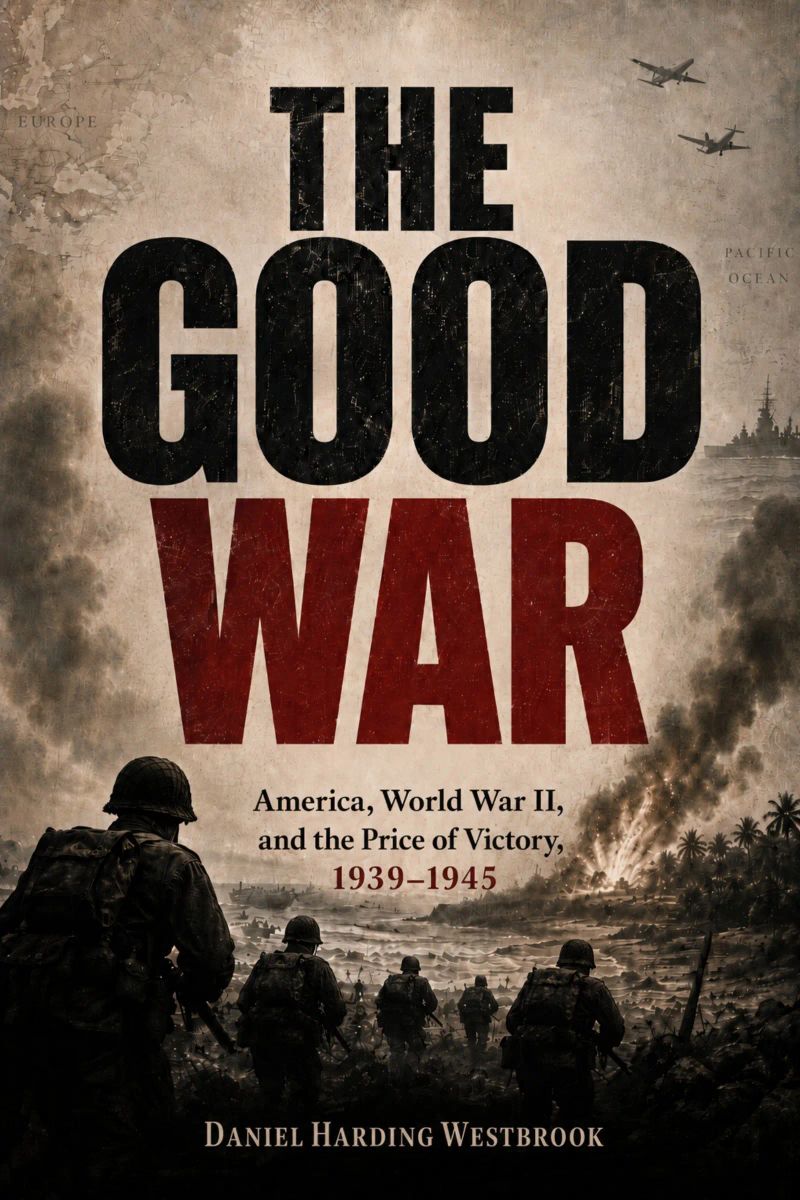
THE GOOD WAR
America in World War II, 1939–1945By Daniel Harding Westbrook


Length7h 29m
About this audiobook
The complete narrative history of World War II — Pearl Harbor, D-Day, the atomic bomb, Rosie the Riveter, the Double V Campaign, and the war that made modern America, 1939-1945.
On September 1, 1939, fifty-three German divisions crossed the Polish frontier at dawn. The Blitzkrieg destroyed the Polish air force on the ground and reached Warsaw within eight days. The United States watched from four thousand miles away, separated by the Atlantic and by a fierce conviction that Europe's catastrophes were not America's to solve. The memory of 116,000 Americans dead in a war that had settled nothing had calcified into policy: neutrality, isolation, the belief that the oceans were barriers rather than highways.
Across twenty-four chapters, historian Daniel Harding Westbrook traces the full American experience in World War II — from the isolationist debate, Lend-Lease, and Pearl Harbor through Midway, D-Day, the firebombing of Tokyo, and the atomic bombs at Hiroshima and Nagasaki — and the homefront mobilization, Japanese American internment, the Double V Campaign, and the GI Bill that built the postwar middle class.
Inside this World War II history:
• Lend-Lease and the arsenal of democracy — how Roosevelt's fireside chat reached sixty million Americans, $50 billion in aid reached Britain and the Soviet Union, and the undeclared naval war cost the USS Reuben James 115 dead (Chapters 3-4)
• Pearl Harbor — Commander Fuchida's "Tora! Tora! Tora!" signal, the Arizona's million pounds of powder detonating in nine minutes, and the 1,177 men still entombed beneath the harbor (Chapter 4)
• Midway and island-hopping — the Pacific turning point, and Iwo Jima's 26,000 Marine casualties in thirty-six days of the bloodiest battle in Marine Corps history (Chapters 9-10)
• The firebombing of Tokyo — Curtis LeMay's 334 B-29s burning sixteen square miles in a single night, 80,000-100,000 dead, and the moral logic of industrial-age air war (Chapter 11)
• The atomic bomb — Trinity in the New Mexico desert on July 16, 1945, Hiroshima on August 6, Nagasaki on August 9, and Oppenheimer's Bhagavad Gita recollection (Chapter 12)
• Women and the Double V — Rosie the Riveter's 1,074 WASP pilots flying 60 million miles in 78 aircraft types, and the Pittsburgh Courier's Double V Campaign demanding two victories: against the Axis and against Jim Crow (Chapters 17-18)
• The GI Bill and the Greatest Generation — how veterans' education and housing benefits built the postwar middle class, and how the mythology of the "Good War" shaped American self-understanding (Chapters 22, 24)
World War II was the event that made modern America — the industrial power, the international commitments, the racial contradictions, and the self-image as a nation that fights for democracy and sometimes fails to practice it. Westbrook's account delivers the military narrative and the human one: the soldiers, the factory workers, the Japanese Americans in internment camps, and the Black veterans who came home demanding the democracy they had fought for abroad.
For readers of Rick Atkinson's THE GUNS AT LAST LIGHT and Doris Kearns Goodwin's NO ORDINARY TIME.
Audiobook details
GenreHistory
Length7 hrs 29 mins
Narrated byListen with 1,000+ voices
FormateBook with Audio
Publish dateJun 2, 2026
LanguageEnglish
Table of contents
1Introduction
2Prologue: The World on Fire
3PART ONE: THE ROAD TO WAR (1939–1941)
4Chapter 1: Hitler's Europe — The War Before America Entered
5Chapter 2: American Isolationism — The Battle Against Intervention
Show all chaptersShow less
6Chapter 3: Lend-Lease — America as Arsenal of Democracy
7Chapter 4: Pearl Harbor — December 7, 1941
8PART TWO: AMERICA MOBILIZES (1942)
9Chapter 5: The Home Front — Conversion, Rationing, and Sacrifice
10Chapter 6: The War Industries — Building the Arsenal
11Chapter 7: Japanese American Internment — Executive Order 9066
12Chapter 8: The Draft and the GI — Building the Citizen Army
13PART THREE: THE PACIFIC WAR (1942–1945)
14Chapter 9: Midway — The Turning Point in the Pacific
15Chapter 10: Island Hopping — Guadalcanal to Iwo Jima
16Chapter 11: The Air War Against Japan — B-29s and Firebombing
17Chapter 12: The Atomic Bomb — Trinity, Hiroshima, and Nagasaki
18PART FOUR: THE EUROPEAN WAR (1942–1945)
19Chapter 13: North Africa and Italy — The Approach to Europe
20Chapter 14: D-Day — Normandy and the Liberation of France
21Chapter 15: The Battle of the Bulge — Germany's Last Offensive
22Chapter 16: Victory in Europe — Berlin and the German Surrender
23PART FIVE: THE WAR'S HUMAN DIMENSIONS
24Chapter 17: Women at War — Rosie the Riveter and Beyond
25Chapter 18: Black Americans in World War II — The Double V Campaign
26Chapter 19: The Holocaust — America's Knowledge and Response
27Chapter 20: The GI Experience — Combat, Fear, and Brotherhood
28PART SIX: THE WAR'S END AND LEGACY
29Chapter 21: The United Nations — Building the Postwar Order
30Chapter 22: The GI Bill — Veterans and the Making of Middle-Class America
31Chapter 23: The Atomic Age — Nuclear Weapons and the Cold War's Dawn
32Chapter 24: The Greatest Generation — Memory, Myth, and America's Self-Image
33Epilogue: What the War Made
34Acknowledgments
35Selected Bibliography
36About the Author
More from Daniel Harding Westbrook

A Brief History of IntelligenceMax S. Bennett12h 18m4.6 (6.6K)$29 · $0.00
MotherlandJulia Ioffe17h 52m4.7 (2.5K)$40 · $0.00

Where Cowards Go to DieBenjamin Sledge8h 42m4.7 (351)$20 · $0.00
RevolutionariesSanjeev Sanyal11h 23m4.6 (2.6K)$29 · $0.00
Days of Love and Rage: A Story of RevolutionAnand Gopal22h 36m4.7 (584)$34 · $0.00

We Crossed a Bridge and It TrembledWendy Pearlman6h4.6 (5.2K)$24 · $0.00
Unbroken Bonds of BattleJohnny Joey Jones8h 31m4.6 (2.6K)$8 · $0.00
The Daughter of AuschwitzTova Friedman, Malcolm Brabant7h 54m4.6 (16.7K)$26 · $0.00
Lily's PromiseLily Ebert, Dov Forman8h 54m4.6 (16.1K)$29 · $0.00
On Democracies and Death CultsDouglas Murray10h 38m4.6 (6.5K)$29 · $0.00

Across the RiverKent Babb11h 40m4.6 (927)$29 · $0.00

Balcony Over Jerusalem: A Middle East Memoir - Israel, Palestine and BeyondJohn Lyons12h 37m4.6 (1.4K)$33 · $0.00
BeyondStephen Walker15h 39m4.6 (3.2K)$33 · $0.00
Kings and PawnsHoward Bryant10h 9m4.6 (678)$29 · $0.00

No EscapeNury Turkel9h 30m4.6 (809)$28 · $0.00
Jubal Stone: U.S. Marshal: Blood Trail To Hell: A Western Adventure NovelCasey Nash3h 42m4.6 (3.2K)$18 · $0.00
Fall and RiseMitchell Zuckoff17h 23m4.6 (9.8K)$40 · $0.00
The SurvivorJosef Lewkowicz, Michael Calvin9h 22m4.6 (2.5K)$29 · $0.00
Always FaithfulThomas Schueman, Zainullah Zaki12h 12m4.6 (977)$29 · $0.00

The State of Society in France Before the Revolution of 1789 (Annotated)Alexis de Tocqueville17h 25m4.6 (1.2K)$2 · $0.00
You may also like

A Southern Woman's StoryPhoebe Yates Pember3h 57m4.2 (762)$2 · $0.00
The Light of BattleMichel Paradis16h 43m4.4 (677)$8 · $0.00
Rising in FlamesJ. D. Dickey14h 13m4.1 (659)$23

Miss BurmaCharmaine Craig13h 20m3.9 (4.5K)$23
Reminiscences of the Civil WarJohn Brown Gordon14h 40m4.4 (647)$23
The Story of a Common Soldier of Army Life in the Civil WarLeander Stillwell10h 53m4.3 (1.3K)$1.99 · $0.00
The Good Man of NankingJohn Rabe9h 23m4.3 (753)$20 · $0.00
By Her HandMarion Taffe14h 46m4.4 (468)$33 · $0.00
MissionRobert Matzen11h 46m4.3 (2.3K)$23
GruntsJohn C. McManus18h 24m4.3 (1.6K)$25
A MAN COULD STAND UPMadox Ford9h 13m4.1 (849)$1 · $0.00
Six Armies in NormandyJohn Keegan17h 26m4.2 (4.1K)$28
Okla HannaliR. A. Lafferty8h 49m4.3 (340)$20

UndauntedTanya Biank11h 32m4.2 (718)$20
The Last BattleCornelius Ryan15h 46m4.4 (11K)$28
Good-Bye To All That: An AutobiographyRobert Graves14h 1m4.1 (19.4K)$3
The Diamond EyeKate Quinn12h 52m4.1 (220.3K)$33 · $0.00
The Unseen Frontline - 30 Powerful Narratives of Civilian Endurance and Aid in the Civil WarLouisa May Alcott, Adam Gurowski, Walt Whitman, William E. Barton, William Howard Russell, Sarah H. Bradford, Thomas E. Taylor, Mary Rhodes Waring Henagan, Susan R. Jervey, Charlotte St. J. Ravenel, Myrta Lockett Avary, Henry Martyn Kieffer, Mary Ann Loughborough, Sarah Morgan Dawson, Elizabeth Bacon Custer, Sara Agnes Rice Pryor, Eliza Frances Andrews, John Beauchamp Jones, Susie King Taylor, Mary Ann Harris Gay, Parthenia Antoinette Hague, C. T. Quintard, Maud E. Morrow, Phoebe Yates Pember, S. Emma E. Edmonds, Mary Boykin Chesnut, George Barton, Fannie A. Beers, Sarah Ellen Blackwell, Tillie Pierce Alleman316h 57m$0.99
A Fortnight at the FrontHenry Russell Wakefield1h 3m$2 · $0.00
The History of the Great War (Complete 6 Volume Edition)Arthur Conan Doyle58h 7m4.3 (33)$1 · $0.00