
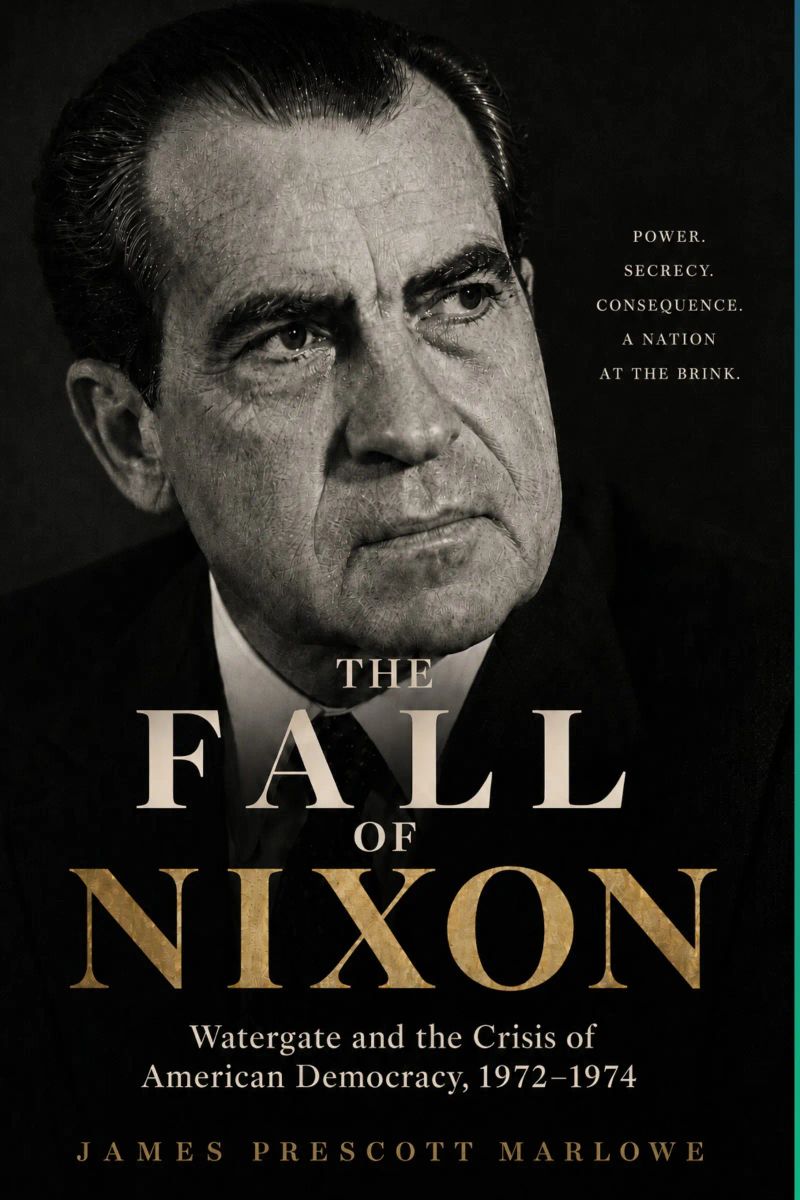
THE FALL OF NIXON
Watergate and the Crisis of American Democracy, 1972-1974By James Prescott Marlowe


Length5h 53m
About this audiobook
The complete narrative history of Watergate — Richard Nixon, the cover-up, Deep Throat, impeachment, and the resignation that proved no president is above the law, 1972-1974.
Shortly after midnight on June 17, 1972, security guard Frank Wills found tape covering a door latch in the Watergate complex. He removed it. An hour later, new tape covered the same latch. He called the police. Officers found five men in surgical gloves on the sixth floor of the Democratic National Committee headquarters — carrying $2,300 in sequentially numbered bills, surveillance equipment, and a lock pick. Their leader was James McCord, security director of Nixon's Committee to Re-Elect the President.
This is the story of how that third-rate burglary became the greatest constitutional crisis since the Civil War. Across twenty-four chapters, historian James Prescott Marlowe traces the Watergate scandal — from the 1972 break-in through the Saturday Night Massacre, the Supreme Court's unanimous ruling in United States v. Nixon, the smoking-gun tape, and Richard Nixon's resignation on August 9, 1974 — and examines the reforms and lasting questions it left behind.
Inside this Watergate history:
The culture of dirty tricks — CREEP's sixty-million-dollar operation, Donald Segretti's sabotage network, and Gordon Liddy's GEMSTONE program (Chapter 1)
The cover-up's mechanics — the June 23 smoking-gun tape, the hush-money pipeline through Herbert Kalmbach, and Dean's "cancer on the presidency" warning (Chapters 3, 11)
Woodward, Bernstein, and Deep Throat — how W. Mark Felt, passed over for the FBI directorship, guided the Washington Post's investigation from inside the bureau (Chapter 5)
The Saturday Night Massacre — Nixon's firing of Archibald Cox and the resignation of Attorney General Richardson (Chapter 7)
United States v. Nixon — the unanimous Supreme Court ruling that executive privilege is not absolute, sixteen days before the resignation (Chapter 10)
August 9, 1974 — the East Room farewell, the double V-sign on the South Lawn, Ford's "our long national nightmare is over," and the pardon that cost Ford the 1976 election (Chapters 12, 20)
The reforms and the reckoning — the Federal Election Campaign Act, FISA, and the Church Committee's intelligence oversight revolution (Chapters 21-24)
Watergate produced Haldeman and Ehrlichman's convictions, the only presidential resignation in American history, and constitutional precedent on executive privilege that governs American law today. Can democratic institutions hold the most powerful official in the world accountable? They can. But it is not guaranteed.
For readers of Bob Woodward's ALL THE PRESIDENT'S MEN and John Dean's BLIND AMBITION.
Audiobook details
GenreHistory, Biography and Memoir
Length5 hrs 53 mins
Narrated byListen with 1,000+ voices
FormateBook with Audio
Publish dateJun 2, 2026
LanguageEnglish
Table of contents
1Introduction
2Prologue: The Break-In
3PART ONE: THE CRIME (1972)
4Chapter 1: CREEP — Nixon's Committee and the Culture of Dirty Tricks
5Chapter 2: June 17, 1972 — The Watergate Burglary
Show all chaptersShow less
6Chapter 3: The Cover-Up Begins — Hush Money, False Statements, and Obstruction
7Chapter 4: The 1972 Election — McGovern, Nixon's Landslide, and the Buried Story
8PART TWO: THE UNRAVELING (1973)
9Chapter 5: Woodward and Bernstein — The Washington Post and Deep Throat
10Chapter 6: The Senate Watergate Committee — Sam Ervin and the Public Hearings
11Chapter 7: The White House Tapes — The Saturday Night Massacre
12Chapter 8: The Enemies List — Nixon's America and the Politics of Paranoia
13PART THREE: THE END (1973-1974)
14Chapter 9: Articles of Impeachment — The House Judiciary Committee
15Chapter 10: The Supreme Court Decides — United States v. Nixon
16Chapter 11: The Smoking Gun Tape — The President Is Guilty
17Chapter 12: August 9, 1974 — Nixon Resigns
18PART FOUR: THE CAST OF CHARACTERS
19Chapter 13: Richard Nixon — The Man Who Did This
20Chapter 14: John Dean — The Counsel Who Turned
21Chapter 15: H.R. Haldeman and John Ehrlichman — The Palace Guard
22Chapter 16: Archibald Cox and Leon Jaworski — The Special Prosecutors
23PART FIVE: THE BROADER WATERGATE
24Chapter 17: The Plumbers — Ellsberg, the Pentagon Papers, and White House Crime
25Chapter 18: The CIA, FBI, and the Abuse of Government Power
26Chapter 19: The Press — Journalism, Freedom, and the Watergate Story
27Chapter 20: Gerald Ford — The Accidental President and the Pardon
28PART SIX: LEGACIES
29Chapter 21: Congressional Reforms — Campaign Finance, Intelligence Oversight, and FISA
30Chapter 22: The Imperial Presidency — Executive Power After Watergate
31Chapter 23: The Cynicism Dividend — Watergate and American Trust in Government
32Chapter 24: Nixon Rehabilitated — The Complicated Legacy of a Disgraced President
33Epilogue: The Pardon
34Acknowledgments
35Selected Bibliography
36About the Author
More from James Prescott Marlowe

A Brief History of IntelligenceMax S. Bennett12h 18m4.6 (6.6K)$29 · $0.00

The Gulag Archipelago Volume 3Aleksandr I. Solzhenitsyn21h 56m4.7 (8.9K)$46 · $0.00

Pearl of Great PriceJoseph Smith3h 8m4.7 (7.2K)$1.20 · $0.00

The Happiest Man on EarthEddie Jaku3h 48m4.6 (178K)$7 · $0.00

MotherlandJulia Ioffe17h 52m4.7 (2.5K)$40 · $0.00

Where Cowards Go to DieBenjamin Sledge8h 42m4.7 (351)$20 · $0.00

RevolutionariesSanjeev Sanyal11h 23m4.6 (2.6K)$29 · $0.00

We Crossed a Bridge and It TrembledWendy Pearlman6h4.6 (5.2K)$24 · $0.00

Unbroken Bonds of BattleJohnny Joey Jones8h 31m4.6 (2.6K)$8 · $0.00

The Daughter of AuschwitzTova Friedman, Malcolm Brabant7h 54m4.6 (16.7K)$26 · $0.00

Lily's PromiseLily Ebert, Dov Forman8h 54m4.6 (16.1K)$29 · $0.00

On Democracies and Death CultsDouglas Murray10h 38m4.6 (6.5K)$29 · $0.00

Across the RiverKent Babb11h 40m4.6 (927)$29 · $0.00

Balcony Over Jerusalem: A Middle East Memoir - Israel, Palestine and BeyondJohn Lyons12h 37m4.6 (1.4K)$33 · $0.00

BeyondStephen Walker15h 39m4.6 (3.2K)$33 · $0.00

Kings and PawnsHoward Bryant10h 9m4.6 (678)$29 · $0.00

No EscapeNury Turkel9h 30m4.6 (809)$28 · $0.00

Jubal Stone: U.S. Marshal: Blood Trail To Hell: A Western Adventure NovelCasey Nash3h 42m4.6 (3.2K)$18 · $0.00

Fall and RiseMitchell Zuckoff17h 23m4.6 (9.8K)$40 · $0.00

The SurvivorJosef Lewkowicz, Michael Calvin9h 22m4.6 (2.5K)$29 · $0.00

Matters of the HeartJacinta Nampijinpa Price9h 35m4.8 (359)$29 · $0.00

The StepsSylvester Stallone9h 4m4.8 (635)$29 · $0.00
How to Test Negative for StupidJohn Kennedy8h 13m4.7 (9.7K)$28 · $0.00

Bad Fat Black GirlSesali Bowen6h 32m4.7 (2.8K)$24 · $0.00

Send MeMarty Skovlund, Joe Kent8h 10m4.7 (1.6K)$26 · $0.00

John Muir: The Story of My Boyhood and Youth & Letters to a Friend (Annotated)John Muir10h 13m4.7 (1.1K)$1.99 · $0.00

Invisible StormJason Kander6h 48m4.7 (3.2K)$24 · $0.00

Forever BoyKate Swenson9h 27m4.7 (5K)$29 · $0.00

You Are Worth ItKyle Carpenter, Don Yaeger8h 53m4.7 (4.8K)$29 · $0.00
The Happiest Man on EarthEddie Jaku3h 48m4.6 (178K)$7 · $0.00
MotherlandJulia Ioffe17h 52m4.7 (2.5K)$40 · $0.00

Evidence Not SeenDarlene Deibler Rose11h 11m4.6 (11.9K)$29 · $0.00
Where Cowards Go to DieBenjamin Sledge8h 42m4.7 (351)$20 · $0.00

Will You Love Me?Cathy Glass9h 5m4.6 (9.3K)$29 · $0.00

Designing Terry Pratchett’s DiscworldPaul Kidby3h 52m4.7 (343)$20 · $0.00

HostageEli Sharabi5h 25m4.6 (10.8K)$24 · $0.00

Finding MeViola Davis9h 15m4.6 (256.4K)$29 · $0.00

The Dangerous Truth about Today’s MarijuanaLaura Stack CSP, MBA9h 57m4.7 (385)$20 · $0.00

Birdie & HarlowTaylor Wolfe7h 50m4.6 (6.5K)$26 · $0.00
The Lives of BrianBrian Johnson9h 45m4.6 (3.5K)$29 · $0.00
You may also like
TWA 800Jack Cashill9h 4m4.0 (787)$20
The MissionTim Weiner17h 7m4.1 (1.5K)$40 · $0.00

HubrisMichael Isikoff, David Corn18h 55m4.0 (2.3K)$32
Abuse and PowerCarter Page9h 16m4.3 (2.5K)$20

The Russia HoaxGregg Jarrett8h 29m4.2 (4.6K)$26 · $0.00

Blood MoneyPeter Schweizer7h 43m4.5 (3.8K)$28 · $0.00
Legacy of AshesTim Weiner21h 37m4.2 (16.9K)$28
RiggedMollie Hemingway12h 48m4.6 (4.2K)$23 · $0.00

The Unarmed TruthJohn Dodson8h 55m4.4 (369)$20 · $0.00

The Power-HouseJohn Buchan3h 5m3.6 (1.4K)$2.30 · $0.00

StonewalledSharyl Attkisson15h 19m4.5 (4.3K)$33 · $0.00

UnredactedChristopher Steele8h 52m4.3 (370)$29 · $0.00

Killing a KingDan Ephron9h 57m4.4 (2.1K)$20

The Invisible CoupPeter Schweizer7h 14m4.4 (1.3K)$24 · $0.00

Witch HuntGregg Jarrett14h 54m4.3 (7K)$33 · $0.00
The Catiline ConspiracySallust3h 17m4.0 (4.9K)$1 · $0.00
BailoutNeil Barofsky9h 26m4.1 (2.7K)$20 · $0.00

The Impeachment Process of Donald TrumpNational Security Agency, Robert S. Mueller, Special Counsel's Office U.S. Department of Justice, Federal Bureau of Investigation, White House, U.S. Congress, Elizabeth B. Bazan47h 32m$1.99 · $0.00

Senate Judiciary Committee Interview of Glenn SimpsonUnited States Senate Judiciary Committee6h 48m4.2 (29)$2 · $0.00

The Musgrave controversyCharles Geneviève Louis Auguste André Timothée d' Eon de Beaumont, Samuel Musgrave1h 33m$2 · $0.00