
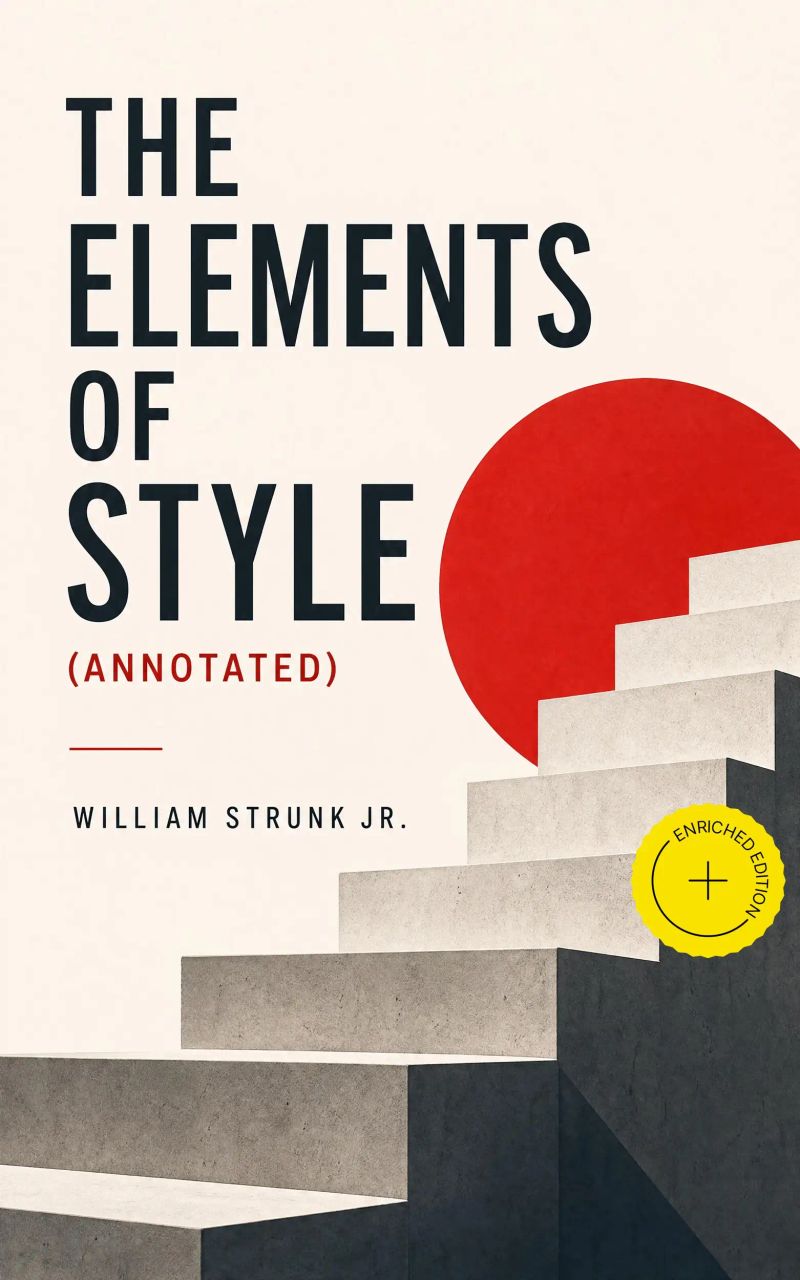
The Elements of Style (Annotated)
Enriched Edition. A Concise Handbook of English Usage, Composition, Grammar, and Clear ProseBy William Strunk Jr.


Length1h 33m
About this audiobook
The Elements of Style is a concise manual of English usage, composition, and rhetorical discipline, organized as a set of rules, principles, and examples for writers seeking clarity and force. Its literary style is famously austere: brief imperatives, pointed corrections, and memorable maxims such as "Omit needless words." Emerging from early twentieth-century classroom pedagogy, the book belongs to the tradition of prescriptive handbooks, yet its enduring appeal lies in its practical vision of prose as exact, economical, and purposeful. William Strunk Jr., a professor of English at Cornell University, composed the original version for his students, distilling years of teaching into a compact guide that could be carried, consulted, and applied. His academic environment shaped the book's insistence on order, grammatical precision, and disciplined revision. Strunk's concern was not ornament but intelligibility: he believed that sound writing reflected sound thinking, and that students could learn style through concrete habits. This book is recommended to students, editors, scholars, and general readers who wish to sharpen their prose. Though some rules invite debate today, its central demand—clarity through restraint—remains invaluable for anyone who writes.
This enriched edition has been carefully crafted to add value to your reading experience.
- A succinct Introduction situates the work's timeless appeal and themes.
- The Synopsis outlines the central plot, highlighting key developments without spoiling critical twists.
- A detailed Historical Context immerses you in the era's events and influences that shaped the writing.
- An Author Biography reveals milestones in the author's life, illuminating the personal insights behind the text.
- A thorough Analysis dissects symbols, motifs, and character arcs to unearth underlying meanings.
- Reflection questions prompt you to engage personally with the work's messages, connecting them to modern life.
- Hand‐picked Memorable Quotes shine a spotlight on moments of literary brilliance.
- Interactive footnotes clarify unusual references, historical allusions, and archaic phrases for an effortless, more informed read.
Audiobook details
Rating★★★★ 4.4 (113.6K)
Includes Goodreads, Amazon, LibraryThing, StoryGraph
GenreOther
Length1 hr 33 mins
Narrated byListen with 1,000+ voices
FormateBook with Audio
Publish dateMay 11, 2018
LanguageEnglish
Table of contents
1WHAT IS ART? & WHEREIN IS TRUTH IN ART? (Meditations on Aesthetics & Literature) (Annotated)
2I. Introductory
3II. Elementary Rules of Usage
41. Form the possessive singular of nouns with 's.
52. In a series of three or more terms with a single conjunction, use a comma after each term except the last.
Show all chaptersShow less
63. Enclose parenthetic expressions between commas.
74. Place a comma before and or but introducing an independent clause.
85. Do not join independent clauses by a comma.
96. Do not break sentences in two.
107. A participial phrase at the beginning of a sentence must refer to the grammatical subject.
118. Divide words at line-ends, in accordance with their formation and pronunciation.
12III. Elementary Principles of Composition
139. Make the paragraph the unit of composition: one paragraph to each topic.
1410. As a rule, begin each paragraph with a topic sentence; end it in conformity with the beginning.
1511. Use the active voice.
1612. Put statements in positive form.
1713. Omit needless words.
1814. Avoid a succession of loose sentences.
1915. Express co-ordinate ideas in similar form.
2016. Keep related words together.
2117. In summaries, keep to one tense.
2218. Place the emphatic words of a sentence at the end.
23IV. A Few Matters of Form
24V. Words and Expressions Commonly Misused
25VI. Words Commonly Misspelled
More from William Strunk Jr.
Mere ChristianityC. S. Lewis7h 7m4.4 (519.7K)$24 · $0.00
Her Daily BreadKate Wood12h 57m4.6 (153)$33 · $0.00
The Holy Bible - 1 SamuelKing James2h 13m4.8 (1.6K)$3 · $0.00
The American Standard Bible — The Gospel of MatthewMatthew3h 56m4.7 (3K)$2 · $0.00
Bad Fat Black GirlSesali Bowen6h 32m4.7 (2.8K)$24 · $0.00
The King James Audio Bible New Testament CompleteChristopher Glyn20h 2m4.7 (2.6K)$12 · $0.00
Faiths CheckbookCharles Spurgeon12h 44m4.7 (3.2K)$11 · $0.00
Ten Things I Wish You Knew About Your Child's Mental HealthDr. Billy Garvey4h 53m4.7 (2.4K)$20 · $0.00
Designing Terry Pratchett’s DiscworldPaul Kidby3h 52m4.7 (343)$20 · $0.00
The Chosen Book OneAmanda Jenkins, Kristen Hendricks, Dallas Jenkins3h 8m4.6 (4.9K)$10 · $0.00
The Lives of BrianBrian Johnson9h 45m4.6 (3.5K)$29 · $0.00
Expository Thoughts on the Gospel of LukeJ.C. Ryle27h 13m4.7 (536)$18 · $0.00
CrossroadsKaleb Dahlgren7h 56m4.6 (4.9K)$26 · $0.00

Across the RiverKent Babb11h 40m4.6 (927)$29 · $0.00
Brain Training for RidersAndrea Monsarrat Waldo5h 56m4.7 (550)$19 · $0.00
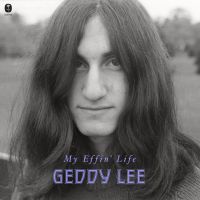
My Effin' LifeGeddy Lee17h 11m4.6 (13.1K)$40 · $0.00
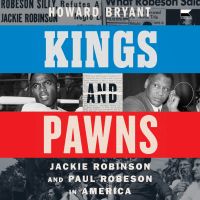
Kings and PawnsHoward Bryant10h 9m4.6 (678)$29 · $0.00
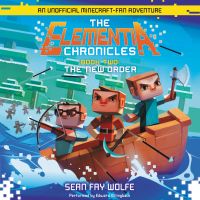
The Elementia Chronicles #2: The New OrderSean Fay Wolfe11h 17m4.6 (841)$29 · $0.00
The ActsLuke2h 55m4.6 (19.7K)$12 · $0.00
New Testament - Easy NavigationWorld English Bible19h 35m4.6 (1.3K)$1.30 · $0.00
You may also like
Fenimore Cooper's Literary OffencesMark Twain31m4.2 (548)Free
A Modest ProposalJonathan Swift22m4.2 (162.7K)$2.30
The Essays of Arthur Schopenhauer; the Art of ControversyArthur Schopenhauer3h 12m3.8 (19.1K)$2.30
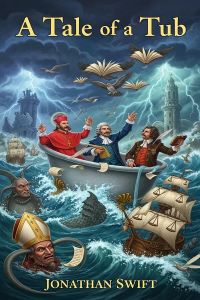
A Tale of a TubJonathan Swift4h 18m3.7 (12.8K)$2.30 · $0.00
Miss MappE. F. Benson8h 50m4.2 (4.1K)$20
The Best Russian Plays and Short Stories by Dostoevsky, Tolstoy, Chekhov, Gorky, Gogol and many moreAnton Chekhov, A.S. Pushkin, N.V. Gogol, I.S. Turgenev, F.M. Dostoyevsky, L.N. Tolstoy, M.Y. Saltykov, V.G. Korolenko, V.N. Garshin, F.K. Sologub, I.N. Potapenko, S.T. Semyonov, Maxim Gorky, L.N. Andreyev, M.P. Artzybashev, A.I. Kuprin, William Lyon Phelps50h 18m4.2 (1.6K)$0.99 · $0.00
A Book of NonsenseEdward Lear33m3.9 (4K)$2.80

The Awful German LanguageMark Twain59m4.1 (2.7K)$6 · $0.00
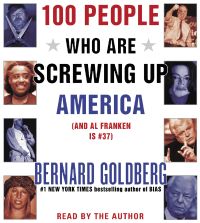
100 People Who Are Screwing Up AmericaBernard Goldberg6h 16m3.5 (2K)$24 · $0.00
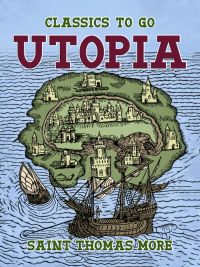
UtopiaSaint Thomas More4h 26m3.7 (102.4K)$2.30
Minding Miss MannersJudith Martin5h 30m4.1 (275)$17
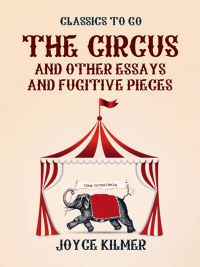
The Circus and Other Essays and Fugitive PiecesJoyce Kilmer6h 24m2.9 (10)$2.30
George Bettinger’s Mom & Pop Shop Interviews & VarietyGeorge Bettinger4h 11m$14
TalkiesEddie Cantor16m$3
The Comic English Grammar: A New And Facetious Introduction To The English TonguePercival Leigh3h 15m$1 · $0.00

Tour Of The Zero Club, Or, Adventures Amid Ice And SnowEdward Stratemeyer8h 10m$2.10
Make America Grate AgainTheobaldo Veira Monteiro10m$9 · $0.00
Christian ScienceMark Twain6h 45m3.5 (567)$2.30
Headlong HallThomas Love Peacock3h 13m3.5 (771)$1.20 · $0.00
Polite Conversation in Three Dialogues (Annotated)Jonathan Swift5h 10m3.9 (77)$1.99 · $0.00