
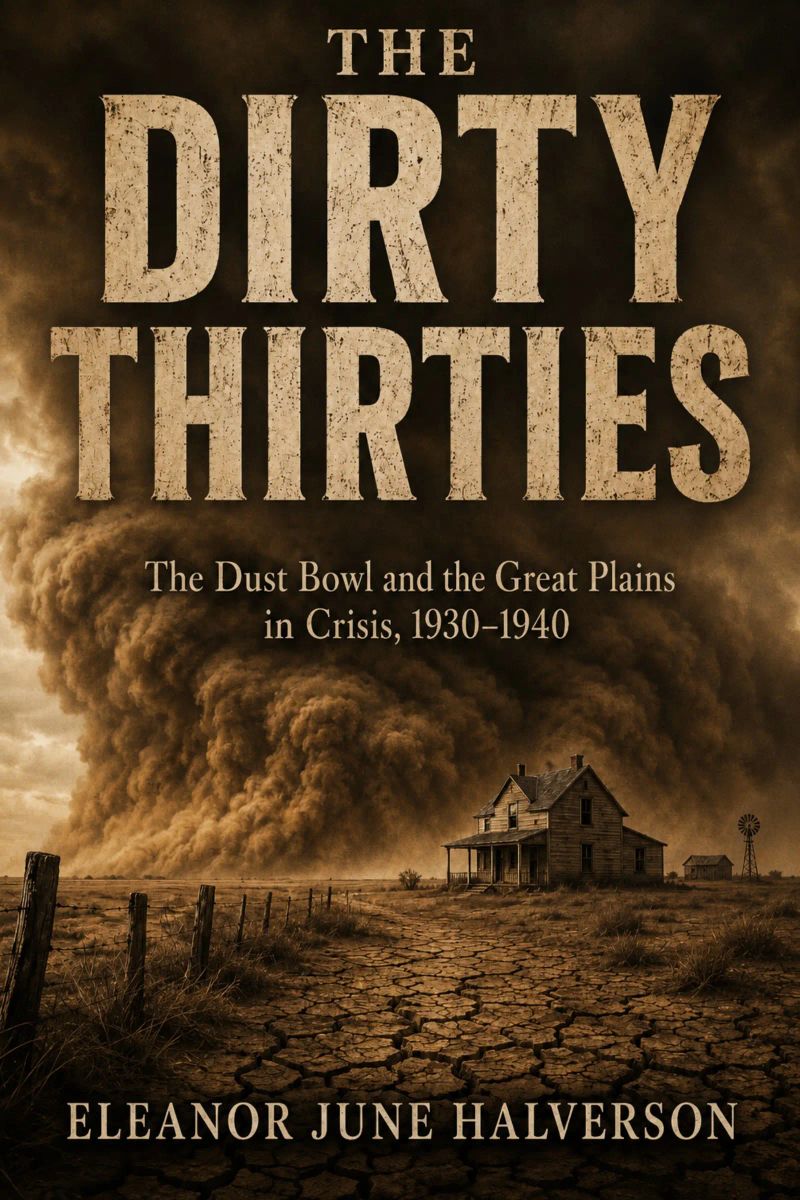
THE DIRTY THIRTIES
The Dust Bowl and the Great Plains in Crisis, 1930-1940By Eleanor June Halverson


Length5h 48m
About this audiobook
The complete narrative history of the Dust Bowl, 1930–1940 — Black Sunday, the Okies, Hugh Bennett's soil conservation battle, and the Great Plains environmental catastrophe that reshaped America.
On the morning of April 14, 1935, the sky over the Texas and Oklahoma panhandles was clear and warm. Families opened windows they had spent weeks sealing against the dust. By mid-afternoon, a cold front had dropped the temperature forty degrees in an hour, and people on the high plains saw it coming from the north — a wall of darkness stretching from horizon to horizon, thousands of feet high, moving at sixty miles per hour. AP reporter Robert Geiger called it "the dust bowl." The name stuck. What had been a region in crisis became, in language, a place: the Dust Bowl.
This Dust Bowl history follows the full arc of the Great Plains catastrophe across twenty-four chapters — from the native grasslands and Homestead Act settlement that set the trap, through the black blizzards of 1933–1936, the Okie migration west on Route 66, and the New Deal's emergency response, to the legacies that shape the southern plains today. Named throughout: Hugh Bennett, who turned Black Sunday into a congressional mandate for soil conservation; Dorothea Lange, whose FSA photographs gave the disaster a human face; John Steinbeck; Tom Collins of the Weedpatch camp; and the Plains women whose daily endurance kept communities intact through years of darkness and dust.
Inside this Dust Bowl and Great Plains history:
• How the Dust Bowl was made — buffalo grass roots five to ten feet deep, the "rain follows the plow" myth, and 1920s wheat prices that drove overfarming until the land was bare (Chapters 1–3)
• Black Sunday, April 14, 1935 — several hundred million tons of soil moved in one afternoon; within weeks, Congress passed the Soil Conservation Act (Chapter 6)
• Dust pneumonia and the human toll — county health records, elevated mortality in Dalhart, Texas, and children whose lungs were damaged before antibiotics existed (Chapter 8)
• The Okies — who left and why — 2.5 million left the Dust Bowl states; 210,000 reached California; the Weedpatch FSA camp housed 10,000 when 100,000 needed shelter (Chapters 9–11)
• Plains women and the long wait — Caroline Henderson's letters in The Atlantic, Imogene Glover's diary of flour and lard reserves, and the labor of maintaining hope without rain (Chapters 17–18)
• Hugh Bennett and soil conservation — how Bennett used Black Sunday to force the Soil Conservation Service into permanent existence and change American farming forever (Chapter 14)
• The Ogallala Aquifer today — what the survivors never knew lay beneath their feet, and what aquifer depletion means for the next Great Plains crisis (Chapter 23)
The Dust Bowl was not primarily an event. It was the revelation of a reality that had always been present — buried under the optimistic statistics of the wetter years. The southern plains had been farmed as though the bad years were exceptional. They were not. That lesson was learned at enormous cost, and it has had to be learned more than once. This Dust Bowl history is about what that learning cost, and what it produced.
For readers of Timothy Egan's THE WORST HARD TIME and Ken Burns's THE DUST BOWL.
Audiobook details
GenreHistory
Length5 hrs 48 mins
Narrated byListen with 1,000+ voices
FormateBook with Audio
Publish dateJun 2, 2026
LanguageEnglish
Table of contents
1Introduction
2Prologue: Black Sunday
3PART ONE: THE MAKING OF THE DUST BOWL
4Chapter 1: The Great Plains — Land, Climate, and the Promise of Farming
5Chapter 2: The Plow That Broke the Plains — Homesteading and Overfarming
Show all chaptersShow less
6Chapter 3: The Roaring Twenties on the Plains — Boom, Wheat, and Optimism
7Chapter 4: Drought Descends — The First Dust Storms, 1930-1932
8PART TWO: THE GREAT STORMS (1933-1936)
9Chapter 5: Black Blizzards — The Dust Storms That Darkened the Sky
10Chapter 6: Black Sunday — April 14, 1935, and the Worst Day
11Chapter 7: The Dirty Thirties — Life Inside the Dust Bowl
12Chapter 8: The Human Toll — Dust Pneumonia, Crop Failure, and Despair
13PART THREE: EXODUS AND MIGRATION
14Chapter 9: The Okies — Who Left and Why
15Chapter 10: Route 66 — The Road to California
16Chapter 11: California Dreaming — The Migrant Camps and the Welcome That Wasn't
17Chapter 12: John Steinbeck and the Grapes of Wrath — Literature and the Dust Bowl
18PART FOUR: THE GOVERNMENT'S RESPONSE
19Chapter 13: The New Deal on the Plains — AAA, SCS, and Federal Relief
20Chapter 14: Hugh Bennett and the Soil Conservation Service
21Chapter 15: The Shelterbelt Project — FDR's Prairie Forest
22Chapter 16: Dorothea Lange and the FSA — Photographing the Disaster
23PART FIVE: THE COMMUNITIES LEFT BEHIND
24Chapter 17: Those Who Stayed — Survival Strategies in the Dust Bowl
25Chapter 18: Plains Women — Endurance, Community, and the Long Wait
26Chapter 19: Churches, Schools, and Social Life in the Dust
27Chapter 20: The End of the Drought — Rain Returns and Recovery Begins
28PART SIX: LEGACIES
29Chapter 21: The Soil Conservation Movement — What the Dust Bowl Taught
30Chapter 22: Federal Farm Policy — The Long Agricultural Legacy
31Chapter 23: The Great Plains Today — Aquifer Depletion and Future Risk
32Chapter 24: Memory and Myth — The Dust Bowl in American Culture
33Epilogue: What the Dust Left Behind
34Acknowledgments
35Selected Bibliography
36About the Author
More from Eleanor June Halverson


A Brief History of IntelligenceMax S. Bennett12h 18m4.6 (6.6K)$29 · $0.00

Where Cowards Go to DieBenjamin Sledge8h 42m4.7 (351)$20 · $0.00

RevolutionariesSanjeev Sanyal11h 23m4.6 (2.6K)$29 · $0.00

We Crossed a Bridge and It TrembledWendy Pearlman6h4.6 (5.2K)$24 · $0.00

Unbroken Bonds of BattleJohnny Joey Jones8h 31m4.6 (2.6K)$8 · $0.00

The Daughter of AuschwitzTova Friedman, Malcolm Brabant7h 54m4.6 (16.7K)$26 · $0.00

Lily's PromiseLily Ebert, Dov Forman8h 54m4.6 (16.1K)$29 · $0.00
On Democracies and Death CultsDouglas Murray10h 38m4.6 (6.5K)$29 · $0.00

Across the RiverKent Babb11h 40m4.6 (927)$29 · $0.00

Balcony Over Jerusalem: A Middle East Memoir - Israel, Palestine and BeyondJohn Lyons12h 37m4.6 (1.4K)$33 · $0.00

BeyondStephen Walker15h 39m4.6 (3.2K)$33 · $0.00
Kings and PawnsHoward Bryant10h 9m4.6 (678)$29 · $0.00

No EscapeNury Turkel9h 30m4.6 (809)$28 · $0.00
Jubal Stone: U.S. Marshal: Blood Trail To Hell: A Western Adventure NovelCasey Nash3h 42m4.6 (3.2K)$18 · $0.00
Fall and RiseMitchell Zuckoff17h 23m4.6 (9.8K)$40 · $0.00
The SurvivorJosef Lewkowicz, Michael Calvin9h 22m4.6 (2.5K)$29 · $0.00

Always FaithfulThomas Schueman, Zainullah Zaki12h 12m4.6 (977)$29 · $0.00

The State of Society in France Before the Revolution of 1789 (Annotated)Alexis de Tocqueville17h 25m4.6 (1.2K)$2 · $0.00

All the Gallant MenDonald Stratton, Ken Gire5h 55m4.6 (11.8K)$24 · $0.00
Saint Joan (Annotated)George Bernard Shaw6h 20m4.6 (1.2K)$1.20 · $0.00
You may also like
DetroitScott Martelle10h 5m3.9 (2.4K)$20
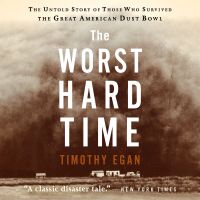
The Worst Hard TimeTimothy Egan12h 57m4.1 (63.4K)$33 · $0.00
The Mess That We MadeMichelle Lord14m4.4 (786)$5 · $0.00
Blizzard!Jim Murphy2h 39m4.0 (1.8K)$15
The Rise and Reign of the MammalsSteve Brusatte13h 26m4.4 (11.1K)$33 · $0.00
Thomas Jefferson: Notes on the State of Virginia (Annotated)Thomas Jefferson12h 6m3.7 (1.1K)$2 · $0.00
The Big BurnTimothy Egan9h 58m4.2 (19.3K)$29 · $0.00
The Great HurricaneCherie Burns5h 50m4.1 (1.9K)$17
The Ginseng HunterJeff Talarigo4h 16m3.6 (1.2K)$20 · $0.00

A Wolf Called RomeoNick Jans9h 49m4.3 (6.3K)$29 · $0.00

The Storm of the CenturyAl Roker, William Hogeland8h 7m4.1 (3.1K)$26 · $0.00
The Little Red Book of Fly FishingDeeter, Kirk4h 18m4.2 (2.3K)Free

Views and OpinionsOuida12h 11m$2.30
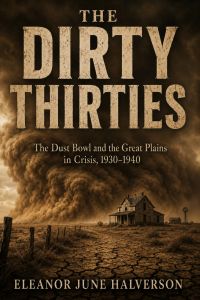
THE DIRTY THIRTIESEleanor June Halverson6h$6 · $0.00
On Youth And Old Age, On Life And Death, On BreathingAristotle1h 10m3.2 (45)$1.80 · $0.00
The Story of the Great Fire in St. John, N.B., June 20th, 1877George Stewart7h 4m$1 · $0.00

NCCCO Mobile Crane Operator Certification Study GuideSebastian Crowe10h 26m$18.50 · $0.00

The Storm. An Essay (Annotated)Daniel Defoe1h 49m3.5 (374)$1.99 · $0.00
THE DARKEST DECADEFrances Millicent Shaw5h 26m$10 · $0.00

The BedbugC. L. Marlatt35m$2.30