
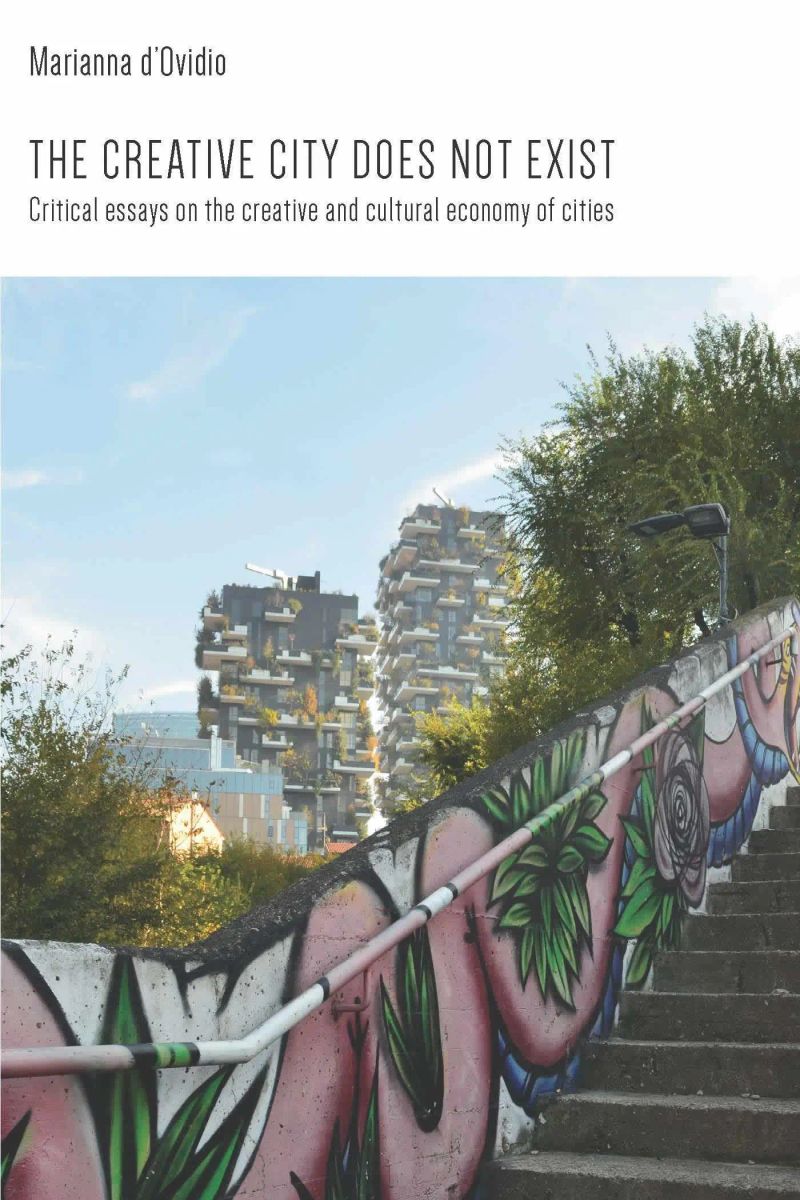
The creative city does not exist
By Marianna d'Ovidio


Length6h 45m
About this audiobook
Every city wants to become creative, perhaps even the most creative ever. But what does it mean to be a creative city? What images take shape as a consequence? What sort of city do we envisage? Which one are we actually building?
In a journey that starts with Blade Runner and passes through English punk, Milanese creative workers and Star Wars, the book explores the features and outcomes of the creative city, penetrating its dark side but also identifying its assets. In the future, cities must be guided by a vision of a creative city able to be inclusive yet competitive, to open new public spaces and to be socially innovative. This book presents some of the tools that allow us to look at the city as a place whose air makes people free.
Audiobook details
GenrePsychology
Length6 hrs 45 mins
Narrated byListen with 1,000+ voices
FormateBook with Audio
Publish dateSep 30, 2016
LanguageEnglish
Table of contents
1Introduction
2Acknowledgments
3Introduction
4Framing concepts
5Which city?
Show all chaptersShow less
6Creative and cultural economy
7Chapter 1 The creative and cultural economy in cities
81 Post-Fordism
92 Mass consumption
102.1 Origin and rising of mass-consumption
11The industrial revolution
12After the Second World War: free time, available income
13Mass-consumption in the making: The 1960s and the 1970s
142.2 The commodification of culture
153 Creating the creative city
163.1 Creative city as a theoretical model
173.2 Creative city as a paradigm for local development
183.3 Creative city as an urban branding
194 Reaction to the creative city
20Chapter 2 Fashion and the creative city
211 Fashion and identity
222 The creation of a fashion industry
233 The creative process
244 Fashion and the city
254.1 Fashion production and consumption in cities
264.2 Fashion as a tool for competition among global cities
27Chapter 3 Supporting the creative and cultural economy. An analytical framework14
281 Cultural policies versus policies for the creative city
292 The rules of the game
303 The capitals of the creative and cultural economy
313.1 Cultural capital
323.2 Economic capital
333.3 Social capital
344 Seven case studies to build an analytical framework
355 Institutions at work
366 Institutions, culture and creativity
37Chapter 4 Social networks in the creative and cultural economy. The case of Milan, Italy20
381 The geography of the creative and cultural economy
392 Social relations and local development
403 Social capital in the urban cultural economy
414 Creativity and culture in the Milanese region: 4.1 Networks of workers in the cultural economy
425 Functioning social networks with an uncertain future
43Chapter 5 The attractiveness of Milan. Testing the creative class theory
441 Do jobs follow people or do people follow jobs33?
452 Researching the attractiveness of Milan: the research design
463 Hard factors
473.1 Labour market and job availability
483.2 Universities and education
493.3 Bureaucracy
503.4 Housing and the cost of living
What to Make of a LifeJim Collins13h 31m4.4 (794)$33 · $0.00

Black AF HistoryMichael Harriot15h 43m4.7 (14.6K)$33 · $0.00

Bad Fat Black GirlSesali Bowen6h 32m4.7 (2.8K)$24 · $0.00

Invisible StormJason Kander6h 48m4.7 (3.2K)$24 · $0.00

I Am The StormJanice Dean9h4.6 (1.5K)$8 · $0.00
On Democracies and Death CultsDouglas Murray10h 38m4.6 (6.5K)$29 · $0.00

TerraformPropaganda5h 39m4.7 (594)$24 · $0.00

Southern Horrors: Lynch Law in All Its Phases (Annotated)Ida B. Wells-Barnett2h 44m4.6 (1.3K)$2 · $0.00
Hour of the HeartIrvin D. Yalom, Benjamin Yalom8h 19m4.6 (2.3K)$26 · $0.00

Braving the TruthRachel Held Evans11h 31m4.7 (359)$29 · $0.00
Level UpRob Dial7h 42m4.6 (3.3K)$26 · $0.00

As a JewSarah Hurwitz8h 36m4.6 (1.2K)$26 · $0.00
Saint Joan (Annotated)George Bernard Shaw6h 20m4.6 (1.2K)$1.20 · $0.00

Burn the HaystackJennie Young, PhD9h 30m4.6 (543)$29 · $0.00

Woman and the New Race (Annotated)Margaret Sanger6h 30m4.6 (1K)$1.99 · $0.00

Good InsideBecky Kennedy9h 55m4.5 (59.3K)$29 · $0.00
The Mis-Education of the NegroCarter Godwin Woodson5h 4m4.5 (29.4K)$1.20 · $0.00
Du Bois: EssaysW.E.B. Du Bois6h 22m4.6 (1.5K)$1 · $0.00

The North American Indian (Illustrated Edition)Edward S. Curtis, Frederick Webb Hodge5h 59m4.6 (1.4K)$2 · $0.00

Valley of the BirdtailAndrew Stobo Sniderman, Douglas Sanderson10h 1m4.6 (2.4K)$29 · $0.00
You may also like
The Speed of SoundScott Eyman13h 39m4.2 (368)$23
Relativity: The special and the general theoryAlbert Einstein3h 23m4.2 (41.4K)$3.50 · $0.00
A History of Video Games in 64 ObjectsWorld Video Game Hall of Fame7h 41m4.1 (477)$26 · $0.00

As I see the world (Translated)Albert Einstain3h 6m4.2 (29.4K)$6.80 · $0.00

The Essential DruckerPeter F. Drucker10h 57m4.3 (11K)$29 · $0.00

Who We Are and How We Got HereDavid Reich10h 51m4.3 (10.5K)$23

The EuropeansOrlando Figes21h 39m4.3 (6.3K)$30

Career: Salary, Remuneration, Positions And FunctionsJoaquim Carlos Lourenço4h 3m$6 · $0.00

Smooth Sailing: A First-Timer’s Guide to Princess CruisesJUDE CALEB7h 18m$10

The Information Age - Computer NetworksJack Chmela28m$5 · $0.00

MeconomyMarkus Albers5h$8 · $0.00

The Autobiography of an ElectronCharles R. Gibson1h 29m3.6 (14)$2 · $0.00

Florida Class A Air Conditioning Contractor Exam Study GuideMarie Peterson8h 45m$10

Blockchain : A Complete HistoryUnknown Author53m$17 · $0.00
Notion Made SimpleRuth Callender4h 16m$8

The Fractional Executive PlaybookJasper LindhoLm4h 13m$9 · $0.00

ChineseMade for Success6h 42m$30

1000 Palavras E Frases Em InglêsRicardo Esteves2h 40m$14 · $0.00
Starting an E-Bay Business for DummiesMarsha Collier3h 25m3.7 (346)$18 · $0.00

How to Discover Your Life Purpose in About 20 MinutesSteve Pavlina13m$4 · $0.00