
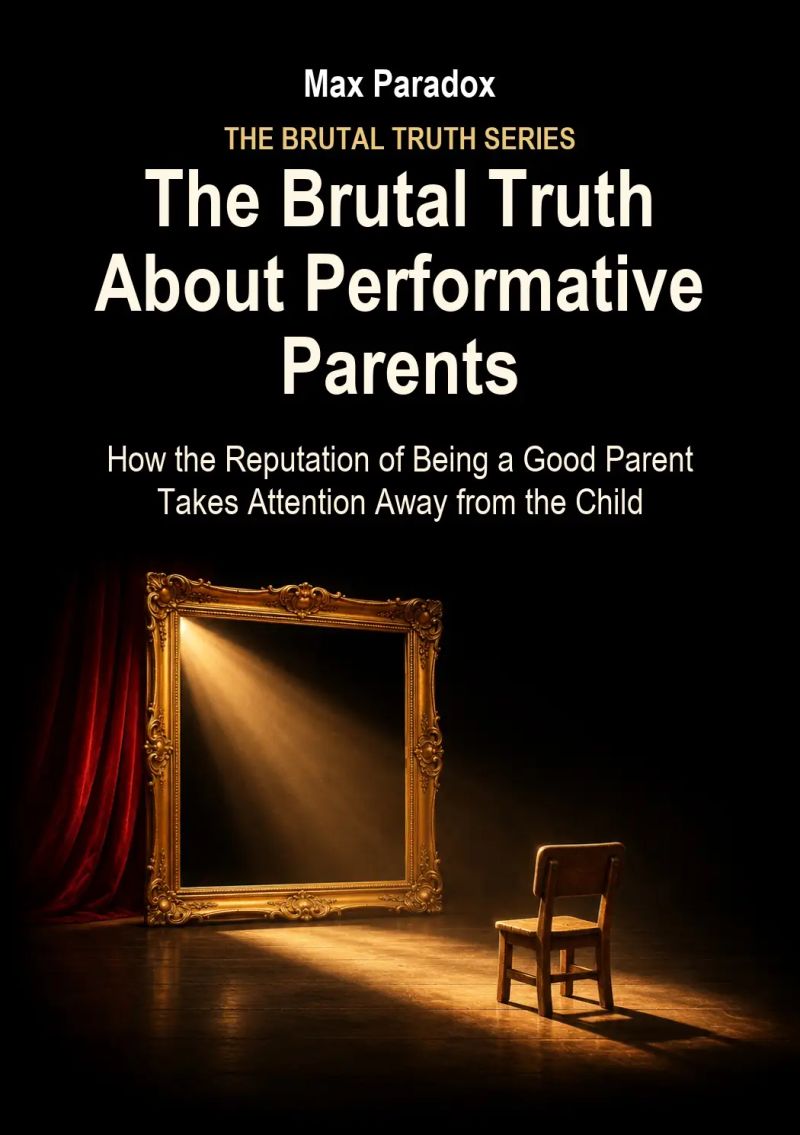
The Brutal Truth About Performative Parents - How the Reputation of Being a Good Parent Takes Attention Away from the Child
By Max Paradox


Length6h 39m
About this audiobook
Who receives a parent's attention when an audience is watching? This book follows the tension between doing the daily work of raising a child and collecting evidence of being seen as a good parent.
From the introduction
At a school performance, a father sits in the third row with his phone raised to eye level. Before she begins reciting her lines, his daughter searches the audience for him. She sees a screen, not his eyes. He records carefully, keeping the frame steady, avoiding the head of the woman sitting in front of him, moving his finger whenever his child drifts away from the centre of the image. After the performance, he will show the video to the family, upload a short clip online and write that he is proud. He is not lying. He is proud. Yet for several minutes, his attention belongs to the people who will eventually watch the recording, even though he is sitting at an event that was supposed to belong to his daughter. When the little girl runs off the stage, she asks, "Did you see me?" Her father replies that of course he did. He recorded everything. To him, this is proof that he was present. To her, it may be evidence of something considerably less comfortable.
Scenes like this do not necessarily indicate emotional coldness, a lack of love or deliberate neglect. They often begin with intentions that are difficult to criticise: preserving a memory, expressing pride, sharing an important moment or documenting a child's childhood. A parent wants to be good and wants other people to know that they are good. For a long time, these two desires can coexist without producing any obvious conflict. The problem begins when the second starts organising the first. An event is no longer simply an experience shared by a child and a parent. It becomes material from which a convincing story about the family can be constructed.
A performative parent does not have to be someone who posts photographs every day, organises extravagant birthday parties or talks about personal sacrifices at every opportunity. Sometimes the most carefully maintained image never reaches the internet. It develops through conversations around the dinner table, school meetings, gatherings with friends, family comparisons and small messages communicated to the surrounding world. One parent talks about how many extracurricular activities their child attends. Another emphasises that they never miss an important event. Someone else displays a photograph of a perfectly organised birthday party, as though arranging it were straightforward proof of parental quality. Each gesture may be entirely innocent. Its meaning changes when other people's judgement becomes the hidden audience for almost every decision.
This publication was prepared using tools that support the creative process, including artificial intelligence solutions. The final concept, structure and editing are the responsibility of the author.
Audiobook details
GenreSelf-Help
Length6 hrs 39 mins
Narrated byListen with 1,000+ voices
FormateBook with Audio
Publish dateNov 29, 2026
LanguageEnglish
Table of contents
1INTRO
2Chapter 1 - The Child Who Has to Look Good
3Chapter 2 - Stories About the Child That Belong to the Parent
4Chapter 3 - Smile, One More Time
5Chapter 4 - When Help Has an Audience
Show all chaptersShow less
6Chapter 5 - The Bill for Everything I Have Done for You
7Chapter 6 - The Second Chance the Child Never Asked For
8Chapter 7 - The Success That Belongs to the Whole Family
9Chapter 8 - Don't Bring Shame on Us
10Chapter 9 - Two Parents, One Version of Events
11Chapter 10 - Two Homes, Two Competitions for the Better Parent
12Chapter 11 - The Child Who Keeps the Adults in a Good Mood
13Chapter 12 - One Child on Display, Another for Comparison
14Chapter 13 - When She No Longer Knows What She Really Wants
15Chapter 14 - Adulthood That Still Belongs to the Parents
16Chapter 15 - You Have No Right to Be Angry with Us
17Chapter 16 - When the Phone Stops Ringing
18Chapter 17 - I'm Only Doing This for Your Own Good
19Chapter 18 - Everyone Was Raised This Way
20Chapter 19 - The Family Story That Must Never Change
21Chapter 20 - The Day the Child Refuses to Confirm the Story

The Brutal Truth About Men Without Confidants - How the Ideal of Self-Sufficiency Sets the Limits of Male IntimacyMax Paradox7h 50m$7.40

Brutalna prawda o mężczyznach bez powierników - Jak wzór samowystarczalności wyznacza granice męskiej bliskościMax Paradox7h 20m$7.40

Brutalna prawda o randkach jak rekrutacja - Co dzieje się z bliskością, kiedy każda osoba jest tylko jedną z opcjiMax Paradox6h 50m$7.40

Brutalna prawda o rodzicach na pokaz - Jak reputacja dobrego rodzica przejmuje uwagę przeznaczoną dla dzieckaMax Paradox6h 7m$7.40

Brutalna prawda o przeprosinach bez zmiany - Dlaczego łatwo uznać winę, kiedy rachunek nadal płaci ktoś innyMax Paradox6h 19m$7.40

Die brutale Wahrheit darüber, immer gebraucht zu werden - Was wir gewinnen, wenn uns die Selbstständigkeit anderer als Bedrohung erscheintMax Paradox6h 20m$7.40

Die brutale Wahrheit über die Ruhe im Internet - Was wir im Tausch gegen eine Bequemlichkeit aufgeben, um die wir nicht einmal mehr bitten müssenMax Paradox6h 46m$7.40

Brutalna prawda o świętym spokoju w internecie - Co oddajemy w zamian za wygodę, o którą już nawet nie musimy prosićMax Paradox5h 42m$7.40
The Brutal Truth About Politeness as Punishment - How Proper Words Can Humiliate Without Raising Your VoiceMax Paradox6h 16m$7.40

Brutalna prawda o automatyzowaniu odpowiedzialności - Kto naprawdę podejmuje decyzje, za które podobno odpowiada systemMax Paradox6h 34m$7.40

Die brutale Wahrheit über öffentliche Trauer - Wer hat ein Recht auf fremden Schmerz, wenn Verlust zum Content wirdMax Paradox6h 24m$7.40

Die brutale Wahrheit über das Wort „toxisch“ - Wann die Sprache des Schutzes hilft, Verletzungen zu benennen, und wann sie das Gespräch beendetMax Paradox7h 16m$7.40

Die brutale Wahrheit über das Leben nach Zahlen - Wie tägliche Messungen das Wohlbefinden in einen optimierungsbedürftigen Leistungsbericht verwandelnMax Paradox6h 21m$7.40
The Brutal Truth About Performative Rest - Why Even Our Free Time Has to Produce Results or Look GoodMax Paradox5h 29m$7.40

The Brutal Truth About Peace of Mind Online - What We Give Up in Exchange for Convenience We No Longer Even Have to Ask ForMax Paradox5h 58m$7.40

The Brutal Truth About the Sacred Right to Honesty - How Honesty Becomes a Tool for Inflicting Wounds and Avoiding ResponsibilityMax Paradox6h 36m$7.40

Brutalna prawda o byciu ciągle potrzebnym - Co zyskujemy, gdy cudza samodzielność wydaje się nam zagrożeniemMax Paradox5h 20m$7.40
The Brutal Truth About Automating Responsibility - Who Really Makes the Decisions the System Is Supposedly Responsible ForMax Paradox6h 59m$7.40

Die brutale Wahrheit über Menschen, die immer recht haben - Was wir wirklich schützen, wenn Widerspruch zur Bedrohung wirdMax Paradox7h 8m$7.40
Learning to PrayJames Martin13h 24m4.5 (3.4K)$33 · $0.00

A Different WayChristopher A. Hall10h 45m4.5 (165)$29 · $0.00

The Hard Thing About Hard ThingsBen Horowitz7h 57m4.2 (134.3K)$26 · $0.00

10% Happier 10th AnniversaryDan Harris9h 28m4.1 (137.1K)$29 · $0.00
The Power of the OtherHenry Cloud5h 52m4.2 (3.5K)$24 · $0.00

What You Are Looking For Is in the LibraryMichiko Aoyama7h 19m4.1 (156.7K)$24 · $0.00
The Way of ExcellenceBrad Stulberg6h 46m4.2 (1.1K)$24 · $0.00

The AlchemistPaulo Coelho4h 1m4.1 (3.9M) · 1326$23 · $0.00

Change the RecipeJosé Andrés, Richard Wolffe4h 57m4.1 (2K)$20 · $0.00

The Lucky RideYasushi Kitagawa4h 26m4.1 (1.8K)$20 · $0.00
Be ExceptionalJoe Navarro, Toni Sciarra Poynter9h 11m4.0 (1.3K)$29 · $0.00
The Subtle Art of Not Giving a F*ckMark Manson5h 18m3.9 (1.7M)$24 · $0.00

HomeschooledStefan Merrill Block7h 10m3.6 (18.5K)$28 · $0.00

Autoimmunity and the Good GirlsSara Hirsh Bordo7h 51m$26 · $0.00

The Purpose Driven® Liferick warren9h 23m4.0 (896.8K) Only with Ultra

Your Desired FutureHenry Cloud6h 43m$24 · $0.00

Spiritual AnatomyDaaji Kamlesh D. Patel9h 47m4.7 (319)$29 · $0.00

The Dangerous Truth about Today’s MarijuanaLaura Stack CSP, MBA9h 57m4.7 (385)$20 · $0.00

The Gospel according to Spiritualism (Translated)Allan Kardec14h 39m4.6 (3.9K)$5.70 · $0.00

Birdie & HarlowTaylor Wolfe7h 50m4.6 (6.5K)$26 · $0.00
You may also like

The Letters of Jane AustenJane Austen8h 34m4.3 (4.5K)$3 · $0.00

Cherries and Cherry PitsVera B. Williams12m4.3 (577)$4 · $0.00

Acres of DiamondsRussell H. Conwell1h 26m4.2 (12.9K)$13

KAMA SUTRA (Annotated)Richard Francis Burton7h 57m3.7 (26.7K)$2 · $0.00

Bogie & BacallWilliam J. Mann27h 34m4.0 (1K)$53 · $0.00

The Family ClauseJonas Hassen Khemiri10h3.9 (4.5K)$20 · $0.00

The Brutal Truth About Children’s Privacy - What Adults Gain by Sharing a Story That Also Belongs to the ChildMax Paradox5h 32m$7.40

How to Talk to Loved Ones When Your Views Divide YouMax Paradox6h 54m4.6 (65)$7.50

The Collected Articles, Lectures, Essays and Letters (Annotated)George Bernard Shaw45h 20m$2 · $0.00

WOMEN & ECONOMICSCharlotte Perkins Gilman8h 19m3.6 (326)$1.99 · $0.00

Partial PortraitsHenry James8h 23m4.1 (156)$1 · $0.00

The Surprising Connection Between Baby Milestones and SleepAurora Brooks1h 8m$3.50 · $0.00

The Working Mom's Guide to Raising Successful KidsAurora Brooks1h 30m$3.50 · $0.00

The psycho-analytic study of the familyJ. C. Flugel9h 31m$2 · $0.00

LovelinessElizabeth Stuart Phelps5m$2 · $0.00

My Shift Is Over, but the Sun Is Already Up - How to Set Up Your Home and Plan Rest After Night ShiftsMax Paradox8h 38m$7.40

The Four Books of Confucianism (Bilingual Edition: English/Chinese)Mencius, Anonymous13h 41m4.4 (18)$1.99 · $0.00

Narcissism: Understanding Narcissism and the Mindset of Toxic People (A Healing Guide to Breaking Free From Toxic Family Patterns and Rediscovering Your True Self)Matt g, James Kearney3h 24m$15 · $0.00

The Brutal Truth About Being a Woman - You Are Expected to Be Everything at Once and Still SmileMax Paradox6h 21m$7.50

I'm Planning My Wedding and Suddenly Everyone's a Consultant - How to Set a Budget, Priorities, and Boundaries with Family and Vendors Without Turning a Single Day into the Biggest Operations Project of the DecadeMax Paradox6h 34m$7.50