
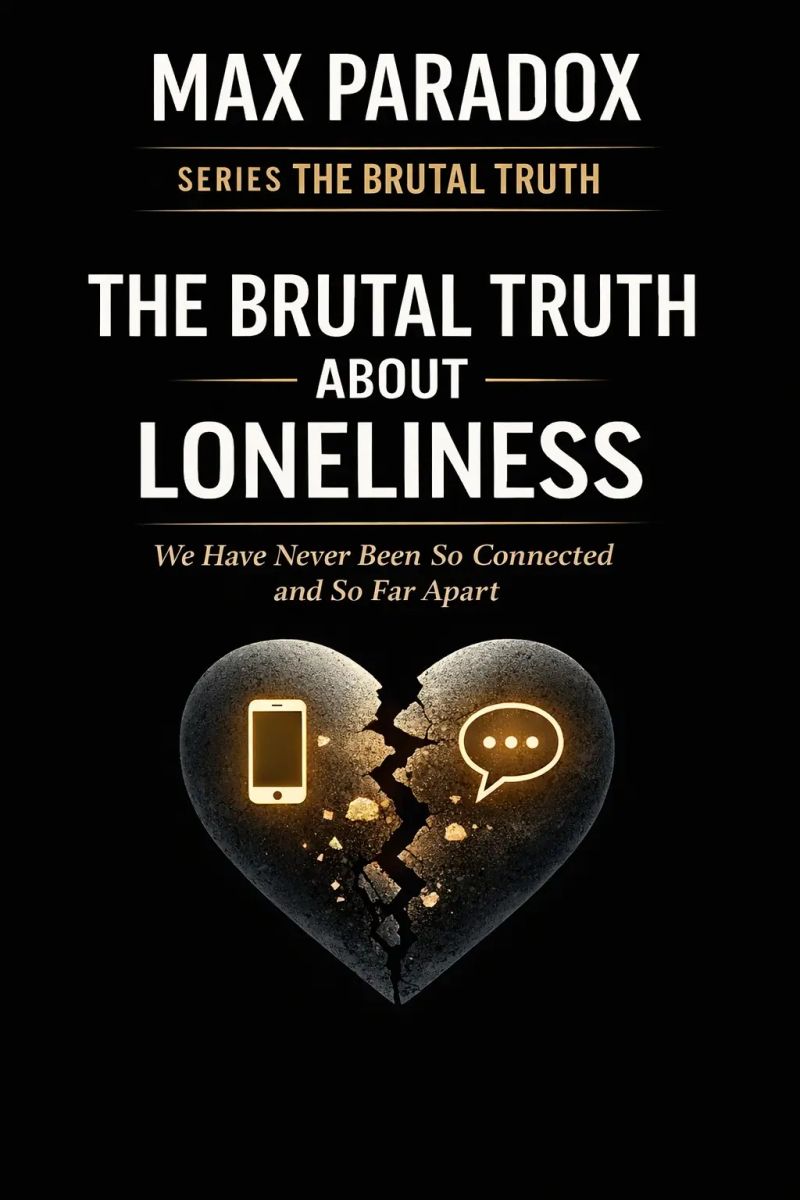
The Brutal Truth About Loneliness - We Have Never Been So Connected and So Far Apart
By Max Paradox


Length5h 48m
About this audiobook
In a world where everyone is always connected, loneliness should no longer exist.
We can message anyone instantly.
We can see what our friends are doing in real time.
We can join conversations, communities, and digital spaces at any hour of the day.
And yet something strange has happened.
Loneliness has not disappeared.
It has simply changed its form.
The Brutal Truth About Loneliness is not a self-help guide, a motivational book, or a collection of comforting advice. It is a sharp, psychological dissection of the quiet mechanisms that shape modern relationships and slowly create emotional distance between people.
This book explores a disturbing paradox of modern life: people communicate constantly, but rarely reveal themselves.
Through thirty-five psychological mechanisms, the book exposes how loneliness grows in environments that appear socially active. It examines patterns such as emotional editing, passive disconnection, attention migration, stimulation substitution, silent comparison, expectation deflation, and emotional minimalism.
Each mechanism reveals a subtle behavioral pattern people repeat every day without realizing how it reshapes their relationships.
The result is rarely dramatic isolation.
The result is something far more complex.
A life surrounded by conversations, messages, and social activity that never quite reach the emotional depth required for genuine connection.
The book moves through realistic situations that feel disturbingly familiar: late-night scrolling through other people's lives, conversations that remain polite instead of honest, friendships that fade without conflict, group gatherings where someone feels quietly peripheral, and relationships where people protect their roles instead of revealing their uncertainty.
At the center of the analysis lies a difficult insight.
Modern loneliness does not always come from being alone.
It often grows inside relationships that function perfectly on the surface while quietly removing vulnerability, curiosity, and emotional friction.
The book explores how fragmented attention weakens listening, how limited emotional vocabulary prevents people from expressing what they truly feel, and how stimulation gradually replaces connection. It reveals why people adapt to shrinking expectations, celebrate independence that may actually be emotional adaptation, and remain trapped in social roles that prevent others from truly seeing them.
Throughout the chapters, readers will recognize moments from their own lives.
The message you meant to answer later but never did.
The conversation that stayed comfortable instead of becoming honest.
The invitation that sounded warm but never turned into a meeting.
The moment you almost said something real and stopped.
These small moments accumulate quietly.
They shape the emotional structure of modern life.
Rather than offering solutions, this book acts as a brutally honest diagnosis of everyday social behavior. It reveals how many habits that seem harmless or practical gradually weaken emotional closeness.
The most unsettling discovery is not how loneliness appears in other people.
It is how easily we recognize ourselves inside these patterns.
This book is for readers who sense that something about modern connection has changed. For those who feel that communication has become constant while understanding has become rare.
And for those willing to confront a difficult truth.
Loneliness is not always created by the absence of people.
Sometimes it grows quietly in the middle of conversation.
This publication was prepared using tools that support the creative process, including solutions based on artificial intelligence. The final concept, structure, and editing are the work of the author.
Audiobook details
GenreSelf-Help
Length5 hrs 48 mins
Narrated byListen with 1,000+ voices
FormateBook with Audio
Publish dateAug 25, 2026
LanguageEnglish
Table of contents
1INTRO
2Chapter 1 - The Performance of Being Social
3Chapter 2 - Narrative Self-Defense
4Chapter 3 - Social Comparison Addiction
5Chapter 4 - Identity Curation
Show all chaptersShow less
6Chapter 5 - Conflict Avoidance
7Chapter 6 - Vulnerability Resistance
8Chapter 7 - Emotional Outsourcing
9Chapter 8 - Status Signaling
10Chapter 9 - Identity Protection
11Chapter 10 - Emotional Self-Sufficiency
12Chapter 11 - Nostalgia Bias
13Chapter 12 - Attention Economics
14Chapter 13 - Reputation Management
15Chapter 14 - Belonging Theater
16Chapter 15 - Reciprocity Illusion
17Chapter 16 - Time Fragmentation
18Chapter 17 - Emotional Editing
19Chapter 18 - Emotional Self-Misinterpretation
20Chapter 19 - Emotional Vocabulary Collapse
21Chapter 20 - Passive Disconnection
22Chapter 21 - Attention Migration
23Chapter 22 - Stimulation Substitution
24Chapter 23 - Emotional Friction Avoidance
25Chapter 24 - Emotional Responsibility Avoidance
26Chapter 25 - Loss Anticipation
27Chapter 26 - Role Fixation
28Chapter 27 - Emotional Minimalism
29Chapter 28 - Listening Without Presence
30Chapter 29 - Emotional Memory Erosion
31Chapter 30 - Expectation Deflation
32Chapter 31 - Independence Illusion
33Chapter 32 - Silent Comparison
34Chapter 33 - Peripheral Presence
35Chapter 34 - Forgettable Presence
36Chapter 35 - Emotional Exposure Threshold

Motherhood Is Not What They Said It Was - A Brutally Honest, Darkly Funny Guide to Surviving the Absurdity of Being a MotherMax Paradox4h 44m$7.70 · $0.00

How to Understand Women - A Completely Useless Guide Based on True StoriesMax Paradox3h 8m$7.70 · $0.00

The Brutal Truth About Confidence - Why Most “Confident” People Are Just Performing CertaintyMax Paradox5h 46m$7.70 · $0.00

Nienawidzę swojej pracy - Jak odzyskać kontrolę, zanim rzucisz identyfikatorem w ekspres do kawyMax Paradox5h 49m$7.70 · $0.00

I Haven't Replied Because Now It's Been Too Long - How to Get Out of Message Debt Without Changing Your NumberMax Paradox7h 45m$7.70 · $0.00

I May Be Too Close to My Chatbot - How to Use AI Without Replacing Everyone You KnowMax Paradox6h 29m$7.70 · $0.00

I'm Jealous of Everything - How to Stop Seeing an Affair in Every “Hi” and Every LikeMax Paradox7h 5m$7.70 · $0.00

The Absurd Empire - A Laughing Explanation of Why the USA Is the Biggest Power on EarthMax Paradox3h 36m$7.70 · $0.00

My Grown Child Doesn't Need Me Anymore - How to Rediscover Yourself When Parenting Stops Being a Full-Time JobMax Paradox6h 34m$7.70 · $0.00
I Feel Responsible for Everyone - How to Give People Back Their Own Lives Without Feeling Like a MonsterMax Paradox6h 20m$7.70 · $0.00
How to Stop Putting Everything OffMax Paradox6h 41m$7.70 · $0.00

The Anesthesia Years - How Surviving on Empty Became the Life You Didn't ChooseMax Paradox6h 1m$7.70 · $0.00

I Pay for the Gym So It Knows I Support It - How to Start Moving Without Launching a Whole New Life on MondayMax Paradox6h 17m$7.70 · $0.00

I Earn More and Still Feel Poorer - How to Navigate a World Where Everything Costs a Ridiculous AmountMax Paradox7h 29m$7.70 · $0.00

How to Stop Fearing RejectionMax Paradox6h 40m$7.70 · $0.00

I Have Friends, but We Always Meet “Someday” - How to Keep Friendships Alive When the Next Free Date Is in 2029Max Paradox6h 54m$7.70 · $0.00

Każde piknięcie rządzi moim dniem - Jak odzyskać uwagę od powiadomień, wiadomości i czerwonych kropekMax Paradox5h 23m$7.70 · $0.00

Kupuję zdrowe jedzenie, a potem zamawiam pizzę - Jak planować posiłki dla człowieka, którym naprawdę jesteśMax Paradox4h 58m$7.70 · $0.00

Nie wiem, czego chcę od życia - Jak znaleźć kierunek bez objawienia, coacha i wyjazdu do TybetuMax Paradox5h 9m$7.70 · $0.00
Learning to PrayJames Martin13h 24m4.5 (3.4K)$33 · $0.00

Swayam Ki AwaazPrem Rawat8h 34m4.7 (1.1K)$26 · $0.00

Forever BoyKate Swenson9h 27m4.7 (5K)$29 · $0.00

You Are Worth ItKyle Carpenter, Don Yaeger8h 53m4.7 (4.8K)$29 · $0.00

The Happiest Man on EarthEddie Jaku3h 48m4.6 (178K)$7 · $0.00

Finding MeViola Davis9h 15m4.6 (256.4K)$29 · $0.00

Spiritual AnatomyDaaji Kamlesh D. Patel9h 47m4.7 (319)$29 · $0.00

The Dangerous Truth about Today’s MarijuanaLaura Stack CSP, MBA9h 57m4.7 (385)$20 · $0.00

The Gospel according to Spiritualism (Translated)Allan Kardec14h 39m4.6 (3.9K)$5.70 · $0.00

Birdie & HarlowTaylor Wolfe7h 50m4.6 (6.5K)$26 · $0.00

CrossroadsKaleb Dahlgren7h 56m4.6 (4.9K)$26 · $0.00

Life on the BridgeKaelynn Partlow5h 40m4.6 (1.1K)$24 · $0.00

Keep Your Love OnDanny Silk9h 4m4.6 (8.1K)$10 · $0.00

The Tao of Joy Every DayDerek Lin10h 24m4.6 (762)$20 · $0.00

UndividedVicky Beeching9h 2m4.6 (1.3K)$29 · $0.00

HE CAN WHO THINKS HE CAN & OTHER BOOKS ON SUCCESSOrison Swett Marden5h 54m4.6 (1.2K)$1.99 · $0.00
Level UpRob Dial7h 42m4.6 (3.3K)$26 · $0.00

Burn the HaystackJennie Young, PhD9h 30m4.6 (543)$29 · $0.00

ACRES OF DIAMONDS: Our Every-day Opportunities (Wisdom & Empowerment Series) (Annotated)Russell Conwell2h 26m4.6 (1K)$2 · $0.00

Good InsideBecky Kennedy9h 55m4.5 (59.3K)$29 · $0.00