
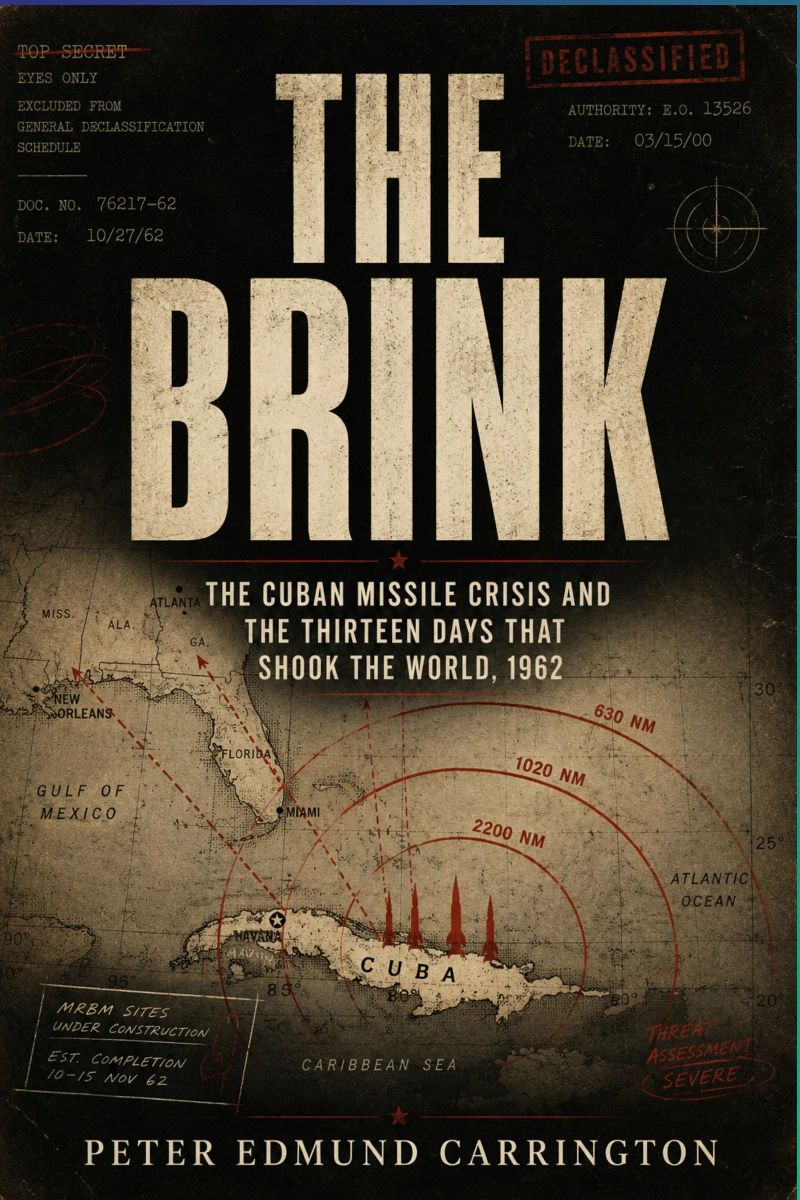
THE BRINK
The Cuban Missile Crisis and the Thirteen Days That Shook the World, 1962By Peter Edmund Carrington


Length5h 46m
About this audiobook
Cuban Missile Crisis history — Kennedy, Khrushchev, and the thirteen days in October 1962 that brought the world to the brink of nuclear war. The complete narrative of ExComm, Black Saturday, and the secret deal that ended the standoff.
On the morning of October 14, 1962, U-2 pilot Major Richard Heyser flew a long arc over western Cuba. The photographs he brought back — processed overnight and examined at the National Photographic Interpretation Center — showed the early stages of Soviet medium-range ballistic missile sites, weapons capable of reaching Washington and New York in minutes. McGeorge Bundy waited until morning to wake the president. What followed were thirteen days that brought the United States and the Soviet Union closer to thermonuclear war than the world has come before or since.
Peter Edmund Carrington's Cuban Missile Crisis narrative traces the full arc across twenty-four chapters, from Castro's revolution, the Bay of Pigs disaster, and Khrushchev's missile gamble through ExComm's secret deliberations, the naval quarantine, and the pivotal decisions of Black Saturday — October 27, 1962, when a U-2 was shot down over Cuba, a Soviet submarine was forced to surface with a nuclear torpedo aboard, and Kennedy told his brother he estimated the odds of nuclear war at one in three. The book names every key figure: Kennedy and Khrushchev, Robert Kennedy and Ambassador Dobrynin, Dean Rusk and Robert McNamara, and the local Soviet officers whose unauthorized decisions nearly ended civilization.
Inside this Cold War history:
• Khrushchev's gamble — why the Soviet premier decided to place missiles in Cuba: the Berlin problem, the Jupiter missiles in Turkey, and the lesson he drew from Kennedy's Bay of Pigs failure (Chapters 3-4)
• ExComm's secret debate — the six options considered (airstrike, invasion, blockade, diplomacy), the arguments for each, and how Kennedy chose the quarantine as the middle path (Chapters 5-7)
• The two Khrushchev letters — the first letter's emotional plea about the "knot" of war neither man could untie, the second's Turkish missile demand, and the "Trollope ploy" that allowed Kennedy to answer only the favorable one (Chapter 11)
• Black Saturday — Major Rudolf Anderson's U-2 shot down over Cuba, a second U-2 straying into Soviet airspace, submarine B-59 forced to surface with its nuclear torpedo, and Kennedy's refusal to order retaliation (Chapter 12)
• The secret deal — Robert Kennedy's private message to Dobrynin: the Jupiter missiles in Turkey would be removed within four to five months, on condition the agreement could never be publicly acknowledged (Chapter 13)
• The Hot Line and the Partial Test Ban Treaty — how the thirteen days directly produced the first arms control measures of the nuclear age (Chapters 21-22)
Kennedy estimated even odds of nuclear war on the evening of October 27. His refusal to retaliate for Anderson's shoot-down — against unanimous Joint Chiefs pressure — was the decision that kept the diplomatic track open. Carrington's Cuban Missile Crisis history shows exactly how close the rational pursuit of national interest came to irrational catastrophe, and what it took to pull back.
For readers of Martin Walker's THE COLD WAR and Michael Dobbs's ONE MINUTE TO MIDNIGHT.
Audiobook details
GenreHistory
Length5 hrs 46 mins
Narrated byListen with 1,000+ voices
FormateBook with Audio
Publish dateJun 2, 2026
LanguageEnglish
Table of contents
1Introduction
2Prologue: The U-2's Discovery
3PART ONE: THE BACKGROUND (1959-1962)
4Chapter 1: Castro's Cuba — Revolution, Nationalization, and the American Response
5Chapter 2: The Bay of Pigs — Kennedy's First Crisis and Its Lessons
Show all chaptersShow less
6Chapter 3: Why Khrushchev Decided — Soviet Motivations and the Missile Gamble
7Chapter 4: The U-2 Photographs — October 14, 1962, and the Discovery
8PART TWO: THE SECRET DELIBERATIONS (OCTOBER 16-22, 1962)
9Chapter 5: ExComm — Kennedy's Inner Circle and the Thirteen Days of Secret Debate
10Chapter 6: The Options — Airstrike, Invasion, Blockade, and Diplomacy
11Chapter 7: The Quarantine Decision — Kennedy Chooses the Middle Path
12Chapter 8: The President Addresses the Nation — October 22, 1962
13PART THREE: THE CONFRONTATION (OCTOBER 22-27, 1962)
14Chapter 9: The Naval Quarantine — Soviet Ships Approach the Line
15Chapter 10: The UN and U Thant — Diplomacy in the Middle of Crisis
16Chapter 11: Khrushchev's Letters — The Two Communications and Their Meaning
17Chapter 12: Black Saturday — October 27, 1962, and the Closest Moment
18PART FOUR: THE RESOLUTION
19Chapter 13: The Secret Deal — Jupiter Missiles, Cuba, and the Private Agreement
20Chapter 14: The Soviet Withdrawal — Khrushchev's Announcement and Its Reception
21Chapter 15: Verification — Overflights, Inspection, and Confirming the Removal
22Chapter 16: The Aftermath — What Each Side Won and What Each Side Lost
23PART FIVE: THE PEOPLE OF THE CRISIS
24Chapter 17: Kennedy — The President Under Pressure
25Chapter 18: Khrushchev — The Soviet Premier and His Gamble
26Chapter 19: Robert Kennedy — The Attorney General's Crucial Role
27Chapter 20: Dean Rusk, McNamara, and the Inner Circle of American Decision-Making
28PART SIX: LEGACIES
29Chapter 21: The Hot Line — Communication and Crisis Prevention After 1962
30Chapter 22: The Partial Test Ban Treaty — Arms Control's First Success
31Chapter 23: Cuba After the Crisis — Castro, Embargo, and the Frozen Conflict
32Chapter 24: Nuclear Crisis Management — What the Thirteen Days Taught the World
33Epilogue: How Close We Came
34Acknowledgments
35Selected Bibliography
36About the Author
More from Peter Edmund Carrington
A Brief History of IntelligenceMax S. Bennett12h 18m4.6 (6.6K)$29 · $0.00

The Daughter of AuschwitzTova Friedman, Malcolm Brabant7h 54m4.6 (16.7K)$26 · $0.00
Lily's PromiseLily Ebert, Dov Forman8h 54m4.6 (16.1K)$29 · $0.00
On Democracies and Death CultsDouglas Murray10h 38m4.6 (6.5K)$29 · $0.00

Across the RiverKent Babb11h 40m4.6 (927)$29 · $0.00
Balcony Over Jerusalem: A Middle East Memoir - Israel, Palestine and BeyondJohn Lyons12h 37m4.6 (1.4K)$33 · $0.00
BeyondStephen Walker15h 39m4.6 (3.2K)$33 · $0.00
Kings and PawnsHoward Bryant10h 9m4.6 (678)$29 · $0.00
No EscapeNury Turkel9h 30m4.6 (809)$28 · $0.00
Jubal Stone: U.S. Marshal: Blood Trail To Hell: A Western Adventure NovelCasey Nash3h 42m4.6 (3.2K)$18 · $0.00
Fall and RiseMitchell Zuckoff17h 23m4.6 (9.8K)$40 · $0.00
The SurvivorJosef Lewkowicz, Michael Calvin9h 22m4.6 (2.5K)$29 · $0.00
Always FaithfulThomas Schueman, Zainullah Zaki12h 12m4.6 (977)$29 · $0.00

The State of Society in France Before the Revolution of 1789 (Annotated)Alexis de Tocqueville17h 25m4.6 (1.2K)$2 · $0.00
All the Gallant MenDonald Stratton, Ken Gire5h 55m4.6 (11.8K)$24 · $0.00
Saint Joan (Annotated)George Bernard Shaw6h 20m4.6 (1.2K)$1.20 · $0.00
Medgar and MyrlieJoy-Ann Reid10h 52m4.5 (27.8K)$29 · $0.00
The History of the Peloponnesian War (Annotated)Thucydides24h 3m4.6 (1.1K)$2 · $0.00
Where the Birds Never SingJack Sacco10h 31m4.6 (3.8K)$29 · $0.00
Serviceman J: The Untold Story of an NZSAS SoldierJamie Pennell5h 51m4.6 (452)$24 · $0.00
You may also like
U.S.S. SeawolfPatrick Robinson14h 32m4.0 (4.1K)$33 · $0.00
The Able ArchersBrian J. Morra8h 50m4.3 (724)$20
The Hunter KillersDan Hampton11h 52m4.2 (2.2K)$29 · $0.00
Sons of Valor II: Violence of ActionBrian Andrews, Jeffrey Wilson12h 34m4.6 (3.6K)$23
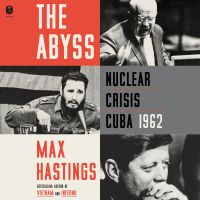
The AbyssMax Hastings19h 9m4.4 (4.1K)$40 · $0.00

Recollections of the Civil WarCharles A. Dana6h 58m4.0 (272)$2 · $0.00
Scorpion StrikeJohn J. Nance11h 9m4.3 (1.2K)$21
The Art Of War: 500BC VersionSun Tzu1h 5m4.1 (662.2K)Free
The Shark MutinyPatrick Robinson15h 29m3.9 (2.6K)$33 · $0.00
The Art of WarSun Tzu1h 12m4.1 (680.7K)$4 · $0.00
Shark MutinyPatrick Robinson5h 59m4.0 (2.8K)$24 · $0.00
In Mortal CombatJohn Toland27h 30m4.4 (1.3K)$30
The Nightingale’s SongRobert Timberg22h 9m4.3 (1.2K)$32
The Last Lion: Winston Spencer Churchill, Vol. 3William Manchester, Paul Reid53h 24m4.5 (11.2K)$35
The Caspian MonsterLarry Jeram-Croft8h 4m4.5 (501)$23
Putin’s TrollsJessikka Aro12h 14m4.2 (2.9K)$23 · $0.00
DempseyJeffrey Wilson, Brian Andrews12h 15m4.5 (6.1K)$25
Ghost ForcePatrick Robinson15h 6m4.0 (2.3K)$25
Act of WarJack Cheevers13h 44m4.3 (1.4K)$23
Homeland: Carrie's RunAndrew Kaplan11h 41m3.9 (2.5K)$29 · $0.00