
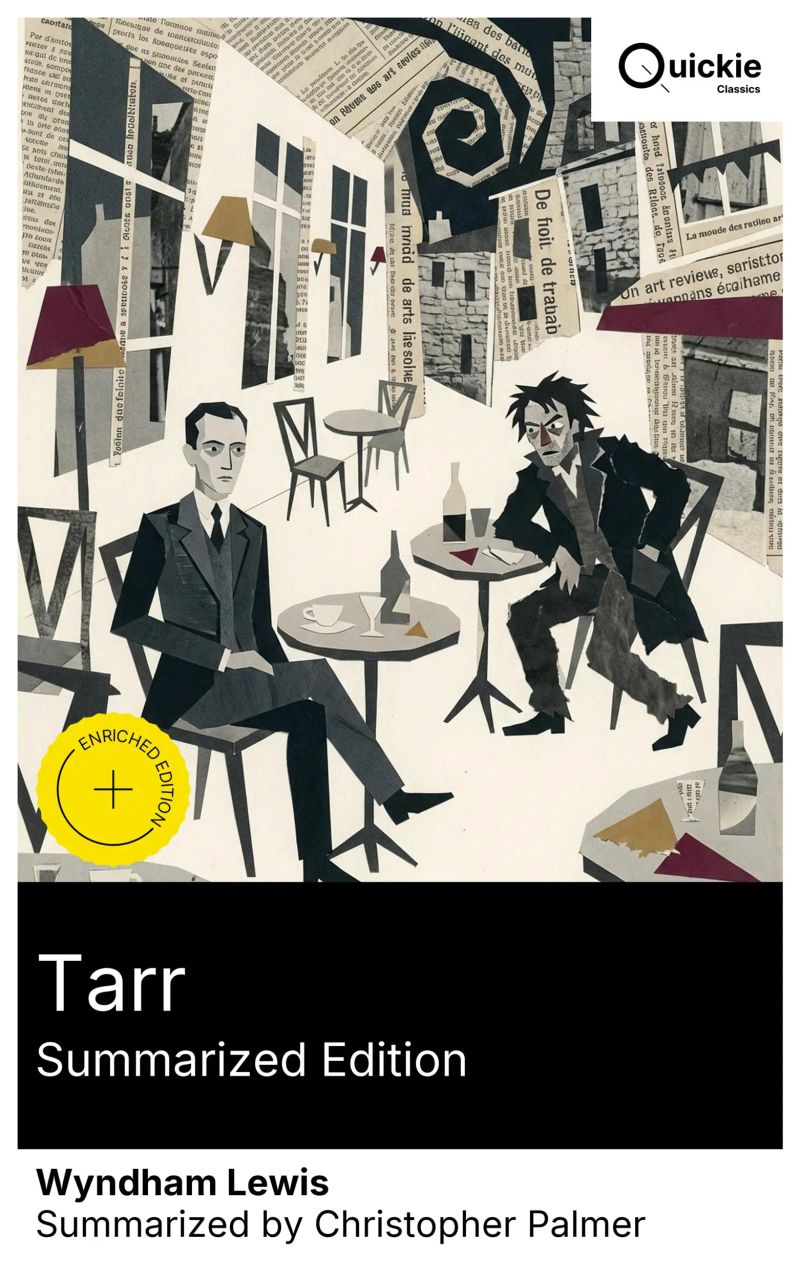
Tarr (Summarized Edition)
Enriched edition. Expatriate Artists in Pre-War Paris: A Vorticist Comedy of Ego, Will, and Anti-Bourgeois ArtBy Wyndham Lewis


Length2h 53m
About this audiobook
Tarr, set amid the expatriate art circles of pre-war Paris, follows the sardonic English painter Frederick Tarr and his violent counterfigure, the German bohemian Otto Kreisler, in a comedy of manners that becomes a ruthless examination of ego, will, and the obligations of art. Lewis's prose is angular and facet-cut, deploying caricature and paradox to satirize both bohemia and bourgeois sentiment. First serialized in The Egoist and later revised in 1928, the novel stands at the crucible of British modernism, channeling Vorticist energies into narrative form. A painter as well as a novelist, Wyndham Lewis helped found Vorticism and edited the polemical magazine Blast; his visual training and years in Paris, alongside contemporaries like Pound, shaped his hard-edged aesthetics. His anti-romantic, often Nietzschean emphasis on impersonality and will—hardened by the shocks of the early twentieth century—provides Tarr's intellectual armature, while his gift for hostile diagnosis turns the artists' quarter into a laboratory of modern personality. Recommended to readers of high modernism, art history, and satire, Tarr rewards close attention with its cold brilliance and structural daring. Approach it for its ideas, its audacious style, and its unflinching portrait of artistic life at the edge.
Quickie Classics summarizes timeless works with precision, preserving the author's voice and keeping the prose clear, fast, and readable—distilled, never diluted. Enriched Edition extras: Introduction · Synopsis · Historical Context · Brief Analysis · 4 Reflection Q&As · Editorial Footnotes.
Audiobook details
GenreGeneral Fiction, Literary Classics
Length2 hrs 53 mins
Narrated byListen with 1,000+ voices
FormateBook with Audio
Publish dateJan 10, 2026
LanguageEnglish
Table of contents
1Introduction
5Tarr
2Introduction
6Analysis
3Synopsis
7Reflection
4Historical Context
More from Wyndham Lewis


WhistlerAnn Patchett10h 45m4.6 (4.6K)$29 · $0.00
Demon CopperheadBarbara Kingsolver21h 3m4.5 (949.4K)$46 · $0.00
To Kill a MockingbirdHarper Lee12h 18m4.5 (7.4M)$29 · $0.00
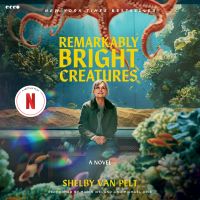
Remarkably Bright CreaturesShelby Van Pelt11h 17m4.4 (1.7M)$29 · $0.00
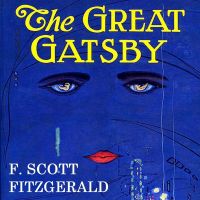
The Great Gatsby: Original 1925 Edition (An F. Scott Fitzgerald Classic NovelFrancis Scott Fitzgerald4h 45m4.6 (9.3K)$18 · $0.00
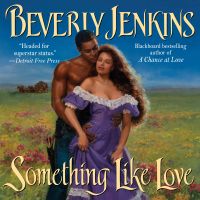
Something Like LoveBeverly Jenkins10h 21m4.6 (2.7K)$29 · $0.00

Black History CollectionFrederick Douglass, Harriet Ann Jacobs, Booker T. Washington, W.E.B. Du Bois27h 9m4.6 (2.6K)$18 · $0.00

The Old Man and the Sea (Annotated)Ernest Hemingway4h 27m4.6 (1.4K)$2 · $0.00

White HotIlona Andrews13h 18m4.5 (136.9K)$5 · $0.00

The Ghost by the Billabong (The Matilda Saga, #5)Jackie French14h 58m4.6 (773)$33 · $0.00
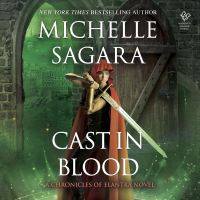
Cast in BloodMichelle Sagara16h 35m4.6 (607)$33 · $0.00
The Captain Blood Trilogy (Annotated)Rafael Sabatini29h 20m4.6 (1K)$3 · $0.00
Ship of the Line (Annotated)Cecil Louis Troughton Smith11h 13m4.6 (1K)$2 · $0.00
The George Orwell CollectionGeorge Orwell24h 46m4.5 (14.4K)$12 · $0.00

ShivajiRanjit Desai25h 13m4.6 (3.1K)$24 · $0.00
Time RegainedMarcel Proust15h 38m4.5 (9.2K)$2 · $0.00

Driving ForceElle James4h 58m4.6 (407)$20 · $0.00

When God Calls the HeartBrian Bird, Michelle Cox3h 24m4.6 (439)$10 · $0.00

Five Little IndiansMichelle Good10h 34m4.5 (64.5K)$29 · $0.00
Lolth's WarriorR. A. Salvatore13h 20m4.6 (2.4K)$33 · $0.00
To Kill a MockingbirdHarper Lee12h 18m4.5 (7.4M)$29 · $0.00

These Precious DaysAnn Patchett11h 14m4.5 (45.2K)$29 · $0.00

This Side of Paradise - The Original 1920 Edition (Annotated)F. Scott Fitzgerald11h 30m4.6 (1.6K)$2 · $0.00
The Great Gatsby: Original 1925 Edition (An F. Scott Fitzgerald Classic NovelFrancis Scott Fitzgerald4h 45m4.6 (9.3K)$18 · $0.00
TWELFTH NIGHTWilliam Shakespeare, Sidney Lee16h 38m4.6 (2.8K)$1.99 · $0.00
The Complete Histories / History Plays of William Shakespeare (Annotated)William Shakespeare29h 42m4.6 (2.3K)$0.99 · $0.00

Braving the TruthRachel Held Evans11h 31m4.7 (359)$29 · $0.00
The Old Man and the Sea (Annotated)Ernest Hemingway4h 27m4.6 (1.4K)$2 · $0.00
Henry V (The Play, Historical Background and Analysis of the Character in the Play)William Shakespeare, William Hazlitt8h 50m4.6 (1.3K)$1.99 · $0.00
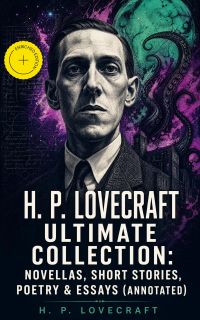
H. P. LOVECRAFT Ultimate Collection: Novellas, Short Stories, Poetry & Essays (Annotated)H. P. Lovecraft12h 28m4.6 (2.3K)$2 · $0.00
Time RegainedMarcel Proust16h 8m4.5 (10.6K)$1.99 · $0.00

The Mis-Education of the NegroCarter Goodwin Woodson4h 32m4.5 (28.4K)$10 · $0.00

TORAH - Bilingual Edition: English/Hebrew (Annotated)Max Margolis, JPS28h 26m4.6 (1K)$2 · $0.00

Betty Crocker picture cooky bookBetty Crocker, Inc. General Mills2h 13m4.5 (6.5K)$1 · $0.00

The Complete Tales of Beatrix PotterBeatrix Potter3h 36m4.5 (75K)$3 · $0.00

Anne of Green GablesL. M. Montgomery11h 1m4.5 (1.2M)$2.30 · $0.00
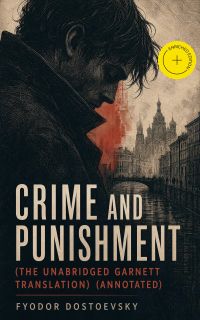
Crime and Punishment (The Unabridged Garnett Translation) (Annotated)Fyodor Dostoevsky24h 25m4.5 (15.4K)$0.99 · $0.00

The North American IndianEdward S. Curtis, Frederick Webb Hodge6h4.5 (1.2K)$2 · $0.00
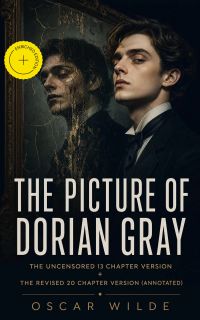
The Picture of Dorian Gray: The Uncensored 13 Chapter Version + The Revised 20 Chapter Version (Annotated)Oscar Wilde16h 12m4.5 (2.8K)$0.99 · $0.00

Grimoire Of The Everyday WitchIsadora Lys / Virginia Santos5h 35m4.5 (3.9K)$9 · $0.00
You may also like

I'm a FanSheena Patel4h 31m3.5 (38.1K)$30
Bel Ami, or, The History of a ScoundrelGuy De Maupassant5h 56m4.0 (74.3K)$2.30
Jacques and His MasterMilan Kundera1h 53m3.9 (2.1K)$16 · $0.00

The Lesson of the MasterHenry James2h 29m3.6 (1.7K)$8 · $0.00
Pauline's Passion and PunishmentLouisa May Alcott1h 51m3.8 (1.5K)$2.30 · $0.00

Elmer Gantry (Annotated)Sinclair Lewis19h 30m4.5 (1.2K)$2 · $0.00

The House of MirthEdith Wharton13h 35m4.1 (143.3K)Free

The Doctor's DilemmaBernard Shaw3h 29m3.6 (1.2K)$2 · $0.00
The EgoistGeorge Meredith21h 25m3.7 (8.5K)$21 · $0.00
Guy de Maupassant - The Complete Works: Short Stories, Novels, Plays, Poetry, Memoirs and more (Annotated)Guy de Maupassant232h 33m4.5 (1.5K)$2 · $0.00
NOTES FROM UNDERGROUNDFyodor Dostoevsky6h 9m4.2 (264.5K)$2 · $0.00

An Outcast of the IslandsJoseph Conrad11h 55m3.7 (1.7K)$20 · $0.00

The Custom of the CountryEdith Wharton14h 9m4.1 (25.8K)$2 · $0.00
Post OfficeCharles Bukowski4h 33m4.0 (167.2K)$20 · $0.00
Point Counter Point (Annotated)Aldous Huxley21h 34m3.9 (13K)$2 · $0.00

Tarr (Annotated)Wyndham Lewis12h 2m3.4 (570)$2 · $0.00
Tarr (Musaicum Rediscovered Classics)Wyndham Lewis12h 43m$1.99 · $0.00

The PhilandererBernard Shaw2h 57m3.6 (852)$2.30
With Edge ToolsH. C. Chatfield-Taylor6h 21m$2 · $0.00
"This Was A Man" A Comedy In Three ActsNoël Coward3h 43m3.6 (13)$3