
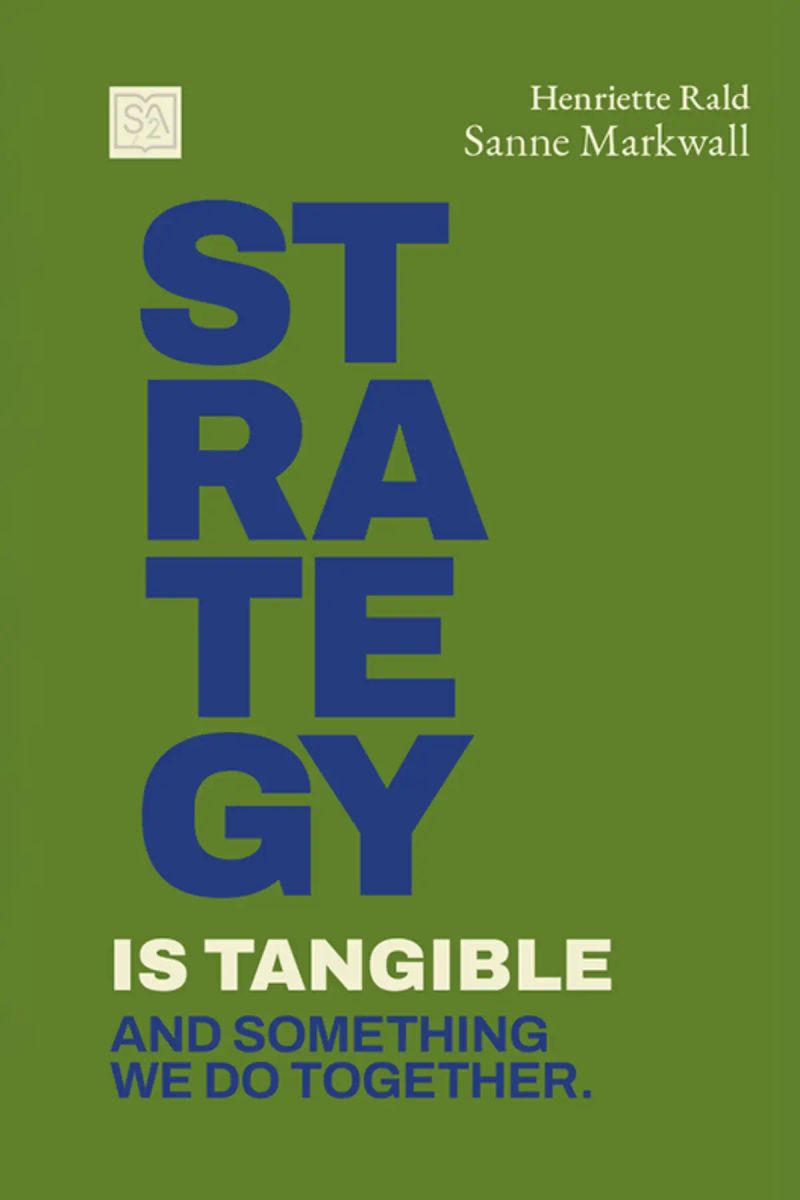
Strategy is tangible - and something we do together
By Sanne Markwall & Henriette Rald


Length3h 13m
About this audiobook
"Strategy is tangible - and something we do together" provides a practical, no-nonsense guide to demystifying strategy work. Authors Sanne Markwall and Henriette Rald introduce a simple, structured 3-phase model that transforms complex strategic thinking into concrete, actionable steps.</p><p> </p><p>Moving beyond heavy theory, this book focuses on what actually works: making difficult choices, involving employees, and ensuring execution. It guides you through essential tools like SWOT, PESTEL, and Must-Win Battles, while integrating modern imperatives like Artificial Intelligence and sustainability.</p><p> </p><p>Whether you are a CEO of an SME, a strategy manager, a board member, or a student, this book offers the tools to turn strategic ambitions into reality. It serves as a "do-it-yourself" manual for creating a living strategy that doesn't just sit on a shelf but drives daily operations and growth.
Audiobook details
GenreBusiness and Economics
Length3 hrs 13 mins
Narrated byListen with 1,000+ voices
FormateBook with Audio
Publish dateDec 17, 2025
LanguageEnglish
Table of contents
1Introduction
2Preface
3Introduction
4CHAPTER 1: Introduction to strategy and to the book
5Good strategy work is about reuse and rethinking
Show all chaptersShow less
6How to use this book
7CHAPTER 2: Preparation
8What is the level of ambition?
9Who should be involved?
10Important documents
11CHAPTER 3: The external perspective – view the organisation from the outside in (step 1)
12The wider world
13The industry
14Customers
15Use the insights to formulate opportunities and threats
16Summary
17CHAPTER 4: The internal perspective – see the organisation from the inside out (step 2)
18Four bottom lines
19Infrastructure
20Owner’s and manager’s preferences
21Use the insights to formulate strengths and weaknesses
22Summary
23CHAPTER 5: Artificial intelligence and sustainability (step 3)
24Artificial intelligence
25Find inspiration
26Sustainability
27Use the insights to formulate strengths, weaknesses, opportunities and threats
28Summary
29CHAPTER 6: The future – no one knows what it holds, but we are all helping to shape it (step 4)
30Four scenarios
31Do you notice anything new?
32Summary
33CHAPTER 7: Vision, mission and values (step 5)
34The vision – what you are striving for
35The mission – why you go to work every day
36The values – the way you behave
37Summary
38CHAPTER 8: The important opt-outs and strategic change requirements (step 6)
39The prioritised SWOT
40The activated SWOT – the TOWS model
41The red and green traffic lights
42Summary
43CHAPTER 9: From traffic lights to themes and goals (step 7)
44Describe the battles you need to win
45Set relevant goals
46A brief review of the vision and mission
47Summary
48CHAPTER 10: Time to execute (step 8)
49You must prioritise again and again
50Keep it simple and make it visual
Never Split the DifferenceChris Voss, Tahl Raz8h 7m4.4 (277.7K)$26 · $0.00
The Intelligent Investor Rev Ed.Benjamin Graham17h 48m4.3 (191.5K)$40 · $0.00
The Hard Thing About Hard ThingsBen Horowitz7h 57m4.2 (134.3K)$26 · $0.00
Boundaries for LeadersHenry Cloud7h 36m4.3 (3.6K)$26 · $0.00

The Secret Door to SuccessFlorence Scovel Shinn2h 25m4.5 (2.1K)$1.20 · $0.00

This Is Going to HurtAdam Kay5h 47m4.4 (444.7K)$24 · $0.00

Big TrustShadé Zahrai, Fayçal Sekkouah8h 36m4.6 (406)$26 · $0.00
The Intelligent Investor Third EditionBenjamin Graham, Jason Zweig20h4.4 (156.6K)$46 · $0.00

Bottle of LiesKatherine Eban14h 25m4.4 (12K)$33 · $0.00

The Antiracist Business BookTrudi Lebrón6h 10m4.6 (275)$17 · $0.00
The FormulaJoshua Robinson, Jonathan Clegg10h 41m4.4 (6.9K)$29 · $0.00

Let Them LeadJohn U. Bacon7h 10m4.5 (1.4K)$24 · $0.00

Secrets of the Millionaire MindT. Harv Eker5h 11m4.4 (301.4K)$24 · $0.00

The Person You Mean to BeDolly Chugh9h 6m4.4 (7.2K)$29 · $0.00
BoundlessNick Kostov, Sean McLain9h 17m4.5 (1.1K)$29 · $0.00
Everyday DharmaSuneel Gupta5h 2m4.5 (761)$20 · $0.00
Let's Talk Mutual FundsMonika Halan7h 5m4.4 (2.4K)$16 · $0.00

Secret PowerDwight Lyman Moody3h 7m4.4 (1.4K)$1.20 · $0.00
The Law of Success in Sixteen LessonsNapoleon Hill2h 39m4.4 (17.2K)$2 · $0.00

Barbarians at the GateBryan Burrough, John Helyar3h 3m4.4 (52.7K)$18 · $0.00
You may also like
Successful Self-Publishing: How to Self-Publish and Market Your BookJoanna Penn3h 23m4.4 (2.9K) Only with Ultra

Seeing Around CornersRita McGrath7h 46m4.1 (886)$26 · $0.00
Never Lost AgainBill Kilday10h 1m4.4 (805)$29 · $0.00
Day Trading AttentionGary Vaynerchuk8h 25m4.3 (1.8K)$28 · $0.00

The PerfectionistsSimon Winchester11h 46m4.2 (9.9K)$29 · $0.00
Escape VelocityGeoffrey A. Moore6h 6m4.1 (857)$24 · $0.00
Think, Focus, Grow RichRobert4h 38m$6 · $0.00

Supply Chain ManagementKnowledge Flow51m$4.10 · $0.00
The In-Car-Nation CodeDr. Engelbert Wimmer20h 15m$21 · $0.00

The Hidden Power of AI for Financial GrowthNora V. Halden3h 33m5.0 (1)$2.30 · $0.00

OutskillPartha Basu6h 10m3.9 (25)$24 · $0.00
Embracing AI At WorkJasper Livingstone6h 37m$9
Ship Machine Learning Web Apps with PythonNathan Jansen8h 26m$5
Work for YourselfHazel Morris2h 8m$9 · $0.00
The Numbers Behind Success in SoccerChest Dugger3h4.1 (39)$14.99

Manual QA to AutomationImad Muratspahic2h 55m$12 · $0.00
RepluggedSatnam Bains13h 47m$14 · $0.00

Smooth Sailing: A First-Timer’s Guide to Princess CruisesJUDE CALEB7h 18m$10

MeconomyMarkus Albers5h$8 · $0.00

Career: Salary, Remuneration, Positions And FunctionsJoaquim Carlos Lourenço4h 3m$6 · $0.00