
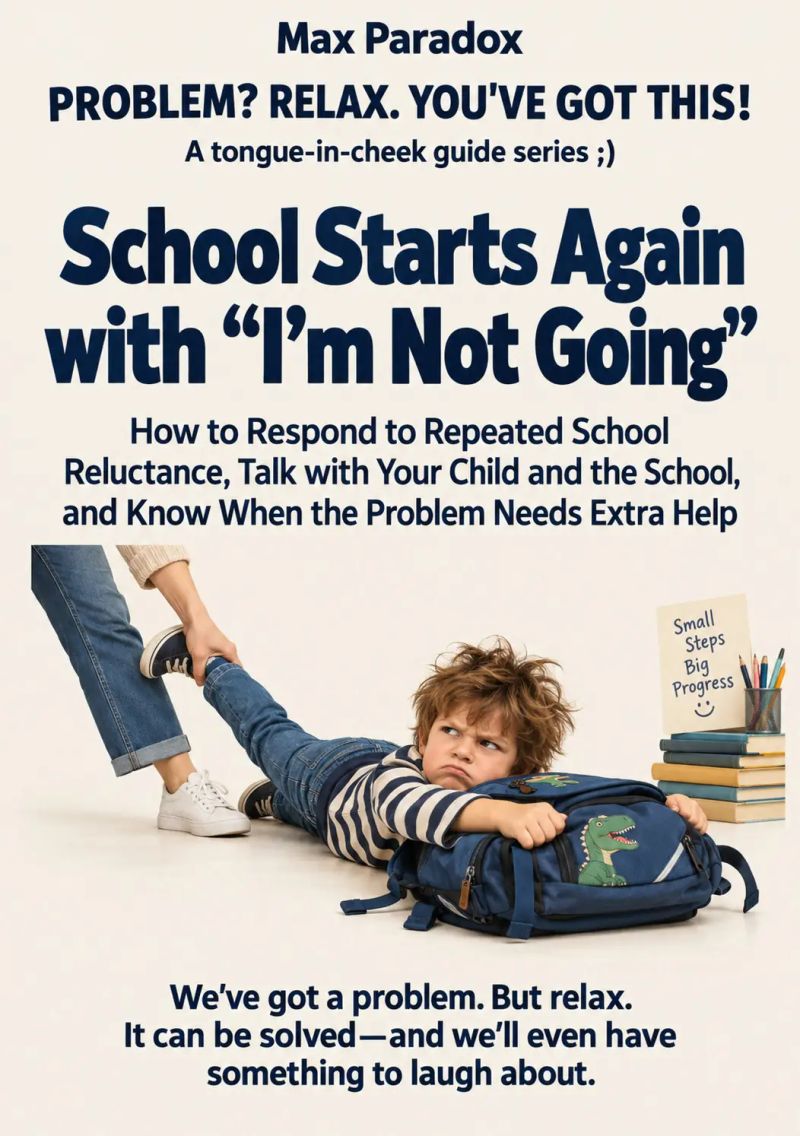
School Starts Again with “I’m Not Going” - How to Respond to Repeated School Reluctance, Talk with Your Child and the School, and Know When the Problem Needs Extra Help
By Max Paradox


Length4h 55m
About this audiobook
Every morning starts the same way: the clock is moving, the bag is ready, someone is looking for a missing shoe, and then comes the sentence that can freeze an entire household: “I’m not going.”
Sometimes it means ordinary reluctance. Sometimes it means fear of a test, embarrassment, loneliness, exhaustion, a difficult teacher, a friendship problem, falling behind, or simply a school day that feels too big to face. The hardest part for a parent is knowing which kind of “I’m not going” you are hearing - and what to do without turning breakfast into a police interview, a motivational seminar, or a constitutional crisis.
School Starts Again with “I’m Not Going” is a practical, funny and compassionate guide for parents dealing with repeated school reluctance. Max Paradox takes the problem seriously without making every difficult morning sound like a diagnosis. Instead, he shows how to notice patterns, separate ordinary resistance from signs that deserve more attention, talk with a child when everyone is calm enough to think, and work with school without producing a twelve-page emergency plan nobody can remember by Tuesday.
Inside, you will learn how to identify the hardest part of the school day instead of treating “school” as one giant problem; reduce morning friction; handle absences and returns; respond to social and academic pressures; create simple in-school coping plans; offer useful choices without handing over every major decision; and prevent support from quietly becoming permanent dependence. The book also explains what to do when progress suddenly slips, how to spot early warning signs, how to reduce help as confidence grows, and when the scale of the problem means it is time to involve appropriate professional support.
This is not a book about forcing a child through the door at any cost. It is also not a book about removing every uncomfortable situation. It is about finding the next workable step, protecting the relationship, keeping school in proportion, and helping a child build skills they can increasingly use for themselves.
There is practical guidance for the 7:15 a.m. version of family life - the version with limited time, imperfect information, real jobs, tired adults, and a child who may answer a thoughtful question with “I don’t know.” No guru voice. No magical routine. No promise that your child will wake up thrilled about double science.
Just a calmer way to understand what is happening, decide what matters now, and know when “I’m not going” needs empathy, structure, school cooperation, professional help - or simply shoes and a Monday-sized sigh.
This publication was prepared using tools that support the creative process, including artificial intelligence solutions. The final concept, structure and editing are the responsibility of the author.
Audiobook details
GenreSelf-Help
Length4 hrs 55 mins
Narrated byListen with 1,000+ voices
FormateBook with Audio
Publish dateOct 9, 2026
LanguageEnglish
Table of contents
1INTRO
2Chapter 1 - “I’m Not Going” Is Not a Diagnosis
3Chapter 2 - Morning Is a Terrible Time for an Investigation
4Chapter 3 - When This Is More Than “I Just Don’t Feel Like It”
5Chapter 4 - The Help That Accidentally Makes Things Harder
Show all chaptersShow less
6Chapter 5 - The School Morning Starts the Night Before
7Chapter 6 - Every Absence Changes the Return
8Chapter 7 - Sometimes the Hardest Part of School Is Other People
9Chapter 8 - School Cannot Help with What It Does Not Know
10Chapter 9 - Do Not Fix the Whole School at Once
11Chapter 10 - Have a Plan for the Moment They Say “I Can’t Do This Anymore”
12Chapter 11 - Give Choices Without Handing Over the Whole Decision
13Chapter 12 - Do Not Let School Become the Family Control Center
14Chapter 13 - Sometimes “I Can’t Go” Means “I Can’t Keep Up”
15Chapter 14 - Build a Plan That Can Survive an Actual Week
16Chapter 15 - When Your Child Truly Cannot Leave the House
17Chapter 16 - When Everyone Sees a Different Child
18Chapter 17 - A Bad Week Does Not Erase the Progress
19Chapter 18 - Notice the Problem Before It Reaches the Front Door
20Chapter 19 - Support Should Shrink as Confidence Grows
21Chapter 20 - The Goal Is Not a Child Who Never Says “I’m Not Going” Again

Moving Was Supposed to Be a Fresh Start, Not Total Chaos - How to Plan the Packing, Paperwork, and First Few Weeks Without Searching Thirty Boxes for Your ToothbrushMax Paradox3h 32m$7.70 · $0.00

Na urlopie też wszystko organizuję - Jak podzielić planowanie wyjazdu, uzgodnić oczekiwania i odpocząć bez etatu pilota własnej rodzinyMax Paradox2h 50m$7.70 · $0.00

Nie potrafię przepraszać bez słowa „ale” - Jak przyznawać się do błędów, naprawiać szkody i odbudowywać zaufanie bez przemowy obrońcy z urzęduMax Paradox3h 32m$7.70 · $0.00

I’m Tired of Being the Family Tech Support - How to Help Relatives with Phones, Passwords, and Apps Without Running a Free Emergency Help DeskMax Paradox3h 2m$7.70 · $0.00

I Work from Home, but Now I Live at Work - How to Set Working Hours, Protect Your Space, and Manage Availability So Your Laptop Stops Being a HousemateMax Paradox3h 10m$7.70 · $0.00

Mój dom jest magazynem rzeczy „na kiedyś” - Jak pozbywać się nadmiaru, podejmować decyzje i odzyskać miejsce bez wyrzucania połowy życia w jeden weekendMax Paradox3h 15m$7.70 · $0.00

My Digital Life Is a Drawer Full of Tangled Cables - How to Organize Your Photos, Files, Accounts, and Messages So You Can Actually Find What You NeedMax Paradox4h 49m$7.70 · $0.00

Moje Dziecko Ma Grafik Jak Dyrektor Generalny - Jak wybierać zajęcia dodatkowe, chronić zwykły wolny czas i przestać organizować dzieciństwo jak przygotowania do igrzyskMax Paradox4h 38m$7.70 · $0.00

Robię Wszystko za Dziecko, Bo Tak Jest Szybciej - Jak rozwijać samodzielność, odpowiedzialność i codzienne umiejętności bez zamieniania każdej skarpetki w godzinny projekt edukacyjnyMax Paradox4h 50m$7.70 · $0.00

My Child Has a Schedule Like a CEO - How to Choose Extracurricular Activities, Protect Ordinary Free Time, and Stop Organizing Childhood Like Olympic TrainingMax Paradox4h 57m$7.70 · $0.00
I Do Everything for My Child Because It’s Faster - How to Build Independence, Responsibility, and Everyday Skills Without Turning Every Sock into an Hour-Long Educational ProjectMax Paradox4h 52m$7.70 · $0.00

I Bought Cheap Tickets. Everything Else Cost a Fortune - How to Plan the Real Cost of Travel, Keep Add-Ons Under Control, and Avoid Savings That Turn Into the Most Expensive Option Once Everything Is Added UpMax Paradox4h 53m$7.70 · $0.00

Szkoła Znowu Zaczyna Się od „Nie Idę” - Jak reagować na powtarzającą się niechęć do szkoły, rozmawiać z dzieckiem i szkołą oraz wiedzieć, kiedy problem wymaga dodatkowej pomocyMax Paradox4h 40m$7.70 · $0.00

Jadę do Biura, Żeby Siedzieć na Teamsie - Jak ułożyć pracę hybrydową, chronić skupienie i zdecydować, co naprawdę warto robić w biurze, a czego nie trzeba wozić przez pół miastaMax Paradox5h 3m$7.70 · $0.00

Moje cyfrowe życie przypomina szufladę z kablami - Jak uporządkować zdjęcia, pliki, konta i wiadomości, żeby wreszcie znajdować to, czego potrzebujeszMax Paradox3h 59m$7.70 · $0.00

I Can't Apologize Without Saying “But” - How to Own Your Mistakes, Make Amends, and Rebuild Trust Without Delivering a Defense SpeechMax Paradox3h 35m$7.70 · $0.00

I Don't Know How to Be There When Someone Is Struggling - How to Listen, Offer Practical Help, and Support Someone You Care About Without Forcing a Bright SideMax Paradox2h 58m$7.70 · $0.00

Moi rodzice potrzebują pomocy, a ja nie mam drugiego etatu - Jak uzgodnić opiekę, podzielić zadania z rodziną i wspierać starzejących się rodziców bez brania wszystkiego na siebieMax Paradox2h 49m$7.70 · $0.00

Mam dość bycia rodzinnym informatykiem - Jak pomagać bliskim z telefonami, hasłami i aplikacjami, nie prowadząc bezpłatnego pogotowia technicznegoMax Paradox3h 19m$7.70 · $0.00
Learning to PrayJames Martin13h 24m4.5 (3.4K)$33 · $0.00

The Dangerous Truth about Today’s MarijuanaLaura Stack CSP, MBA9h 57m4.7 (385)$20 · $0.00

The Gospel according to Spiritualism (Translated)Allan Kardec14h 39m4.6 (3.9K)$5.70 · $0.00

Birdie & HarlowTaylor Wolfe7h 50m4.6 (6.5K)$26 · $0.00

CrossroadsKaleb Dahlgren7h 56m4.6 (4.9K)$26 · $0.00

Life on the BridgeKaelynn Partlow5h 40m4.6 (1.1K)$24 · $0.00

Keep Your Love OnDanny Silk9h 4m4.6 (8.1K)$10 · $0.00

The Tao of Joy Every DayDerek Lin10h 24m4.6 (762)$20 · $0.00

UndividedVicky Beeching9h 2m4.6 (1.3K)$29 · $0.00

HE CAN WHO THINKS HE CAN & OTHER BOOKS ON SUCCESSOrison Swett Marden5h 54m4.6 (1.2K)$1.99 · $0.00
Level UpRob Dial7h 42m4.6 (3.3K)$26 · $0.00

Burn the HaystackJennie Young, PhD9h 30m4.6 (543)$29 · $0.00

ACRES OF DIAMONDS: Our Every-day Opportunities (Wisdom & Empowerment Series) (Annotated)Russell Conwell2h 26m4.6 (1K)$2 · $0.00

Good InsideBecky Kennedy9h 55m4.5 (59.3K)$29 · $0.00

The Lost VoiceGreta Morgan8h 30m4.7 (285)$26 · $0.00

Stripped DownBunnie Xo8h 25m4.5 (32.9K)$26 · $0.00

UnthinkableJamie Raskin15h 8m4.5 (9.3K)$8 · $0.00

Wallace D. Wattles Ultimate Collection Wallace D. Wattles16h 53m4.6 (1.3K)$1 · $0.00

Inquire WithinIn-Q2h 18m4.6 (993)$16 · $0.00

Under His WingsEmily Compagno7h 16m4.6 (848)$22 · $0.00
You may also like

Brain-Body ParentingMona Delahooke10h 15m4.4 (4.2K)$29 · $0.00

Parents and Children (Annotated)Charlotte Mason9h 23m4.6 (988)$2 · $0.00
Building Resilience in Children and Teens, 4th edKenneth R. Ginsburg15h 10m4.4 (1.1K)$17 · $0.00

Eyes That Speak to the StarsJoanna Ho5m4.5 (3.5K)$4 · $0.00

The Blessing of a Skinned KneeWendy Mogel PhD8h 17m4.4 (7.2K)$17

Raising Your Spirited Child, Third EditionMary Sheedy Kurcinka13h 17m4.3 (13K)$33 · $0.00

Tiny Humans, Big EmotionsAlyssa Blask Campbell, Lauren Elizabeth Stauble10h 14m4.3 (6K)$29 · $0.00
How Children SucceedPaul Tough8h 36m4.0 (29.1K)$26 · $0.00

The Big DisconnectCatherine Steiner-Adair, Teresa H. Barker10h 2m4.0 (2.4K)$29 · $0.00

Of Boys and MenRichard V. Reeves6h 55m4.1 (14.1K)$17

Choice TheoryWilliam Glasser12h 7m4.2 (6.1K)$29 · $0.00

How to Survive the Exhaustion of Having a Baby Who Doesn't SleepAurora Brooks1h 1m$3.50 · $0.00
Parents, Teachers, and Mental HealthJames E. Campbell MD4h 2m$15

How to Foster Sibling Relationships- A Parent's GuideAurora Brooks1h$3.50 · $0.00

Worry-Proofing Your Anxious ChildBev Aisbett2h 9m3.3 (89)$28 · $0.00

New Skills for Frazzled Parents, Revised EditionDaniel G. Amen MD3h 49m4.1 (115)$17

Deep BreathsMichelle Pearson2h 59m3.3 (44)$15

The Unspoken Challenges of Being a Working MomAurora Brooks1h 1m$3.50 · $0.00
I’m Tired of Being the Family Tech Support - How to Help Relatives with Phones, Passwords, and Apps Without Running a Free Emergency Help DeskMax Paradox3h 2m$7.70 · $0.00

How to Excel in Your Career as a Working MomAurora Brooks1h 13m$3.50 · $0.00