
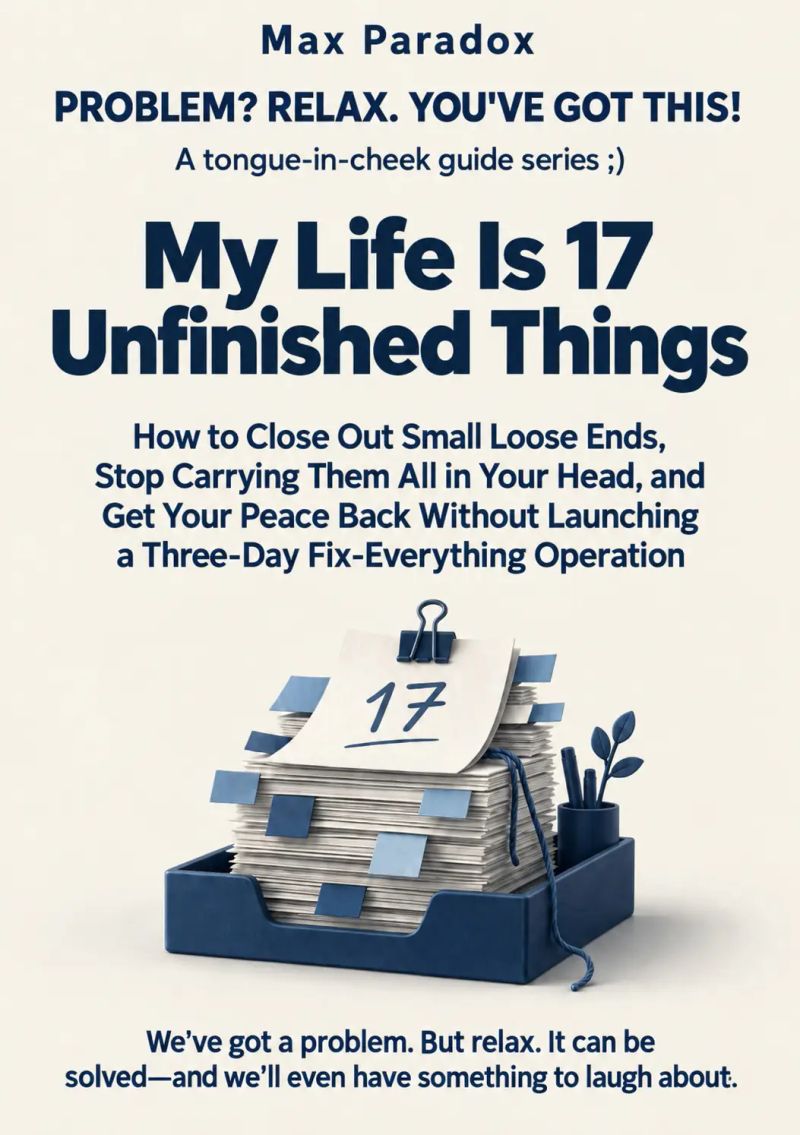
My Life Is 17 Unfinished Things - How to Close Out Small Loose Ends, Stop Carrying Them All in Your Head, and Get Your Peace Back Without Launching a Three-Day Fix-Everything Operation
By Max Paradox

Length4h 34m
About this audiobook
Seventeen unfinished things. None of them is dramatic enough to justify a crisis, yet together they have somehow formed a committee and moved into your head.
There is the message you still need to answer, the package you meant to return, the form you need to submit, the small decision you keep postponing, the thing you are waiting for from someone else, and the object that has been sitting in the wrong place long enough to become part of the furniture. Each one seems minor. The problem is not that they are difficult. The problem is that they keep reopening.
My Life Is 17 Unfinished Things is a practical, funny guide to closing small loose ends without turning your weekend into a three-day emergency operation. Max Paradox shows how unfinished tasks create background noise, why five-minute jobs can survive for three weeks, why "later" is not a deadline, and why the easiest task is not always the one worth doing first.
This book is not about becoming a productivity machine. It is about giving unfinished things a clear status so they stop demanding attention at random moments. You will learn how to capture open loops, identify the real next move, reduce friction, create useful finish lines, handle things you are waiting on, build better places for incoming and outgoing tasks, batch small jobs without creating a second administrative career, and leave enough margin for real life to remain real.
You will also learn when not to finish something. Some commitments need to be dropped. Some decisions need a default rule. Some "tiny tasks" are actually emotionally difficult conversations wearing a five-minute disguise. Some recurring responsibilities are not failures at all - they are simply part of maintaining a life. The goal is not an empty list. The goal is a list you understand.
Throughout the book, the methods stay practical enough for busy, tired, imperfect days. There is a minimum version when energy is low, a Plan B when the obvious method does not fit, and plenty of room for the fact that other people, broken appliances, late replies, changing plans, and your own limited patience will continue to exist.
You will learn how to tell the difference between a task that needs action, one that needs a decision, one that is safely waiting, and one that deserves to disappear altogether. You will also see why a good system should eventually become boring enough that you barely notice it.
If you are tired of remembering the same small obligations at exactly the wrong moment, rereading the same message without answering it, moving the same object around the house, and promising yourself that "this weekend" you will finally fix everything, this book is for you.
You do not need a new personality, a command center, or twelve color-coded categories. You need a calmer way to decide what deserves action, what can wait, what should be dropped, and what is already safely under control.
This publication was prepared using tools that support the creative process, including artificial intelligence solutions. The final concept, structure and editing are the responsibility of the author.
Audiobook details
GenreBusiness and Economics
Length4 hrs 34 mins
Narrated byListen with 1,000+ voices
FormateBook with Audio
Publish dateOct 18, 2026
LanguageEnglish
Table of contents
1INTRO
2Chapter 1 - The Problem Is Not the Tasks. It Is the Open Loops
3Chapter 2 - Why a Five-Minute Task Can Survive for Three Weeks
4Chapter 3 - "Later" Is Not a Deadline
5Chapter 4 - The Great Weekend Reset Is Not a Maintenance Plan
Show all chaptersShow less
6Chapter 5 - Not Every Loose End Deserves Saving
7Chapter 6 - The Longer You Wait, the More You Have to Explain
8Chapter 7 - Waiting on Other People Is Still a System Problem
9Chapter 8 - Tasks Fail When They Show Up in the Wrong Place
10Chapter 9 - Do the Task That Is Charging You Rent
11Chapter 10 - Every Time You Touch It, Change Its State
12Chapter 11 - Decide the Rule Before You Need the Decision
13Chapter 12 - Decide What "Done" Means Before the Task Expands
14Chapter 13 - Build a Place Where Things Actually End
15Chapter 14 - Batch Small Tasks Without Opening a Second Office
16Chapter 15 - Some Small Tasks Are Only Small From the Outside
17Chapter 16 - Stop Clearing the Backlog Faster Than You Create It
18Chapter 17 - Not Everything Has to Disappear From the List
19Chapter 18 - Review Things Before Your Brain Schedules a Midnight Meeting
20Chapter 19 - Leave Some Margin Because Life Does Not Book an Appointment
21Chapter 20 - The System Is Finished When You Can Stop Thinking About the System

Rodzeństwo Znowu Kłóci Się o Powietrze - Jak reagować na konflikty między dziećmi, uczyć je dogadywania się i nie zostawać pełnoetatowym sędzią od wszystkiegoMax Paradox4h 47m$7.80 · $0.00

Wszystko Mam Zapisane. W Siedmiu Różnych Miejscach - Jak stworzyć jeden prosty system na zadania, terminy i notatki, żeby przestać szukać własnego życia między kalendarzem, kartką, czatem i aplikacjąMax Paradox4h 33m$7.80 · $0.00

I Don't Read Contracts Until It's Too Late - How to Spot the Key Clauses, Deadlines, Fees, and Automatic Renewals Without Becoming Your Own Internet, Phone, and Apartment LawyerMax Paradox4h 32m$7.80 · $0.00

Mam Kredyt i Wolę o Nim Nie Myśleć - Jak zrozumieć ratę, oprocentowanie, nadpłatę i własny plan spłaty bez codziennego sprawdzania banku ani udawania, że zobowiązanie samo zniknieMax Paradox4h 34m$7.80 · $0.00

I Have a Loan and I’d Rather Not Think About It - How to Understand Your Payment, Interest Rate, Extra Payments, and Your Own Repayment Plan Without Checking Your Bank Every Day or Pretending the Debt Will Disappear on Its OwnMax Paradox4h 37m$7.80 · $0.00

Moje Życie To 17 Niedokończonych Spraw - Jak domykać małe zaległości, przestać nosić je wszystkie w głowie i odzyskać spokój bez organizowania trzydniowej akcji naprawczejMax Paradox4h 27m$7.80 · $0.00

Wszystko Jest Pilne, Więc Nie Robię Nic - Jak ustalać priorytety, odróżniać ważne od głośnego i kończyć dzień bez poczucia, że cały czas gasiłeś cudze pożaryMax Paradox4h 56m$7.80 · $0.00

My Child Won’t Eat Anything That’s Green - How to Take a Calmer Approach to Picky Eating, Expand the Family Menu, and Stop Turning Every Meal into High-Level NegotiationsMax Paradox4h 50m$7.80 · $0.00

Kupiłem Najtańsze. Teraz Płacę Drugi Raz - Jak podejmować rozsądniejsze decyzje zakupowe, oceniać jakość i całkowity koszt rzeczy bez przepłacania ani kupowania wszystkiego po raz drugiMax Paradox4h 42m$7.80 · $0.00

Kupiłem To na Ratę. Teraz Mam Siedemnaście Małych Rat - Jak odzyskać kontrolę nad płatnościami odroczonymi, ratami i drobnymi zobowiązaniami, zanim „tylko 49 zł miesięcznie” stanie się drugim czynszemMax Paradox4h 21m$7.80 · $0.00

I Have Adult Siblings and We Still Fight Like It’s 2004 - How to Build a Relationship with Your Adult Brother or Sister, Talk About Family and Old Grudges, and Stop Falling Back into Childhood Roles Every Time You Get TogetherMax Paradox4h 57m$7.80 · $0.00

Mamy Dzieci i Nagle Zostaliśmy Wspólnikami - Jak nie zgubić związku między logistyką, obowiązkami i rodzicielstwem oraz przypomnieć sobie, że kiedyś rozmawialiście także o czymś innym niż zakupyMax Paradox4h 34m$7.80 · $0.00

I Have It All Written Down. In Seven Different Places - How to Create One Simple System for Tasks, Deadlines, and Notes So You Can Stop Searching for Your Own Life Between a Calendar, a Piece of Paper, a Chat, and an AppMax Paradox4h 41m$7.80 · $0.00

I Don’t Know How to Make Small Talk and I Don’t Want to Pretend I Love the Weather - How to Start Conversations, Keep in Touch, and Feel More at Ease with People Without Memorizing Twenty-Seven Artificial QuestionsMax Paradox4h 52m$7.80 · $0.00

The Kids Are Fighting Over Air Again - How to Respond to Sibling Conflicts, Teach Them to Work Things Out, and Avoid Becoming a Full-Time Referee for EverythingMax Paradox4h 31m$7.80 · $0.00

Mam Dorosłe Rodzeństwo i Wciąż Kłócimy Się Jak w 2004 - Jak ułożyć relację z dorosłym bratem lub siostrą, rozmawiać o rodzinie i dawnych pretensjach oraz przestać wracać do ról z dzieciństwa przy każdym spotkaniuMax Paradox4h 47m$7.70 · $0.00

Poranek z Dziećmi Powinien Być Dyscypliną Olimpijską - Jak uprościć rodzinne poranki, wyjść z domu na czas i ograniczyć liczbę kryzysów wywołanych skarpetką, śniadaniem i zaginionym plecakiemMax Paradox5h 1m$7.70 · $0.00

My Child Doesn't Want to Do Homework. Neither Do I - How to Build a Calmer Study Routine, Cut Down on Daily Negotiations, and Help Your Child Without Doing School for ThemMax Paradox4h 52m$7.70 · $0.00

Każde Ubezpieczenie Brzmi Jak Instrukcja do Reaktora - Jak rozumieć najważniejsze pojęcia, porównywać zakres ochrony i pilnować terminów bez czytania trzydziestu stron drobnego druku z lupąMax Paradox4h 22m$7.70 · $0.00

Never Split the DifferenceChris Voss, Tahl Raz8h 7m4.4 (277.7K)$26 · $0.00

The Intelligent Investor Rev Ed.Benjamin Graham17h 48m4.3 (191.5K)$40 · $0.00

The Hard Thing About Hard ThingsBen Horowitz7h 57m4.2 (134.3K)$26 · $0.00
Boundaries for LeadersHenry Cloud7h 36m4.3 (3.6K)$26 · $0.00

Not Everything Counts but Everything Matters: The powerful and inspirational new book about leadership and achieving success from the visionary multi-premiership winning Panthers coachIvan Cleary6h 1m4.6 (680)$24 · $0.00
BuildTony Fadell11h 5m4.5 (14.3K)$8 · $0.00
The Joys Of CompoundingGautam Baid17h 34m4.5 (2.5K)$18 · $0.00
Basic EconomicsThomas Sowell18h 32m4.5 (29.3K)$28 · $0.00

Poor Charlie’s AlmanackGrover Gardener, Charles T. Munger13h 9m4.5 (24.7K)$18 · $0.00

The Ambuja StoryNarotam Sekhsaria13h 59m4.5 (830)$33 · $0.00

The Secret Door to SuccessFlorence Scovel Shinn2h 25m4.5 (2.1K)$1.20 · $0.00

This Is Going to HurtAdam Kay5h 47m4.4 (444.7K)$24 · $0.00

Big TrustShadé Zahrai, Fayçal Sekkouah8h 36m4.6 (406)$26 · $0.00

The Intelligent Investor Third EditionBenjamin Graham, Jason Zweig20h4.4 (156.6K)$46 · $0.00

Bottle of LiesKatherine Eban14h 25m4.4 (12K)$33 · $0.00

The Antiracist Business BookTrudi Lebrón6h 10m4.6 (275)$17 · $0.00

The FormulaJoshua Robinson, Jonathan Clegg10h 41m4.4 (6.9K)$29 · $0.00

Let Them LeadJohn U. Bacon7h 10m4.5 (1.4K)$24 · $0.00

Secrets of the Millionaire MindT. Harv Eker5h 11m4.4 (301.4K)$24 · $0.00

The Person You Mean to BeDolly Chugh9h 6m4.4 (7.2K)$29 · $0.00
You may also like

THE ART OF PUBLIC SPEAKINGDale Carnegie, Joseph Berg Esenwein18h 32m4.1 (7.4K)$1.99 · $0.00

Your Brain at Work, Revised and UpdatedDavid Rock9h 25m4.1 (12.1K)$29 · $0.00

Biohack Your BrainKristen Willeumier7h 31m4.1 (2.1K)$26 · $0.00

Your Mind and How to Use ItWilliam Walker Atkinson5h 10m4.0 (1.5K)$21 · $0.00

The 22 Immutable Laws of BrandingAl Ries, Laura Ries8h 8m4.0 (7.9K)$26 · $0.00
Play Poker Like The ProsPhil Hellmuth10h 11m3.9 (2.7K)$29 · $0.00
The Anatomy of HumbugPaul Feldwick4h 5m4.3 (589)$16 · $0.00

In Search of Lost Time - Complete Edition (All 7 Books in One Volume) (Annotated)Marcel Proust141h 36m4.4 (3K)$2 · $0.00

The Golfer's RubaiyatHenry Walcott Boynton22m$1 · $0.00

How to Master the Spoken WordEdwin Gordon Lawrence11h$2 · $0.00

I Walk Into a Room and Forget Why - How to Lighten the Load on Your Everyday Memory, Create Simple Supports and Routines, and Stop Going Back for Your Keys, Groceries, and What You Meant to DoMax Paradox5h 3m$7.70 · $0.00

AP Psychology Exam Study GuideMarie Peterson7h 41m$10

AgoraphobiaWillow R. Stone4h 30m$4 · $0.00
Photographic Memory: Advanced Strategies and Techniques for Remembering More (How to Use Advanced Learning Strategies to Learn Faster, Remember More and Be More Productive)Stephen Phillips3h 36m3.8 (129)$3.50 · $0.00

Foundations of Human Learning: Theories, Processes, and Motivation in EducationAsheotsala A. Alaku (PhD)., Stephen B. Gadzama (PhD).2h 36m$11 · $0.00
Memory Hacks: How to Hack Your Memory and Remember Almost AnythingTina Brown29m$8 · $0.00

StyleWalter Alexander Sir Raleigh2h 38m$1 · $0.00

My Inbox Has 12,000 Emails and I Still Can’t Find the Important One - How to Organize Your Email, Build a Simple Reply System, and Stop Using Your Inbox as an Archive, To-Do List, and Archaeological Dig SiteMax Paradox4h 41m$7.70 · $0.00

THE COMPLETE MCAT Exam Prep 2026-2027Sani Sulaiman8h 19m$5 · $0.00
The Brutal Truth About Friendship - Why Most Relationships Only Work When You Are NeededMax Paradox5h 31m$7.70 · $0.00