
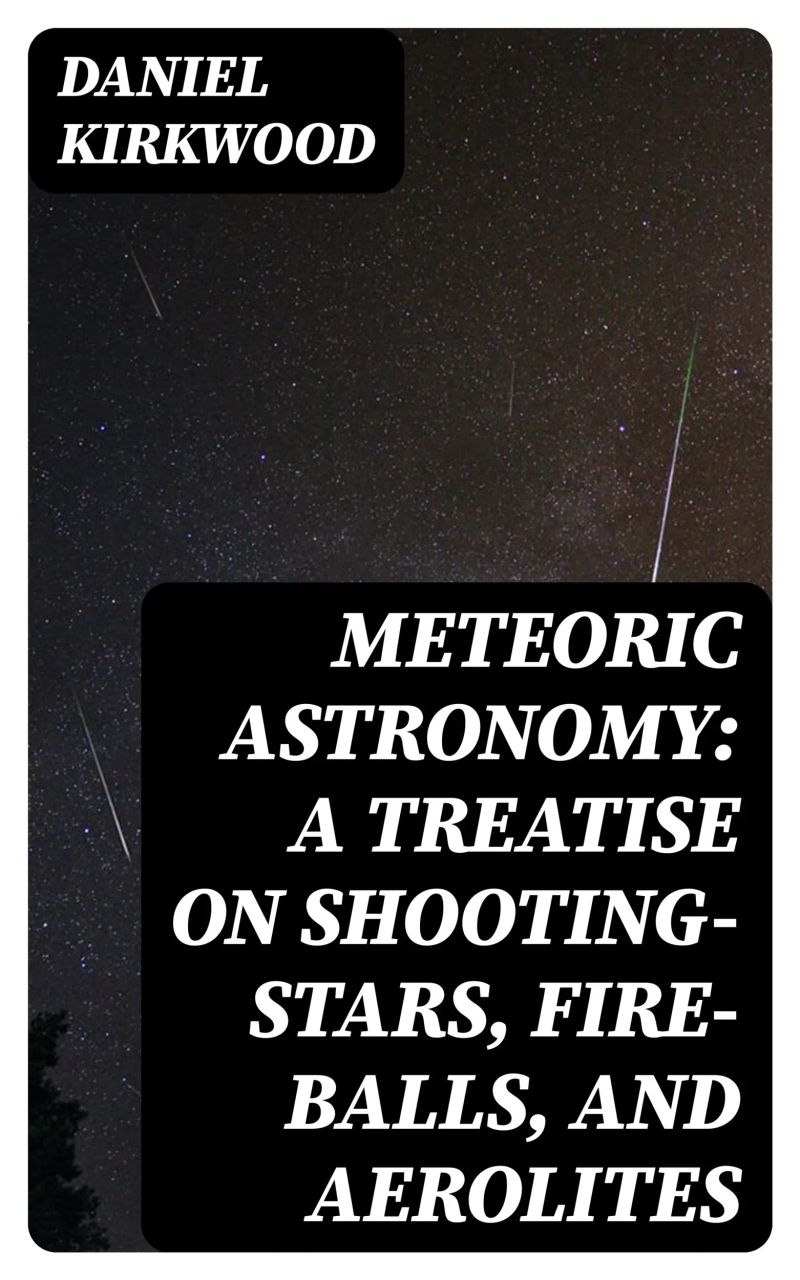
Meteoric astronomy: A treatise on shooting-stars, fire-balls, and aerolites
By Daniel Kirkwood


Length2h 47m
About this audiobook
In "Meteoric Astronomy: A Treatise on Shooting-Stars, Fire-Balls, and Aerolites," Daniel Kirkwood masterfully bridges the early scientific inquiries into meteorology and astronomy, providing a comprehensive exploration of the phenomena associated with meteors. Utilizing empirical observation and a methodical approach, Kirkwood delves into the nature, origin, and classification of shooting stars, fireballs, and meteorites, meticulously documenting their characteristics and occurrences. His work reflects the burgeoning ethos of 19th-century science, where rational inquiry and systematic study began to transform our understanding of celestial phenomena, positioning astronomy as a groundbreaking field of scientific inquiry. Daniel Kirkwood (1814-1895) was a prominent American astronomer whose significant contributions to the field, particularly regarding the study of asteroids and meteors, underscore his intellectual depth. His academic pursuits, driven by a keen interest in celestial mechanics and the mathematical underpinnings of astronomy, laid a foundation for the systematic study of meteoroids, culminating in this seminal treatise. His work reflects not only his scientific rigor but also the awe and wonder associated with the cosmos during his era. "Meteoric Astronomy" is a must-read for anyone fascinated by the celestial wonders of our night sky. Not only does it offer insight into the historical context of astronomical study, but it also enriches the reader's appreciation for the intricate dance of meteors through our atmosphere. Whether you're a seasoned astronomer or a curious novice, Kirkwood's work invites you to explore the mesmerizing world of meteorites with newfound understanding.
Audiobook details
GenreScience and Nature
Length2 hrs 47 mins
Narrated byListen with 1,000+ voices
FormateBook with Audio
Publish dateSep 16, 2022
LanguageEnglish
Table of contents
1PREFACE.
2INTRODUCTION. A GENERAL VIEW OF THE SOLAR SYSTEM.
3METEORIC ASTRONOMY.
4I. The Meteors of November 12th–14th.
5The Meteors of 1866 compared with those of former Displays.
Show all chaptersShow less
6Discussion of the Phenomena.
7Elements of the Orbit.
8II. The Meteors of August 6th–11th.
9III. The Meteors of April 18th–26th.
10IV. The Meteors of December 6th–13th.
11V. The Meteors of January 2d–3d.
12General Remarks.
13CHAPTER III. AEROLITES.
14The Epoch of November 29.
15I. The Epoch of November 11th–14th.
16II. The Epoch of August 7th–11th.
17III. The Epoch of December 6th–13th.
18IV. The Epoch of April 18th–26th.
19V. The Epoch of April 9th–12th.
20Meteoric Transits—Dark Days.
21Partial Interception of the Sun's Light and Heat.
22CHAPTER VII. FURTHER RESEARCHES OF REICHENBACH—THEORY OF METEORS—STABILITY OF THE SOLAR SYSTEM—DOCTRINE OF A RESISTING MEDIUM.
23CHAPTER VIII. DOES THE NUMBER OF AEROLITIC FALLS VARY WITH THE EARTH'S DISTANCE FROM THE SUN?—RELATIVE NUMBERS OBSERVED IN THE FORENOON AND AFTERNOON—EXTENT OF THE ATMOSPHERE AS INDICATED BY METEORS.
24The Meteoric Theory.
25Variable and Temporary Stars.
26The Lunar Theory.
27The Solar Theory.
28CHAPTER XII. THE RINGS OF SATURN.
29Remarks on the foregoing Table.
More from Daniel Kirkwood

A Brief History of IntelligenceMax S. Bennett12h 18m4.6 (6.6K)$29 · $0.00
The Story of BirdsSteve Brusatte11h 49m4.6 (401)$29 · $0.00
Black Earth WisdomLeah Penniman11h 54m4.6 (577)$8 · $0.00

Total Cat MojoJackson Galaxy10h 13m4.5 (8.4K)$23 · $0.00

My Life Among the UnderdogsTia Torres5h 51m4.5 (4K)$24 · $0.00

What It Takes to Save a LifeKwane Stewart6h4.6 (556)$24 · $0.00

Pastoral SongJames Rebanks8h 35m4.5 (12K)$26 · $0.00

How Stella Learned to TalkChristina Hunger7h4.5 (10.9K)$24 · $0.00

Craig & FredCraig Grossi8h 6m4.5 (9.6K)$26 · $0.00

Celebrating BirdsNatalia Rojas, Ana Maria Martinez6h 47m4.6 (330)$24 · $0.00

Saving JemimaJulie Zickefoose4h 59m4.5 (749)$20 · $0.00

Will's Red CoatTom Ryan8h 23m4.5 (2.3K)$26 · $0.00

Of Time and TurtlesSy Montgomery10h 34m4.5 (5K)$29 · $0.00

THE WOLF TRILOGY: Call of the Wild, White Fang & The Son of the WolfJack London17h 31m4.5 (2.4K)$1.99 · $0.00

Zen and the Art of Saving the PlanetThich Nhat Hanh9h 20m4.5 (3.9K)$29 · $0.00

BLACK BEAUTY (With Original Illustrations)Anna Sewell7h 31m4.5 (1.3K)$1.99 · $0.00

Bottle of LiesKatherine Eban14h 25m4.4 (12K)$33 · $0.00
IngrainedCallum Robinson8h 10m4.5 (1.1K)$26 · $0.00

The Lion Tracker's Guide To LifeBoyd Varty3h 1m4.4 (4.8K)$18 · $0.00

Born for LoveBruce D. Perry, Maia Szalavitz11h 42m4.4 (4K)$29 · $0.00
You may also like

Soap-Bubbles and the Forces Which Mould ThemC. V. Boys2h 16m4.2 (340)$2 · $0.00

On the Origin of SpeciesCharles Darwin21h 28m4.2 (303K)$21 · $0.00

Flight PathsRebecca Heisman8h 33m4.2 (1.1K)$6 · $0.00
Cosmic QueriesNeil deGrasse Tyson, James Trefil6h 18m4.3 (4.8K)$17 · $0.00
Astronomy: The Science of the Heavenly BodiesDavid P. Todd11h 5m3.9 (48)$2 · $0.00

Wi-Fi Router Setup Made SimpleWalter Hemsley4h 10m$5

Practical Exercises in Elementary MeteorologyRobert DeCourcy Ward7h 16m$2 · $0.00

Galactic TiesElijah V. Reynolds6h 58m$4.10 · $0.00

Hannibal Crosses the AlpsCecil Torr1h 17m$1 · $0.00

Prehistoric MenRobert J. Braidwood7h 14m3.5 (58)$2 · $0.00

An Expository Outline of the "Vestiges of the Natural History of Creation"S. Laing2h 48m$2 · $0.00

Nature and CultureHarvey Rice4h 44m$2 · $0.00

The Rise and Progress of PalaeontologyThomas Henry Huxley35m$2 · $0.00

The Birth-Time of the World and Other Scientific EssaysJohn Joly8h 31m$1 · $0.00

Spinning TopsJohn Perry1h 31m3.8 (18)$2 · $0.00

CrystalsA. E. H. Tutton8h 23m$2 · $0.00

Fossil ButterfliesSamuel Hubbard Scudder3h 18m$2 · $0.00
The Forces of MatterMichael Faraday4h 31m4.3 (242)$1 · $0.00

The Geographical Distribution of Animals (Vol.1&2) (Annotated)Alfred Russel Wallace42h 13m4.6 (12)$2 · $0.00

On adipocire, and its formationCharles Mayer Wetherill1h 7m$2 · $0.00