
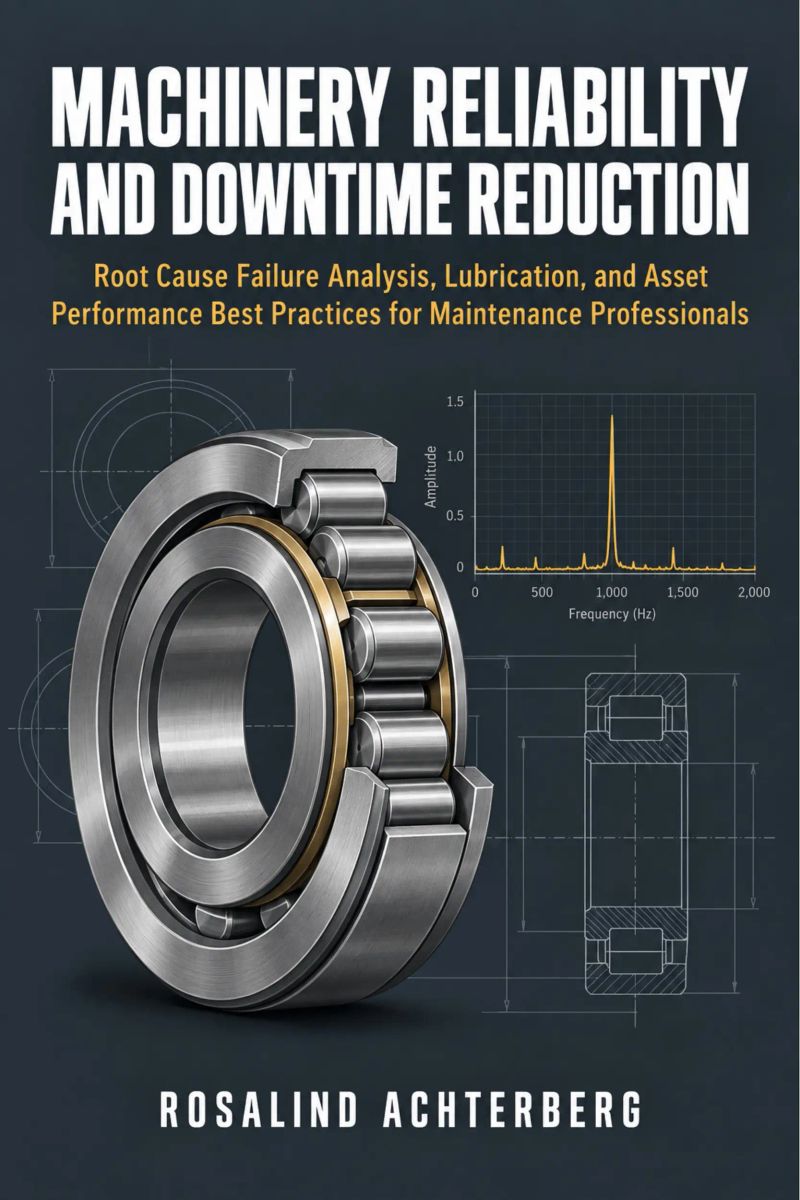
Machinery Reliability and Downtime Reduction
Root Cause Failure Analysis, Lubrication, and Asset Performance Best Practices for Maintenance ProfessionalsBy Rosalind Achterberg


Length15h 11m
About this audiobook
Downtime is rarely a mystery once the evidence is read properly.
This book gives you a complete reliability method, starting with the metrics that survive scrutiny and the asset hierarchy that makes failure history worth keeping. You will learn the failure mechanisms of bearings, gears, seals and couplings, run a structured root cause analysis using logic trees and preserved evidence, and read damage patterns straight off the failed component.
Lubrication chapters cover viscosity selection, contamination control, cleanliness coding and oil analysis interpretation. Condition monitoring chapters teach vibration spectra, thermography and ultrasound routes with practical alarm limits. Final chapters turn all of it into strategy: task selection, planning, spares policy and downtime accounting.
What you will learn:
• Reliability language and metrics that withstand scrutiny
• How to build an asset hierarchy that preserves failure history
• Failure modes of rotating equipment: bearings, gears, seals, couplings
• Structured root cause failure analysis using logic trees and evidence
• Component forensics: reading damage patterns from failed parts
• Lubrication fundamentals: viscosity selection, contamination control, cleanliness coding
• Lubricant degradation and oil analysis interpretation
• Vibration analysis, thermography, ultrasound, and motor testing with alarm limits
• Precision maintenance, maintenance strategy selection, planning, scheduling, spares, and downtime reduction
For reliability engineers, maintenance managers, planners and condition-monitoring technicians.
Audiobook details
GenreTechnology
Length15 hrs 11 mins
Narrated byListen with 1,000+ voices
FormateBook with Audio
Publish dateSep 27, 2026
LanguageEnglish
Table of contents
1Machinery Reliability and Downtime Reduction
2Foreword
3Preface
4About This Book
5Important Safety Notice
Show all chaptersShow less
6Chapter 1: Reliability Language and Metrics
71.1 Failure, Repair, and the Events That Count
81.2 Mean Time Between Failures and Mean Time to Repair
91.3 Hazard Rate and the Bathtub Curve
101.4 Weibull Basics and Plotting Failure Data
111.5 Availability, Its Components, and What Management Hears
121.6 Reliability Data You Can Defend in a Meeting
13Chapter 2: Building the Asset Hierarchy
142.1 Equipment Registers and Functional Locations
152.2 Equipment Criticality Ranking
162.3 Failure Coding That Survives an Audit
172.4 Work History, Meters, and Operating Context
182.5 Making the Hierarchy Work: Governance and Change Control
19Chapter 3: Failure Modes of Rotating Equipment
203.1 How Bearings Fail
213.2 Gear Failure Mechanisms
223.3 Couplings, Shafts, and Seals
233.4 Belts, Chains, and Other Drives
243.5 Electric Motor Failure Modes
25Chapter 4: Root Cause Failure Analysis
264.1 What Root Cause Analysis Is and Is Not
274.2 The Limits of Five Whys
284.3 Logic Trees and Hypothesis Testing
294.4 Evidence Preservation and the Chain of Custody
304.5 Writing the Report and Closing the Loop
31Chapter 5: Component Forensics
325.1 Reading Bearing Damage Patterns
335.2 Fracture Surfaces and Shaft Failures
345.3 Wear Debris and Lubricant Forensics
355.4 Discoloration, Deposits, and Overheating Evidence
365.5 Turning Forensics into Action
37Chapter 6: Lubrication Fundamentals
386.1 Why Lubrication Decides Machine Life
396.2 Viscosity, Grades, and Selection
406.3 Base Oils, Additives, and Compatibility
416.4 Film Thickness and Elastohydrodynamic Lubrication
426.5 Grease Selection, Application, and Compatibility
43Chapter 7: Lubricant Degradation and Analysis
447.1 Oxidation and Thermal Degradation
457.2 Varnish, Deposits, and Their Consequences
467.3 Water Ingress and Its Effects
477.4 Cleanliness Codes and Contamination Control
487.5 Reading an Oil Analysis Report
497.6 Sampling Practice and Programme Design
50Chapter 8: Vibration Analysis

LiftoffEric Berger9h 4m4.6 (9.5K)$29 · $0.00

The Honey BusMeredith May9h 31m4.4 (16.6K)$25 · $0.00
Collected Writings of Nikola TeslaThomas Commerford Martin, Nikola Tesla19h 42m4.4 (2.8K)$1.99 · $0.00

Operation PedestalMax Hastings12h 29m4.4 (5.2K)$29 · $0.00

When the Heavens Went on SaleAshlee Vance18h 20m4.4 (3K)$40 · $0.00

Everybody Has a Podcast (Except You)Justin McElroy, Travis McElroy, Griffin McElroy5h 9m4.3 (2.3K)$24 · $0.00

Hands of TimeRebecca Struthers8h 8m4.4 (1.3K)$26 · $0.00
Never Lost AgainBill Kilday10h 1m4.4 (805)$29 · $0.00
How the Internet HappenedBrian McCullough13h 28m4.3 (2.7K)$23 · $0.00

Collected Writings of Nikola TeslaNikola Tesla, Thomas Commerford Martin21h 50m4.3 (1.7K)$1 · $0.00

Just AspireAjai Chowdhry9h 13m4.4 (260)$29 · $0.00

The Little Book of AliensAdam Frank8h 20m4.3 (1.3K)$26 · $0.00
The inventions, researches and writings of Nikola Tesla (Annotated)Thomas Commerford Martin16h 59m4.3 (1.3K)$2 · $0.00

KargilV.P. Malik15h 18m4.3 (2K)$24 · $0.00

Experiments with Alternating CurrentsNikola Tesla9h 16m4.3 (874)$1.99 · $0.00

Fire on the HorizonTom Shroder, John Konrad8h 23m4.3 (858)$26 · $0.00

The Smell of Kerosene (Annotated)National Aeronautics and Space Administration, Donald L. Mallick, Peter W. Merlin11h 32m4.3 (523)$2 · $0.00

The Boy Who Harnessed the WindWilliam Kamkwamba, Bryan Mealer10h 5m4.2 (78.9K)$29 · $0.00

Across the Airless WildsEarl Swift10h 8m4.3 (1.3K)$29 · $0.00
Console WarsBlake J. Harris20h 41m4.2 (13.7K)$46 · $0.00
You may also like

A Silent FireShilpa Ravella12h 2m4.0 (1.3K)$23
Pets on the CouchNicholas Dodman DVM8h 42m4.0 (1.1K)$20 · $0.00

Unlocking the Keto CodeSteven R. Gundry, MD6h 12m3.9 (3.3K)$24 · $0.00

A Series of Lessons in Gnani Yoga: The Yoga of WisdomWilliam Walker8h 20m4.2 (297)$3.50 · $0.00
The Artist's Guide to Grant WritingGigi Rosenberg5h 39m4.3 (269)Free

Do Penguins Have Knees?David Feldman1h 23m3.8 (1K)$16 · $0.00

Kant's Critique of JudgementImmanuel Kant12h 49m4.2 (12.5K)$1.80 · $0.00

Power BI for Business IntelligenceLena Farrell7h 24m$5 · $0.00

Medicare App Made SimpleWalter Hemsley4h 17m$11
Comprehensive Ophthalmology Multiple-Choice Questions and Answers Study GuideJonathan Stephens5h 46m$17 · $0.00
YeastThomas Henry Huxley41m3.5 (66)$2 · $0.00
The Invisible Code of PeopleDanniel Silva3h 30m$1.80 · $0.00
Clinical Echocardiography Review GuideJason J. Brancos16h 28m$11.50

All-American DogsAndrew Hager4h 55m4.1 (66)$20 · $0.00

Sacred Geometry of the SoulLuz Harper24m$14 · $0.00

Question Meditation—LIFEMichael Draksal28m$11 · $0.00

The Biological Problem of To-day: Preformation Or Epigenesis?Oscar Hertwig3h 32m$2 · $0.00

How to Escape the Maze of Autism and ASDSergei Toder6h 33m4.6 (11) Only with Ultra
The Art of Reading PeopleDanniel Silva3h 34m4.2 (21)$1.80 · $0.00
Discounted Cash Flow DemystifiedLuna Z. Rainstorm8h 4m$6.40 · $0.00