
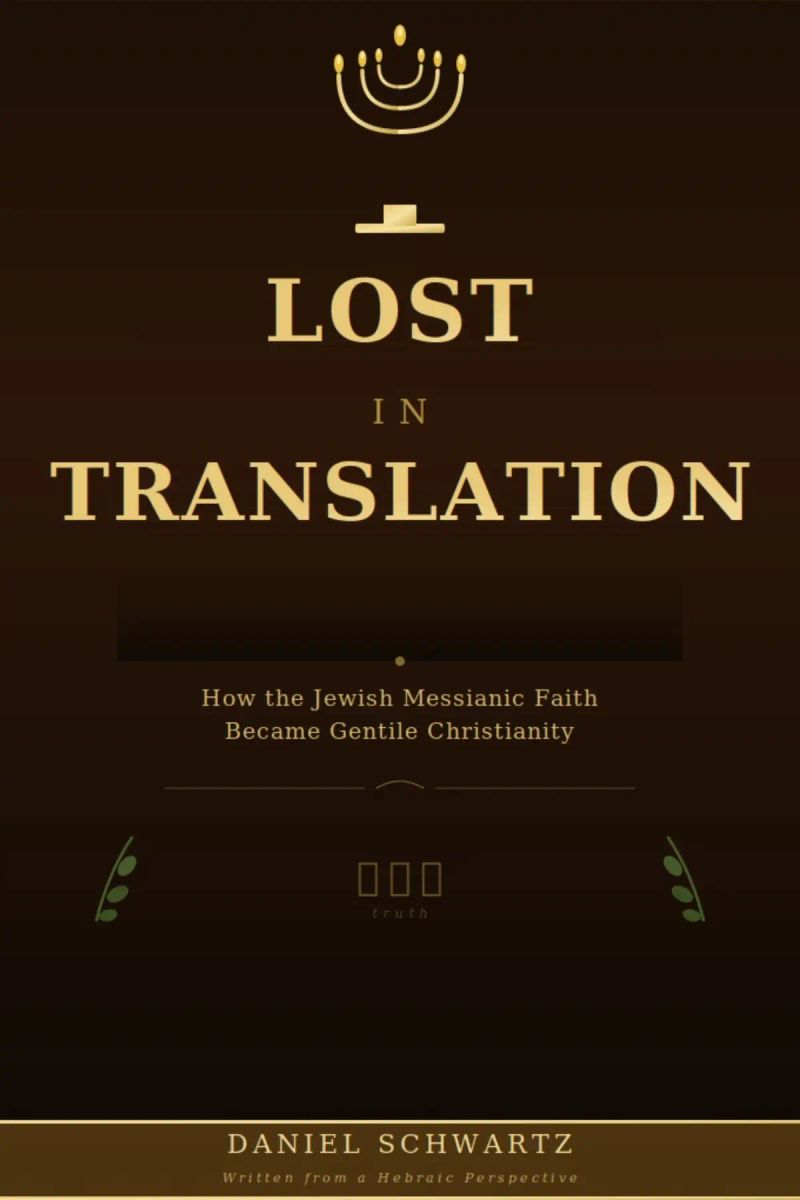
LOST IN TRANSLATION
How the Jewish Messianic Faith Became Gentile ChristianityBy Daniel Schwartz


Length3h 33m
About this audiobook
Lost in Translation: How the Jewish Messianic Faith Became Gentile Christianity tells the story of one of history's most consequential transformations — the journey of a thoroughly Jewish movement, born within the covenant world of Second Temple Judaism, into the Gentile religion that came to be called Christianity. This book traces, in specific and scholarly detail, how that foundation was gradually dismantled: the destruction of Jerusalem in 70 C.E. scattered the Jewish Messianic center; the Roman fiscus Judaicus gave Gentile believers powerful economic incentives to publicly distance themselves from Jewish identity; separation from the synagogue ended the Torah education that had formed them.
Audiobook details
Rating★★★★★ 4.6 (1.4K)
Includes Amazon, Goodreads
GenreSpirituality and Religion
Length3 hrs 33 mins
Narrated byListen with 1,000+ voices
FormateBook with Audio
Publish dateApr 15, 2026
LanguageEnglish
Table of contents
1Introduction
2Author's Preface
3Introduction: The Movement Called the Way
4Chapter One: Historical and Cultural Context — A Jewish World
51.1 The Roman World and Its Impact on Jewish Life
Show all chaptersShow less
61.2 The Diversity of First Century Judaism
71.3 Messianic Expectations and the Hope of Israel
8Chapter Two: Yeshua, Son of David — A Teacher in the Tradition of Israel
92.1 The Jewish Teacher from Nazareth
102.2 Parables, Healing, and the Kingdom of God
112.3 Death on the Roman Cross and Resurrection
12Chapter Three: The Birth of the Messianic Community — Deeply and Thoroughly Jewish
133.1 Shavuot and the Outpouring of the Ruach HaKodesh
143.2 A Community Rooted in Jewish Practice
153.3 Leadership Structures Drawn from Jewish Models
16Chapter Four: The Gentiles Come In — Torah Study in the Synagogue
174.1 God-Fearers, Proselytes, and the Synagogue World
184.2 The Jerusalem Council and the Question of Gentile Inclusion
194.3 Paul: Jewish Apostle to the Nations
20Chapter Five: Worship, Torah, and Daily Life in the Messianic Community
215.1 Prayer and the Hebrew Scriptures
225.2 The Communal Meal and Covenant Memory
235.3 Ethical Life Shaped by Torah
24Chapter Six: The Great Unraveling — How Gentile Believers Lost Their Jewish Roots
256.1 The Catastrophe of 70 C.E. — When the Center Did Not Hold
266.2 The Fiscus Judaicus — Taxation, Identity, and Forced Separation
27The Tax Under Domitian: Enforced Identity and the Crisis of Association
28The Tax Under Nerva: 'Relief' That Deepened the Divide
29The Fiscal and the Theological: How Economics Shaped Doctrine
306.4 The Seventh Day to the First: How the Biblical Sabbath Was Replaced and Why It Matters
31The Sabbath in the Hebrew Bible and in the Life of Yeshua
32The Apostolic Community and the Seventh Day
33The Gradual Shift: Second Century Motivations
34Constantine's Sunday Law and the Imperial Seal
35The Theological Arguments for Sunday and Their Weaknesses
36What Was Lost When the Sabbath Was Lost
37The Path of Recovery
386.5 The Separation from the Synagogue and Its Consequences
396.6 'Christians': The Birth of a New Label and What It Erased
406.7 Marcion and the Assault on the Hebrew Scriptures
416.8 The Gentile Church Councils and the Severing of Jewish Roots
426.9 Supersessionism: The Theology of Replacement
43Chapter Seven: Fragmentation — The Long Aftermath of Lost Roots
447.1 Theological Fragmentation Without Torah as the Common Foundation
457.2 The Loss of Yeshua's Jewish Context
467.3 The Misreading of Paul: How the Most Jewish of Apostles Became the Father of Anti-Torah Christianity
47The Problem of Reading Paul Without Jewish Context
48Augustine, Luther, and the Introspective Reading
49Specific Texts and Their Distortion
50The New Perspective and the Paul Within Judaism School
Series
More from Daniel Schwartz
THE FORTY DAYS BETWEEN RESURRECTION AND ASCENSIONDaniel Schwartz8h 37m$2.99 · $0.00

JUMOR Laughing Through the Ages:Daniel Schwartz1h 12m$2.99 · $0.00
FINDING CHRIST IN THE PASSOVERDaniel Schwartz2h 29m4.6 (50)$2.99 · $0.00
The unseen Spiritual WorldDaniel Schwartz1h 49m4.8 (198)$2.99 · $0.00
REFUTING ANTI-MISSIONARIESDaniel Schwartz1h 50m$2.99 · $0.00
One Covenant, One BodyDaniel Schwartz3h 30m4.9 (267)$2.99 · $0.00

THE AMERICAN RESTORATION MANIFESTODan Schwartz5h 29m$2.99
When Heaven is SilentDaniel Schwartz2h4.7 (89)$2.99

CIDPDaniel Schwartz2h 47m$4.99 · $0.00
Advents of the Jewish MessiahDaniel Schwartz3h 13m4.8 (156)$2.99 · $0.00
Paul ReconsideredDaniel Schwartz1h 55m$2.99 · $0.00

A Little God Time for Women Morning & Evening DevotionalBroadStreet Publishing Group LLC15h 15m4.9 (1.2K)$10 · $0.00
The Chosen Presents: A Blended Harmony of the GospelsSteve Laube, Amanda Jenkins, Dallas Jenkins7h 8m4.9 (823)$10 · $0.00
Prayers from the Throne RoomBrian Simmons8h 55m4.9 (256)$10 · $0.00
31 Decrees of Blessing for Your LifePatricia King2h 38m4.8 (1.4K)$10 · $0.00

Loved BabySarah Philpott4h 51m4.8 (1.4K)$10 · $0.00

The QuranAllah23h 7m4.7 (136.1K)$1 · $0.00

The Secret of the RosaryLouis de Montfort6h 1m4.7 (16K)$2 · $0.00

The Holy Qur-an: Text, Translation and CommentaryAbdullah Yusuf Ali22h 16m4.7 (133K)$1 · $0.00

All of Grace (Annotated)Charles Spurgeon5h 1m4.7 (1.3K)$0.99 · $0.00

Steps to ChristEllen G. White3h 12m4.7 (13.8K)$2 · $0.00
The Doctrine and Selected CovenantsJoseph Smith13h 53m4.7 (10.4K)$1.99 · $0.00

Sinners in the Hands of an Angry God & Other Sermons (Annotated)Jonathan Edwards7h 51m4.7 (1.5K)$2 · $0.00

Swayam Ki AwaazPrem Rawat8h 34m4.7 (1.1K)$26 · $0.00

Behind the BadgeAdam Davis10h 18m4.7 (2.7K)$10 · $0.00

The New Human Revolution, vol. 1Daisaku Ikeda7h 46m4.7 (669)$12 · $0.00

You Are Worth ItKyle Carpenter, Don Yaeger8h 53m4.7 (4.8K)$29 · $0.00

Praying GraceDavid A. Holland3h 2m4.7 (658)$10 · $0.00

Evidence Not SeenDarlene Deibler Rose11h 11m4.6 (11.9K)$29 · $0.00
The Christ KeyChad Bird, Chad Bird7h 33m4.7 (592)$17.40 · $0.00
He and IGabrielle Bossis10h 12m4.7 (554)$17 · $0.00
You may also like

The Doctrine and Covenants of the Church of Jesus Christ of Latter Day Saints (Annotated)Joseph Smith13h 57m4.7 (575)$2 · $0.00
Simply JesusN. T. Wright10h 30m4.3 (14.1K)$29 · $0.00
JesusMarcus J. Borg12h 11m4.3 (6.3K)$29 · $0.00
The History of the Christian Church: Vol.1-8Philip Schaff306h 53m4.6 (503)$1.99 · $0.00

Gospel Doctrine: Selections from the Sermons and Writings of Joseph F. SmithJoseph F. Smith21h 40m4.6 (524)$1 · $0.00
The Light and the GloryPeter Marshall, David Manuel15h 16m4.3 (4.7K)$25
The True JesusLimbaugh, David15h 46m4.5 (1.6K)Free

The Articles of FaithJames E. Talmage20h 1m4.6 (8K)$2 · $0.00

Tanakh, Bible & Qu'ran (Annotated)Various Authors92h 25m$1.99 · $0.00

Tanakh, Bible & Qu'ran: The Pillars of Three Faiths (Annotated)Various Authors159h$2 · $0.00

The Literature and History of New Testament TimesJ. Gresham Machen13h 24m4.2 (13)$1 · $0.00

The Essential Writings of Philip SchaffPhilip Schaff458h 18m$0.99 · $0.00
Rays of Living Light on the One Way of SalvationCharles W. Penrose3h 22m4.8 (11)$2 · $0.00

The History of the Christian Church According to Eusebius & Philip Schaff (Annotated)Philip Schaff, Eusebius351h 48m$2 · $0.00

Understanding the LawPaul McGhie36m5.0 (2) Only with Ultra

English Summary Of Genesis ApocalypseFrancisco Jerbesson De Freitas Morais12h 7m$6 · $0.00
Septuagint - HaggaiScriptural Research Institute1h 14m$3.50 · $0.00
A Harmony of the Gospels for Students of the Life of ChristA. T. Robertson, John Albert Broadus13h 48m4.2 (138)$1.50 · $0.00

The Centurion's StoryDavid James Burrell21m$1 · $0.00

The New TestamentNina Reymann, Luna Luna2h 59m$12 · $0.00