
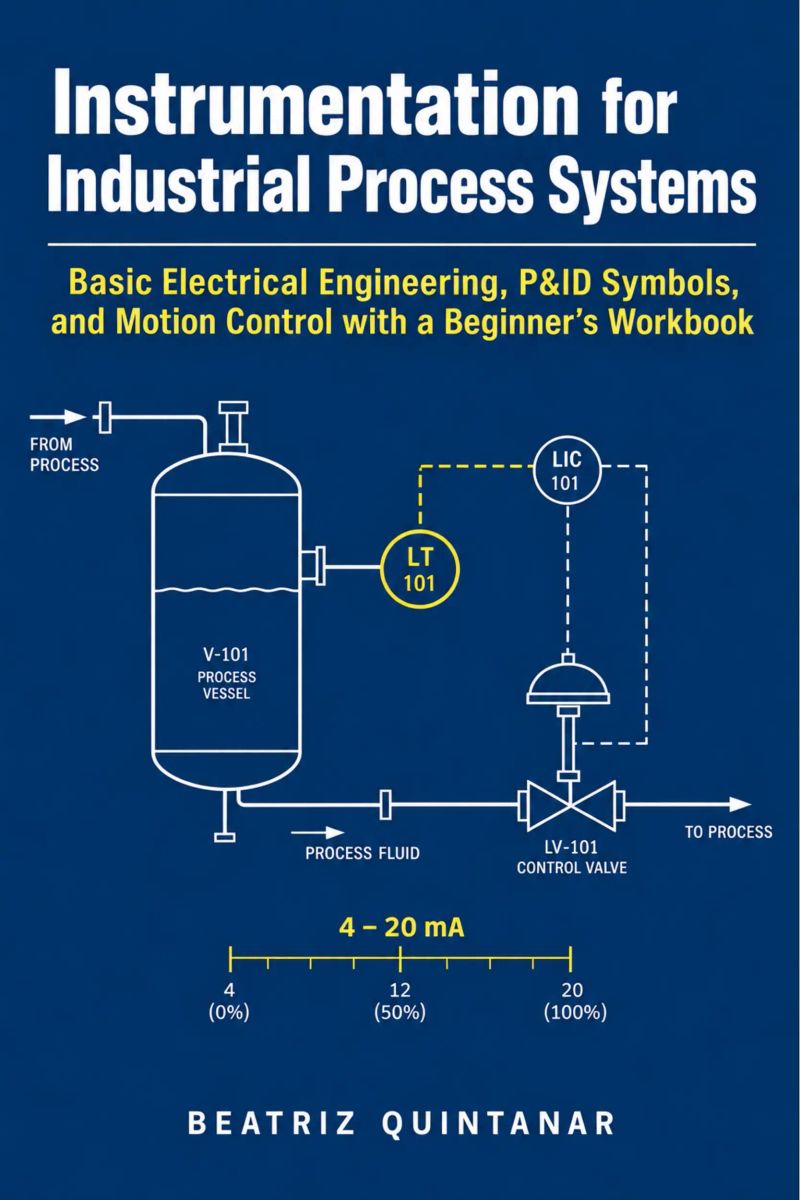
Instrumentation for Industrial Process Systems
Basic Electrical Engineering, P&ID Symbols, and Motion Control with a Beginner's WorkbookBy Beatriz Quintanar


Length13h 1m
About this audiobook
Before you can troubleshoot an instrument, you have to read the drawing that says what it is supposed to do. This book gets you there from the beginning.
Instrumentation for Industrial Process Systems is a practical, ground-up guide for anyone who needs to understand how measurement and control loops actually work in a plant. You will start with the electrical basics that every loop depends on—circuits, power, grounding, and the noise that corrupts a millivolt signal—then learn what accuracy, span, zero, and hysteresis actually cost you in a real measurement. From there you cover pressure, level, temperature, flow, and analytical instruments with their installation rules and failure modes.
The second half of the book turns to the drawings themselves: identification letters, tag numbers, instrument balloons, line conventions, full piping and instrumentation diagrams (P&IDs), loop sheets, and panel wiring. Valves, drives, controllers, and safety systems follow, and a graded workbook with answer keys closes the book. Each chapter builds on the last, so you finish with a working knowledge of both the hardware and the documents that describe it.
What you will learn:
• Electrical fundamentals for instrumentation: circuits, power supplies, grounding, and noise control
• How sensor performance is specified—accuracy, span, zero, hysteresis, and error
• Standard signal types and transmission methods used in process loops
• Pressure, level, temperature, flow, and analytical measurement principles, installation rules, and failure modes
• Instrument identification letters, tag numbers, and P&ID symbols
• How to read process drawings, loop sheets, and panel wiring diagrams
• Final control elements, drives, controllers, and safety systems
• A graded workbook with answer keys to test your understanding
For instrumentation students and new technicians, this book is designed to take you from basic electrical concepts to reading real process drawings. If you are starting a career in process instrumentation or need a clear reference for the symbols and standards used in industrial facilities, this is your starting point.
Audiobook details
GenreTechnology
Length13 hrs 1 min
Narrated byListen with 1,000+ voices
FormateBook with Audio
Publish dateSep 27, 2026
LanguageEnglish
Table of contents
1Instrumentation for Industrial Process Systems
2Foreword
3Preface
4About This Book
5Important Safety Notice
Show all chaptersShow less
6Chapter 1: Basic Electrical Engineering for Instruments
71.1 Voltage, Current and Resistance in the Instrument Loop
81.2 Series and Parallel Circuits and the Voltage Divider
91.3 Alternating Current, Frequency and Power
101.4 Transformers, Rectifiers and Instrument Power Supplies
111.5 Reading a Simple Instrument Circuit
12Chapter 2: Wiring, Grounding and Noise
132.1 Conductors, Insulation and Terminations
142.2 Grounding, Shielding and Single-Point Practice
152.3 Induced Noise, Capacitive and Magnetic Coupling
162.4 Intrinsic Safety and Hazardous Area Basics
17Chapter 3: Sensor Performance and Error
183.1 Accuracy, Precision, Repeatability and Linearity
193.2 Hysteresis, Dead Band and Resolution
203.3 Span, Zero, Turndown and Drift
213.4 Building an Error Budget
22Chapter 4: Signal Standards and Transmission
234.1 The Four-to-Twenty Milliamp Current Loop
244.2 Loop Power, Load Resistance and Compliance
254.3 Digital Data over the Analogue Signal
264.4 Fieldbus and Wireless Links
27Chapter 5: Pressure Measurement
285.1 Gauge, Absolute and Differential Pressure
295.2 Strain Gauge and Capacitance Sensing Elements
305.3 Impulse Lines, Diaphragm Seals and Installation Errors
31Chapter 6: Level Measurement
326.1 Differential Pressure Level with Dry and Wet Legs
336.2 Displacers, Radar, Ultrasonic and Capacitance
346.3 Interfaces, Foam, Turbulence and Mounting
35Chapter 7: Temperature Measurement
367.1 Resistance Thermometers and Lead Compensation
377.2 Thermocouples and Cold Junction Compensation
387.3 Thermowells, Response Time and Installation Depth
39Chapter 8: Flow Measurement
408.1 Differential Pressure Flow and the Square-Root Relationship
418.2 Magnetic, Vortex, Turbine, Coriolis and Ultrasonic Meters
428.3 Straight Run, Reynolds Number and Installation Limits
43Chapter 9: Analytical and Miscellaneous Measurement
449.1 pH and Conductivity
459.2 Gas Analysis, Density and Moisture
469.3 Weight, Speed and Sample Handling Systems
47Chapter 10: Instrument Identification and P&ID Symbols
4810.1 Identification Letters and Tag Numbers
4910.2 Instrument Balloons and Location Conventions
5010.3 Process, Signal and Utility Line Symbols

LiftoffEric Berger9h 4m4.6 (9.5K)$29 · $0.00

The Honey BusMeredith May9h 31m4.4 (16.6K)$25 · $0.00

Collected Writings of Nikola TeslaThomas Commerford Martin, Nikola Tesla19h 42m4.4 (2.8K)$1.99 · $0.00

Operation PedestalMax Hastings12h 29m4.4 (5.2K)$29 · $0.00

When the Heavens Went on SaleAshlee Vance18h 20m4.4 (3K)$40 · $0.00

Everybody Has a Podcast (Except You)Justin McElroy, Travis McElroy, Griffin McElroy5h 9m4.3 (2.3K)$24 · $0.00

Hands of TimeRebecca Struthers8h 8m4.4 (1.3K)$26 · $0.00

Never Lost AgainBill Kilday10h 1m4.4 (805)$29 · $0.00

How the Internet HappenedBrian McCullough13h 28m4.3 (2.7K)$23 · $0.00

Collected Writings of Nikola TeslaNikola Tesla, Thomas Commerford Martin21h 50m4.3 (1.7K)$1 · $0.00

Just AspireAjai Chowdhry9h 13m4.4 (260)$29 · $0.00

The Little Book of AliensAdam Frank8h 20m4.3 (1.3K)$26 · $0.00
The inventions, researches and writings of Nikola Tesla (Annotated)Thomas Commerford Martin16h 59m4.3 (1.3K)$2 · $0.00

KargilV.P. Malik15h 18m4.3 (2K)$24 · $0.00

Experiments with Alternating CurrentsNikola Tesla9h 16m4.3 (874)$1.99 · $0.00

Fire on the HorizonTom Shroder, John Konrad8h 23m4.3 (858)$26 · $0.00

The Smell of Kerosene (Annotated)National Aeronautics and Space Administration, Donald L. Mallick, Peter W. Merlin11h 32m4.3 (523)$2 · $0.00

The Boy Who Harnessed the WindWilliam Kamkwamba, Bryan Mealer10h 5m4.2 (78.9K)$29 · $0.00

Across the Airless WildsEarl Swift10h 8m4.3 (1.3K)$29 · $0.00

Console WarsBlake J. Harris20h 41m4.2 (13.7K)$46 · $0.00
You may also like

MetaphysicsAristotle11h 38m4.4 (1.5K)$2.30 · $0.00

Pete the Cat Plays Hide-and-SeekJames Dean, Kimberly Dean6m4.3 (572)$4 · $0.00

A Silent FireShilpa Ravella12h 2m4.0 (1.3K)$23

Neutrino HuntersRay Jayawardhana6h 4m4.1 (955)$17
TubesAndrew Blum7h 21m3.6 (4.9K)$24 · $0.00

Discounted Cash Flow DemystifiedLuna Z. Rainstorm8h 4m$6.40 · $0.00

AP Statistics Exam Study GuideMarie Peterson9h 23m$10
Discounted Cash Flow BudgetingEvan J. Patel8h 20m$6.40 · $0.00

Gemstones and their distinctive CharactersFrederik Herbert Smith8h 18m4.3 (40)$2.30
Petroleum Fluids and Production MethodsCallum Braithwaite14h 57m$85

How to Make Money Flipping Used Books - How to Identify Valuable Editions, Assess Condition, Build Profitable Lots, and Sell to the Right ReadersJACK FLIPWELL8h 19m$8.10 · $0.00

How to Make Money Flipping Motorhomes and Travel Trailers - How to Assess Structure and Systems, Plan Profitable Renovations, and Resell SafelyJACK FLIPWELL2h 2m$7.70 · $0.00
How to Make Money Flipping Used Construction Machinery - How to Verify Mechanical Condition, Work History, Transport Costs, and Resale PotentialJACK FLIPWELL2h 5m$7.70 · $0.00

Comments on AstrophysicsPedro Paulo Prado42m$16 · $0.00

How to Make Money Flipping Fishing Gear - How to Evaluate Rods, Reels, and Accessories, Build Complete Kits, and Resell for ProfitJACK FLIPWELL6h 41m$7.80 · $0.00
HVAC and Motor Controls Field WorkbookDale Mattingly12h 43m4.6 (12)$60

HumoristsPaul Johnson6h 59m3.3 (175)$17 · $0.00

Early Printed BooksE. Gordon Duff5h 55m3.7 (18)$2.30
Ace Statics Through Problem SolvingBethany Okonkwo13h 20m$75

On Sophistical RefutationsAristotle2h 27m3.8 (170)$1.80 · $0.00