
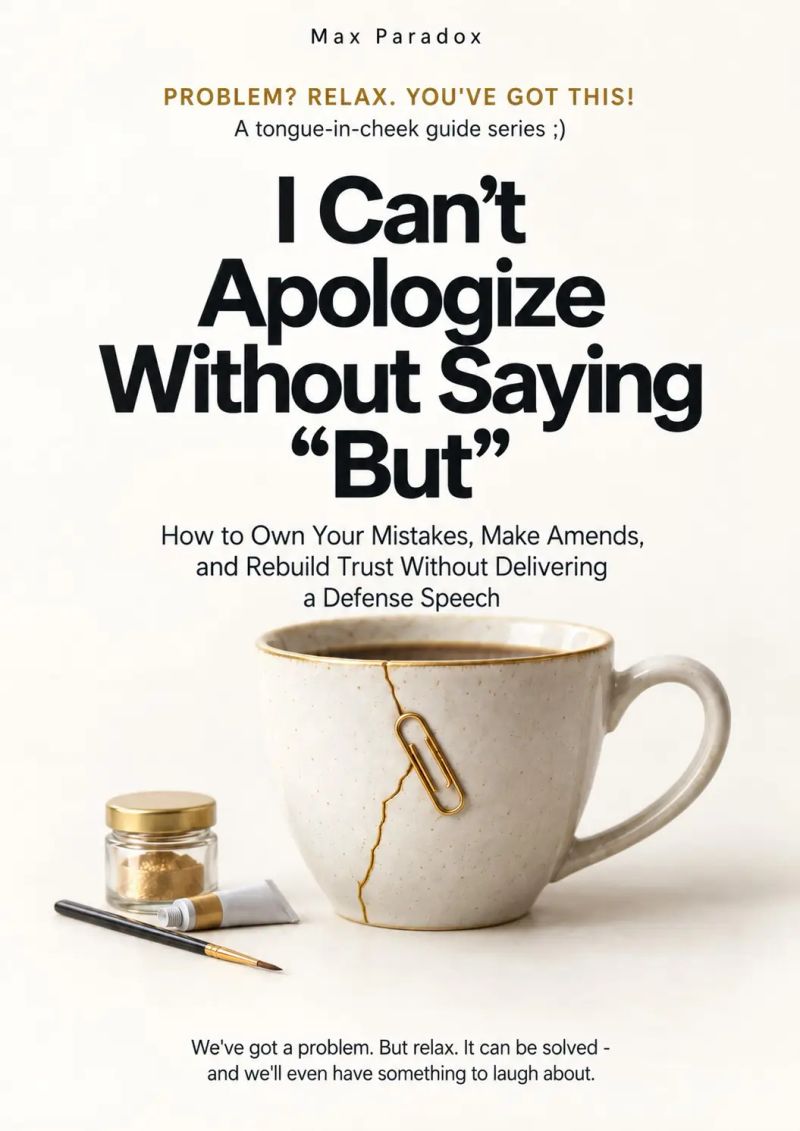
I Can't Apologize Without Saying “But” - How to Own Your Mistakes, Make Amends, and Rebuild Trust Without Delivering a Defense Speech
By Max Paradox


Length3h 34m
About this audiobook
What happens when an ordinary part of life becomes so complicated, repetitive, or emotionally loaded that it starts running the whole day? I Can't Apologize Without Saying “But” is a practical, empathetic guide for readers who want useful answers without judgment, perfectionism, or a second full-time job devoted to self-improvement.
Max Paradox turns a frustrating real-life problem into manageable decisions and repeatable routines. The book does not promise an instant transformation. It shows how to understand what is actually going wrong, choose a realistic minimum, communicate clearly, and build a system that still works on a busy or difficult week.
The first part of the book explores An apology is not an appeal against the verdict; Owning a mistake without resigning from being a decent person; “I'm sorry” does not fix everything. And that's a good thing; How to listen when someone is still angry after your beautifully executed apology; Trust does not come back because of one grand gesture; Don't apologize for things you didn't do; When to apologize, how to apologize, and why a text is sometimes not enough. Each topic is handled through concrete examples, sensible boundaries, and small actions that can be tested immediately instead of admired in a notebook and forgotten by Tuesday.
The middle chapters move through When your apology is not accepted; The more power you have, the more important your “I'm sorry” becomes; If you're apologizing for the same thing for the fifth time, the problem is no longer the apology; Apologies in practice: fewer speeches, better sentences; When you're the one waiting for an apology; Apologize before someone has to file a formal complaint; Build relationships where mistakes can actually be repaired. They help the reader separate urgency from habit, responsibility from guilt, and a useful standard from an impossible one. The goal is not to control every detail, but to make the next decision easier and more reliable.
The final part covers Sometimes the best apology sounds like: “I understand things may be different now”; Group, family, and public apologies: when one “I'm sorry” has many recipients; How to forgive yourself without turning it into convenient forgetting; The hardest apologies are about a pattern, not a mistake; You don't have to accept every apology immediately; The perfect apology does not exist. An honest one is enough. By the end, the reader has a clear way to review what works, repair what does not, and continue without starting over whenever life becomes messy again.
Written in a warm, direct, lightly humorous style, this is a guide for people who value practical progress over motivational slogans. It respects different circumstances and capacities, avoids blaming, and keeps the advice focused on choices the reader can actually make.
If you are tired of carrying the same problem around and would like a calm plan that fits real life, I Can't Apologize Without Saying “But” will help you move from vague frustration to specific, workable next steps.
This publication was prepared with the use of tools supporting the creative process, including solutions based on artificial intelligence. The final concept, structure, and editing belong to the author.
Audiobook details
Rating★★★★★ 4.6 (65)
Includes Goodreads, Amazon
GenreSelf-Help
Length3 hrs 34 mins
Narrated byListen with 1,000+ voices
FormateBook with Audio
Publish dateOct 7, 2026
LanguageEnglish
Table of contents
1I Can't Apologize Without Saying “But”
2INTRO
3Chapter 1 - An apology is not an appeal against the verdict
4Chapter 2 - Owning a mistake without resigning from being a decent person
5Chapter 3 - “I'm sorry” does not fix everything. And that's a good thing
Show all chaptersShow less
6Chapter 4 - How to listen when someone is still angry after your beautifully executed apology
7Chapter 5 - Trust does not come back because of one grand gesture
8Chapter 6 - Don't apologize for things you didn't do
9Chapter 7 - When to apologize, how to apologize, and why a text is sometimes not enough
10Chapter 8 - When your apology is not accepted
11Chapter 9 - The more power you have, the more important your “I'm sorry” becomes
12Chapter 10 - If you're apologizing for the same thing for the fifth time, the problem is no longer the apology
13Chapter 11 - Apologies in practice: fewer speeches, better sentences
14Chapter 12 - When you're the one waiting for an apology
15Chapter 13 - Apologize before someone has to file a formal complaint
16Chapter 14 - Build relationships where mistakes can actually be repaired
17Chapter 15 - Sometimes the best apology sounds like: “I understand things may be different now”
18Chapter 16 - Group, family, and public apologies: when one “I'm sorry” has many recipients
19Chapter 17 - How to forgive yourself without turning it into convenient forgetting
20Chapter 18 - The hardest apologies are about a pattern, not a mistake
21Chapter 19 - You don't have to accept every apology immediately
22Chapter 20 - The perfect apology does not exist. An honest one is enough

I Have Several Accounts and Cards, and I Don't Know How Much Money I Really Have - How to Simplify Your Personal Finances, See All Your Money Flows in One Place, and Know What You Can Actually Spend Without Recalculating Everything Every DayMax Paradox6h 38m$7.70 · $0.00

Odezwał Się Stary Przyjaciel i Nie Wiem, Czy Wracamy do 2012 - Jak odbudowywać kontakt po latach, sprawdzać, kim jesteście dzisiaj, i nie oczekiwać, że historia automatycznie stworzy nową bliskośćMax Paradox6h 5m$7.70 · $0.00

Mam ADHD i Wszystkie Systemy Działają Przez Trzy Dni - Jak budować prostsze sposoby planowania, zaczynania i kończenia zadań, kiedy nowy planer przestaje być ekscytujący w czwartekMax Paradox6h 4m$7.70 · $0.00

Mój Szef Pyta o Status Częściej, Niż Ja Sprawdzam Godzinę - Jak odzyskać zaufanie, ustalić rytm raportowania i rozmawiać o autonomii bez ukrywania się przed komunikatorem ani wysyłania statusu co 47 minutMax Paradox6h 21m$7.70 · $0.00

Mój Partner Śpi Wtedy, Kiedy Ja Dopiero Zaczynam Żyć - Jak dogadać różne chronotypy, wieczorne rytuały i wspólny czas bez zmuszania sowy do śpiewania o szóstej rano ani skowronka do serialu o północyMax Paradox6h 6m$7.70 · $0.00

Organizuję Ślub i Każdy Nagle Jest Konsultantem - Jak ustalić budżet, priorytety i granice z rodziną oraz dostawcami bez robienia z jednego dnia największego projektu operacyjnego dekadyMax Paradox6h 11m$7.70 · $0.00

Nie Chcę Awansu. Czy Nadal Jestem Ambitny? - Jak świadomie wybrać rozwój bez zarządzania ludźmi, rozmawiać o ścieżce eksperckiej i nie brać wyższego stanowiska tylko dlatego, że „tak się robi”Max Paradox6h 17m$7.70 · $0.00

I'm Expected to Deliver Results, but Nobody Added People, Budget, or a Miracle - How to Negotiate Scope, Resources, and Deadlines When Expectations Grow Faster Than Your Team's Capacity, Without Saving the Project by Working Through the NightMax Paradox6h 28m$7.70 · $0.00

Mój Partner Przeszedł na Emeryturę i Nagle Jesteśmy Razem 24/7 - Jak ułożyć nowy rytm dnia, przestrzeń i podział obowiązków, kiedy jedna osoba kończy pracę, a związek nagle dostaje dodatkowe osiem godzin wspólnego czasu dziennieMax Paradox6h 25m$7.70 · $0.00

Mam Kartę Kredytową i Traktuję Limit Jak Drugą Wypłatę - Jak korzystać z kredytu świadomie, pilnować terminów i kosztów oraz przestać mylić dostępne pieniądze z własnymiMax Paradox6h 35m$7.70 · $0.00

I Have a Credit Card and Treat Its Limit Like a Second Paycheck - How to Use Credit Wisely, Keep Track of Due Dates and Costs, and Stop Mistaking Available Credit for My Own MoneyMax Paradox6h 23m$7.70 · $0.00

Nasza Przyjaźń Skończyła Się Bez Żadnego Rozstania - Jak przejść przez cichy koniec ważnej relacji, zaakceptować brak domknięcia i przestać czekać na rozmowę, która może nigdy nie nadejśćMax Paradox5h 54m$7.70 · $0.00

Okres Próbny Brzmi Jak Egzamin z Bycia Człowiekiem - Jak ustalić oczekiwania na pierwsze miesiące, zbierać feedback i pokazywać postęp bez analizowania każdego „masz chwilę?” jak wyroku komisjiMax Paradox6h 20m$7.70 · $0.00

Nie Rozumiem Połowy Korporacyjnych Słów, Ale Wszyscy Kiwnęli Głową - Jak rozumieć firmowy język, dopytywać o konkrety i tłumaczyć strategię na normalne zadania bez używania „synergii” jako przecinkaMax Paradox6h 22m$7.70 · $0.00

Nikt Nie Wie, Jak Wygląda Teraz „Dobra Robota” - Jak doprecyzować cele, kryteria sukcesu i zakres odpowiedzialności, kiedy firma zmienia strategię szybciej niż slajdy w prezentacjiMax Paradox6h 26m$7.70 · $0.00

I Bought Supplies for My Hobby and Now I'm Afraid to Use Them - How to Actually Start Painting, Sewing, Gluing, Building, and Creating Without Saving the Best Materials for "Later" That Never ComesMax Paradox8h 29m$7.70 · $0.00

Pocket Money Disappears in 24 Hours - How to Teach Your Child to Plan Spending, Save, and Make Money Decisions Without Turning Every Penny into an Economics LectureMax Paradox6h 35m$7.70 · $0.00

Kieszonkowe Znika w 24 Godziny - Jak uczyć dziecko planowania wydatków, oszczędzania i podejmowania decyzji o pieniądzach bez zamieniania każdej złotówki w wykład ekonomicznyMax Paradox6h 14m$7.70 · $0.00

Mam 40+ i Nagle Regeneracja Ma Regulamin - Jak mądrzej zarządzać snem, ruchem, energią i odpoczynkiem, kiedy organizm przestaje honorować warunki z czasów studenckichMax Paradox8h 19m$7.70 · $0.00

Klikam „Akceptuj Wszystko”, Bo Chcę Tylko Zobaczyć Przepis - Jak rozumieć cookies, zgody i uprawnienia aplikacji, wybierać ustawienia prywatności, które mają sens, i przestać oddawać dane jednym nerwowym kliknięciem „byle dalej”Max Paradox6h 14m$7.70 · $0.00
Learning to PrayJames Martin13h 24m4.5 (3.4K)$33 · $0.00

Swayam Ki AwaazPrem Rawat8h 34m4.7 (1.1K)$26 · $0.00

Forever BoyKate Swenson9h 27m4.7 (5K)$29 · $0.00

You Are Worth ItKyle Carpenter, Don Yaeger8h 53m4.7 (4.8K)$29 · $0.00

The Happiest Man on EarthEddie Jaku3h 48m4.6 (178K)$7 · $0.00

Finding MeViola Davis9h 15m4.6 (256.4K)$29 · $0.00

Spiritual AnatomyDaaji Kamlesh D. Patel9h 47m4.7 (319)$29 · $0.00

The Dangerous Truth about Today’s MarijuanaLaura Stack CSP, MBA9h 57m4.7 (385)$20 · $0.00

The Gospel according to Spiritualism (Translated)Allan Kardec14h 39m4.6 (3.9K)$5.70 · $0.00

Birdie & HarlowTaylor Wolfe7h 50m4.6 (6.5K)$26 · $0.00

CrossroadsKaleb Dahlgren7h 56m4.6 (4.9K)$26 · $0.00

Life on the BridgeKaelynn Partlow5h 40m4.6 (1.1K)$24 · $0.00

Keep Your Love OnDanny Silk9h 4m4.6 (8.1K)$10 · $0.00

The Tao of Joy Every DayDerek Lin10h 24m4.6 (762)$20 · $0.00

UndividedVicky Beeching9h 2m4.6 (1.3K)$29 · $0.00

HE CAN WHO THINKS HE CAN & OTHER BOOKS ON SUCCESSOrison Swett Marden5h 54m4.6 (1.2K)$1.99 · $0.00
Level UpRob Dial7h 42m4.6 (3.3K)$26 · $0.00

Burn the HaystackJennie Young, PhD9h 30m4.6 (543)$29 · $0.00

ACRES OF DIAMONDS: Our Every-day Opportunities (Wisdom & Empowerment Series) (Annotated)Russell Conwell2h 26m4.6 (1K)$2 · $0.00

Good InsideBecky Kennedy9h 55m4.5 (59.3K)$29 · $0.00
You may also like
How to Master the Art of SellingTom Hopkins15h 27m4.3 (4K)$35

Love LifeMatthew Hussey11h 1m4.4 (7.9K)$8 · $0.00

The Sour GrapeJory John14m4.6 (4.4K)$4 · $0.00
The Law of Success in Sixteen LessonsNapoleon Hill1h 31m4.5 (17.7K)$2 · $0.00

From Poverty to PowerJames Allen3h 56m4.2 (4.1K)$21 · $0.00

Introduction to the Devout Life (Annotated)Francis de Sales10h 8m4.6 (15.6K)$2 · $0.00

Why Good People Do Bad ThingsDebbie Ford8h 9m4.1 (630)$26 · $0.00

In Tune with the Infinite; or, Fullness of Peace, Power, and PlentyRalph Waldo Trine5h 42m4.3 (2.5K)$2 · $0.00

The Rare Jewel of Christian ContentmentJeremiah Burroughs8h 25m4.5 (7.5K)$20

THE MIRACLES OF RIGHT THOUGHTOrison Swett Marden7h 57m4.3 (263)$1.99 · $0.00

From Poverty to PowerJames Allen3h 56m4.1 (2.1K)$3.50 · $0.00

I Heard “I'm Sorry,” but I Don't Want to Go Back to the Way Things Were - How to Tell Forgiveness Apart from Agreeing to the Old Rules, Rebuild Trust at Your Own Pace, and Decide What Really Needs to ChangeMax Paradox6h 7m$7.70 · $0.00

The Best of Radical Candor, Vol. 2: The Role-Play CollectionKim Scott, Jason Rosoff, Amy Sandler, Brandi Neal5h 18m$20
Leadership Without Mind GamesFrank Hagenow6h 54m$24 · $0.00

The Enlightened MarriageJed Diamond PhD6h 51m3.7 (82)$17

Sermons Preached at BrightonFrederick William Robertson9h4.5 (43)$1 · $0.00

What Your Team Won't Tell YouTanya Uyigue3h 23m$23

The Safe Place of LoveLuciana Priscila3h 9m$3.40 · $0.00

The Essence of All Religion - English Audio BookDada Bhagwan1h 37m4.8 (11)$2 · $0.00
THE LAW OF SUCCESS Lesson Sixteen - THE GOLDEN RULENapoleon Hill1h 38m$4.70 · $0.00