


Length7h 41m
About this audiobook
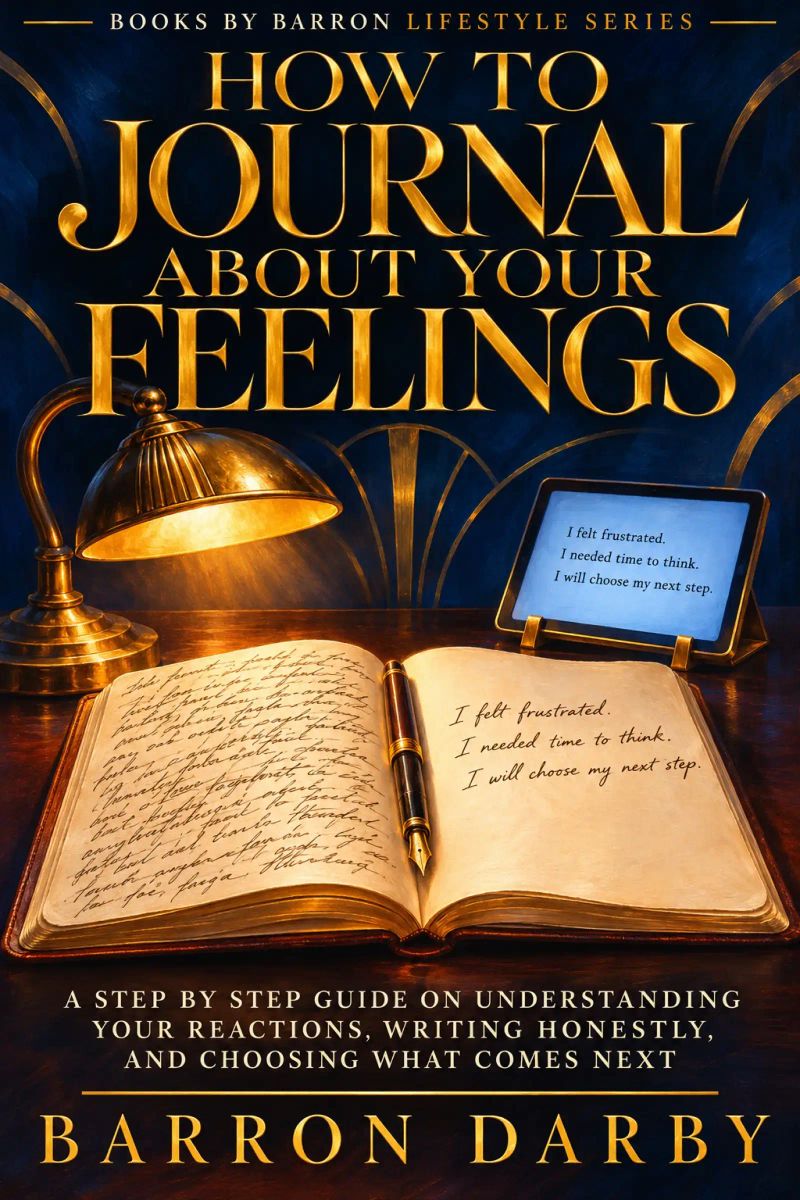
The notebook is open at the first page and the pen is in your hand, and the only honest sentence available is that something about today is sitting wrong. So you write around it. Two pages later you have a confident explanation of why somebody did what they did, and no way on earth to check it.
This is a practical guide for one adult who has something on their mind and does not know what to put on the page. It teaches one method and repeats it on thirty ordinary evenings. Choose a manageable subject. Record the event the way another person could verify it. Name the feeling without putting yourself on trial for having it. Keep what you know apart from what you assume, and write the word unknown where an answer would have needed you to read somebody's mind. Then decide whether the situation calls for a question, a request, a practical action, professional help, or nothing further for now.
Audiobook details
GenreSelf-Help, Psychology
Length7 hrs 41 mins
Narrated byListen with 1,000+ voices
FormateBook with Audio
Publish dateNov 25, 2026
LanguageEnglish
Table of contents
1Chapter One: Give This Page One Job
2Chapter Two: Choose Where Your Words Will Live
3Chapter Three: Decide Who Could Read It
4Chapter Four: Start With Something Ordinary
5Chapter Five: Separate What Happened From What You Think It Means
Show all chaptersShow less
6Chapter Six: Finish Before Everything Is Resolved
7Part Two: Write What You Feel Without Turning It Into a Verdict
8Chapter Seven: Find a Word That Fits
9Chapter Eight: Separate the Feeling From the Urge
10Chapter Nine: Turn a Worry Into a Question You Can Address
11Chapter Ten: Give Anger a Clear Description
12Chapter Eleven: Write About a Disappointment Without Putting Yourself on Trial
13Chapter Twelve: Notice What Was Good Without Erasing What Was Hard
14Part Three: Shadow Work With Clear Limits
15Chapter Thirteen: Check the Prompt Before You Answer It
16Chapter Fourteen: Admit Envy Without Making It an Accusation
17Chapter Fifteen: Examine a Harsh Judgment Without Turning It Against Yourself
18Chapter Sixteen: Write the Want You Keep Editing Out
19Chapter Seventeen: Take Responsibility for the Part That Is Yours
20Chapter Eighteen: Let Two Feelings Be True
21Part Four: Use the Page in Ordinary Life
22Chapter Nineteen: Prepare a Conversation Without Sending the Journal
23Chapter Twenty: Use the Journal for an Everyday Choice
24Chapter Twenty-One: Write About a Change Without Forcing a Fresh Start
25Chapter Twenty-Two: Stop an Entry That Is Going in Circles
26Chapter Twenty-Three: Choose a Prompt for the Job You Actually Have
27Chapter Twenty-Four: Return Without Writing the Missing Entries
28Part Five: Review, Adjust, and Know When to Ask for Help
29Chapter Twenty-Five: Read a Few Pages Without Making a Case Against Yourself
30Chapter Twenty-Six: Check One Interpretation Outside the Journal
31Chapter Twenty-Seven: Make the Routine Fit the Life You Have
32Chapter Twenty-Eight: Bring a Useful Summary to a Qualified Person
33Chapter Twenty-Nine: Decide Whether Journaling Is Helping You
34Chapter Thirty: Build the Page You Can Use Again
35Afterword: The Sources This Book Names
36Also by Barron Darby

Make Your Routines A GameBarron Darby8h 5m$9.99 · $0.00

Make Room For Life OfflineBarron Darby6h 58m$9.99 · $0.00

Cold Plunges And Saunas: Are They For You?Barron Darby6h 53m$9.99 · $0.00

Work At A Pace You Can KeepBarron Darby7h 18m$9.99 · $0.00

Finish What You StartedBarron Darby8h 30m$9.99 · $0.00

Get Your Attention BackBarron Darby8h 1m$9.99 · $0.00

How To Sell A Book To A StrangerBarron Darby13h 17m$9.99 · $0.00

Break MeBarron Darby12h 27m$9.99 · $0.00

Pulsreal Massage ClubBarron Darby9h 10m$9.99 · $0.00

A Bible Story: TamarBarron Darby9h 14m$9.99 · $0.00

King Carl Gustaf and Queen SilviaBarron Darby1h 12m$4.99 · $0.00

Ozzy and SharonBarron Darby1h 56m$4.99 · $0.00

Emperor Naruhito and Empress MasakoBarron Darby1h 52m$4.99 · $0.00

Virat Kohli and Anushka SharmaBarron Darby1h 28m$4.99 · $0.00

Joe and Jill BidenBarron Darby1h 8m$4.99 · $0.00

Keith Richards and Patti HansenBarron Darby1h 53m$4.99 · $0.00

King Frederik and Queen MaryBarron Darby1h 19m$4.99 · $0.00

George and Laura BushBarron Darby1h 58m$4.99 · $0.00

LIKESBarron Darby9h 41m$4.99 · $0.00

A Different WayChristopher A. Hall10h 45m4.5 (165)$29 · $0.00

The Hard Thing About Hard ThingsBen Horowitz7h 57m4.2 (134.3K)$26 · $0.00
10% Happier 10th AnniversaryDan Harris9h 28m4.1 (137.1K)$29 · $0.00
The Power of the OtherHenry Cloud5h 52m4.2 (3.5K)$24 · $0.00

What You Are Looking For Is in the LibraryMichiko Aoyama7h 19m4.1 (156.7K)$24 · $0.00
The Way of ExcellenceBrad Stulberg6h 46m4.2 (1.1K)$24 · $0.00

The AlchemistPaulo Coelho4h 1m4.1 (3.9M) · 1315$23 · $0.00

Change the RecipeJosé Andrés, Richard Wolffe4h 57m4.1 (2K)$20 · $0.00

The Lucky RideYasushi Kitagawa4h 26m4.1 (1.8K)$20 · $0.00
Be ExceptionalJoe Navarro, Toni Sciarra Poynter9h 11m4.0 (1.3K)$29 · $0.00
The Subtle Art of Not Giving a F*ckMark Manson5h 18m3.9 (1.7M)$24 · $0.00

HomeschooledStefan Merrill Block7h 10m3.6 (18.5K)$28 · $0.00

Autoimmunity and the Good GirlsSara Hirsh Bordo7h 51m$26 · $0.00

The Purpose Driven® Liferick warren9h 23m4.0 (896.8K) Only with Ultra

Your Desired FutureHenry Cloud6h 43m$24 · $0.00
Learning to PrayJames Martin13h 24m4.5 (3.4K)$33 · $0.00

Forever BoyKate Swenson9h 27m4.7 (5K)$29 · $0.00

You Are Worth ItKyle Carpenter, Don Yaeger8h 53m4.7 (4.8K)$29 · $0.00

The Happiest Man on EarthEddie Jaku3h 48m4.6 (178K)$7 · $0.00

Finding MeViola Davis9h 15m4.6 (256.4K)$29 · $0.00
Boundaries for LeadersHenry Cloud7h 36m4.3 (3.6K)$26 · $0.00
The Way of ExcellenceBrad Stulberg6h 46m4.2 (1.1K)$24 · $0.00

Suicidal EmpathyGad Saad8h 24m4.1 (736)$28 · $0.00

Unreasonable WomenJustine van der Leun10h 45m4.9 (13)$29 · $0.00
Be ExceptionalJoe Navarro, Toni Sciarra Poynter9h 11m4.0 (1.3K)$29 · $0.00

How Soccer Explains the WorldFranklin Foer7h 22m3.9 (14.9K)$24 · $0.00
What to Make of a LifeJim Collins13h 31m4.8 (4)$33 · $0.00
The Dunder Mifflin Employee ManualBrian Baumgartner, Ben Silverman, Warren Lieberstein3h 45m$18 · $0.00
The Power of the OtherHenry Cloud5h 52m4.2 (3.5K)$24 · $0.00
Your Desired FutureHenry Cloud6h 43m$24 · $0.00

All About Lovebell hooks6h 10m4.3 (330.3K)$7 · $0.00

I Am The StormJanice Dean9h4.6 (1.5K)$8 · $0.00

On Democracies and Death CultsDouglas Murray10h 38m4.6 (6.5K)$29 · $0.00

TerraformPropaganda5h 39m4.7 (594)$24 · $0.00

Southern Horrors: Lynch Law in All Its Phases (Annotated)Ida B. Wells-Barnett2h 44m4.6 (1.3K)$2 · $0.00

Hour of the HeartIrvin D. Yalom, Benjamin Yalom8h 19m4.6 (2.3K)$26 · $0.00

Braving the TruthRachel Held Evans11h 31m4.7 (359)$29 · $0.00
Level UpRob Dial7h 42m4.6 (3.3K)$26 · $0.00

As a JewSarah Hurwitz8h 36m4.6 (1.2K)$26 · $0.00

Saint Joan (Annotated)George Bernard Shaw6h 20m4.6 (1.2K)$1.20 · $0.00
You may also like
Stress Less, Accomplish MoreEmily Fletcher7h 22m3.9 (6.4K)$24 · $0.00

Keep HappyEustace Miles54m$1 · $0.00

Unveiling StressEdivaldo Ascaneo32m$6 · $0.00

More Calming Music For SleepNEOWAVES - Calming Music For Sleep14h 54m$15 · $0.00

Achieving Prosperity - Ultimate CollectionNiccolò Machiavelli, Elbert Hubbard, James Allen, William Walker Atkinson, Orison Swett Marden, Benjamin Franklin, William Crosbie Hunter, Harry A. Lewis, Thorstein Veblen, Kahlil Gibran, P. T. Barnum, Marcus Aurelius, Wallace D. Wattles, Lao Tzu, Russell Conwell, Henry Harrison Brown, Florence Scovel Shinn, Émile Coué, Charles F. Haanel, B. F. Austin, Robert Collier144h 34m4.3 (11)$1 · $0.00

The 7 Day Juice CureSusan Schmitta2h 50m$9 · $0.00

An Account of the Extraordinary Medicinal Fluid, called AetherMatthew Turner20m$2 · $0.00

Grabovoi Frequency CodesFilipe Chagas1h 1m$11 · $0.00

Flip and Flap know the angelsSilvia Strufaldi3m$5.90 · $0.00
Brown Noise - Sleep, Study, Focus, TinnitusBrown Noise Laboratory12h 43m4.7 (15)$11 · $0.00

Hypnotic Music: Blissful Sounds for Hypnotherapy, Meditation & Deep RelaxationPatrick Lynen7h 24m$17 · $0.00

Fat and Blood / An Essay on the Treatment of Certain Forms of Neurasthenia and HysteriaS. Weir Mitchell4h 21m3.2 (29)$2

Heart Breath MindLeah Lagos7h 58m3.8 (280)$26 · $0.00

Stress ResistanceFalco Wisskirchen30m$17 · $0.00
Dopamine Detox: Rewire Your Mind for Optimal Clarity and Mental Strength (Your Practical Step-by-step Guide to Reduce Distractions, Beat Addiction, and Boost Productivity and Focus)Mason g, Edward Hatfield3h 29m$15 · $0.00

BROWN NOISE FOR BETTER SLEEP - Vol. IIThe Brown Noise Studios34h 29m$10 · $0.00

Tinnitus Retraining TherapyTinnitus Research Center25h 11m$35 · $0.00

Sound Therapy - Healing Frequencies - Calming Music For Deep Sleep - Sound Healing TherapyHealing Frequencies9h 38m$20 · $0.00
Rest, Relax & Repair - Sound Healing - Autonomic Nervous System BalanceCenter for Sound Healing Therapy10h 31m5.0 (1)$29 · $0.00

Best-in-Class Tinnitus Relief Collection: 30 Tracks – Remastered & Clinically TestedDr. Nuria van Baaren35h 5m$29 · $0.00