
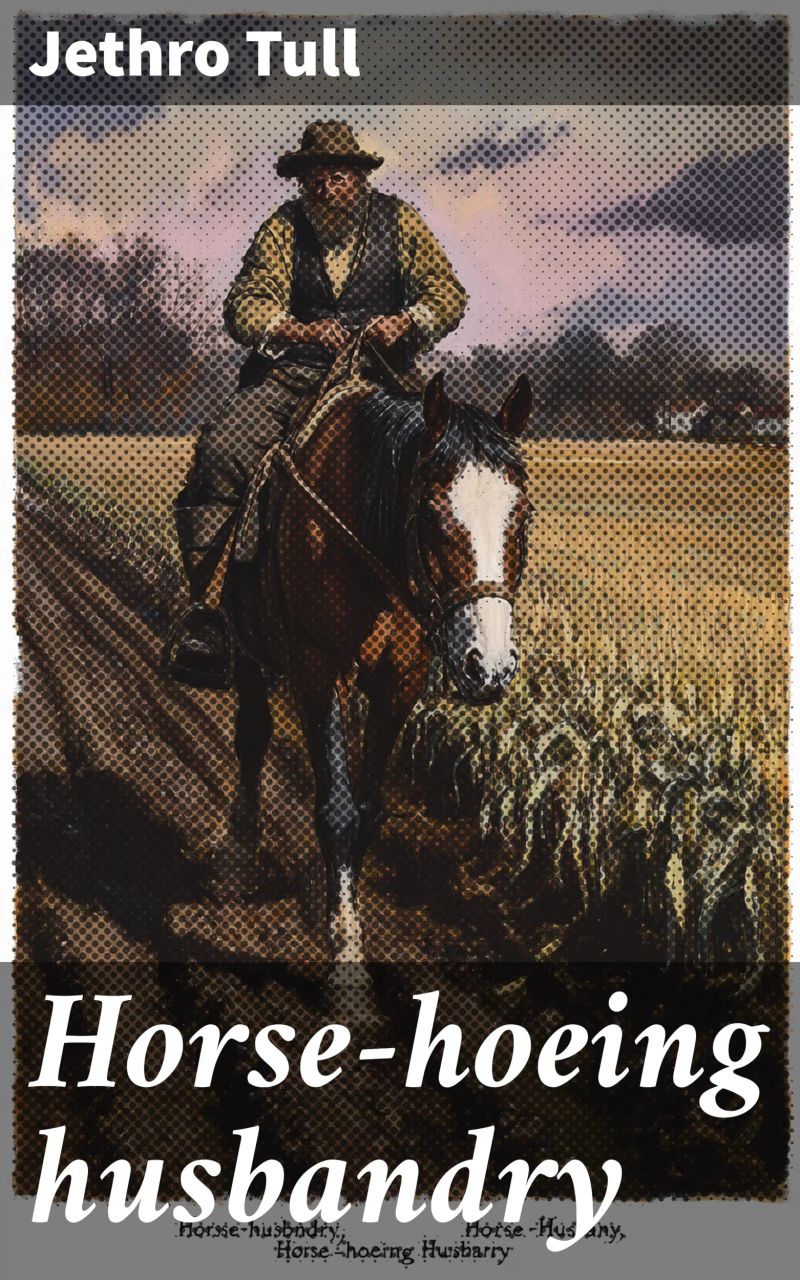


Length14h 16m
About this audiobook
In "Horse-hoeing Husbandry," Jethro Tull presents an innovative treatise that revolutionizes agricultural practices in the early 18th century. Tull's literary style is characterized by a systematic and empirical approach, drawing upon observation and experimentation to espouse the importance of systematic farming techniques. His discourse on the use of the seed drill and horse-drawn hoe reflects a profound understanding of agronomy, marking a pivotal shift towards the scientific methods that would later define modern agriculture. By integrating practical advice with theoretical insights, Tull situates his work within the burgeoning field of agricultural science, contributing significantly to the broader Enlightenment discourse on improvement and progress. Jethro Tull, an English agriculturist and inventor, was deeply influenced by his own experiences on his farm in Berkshire. Having initially pursued a degree in law, Tull's transition to agriculture came from a personal desire to enhance crop yield and soil management. His innovative mindset, coupled with the socio-economic pressure for increased food production during England's agrarian transformation, spurred him to synthesize his observations into practical applications, leading to the publication of this influential work. "Horse-hoeing Husbandry" is essential reading for anyone interested in the evolution of agricultural practices and the scientific revolution. Tull's methodological approach not only provides insights into 18th-century farming but also offers timeless principles that resonate with contemporary agricultural challenges. Readers will find in Tull's work a fertile ground for understanding the relationship between agriculture, technology, and sustainability.
Audiobook details
GenreScience and Nature
Length14 hrs 16 mins
Narrated byListen with 1,000+ voices
FormateBook with Audio
Publish dateApr 24, 2025
LanguageEnglish
Table of contents
1Introduction
2THE PREFACE.
3A Method how to find the Distance to which Roots extend Horizontally.
4Remarks on the Mints, &c.
5CHAP. II. Of Food of Plants.
Show all chaptersShow less
6CHAP. III. Of Pasture of Plants.
7CHAP. IV. Of DUNG.
8CHAP. V. Of Tillage.
9CHAP. VI. Of Hoeing.
10CHAP. VII. Of Weeds.
11CHAP. VIII. Of Turneps.
12Of Partitions.
13CHAP. X. Of Smuttiness.
14First, Want of Nourishment.
15Secondly, Want of Air.
16Thirdly, Want of the Sun’s Rays.
17CHAP. XII. Of St. Foin.
18CHAP. XIII. Of Luserne.
19CHAP. XIV. Of Change of Species.
20CHAP. XV. Of Change of Individuals.
21CHAP. XVI. Of Ridges.
22II. Of the different Goodness of a Crop.
23III. The Certainty of a Crop.
24IV. The Condition in which the Land is left after a Crop.
25CHAP. XVIII. Of Ploughs.
26CHAP. XIX. The Description of a Four-coulter’d Plough.
27The Mortise.
28The Setting-Screw.
29CHAP. XXI. Of the Wheat-Drill.
30CHAP. XXII. Of the Turnep-Drill.
31CHAP. XXIII. Of the Hoe-Plough, &c.
32Explanation of Plate VII.
33An Appendix to Chap. IX. of Wheat, p. 138. containing Memoranda for the Practisers of this Husbandry.
34INDEX.

A Brief History of IntelligenceMax S. Bennett12h 18m4.6 (6.6K)$29 · $0.00
The Story of BirdsSteve Brusatte11h 49m4.6 (401)$29 · $0.00

Craig & FredCraig Grossi8h 6m4.5 (9.6K)$26 · $0.00
Celebrating BirdsNatalia Rojas, Ana Maria Martinez6h 47m4.6 (330)$24 · $0.00

Saving JemimaJulie Zickefoose4h 59m4.5 (749)$20 · $0.00

Will's Red CoatTom Ryan8h 23m4.5 (2.3K)$26 · $0.00
Of Time and TurtlesSy Montgomery10h 34m4.5 (5K)$29 · $0.00

Zen and the Art of Saving the PlanetThich Nhat Hanh9h 20m4.5 (3.9K)$29 · $0.00

BLACK BEAUTY (With Original Illustrations)Anna Sewell7h 31m4.5 (1.3K)$1.99 · $0.00

Bottle of LiesKatherine Eban14h 25m4.4 (12K)$33 · $0.00
IngrainedCallum Robinson8h 10m4.5 (1.1K)$26 · $0.00

The Lion Tracker's Guide To LifeBoyd Varty3h 1m4.4 (4.8K)$18 · $0.00

Born for LoveBruce D. Perry, Maia Szalavitz11h 42m4.4 (4K)$29 · $0.00

The Mountains of California (With Original Drawings & Photographs) (Annotated)John Muir11h 35m4.5 (1.1K)$2 · $0.00

The New GuysMeredith Bagby16h 50m4.4 (1.2K)$40 · $0.00
Blue PasturesMary Oliver3h 23m4.4 (3.8K)$18 · $0.00
The Rise and Reign of the MammalsSteve Brusatte13h 26m4.4 (11.1K)$33 · $0.00

VaccinatedPaul A. Offit8h 30m4.4 (3.7K)$26 · $0.00

The Light EatersZoë Schlanger10h 57m4.4 (22.8K)$29 · $0.00

Where the Lost Dogs GoSusannah Charleson11h 7m4.5 (699)$23 · $0.00
You may also like
EvolutionMichael Denton11h 4m4.2 (556)$20
The New OrganonFrancis Bacon9h 3m3.9 (2.3K)$0.60 · $0.00

Constitution of the State of FloridaThe State of Florida2h 41m$1 · $0.00

Coal and the coal minesHomer Greene6h 39m$2 · $0.00
On an Inversion of Ideas as to the Structure of the UniverseOsborne Reynolds46m$1 · $0.00

A Manual of the Antiquity of ManJ. P. MacLean4h 43m$1 · $0.00
Glacières; or, Freezing CavernsEdwin Swift Balch7h 42m$2 · $0.00

Type specimens of amphibians and reptiles in the Museum of Natural History, the University of KansasWilliam Edward Duellman, Barbara Berg58m$1 · $0.00
Food of the Crow, Corvus brachyrhynchos Brehm, in South-central KansasDwight R. Platt51m$1 · $0.00
Are the Planets Inhabited?E. Walter Maunder2h 11m$1 · $0.00

A Mechanico-Physiological Theory of Organic EvolutionCarl Nägeli2h 33m$2 · $0.00

Wild Birds in City ParksHerbert Eugene Walter, Alice Hall Walter1h 45m$2 · $0.00
Impressionism and Post-ImpressionismNathalia Brodskaïa16h 2m4.5 (14)$19 · $0.00
Sweet-Clover SeedH. S. Coe, John N. Martin1h 52m$2 · $0.00
The Plants of Michigan. Simple Keys for the Identification of the Native Seed Plants of the StateHenry A. Gleason8h 36m$1 · $0.00

Thomas Henry Huxley; A Sketch Of His Life And WorkSir P. Chalmers Mitchell7h 38m$2 · $0.00
An essay on the winds and the currents of the oceanWilliam Ferrel1h 10m$2 · $0.00

Arizona SketchesJ. A. Munk3h 52m3.9 (41)$2 · $0.00
On the Generation of AnimalsAristotle8h 13m4.0 (258)$1 · $0.00
Supplement to Harvesting Ants and Trap-Door SpidersJohn Traherne Moggridge, Octavius Pickard-Cambridge4h 41m$2 · $0.00