
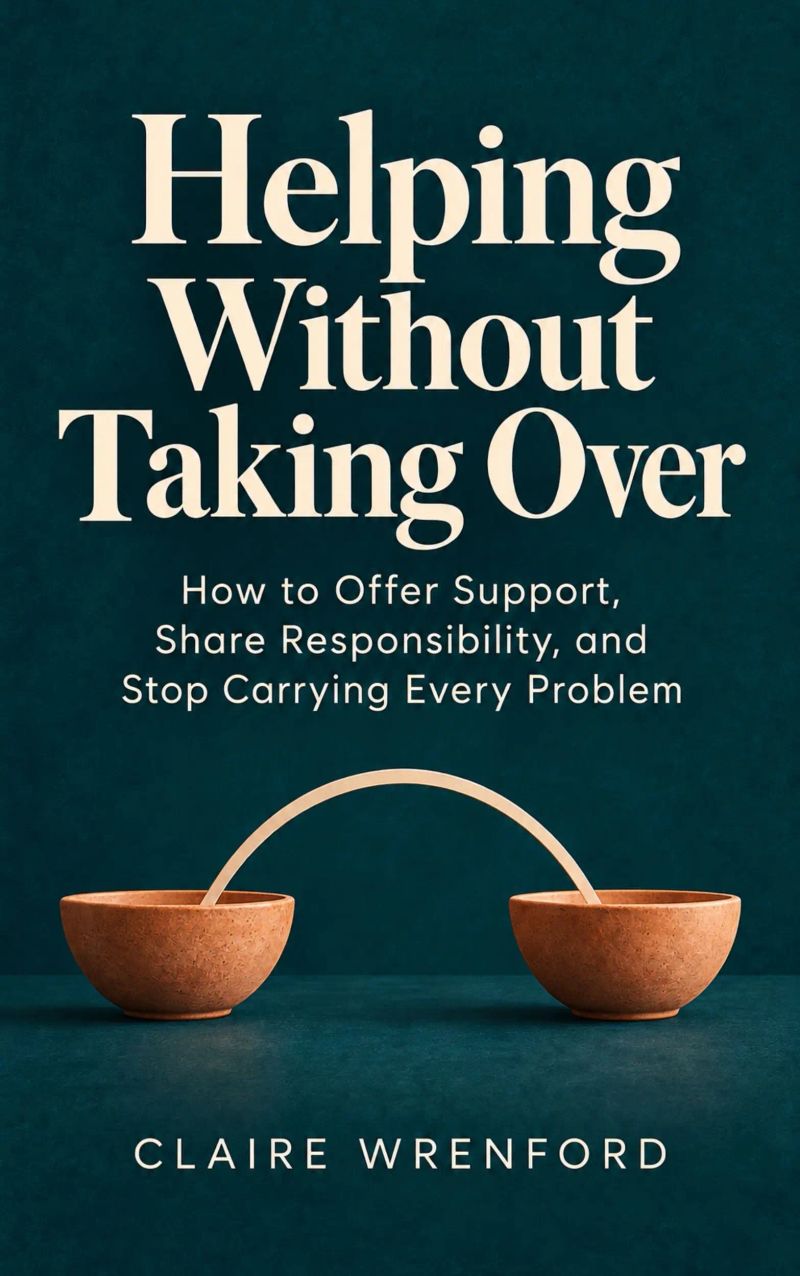
Helping Without Taking Over
How to Offer Support, Share Responsibility, and Stop Carrying Every ProblemBy Claire Wrenford


Length3h 22m
About this audiobook
You agreed to help with one task. Somehow, you became responsible for remembering, arranging, checking, and fixing everything that followed.
Helping Without Taking Over explores how to offer meaningful support without automatically becoming the person who manages every problem. Claire Wrenford helps you distinguish another adult’s responsibilities from your own promises, shared obligations, and essential care duties.
Through realistic fictional situations, practical conversations, and 72 guided exercises, you’ll learn to clarify requests before agreeing, recognize the work hidden inside a small favor, and make commitments you can actually keep. You’ll also explore how to share household tasks, discuss money requests, plan caregiver support, and respond to guilt after saying no.
The book makes room for difficult circumstances. Disability, illness, limited resources, and dependent care require thoughtful arrangements that protect safety and dignity while acknowledging the helper’s capacity.
Whether you are supporting a sibling, partner, friend, colleague, or dependent relative, these pages offer a starting point for clearer conversations and fairer agreements so care can remain part of your relationships without consuming every available hour.
Audiobook details
GenreSelf-Help
Length3 hrs 22 mins
Narrated byListen with 1,000+ voices
FormateBook with Audio
Publish dateOct 13, 2026
LanguageEnglish
Table of contents
1A note to the reader
2Introduction
3When being helpful becomes a second job
4How to use the book
5Your helping pattern
Show all chaptersShow less
6The moment before you volunteer
7Find the work behind the favor
8Notice the rewards without accusing yourself
9Separate your history from today's decision
10Make a pause small enough to use
11Observe resentment before it becomes a speech
12Choose one pattern to interrupt
13Practice 1.1 The actual request
14Practice 1.2 The edges of one favor
15Practice 1.3 Immediate relief and later cost
16Practice 1.4 Your early resentment signal
17Practice 1.5 A fair week of observations
18Practice 1.6 Rehearsing the pause
19What belongs to whom
20Responsibility needs a name
21Four useful questions
22Ownership is not a verdict on ability
23What you promise really does become yours
24Shared work has shared consequences
25The difference between influence and control
26Return the next action clearly
27Leave room for revision
28Practice 2.1 Map one problem
29Practice 2.2 Turn goodwill into a promise
30Practice 2.3 Barrier or preference
31Practice 2.4 A shared duty and its backup
32Practice 2.5 A condition you can explain
33Practice 2.6 The next action handoff
34Requests versus emergencies
35Urgency changes the conversation
36Ask about consequences rather than volume
37Three kinds of time pressure
38A real deadline can still have the wrong owner
39Recurring urgency deserves a separate conversation
40Decide the duration before it expands
41Do not punish lateness through avoidable harm
42Make the answer clear
43Practice 3.1 Establish the actual deadline
44Practice 3.2 Separate safety from inconvenience
45Practice 3.3 The smallest useful action
46Practice 3.4 A repeated last-minute problem
47Practice 3.5 Temporary help with a review point
48Practice 3.6 A clear delayed answer
49Invisible obligations
50The work nobody remembers assigning
More from Claire Wrenford
Learning to PrayJames Martin13h 24m4.5 (3.4K)$33 · $0.00

Swayam Ki AwaazPrem Rawat8h 34m4.7 (1.1K)$26 · $0.00

Forever BoyKate Swenson9h 27m4.7 (5K)$29 · $0.00

You Are Worth ItKyle Carpenter, Don Yaeger8h 53m4.7 (4.8K)$29 · $0.00

The Happiest Man on EarthEddie Jaku3h 48m4.6 (178K)$7 · $0.00

Finding MeViola Davis9h 15m4.6 (256.4K)$29 · $0.00

Spiritual AnatomyDaaji Kamlesh D. Patel9h 47m4.7 (319)$29 · $0.00

The Dangerous Truth about Today’s MarijuanaLaura Stack CSP, MBA9h 57m4.7 (385)$20 · $0.00

The Gospel according to Spiritualism (Translated)Allan Kardec14h 39m4.6 (3.9K)$5.70 · $0.00

Birdie & HarlowTaylor Wolfe7h 50m4.6 (6.5K)$26 · $0.00

CrossroadsKaleb Dahlgren7h 56m4.6 (4.9K)$26 · $0.00

Life on the BridgeKaelynn Partlow5h 40m4.6 (1.1K)$24 · $0.00

Keep Your Love OnDanny Silk9h 4m4.6 (8.1K)$10 · $0.00

The Tao of Joy Every DayDerek Lin10h 24m4.6 (762)$20 · $0.00

UndividedVicky Beeching9h 2m4.6 (1.3K)$29 · $0.00

HE CAN WHO THINKS HE CAN & OTHER BOOKS ON SUCCESSOrison Swett Marden5h 54m4.6 (1.2K)$1.99 · $0.00

Level UpRob Dial7h 42m4.6 (3.3K)$26 · $0.00

Burn the HaystackJennie Young, PhD9h 30m4.6 (543)$29 · $0.00

ACRES OF DIAMONDS: Our Every-day Opportunities (Wisdom & Empowerment Series) (Annotated)Russell Conwell2h 26m4.6 (1K)$2 · $0.00

Good InsideBecky Kennedy9h 55m4.5 (59.3K)$29 · $0.00
You may also like
The Art of Talking with ChildrenRebecca Rolland12h 29m4.1 (442)$29 · $0.00
Good InsideBecky Kennedy9h 55m4.5 (59.3K)$29 · $0.00

Money and LoveMyra Strober, Abby Davisson8h 46m4.1 (368)$29 · $0.00

Raising Your Spirited Child, Third EditionMary Sheedy Kurcinka13h 17m4.3 (13K)$33 · $0.00

Ignore It!Catherine Pearlman PhD, LCSW5h 51m3.9 (1.4K)$20 · $0.00

How To Win Friends and Influence PeopleDale Carnegie9h 16m4.2 (1.3M)$8 · $0.00

Grumpy Mom Takes a HolidayValerie Woerner6h 57m4.4 (2.7K)$20 · $0.00

School Starts Again with “I’m Not Going” - How to Respond to Repeated School Reluctance, Talk with Your Child and the School, and Know When the Problem Needs Extra HelpMax Paradox4h 56m4.6 (59)$7.70 · $0.00

I Don’t Want to Yell at My Child. My Child Has Other Plans - How to Stop Your Own Outbursts, Set Boundaries, and Respond More Calmly Without Expecting to Become a Zen Parent OvernightMax Paradox4h 36m$7.70 · $0.00

I'm Fed Up with My Family - How to Love Your Relatives Without Spending Every Sunday with ThemMax Paradox7h 5m$7.80 · $0.00

My In-Laws Are Taking Over - How to Set Boundaries Before They Start Choosing Your CurtainsMax Paradox7h 20m$7.80 · $0.00

Boundaries When Everyone Depends on YouClaire Wrenford3h 39m$5

Baby Sleep Myths Busted by ExpertsAurora Brooks1h 17m$3.50 · $0.00

Let's Talk About Baby Milestones- Breaking the TabooAurora Brooks1h 14m$3.50 · $0.00

How to Protect Your Child from Online Hate and CyberbullyingMax Paradox7h 1m$7.80 · $0.00

How to Help Your Teen Quit VapingMax Paradox6h 49m$7.80 · $0.00

My Child Doesn't Want to Do Homework. Neither Do I - How to Build a Calmer Study Routine, Cut Down on Daily Negotiations, and Help Your Child Without Doing School for ThemMax Paradox4h 52m$7.70 · $0.00

Don’t Take the Bait to EscalateJay Payleitner6h 18m$17 · $0.00

The Unspoken Challenges of Being a Working MomAurora Brooks1h 1m$3.50 · $0.00

Why It's Okay to Be a "Good Enough" ParentAurora Brooks1h 13m$3.50 · $0.00