
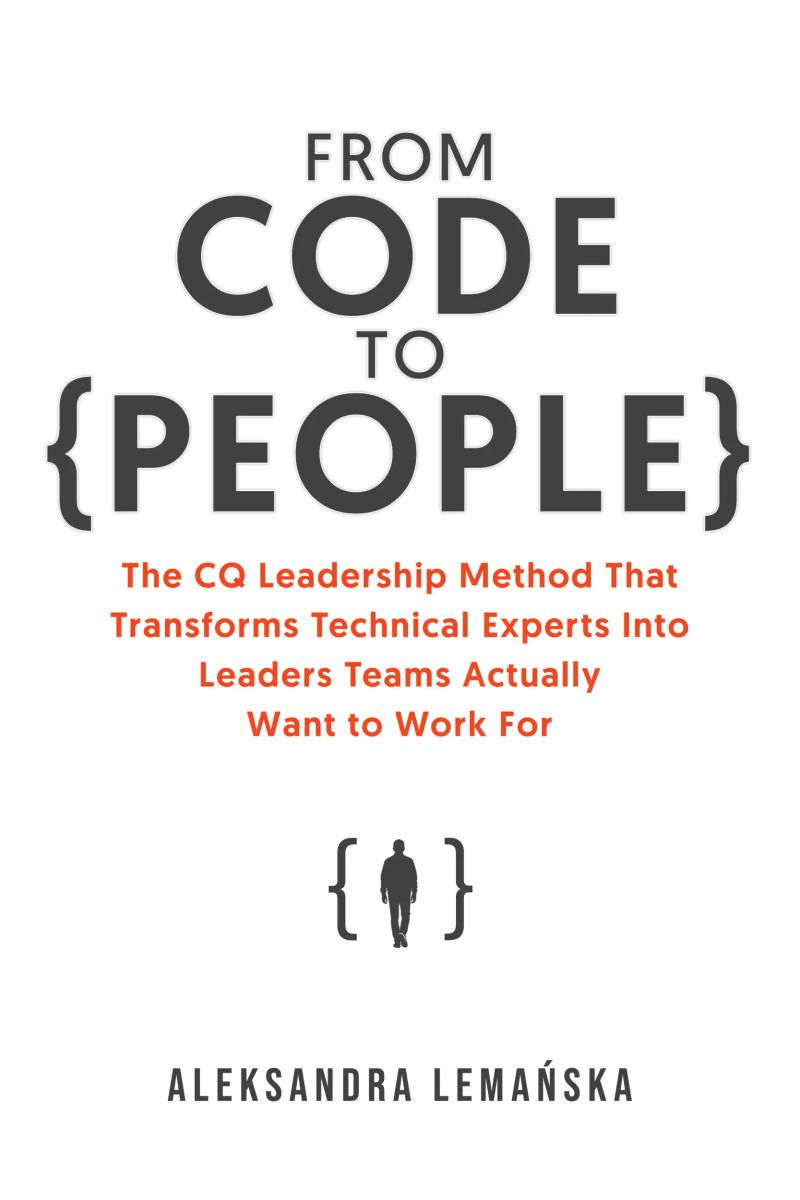
From Code to People. The CQ Leadership Method That Transforms Technical Experts Into Leaders Teams Actually Want to Work For
By Aleksandra Lemańska


Length8h 2m
About this audiobook
From Code to People
You were exceptional at the technical work. That's why you got promoted. Now everything has changed.
Instead of debugging code, you're navigating conflicts. Instead of writing clean architecture, you're writing performance reviews. Instead of solving problems alone, you're responsible for a team of people you weren't trained to lead.
From Code to People gives you the system that fixes this. The CQ Leadership Method combines three practical frameworks: Process Communication Model® (PCM®) for understanding people the way you understand systems, Contracting for eliminating the "I thought you meant..." conversations before they start, and the Wheel of Conflict for diagnosing and resolving team dysfunction at the root.
No theory. No MBA required. Just tools that work on Monday morning.
For technical leaders who are ready to become the kind of leader their team actually wants to work for.
Audiobook details
GenreBusiness and Economics
Length8 hrs 2 mins
Narrated byListen with 1,000+ voices
FormateBook with Audio
Publish dateOct 26, 2026
LanguageEnglish
Table of contents
1{Introduction}
2The Problem You’re Facing
3Why Is This Happening?
4What This Book Promises?
5What You’ll Get From This Book?
Show all chaptersShow less
6Why I Wrote This?
7How to Use This Book?
8The CQ Imperative: Why Tech Leaders Need It Now More Than Ever
9True or true?
10How Much Does it Cost?
11What Does This Mean for TechStart?
12CQ as the Missing Piece in Leadership Excellence
13The CQ Leadership Method: Foundations of Effective Communication
14Introduction to the CQ Leadership Method
15The Three Core Pillars: Self-Awareness, Adaptability, and Lifelong Learning
16Self-Awareness
17Adaptability
18Lifelong Learning
19How to Integrate CQ into Your Daily Leadership Practices?
20Understanding Yourself: The First Step to CQ Mastery
21Understanding the PCM® Framework
22The 6 PCMⓇ Personality Types
23Mike’s Story - Patterns Explained
24Your Turn - Practical Application
25Reading the Room: Understanding Others Through PCM® Lens
26How 6 Types of Personality Show Up Positively in Tech Teams (Superpowers)
27Recognizing Distress Sequences and How to Address That (Dark Side)
28Quadrant 1: OK-OK
29Quadrant 2: OK-Not-OK
30Quadrant 3: Not-OK-OK
31Quadrant 4: Not-OK-Not-OK
323 Buckets of Distress Sequence
33BUCKET 1: ATTACK
34THINKER’s Distress: “Nobody Here Can Think”
35PERSISTER’s Distress: “Nobody Follows the Rules”
36How to Help People in ATTACKER’s Distress Get Back to OK-OK?
37IMAGINER’s Distress: “I’ll Retreat Where It’s Safe”
38How to Help People in DROOPER’s Distress to Get Back to OK-OK?
39BUCKET 3: BLAME
40Building Trust by Speaking Their “Language” (and How It’s not a Manipulation)
41Before You Move to Chapter 5: Self-Distress Audit
42Preventing Conflict Before It Starts: The CQ Approach
43How Stress Impacts Communication and Decision-Making?
44The Wheel of Conflict
45How Can We Use Conflict That Nourishes Our Team?
46Using CQ to Spot Early Signs of Miscommunication in Your Team
47Conflict Quick Reference
48Before You Move to Chapter 6: Conflict Team Audit
49Building High-Performing Tech Teams with CQ
50Creating an Inclusive Culture Where Every Voice is Heard

Never Split the DifferenceChris Voss, Tahl Raz8h 7m4.4 (277.7K)$26 · $0.00
The Intelligent Investor Rev Ed.Benjamin Graham17h 48m4.3 (191.5K)$40 · $0.00
The Hard Thing About Hard ThingsBen Horowitz7h 57m4.2 (134.3K)$26 · $0.00
Boundaries for LeadersHenry Cloud7h 36m4.3 (3.6K)$26 · $0.00

Poor Charlie’s AlmanackGrover Gardener, Charles T. Munger13h 9m4.5 (24.7K)$18 · $0.00

The Ambuja StoryNarotam Sekhsaria13h 59m4.5 (830)$33 · $0.00

The Secret Door to SuccessFlorence Scovel Shinn2h 25m4.5 (2.1K)$1.20 · $0.00

This Is Going to HurtAdam Kay5h 47m4.4 (444.7K)$24 · $0.00

Big TrustShadé Zahrai, Fayçal Sekkouah8h 36m4.6 (406)$26 · $0.00
The Intelligent Investor Third EditionBenjamin Graham, Jason Zweig20h4.4 (156.6K)$46 · $0.00

Bottle of LiesKatherine Eban14h 25m4.4 (12K)$33 · $0.00

The Antiracist Business BookTrudi Lebrón6h 10m4.6 (275)$17 · $0.00

The FormulaJoshua Robinson, Jonathan Clegg10h 41m4.4 (6.9K)$29 · $0.00

Let Them LeadJohn U. Bacon7h 10m4.5 (1.4K)$24 · $0.00

Secrets of the Millionaire MindT. Harv Eker5h 11m4.4 (301.4K)$24 · $0.00

The Person You Mean to BeDolly Chugh9h 6m4.4 (7.2K)$29 · $0.00

BoundlessNick Kostov, Sean McLain9h 17m4.5 (1.1K)$29 · $0.00

Everyday DharmaSuneel Gupta5h 2m4.5 (761)$20 · $0.00

Let's Talk Mutual FundsMonika Halan7h 5m4.4 (2.4K)$16 · $0.00

Secret PowerDwight Lyman Moody3h 7m4.4 (1.4K)$1.20 · $0.00
You may also like

The Hollywood CommandmentsDeVon Franklin, Tim Vandehey7h 15m4.5 (850)$24 · $0.00

How to Live on 24 Hours a DayArnold Bennett1h 33m3.8 (17K)$12 · $0.00

Your Invisible PowerGeneviève Behrend4h 58m4.2 (5.5K)$1.99 · $0.00

A Series of Lessons in Raja YogaWilliam Walker Atkinson8h 9m4.1 (281)$2.30

The Courage to Teach, Tenth Anniversary EditionParker J. Palmer8h 34m4.3 (5.7K)$20

The Millionaire Maker LectureJ. Earl Shoaff52m4.7 (421)$4 · $0.00

The Secret of the Ages (Annotated)Robert Collier9h 29m4.4 (6.5K)$0.99 · $0.00

The Essays of Arthur Schopenhauer (translated)Arthur Schopenhauer4h 55m4.3 (3.2K)$4.70 · $0.00
Personal GrowthSteve Pavlina1h 30m4.1 (5.1K)$12 · $0.00
The Art of ImpossibleSteven Kotler9h 17m4.2 (10K)$29 · $0.00
The Achievement HabitBernard Roth7h 23m3.9 (5.7K)$24 · $0.00

The Science of Wallace D. Wattles: Complete TrilogyWallace D. Wattles8h 3m4.5 (2.6K)$2 · $0.00
Self Improvement: A Practical Guide to Overcome Negativity and Better Manage Your Feelings (How to Use Advanced Learning Strategies to Learn Faster, Remember More and Be More Productive)Harold Broughton2h 48m$3.50 · $0.00

Firing Up with DisciplineMason U. Delaney8h 43m$4.10 · $0.00

I Started a New Habit. I Was Done by Tuesday - How to Build Small Changes That Survive a Bad Day, a Lack of Motivation, and a Week When Life Didn’t Read Your PlanMax Paradox4h 55m$7.70 · $0.00

50 and FreshScarlett Y. Turner6h 36m$6.40 · $0.00

Remove, Replace, RestartChristian Greiser7h 46m4.5 (19)$30 · $0.00

What I Wish I Knew About LuckTina Seelig4h 58m4.2 (16)$20 · $0.00

Mastering Your Attitude: A Guide to Navigating Life's UncertaintiesJasper Livingstone6h 57m4.0 (366)$9

The Code Of SovereigntyAnna Cupryn11h 38m$20 · $0.00