
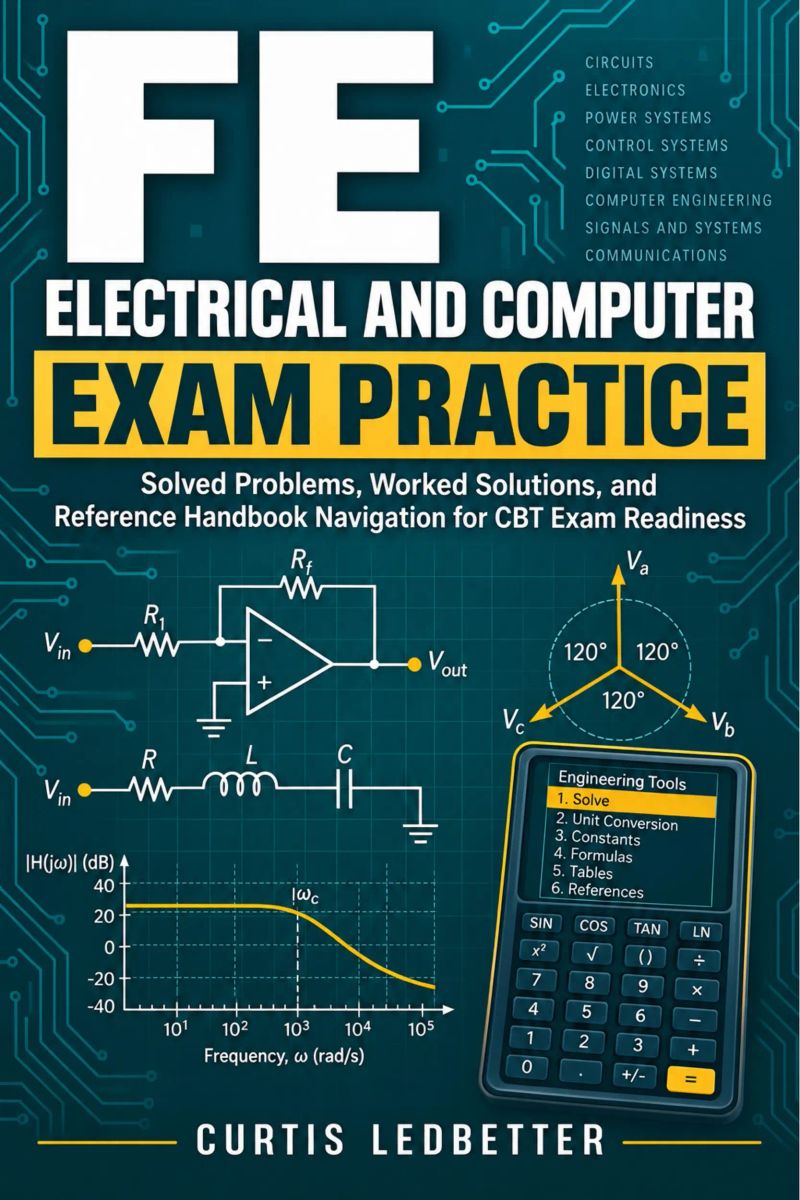
FE Electrical and Computer Exam Practice
Solved Problems, Worked Solutions, and Reference Handbook Navigation for CBT Exam ReadinessBy Curtis Ledbetter


Length12h 58m
About this audiobook
On exam day you will not be rewarded for deriving anything. You will be rewarded for recognising the problem type, finding the right equation in the reference handbook and substituting cleanly under time pressure. This book trains exactly that.
Every worked solution names the handbook section it comes from, shows the substitution in full, checks units and explains why the near-miss answers are wrong. You get drilled coverage of circuits, linear systems, electronics, power, electromagnetics, digital and computer systems, control, mathematics, statistics, economics and ethics, with hundreds of problems timed to exam pace and a full-length practice exam to finish.
For electrical and computer engineering students and working engineers sitting the FE computer-based exam, this book is built around the way the CBT actually tests you: fast recall, confident handbook navigation and clean arithmetic. Instead of long derivations, each chapter walks through the problem types that appear on the exam, points to the exact reference handbook section, and shows the full substitution step by step. Unit checks are built into every solution, and the distractors are explained so you learn to spot the trap answers before you commit to them.
What you will learn:
• How the CBT exam is structured and how to navigate the supplied reference handbook quickly
• Mathematics and probability and statistics problems solved at exam pace
• Ethics and professional practice questions, plus engineering economics calculations
• Properties of electrical materials and how they are tested
• DC and AC circuit analysis, linear systems and signal processing
• Electronics, power systems and electromagnetics problem types
• Digital systems, computer systems and software questions
• Control systems problems and full-length timed practice under exam conditions
This book is for electrical and computer engineering students preparing for the FE exam, working engineers returning to the fundamentals before sitting the CBT, and anyone who wants a structured, solution-driven way to practise rather than a passive review of theory.
Audiobook details
Rating★★★★★ 4.6 (24)
Includes Goodreads, Amazon
GenreTechnology, Education and Learning
Length12 hrs 58 mins
Narrated byListen with 1,000+ voices
FormateBook with Audio
Publish dateSep 28, 2026
LanguageEnglish
Table of contents
1FE Electrical and Computer Exam Practice
2Foreword
3Preface
4About This Book
5Chapter 1: The CBT Exam and the Reference Handbook
Show all chaptersShow less
61.1 Exam Structure, Specifications, and Scoring
71.2 The On-Screen Calculator and Permitted Aids
81.3 Searching the Electronic Reference Handbook
91.4 Question Formats, Flagging, and Pacing Strategy
101.5 Building a Study Plan and a Formula Recall Sheet
11Chapter 2: Mathematics
122.1 Algebra, Logarithms, and Trigonometric Identities
132.2 Analytic Geometry, Vectors, and Matrices
142.3 Complex Numbers and Phasor Arithmetic
152.4 Differential and Integral Calculus
162.5 Differential Equations and Series
17Chapter 3: Probability and Statistics
183.1 Descriptive Statistics and Probability Rules
193.2 Discrete and Continuous Distributions
203.3 Sampling, Confidence Intervals, and Hypothesis Tests
213.4 Linear Regression, Correlation, and Quality Control
22Chapter 4: Ethics and Professional Practice
234.1 Licensure, the Exam, and Professional Responsibility
244.2 Rules of Professional Conduct and Conflicts of Interest
254.3 Codes, Standards, and Regulatory Compliance
264.4 Intellectual Property, Confidentiality, and Data Integrity
274.5 Liability, Contracts, and Ethical Decision Frameworks
28Chapter 5: Engineering Economics
295.1 Time Value of Money and Cash Flow Diagrams
305.2 Present Worth, Annual Worth, and Future Worth Analysis
315.3 Rate of Return, Benefit-Cost, and Breakeven Analysis
325.4 Depreciation, Taxes, and Replacement Decisions
33Chapter 6: Properties of Electrical Materials
346.1 Conductors, Resistivity, and Temperature Effects
356.2 Insulators, Dielectrics, and Capacitance
366.3 Semiconductors, Doping, and Junction Behavior
376.4 Magnetic Materials, Thermal Effects, and Noise
38Chapter 7: DC and AC Circuit Analysis
397.1 DC Circuit Laws, Node and Mesh Analysis
407.2 Thevenin and Norton Equivalents, Superposition, and Maximum Power
417.3 Capacitance, Inductance, and First-Order Transients
427.4 AC Steady State, Phasors, and Impedance
437.5 Resonance, Frequency Response, and Filters
447.6 Second-Order RLC Transients and Switching
45Chapter 8: Linear Systems and Signal Processing
468.1 Continuous-Time Systems, Convolution, and Transfer Functions
478.2 Laplace Transforms and System Response
488.3 Fourier Series and Fourier Transform
498.4 Sampling, Aliasing, and Reconstruction
508.5 Discrete-Time Systems and the z-Transform
Everybody Has a Podcast (Except You)Justin McElroy, Travis McElroy, Griffin McElroy5h 9m4.3 (2.3K)$24 · $0.00

Hands of TimeRebecca Struthers8h 8m4.4 (1.3K)$26 · $0.00
Never Lost AgainBill Kilday10h 1m4.4 (805)$29 · $0.00
How the Internet HappenedBrian McCullough13h 28m4.3 (2.7K)$23 · $0.00
Collected Writings of Nikola TeslaNikola Tesla, Thomas Commerford Martin21h 50m4.3 (1.7K)$1 · $0.00
Just AspireAjai Chowdhry9h 13m4.4 (260)$29 · $0.00

The Little Book of AliensAdam Frank8h 20m4.3 (1.3K)$26 · $0.00
The inventions, researches and writings of Nikola Tesla (Annotated)Thomas Commerford Martin16h 59m4.3 (1.3K)$2 · $0.00

KargilV.P. Malik15h 18m4.3 (2K)$24 · $0.00
Experiments with Alternating CurrentsNikola Tesla9h 16m4.3 (874)$1.99 · $0.00

Fire on the HorizonTom Shroder, John Konrad8h 23m4.3 (858)$26 · $0.00

The Smell of Kerosene (Annotated)National Aeronautics and Space Administration, Donald L. Mallick, Peter W. Merlin11h 32m4.3 (523)$2 · $0.00

The Boy Who Harnessed the WindWilliam Kamkwamba, Bryan Mealer10h 5m4.2 (78.9K)$29 · $0.00

Across the Airless WildsEarl Swift10h 8m4.3 (1.3K)$29 · $0.00

Console WarsBlake J. Harris20h 41m4.2 (13.7K)$46 · $0.00

Improvised Munitions HandbookU.S. Department of Defense4h 49m4.3 (1.6K)$1.99 · $0.00
Escaping GravityLori Garver10h 54m4.2 (2.2K)$20 · $0.00

Wireless WarsJonathan Pelson8h 2m4.3 (418)$20 · $0.00

Let There Be WaterSeth M. Siegel8h 36m4.2 (2.3K)$20 · $0.00
The PerfectionistsSimon Winchester11h 46m4.2 (9.9K)$29 · $0.00
A Brief History of IntelligenceMax S. Bennett12h 18m4.6 (6.6K)$29 · $0.00

HomeschooledStefan Merrill Block7h 10m3.6 (18.5K)$28 · $0.00

WitnessAriel Burger8h 1m4.6 (1.3K)$20 · $0.00

EducationEllen G. White9h 41m4.6 (1.5K)$2 · $0.00

Parents and Children (Annotated)Charlotte Mason9h 23m4.6 (988)$2 · $0.00

Children Under FireJohn Woodrow Cox10h 17m4.5 (1.6K)$29 · $0.00

The State Must ProvideAdam Harris7h 15m4.5 (775)$24 · $0.00

The Call of the Wild and FreeAinsley Arment9h 7m4.4 (21.2K)$29 · $0.00
The Freelance WayRobert Vlach19h 48m4.5 (528)$40 · $0.00

Race to the BottomLuke Rosiak9h 20m4.5 (600)$29 · $0.00

They Came for the SchoolsMike Hixenbaugh9h 5m4.5 (2.6K)$8 · $0.00

Find Me UnafraidKennedy Odede, Jessica Posner11h 11m4.5 (2.7K)$29 · $0.00

Asking for ItKate Harding8h 55m4.4 (5.3K)$20 · $0.00
Defining Moments in Black HistoryDick Gregory7h 37m4.4 (6K)$26 · $0.00
The Emerald Tablets of Thoth the AtlanteanMaurice Doreal3h 4m4.4 (8.8K)$6 · $0.00

Learning AmericaLuma Mufleh6h 37m4.4 (564)$24 · $0.00
Math-ishJo Boaler7h 21m4.4 (588)$24 · $0.00
It Worked For MeColin Powell7h 42m4.3 (9.8K)$26 · $0.00

Little SoldiersLenora Chu11h 30m4.3 (3.1K)$29 · $0.00

Financial FeministTori Dunlap8h 3m4.2 (22.2K)$8 · $0.00
You may also like
The Principles of Scientific ManagementFrederick Winslow Taylor3h 24m4.0 (3.1K)$15 · $0.00
The Success System that never failsW. Clement Stone7h 33m4.1 (2K)$5.10 · $0.00
Investable EntrepreneurJames Church4h 13m4.3 (321)$18 · $0.00
UltralearningScott H. Young7h 46m4.0 (29K)$26 · $0.00
Change by DesignTim Brown6h 48m4.0 (12.9K)$24 · $0.00

Jab, Jab, Jab, Right HookGary Vaynerchuk5h 42m4.1 (36.7K)$17 · $0.00
Eat That Frog!Brian Tracy42m4.0 (231.8K)$4.99
Mind Set!John Naisbitt3h 33m3.7 (421)$18 · $0.00

Digital ProductsIvy N. Crowhurst2h 10m$2.30 · $0.00

Real Estate Marketing in the Digital EraJorge Hernández3h 27m4.5 (14) Only with Ultra

Welcome To MorrowTheobaldo Vieira Monteiro1m$7 · $0.00
IELTS ACADEMIC STUDY GUIDE 2026/2027Adrian Hartwell10h 1m$10
Digital Wealth - The secrets of online entrepreneurshipRichard Mason4h 18m$5.70 · $0.00

Gena of the AppalachiansClarence Monroe Wallin1h 50m$2 · $0.00
Millionaire HabitsLaura Sthephane2h 11m$5.30 · $0.00
Summary of Rich Dad Poor DadDavid De Angelis1h 28m$1.20 · $0.00

Hustle from HomeLaura Stack CSP, MBA, Chris Widener, Sharon Lechter, Krish Dhanam, various authors15h 18m$30

CONNECTICUT NOTARY PUBLIC EXAM PREP 2026/2027Adrian Hartwell8h 48m$10
Remote Work RevolutionTsedal Neeley5h 59m3.8 (826)$24 · $0.00
300+ Python for iOS App Development QuizMiles Carter8h 32m$6.50 · $0.00