
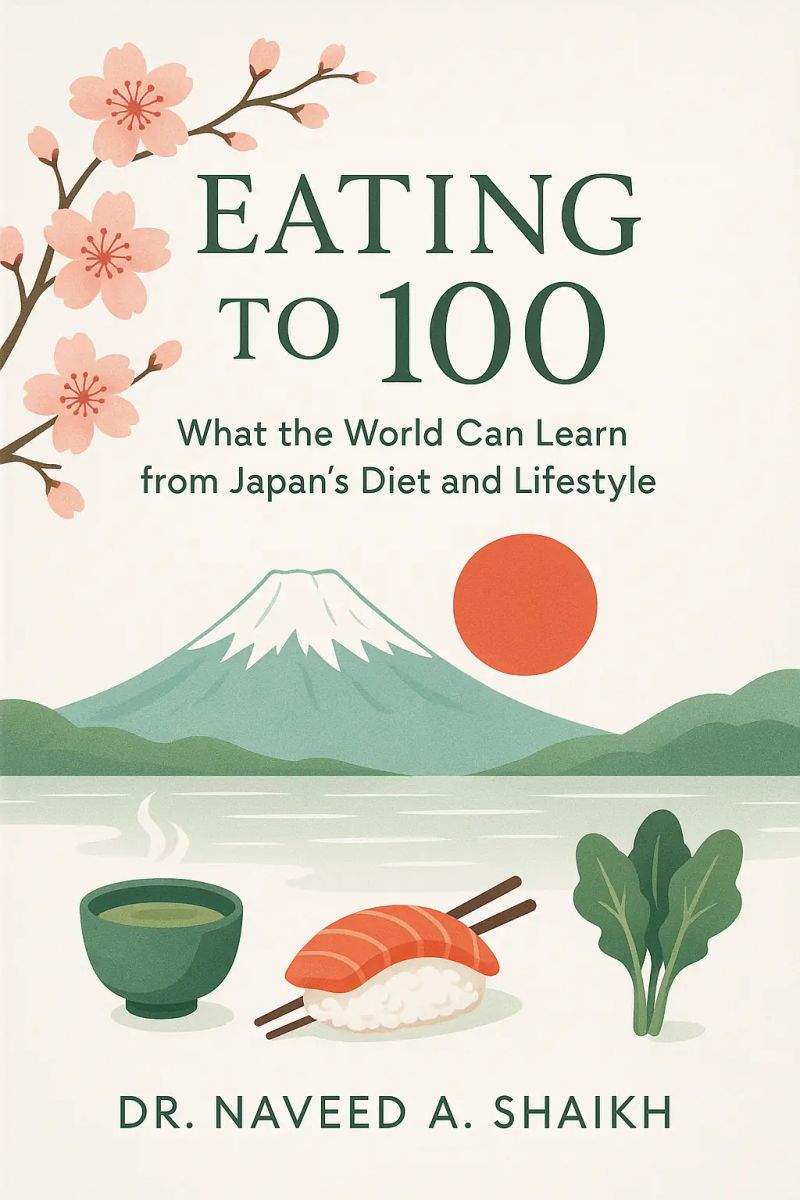
Eating to 100
What the World Can Learn from Japan's Diet and LifestyleBy Dr. Naveed A. Shaikh


Length4h 18m
About this audiobook
Let's begin with a thought. Every five seconds… just now, it happened again… someone in the world develops diabetes. And every two seconds, someone dies from cardiovascular disease.
These aren't statistics from some dystopian future; they are happening right now, as you listen to these words. The global health crisis has become so normalized that we barely even flinch at these numbers anymore.
Somehow, we've come to accept that two-thirds of Americans are overweight. We've accepted that a full half of all South Asians will eventually develop diabetes, and that obesity rates in China have quadrupled in a single generation. We've simply accepted that this is the price of modernization.
But… what if it isn't?
On an archipelago in the Pacific, 126 million people are quietly, consistently defying these global trends. Japan maintains an obesity rate of just 3.6 percent, compared to America's staggering 36 percent.
Audiobook details
GenreHealth and Wellness, Science and Nature
Length4 hrs 18 mins
Narrated byListen with 1,000+ voices
FormateBook with Audio
Publish dateOct 12, 2025
LanguageEnglish
Table of contents
1Eating to 100: What the World Can Learn from Japan's Diet and Lifestyle
2Preface
3Part I The Japanese Health Advantage
4Chapter 1: The Paradox of Plenty
5Japan vs. the world: low obesity, high life expectancy
Show all chaptersShow less
6Data snapshot: USA, Pakistan, India, China, compared to Japan
7The paradox within: work stress, suicide rates, yet remarkable longevity
8Why health is multifaceted and what Japan gets right
9Chapter 2: Washoku: The Architecture of the Japanese Diet
10Rice, fish, soy, vegetables, seaweed, fermented foods
11Umami as the secret to healthy satiety
12Comparison with the Western diet
13How Japan "domesticated" Western fast food: the KFC and McDonald's case studies
14Chapter 3: Hara Hachi Bu The 80% Full Rule
15Okinawan wisdom and calorie moderation
16Physiology of satiety and portion culture
17The small plate revolution: dishware as design intervention
18Try Tomorrow: Your first hara hachi bu meal.
19Chapter 4: Active by Design
20Walking culture and urban planning
21Why Japan moves more without gyms
22Silver mobility: how Japan keeps its elderly moving
23Contrast with car-dependent nations.
24Radio calisthenics and micromovement culture
25Try Tomorrow: Design your walking radius.
26Chapter 5: Policy as Prevention
27Shokuiku (food education) and the world's best school lunch program
28Metabo Law and corporate responsibility
29The collective approach to health
30Part II Lessons for the World
31Chapter 6: America's Weight Problem
32Fast food culture, portion distortion, and a sedentary lifestyle
33What the U.S. can borrow from Japan: urban redesign, food education, corporate wellness
34Fusion solutions: the California roll principle
35Practical Application: An American Washoku Week Meal Plan
36Chapter 7: South Asia's Silent Diabetes Epidemic
37Pakistan & India: refined carbs, oil-heavy cooking, low activity
38The vegetarian advantage: enhancing plant-based traditions with Japanese principles
39Adapting Japanese principles within South Asian cuisine & culture
40Practical Application: A South Asian washoku week meal plan
41Chapter 8: China's Crossroads
42Rapid Westernization of diet vs. traditional wisdom
43Shared foundations: rice culture, tea tradition, vegetable variety
44The convenience store transformation: from junk food to fresh options
45Opportunities for a Japanese-inspired reset
46Practical Application: A Chinese washoku fusion week
47Chapter 9: Global Blue Zones Japan in Context
48Okinawa compared with Sardinia, Ikaria, Nicoya, and Loma Linda
49Common threads: movement, purpose, plant-forward eating, community
50What makes Japan unique and reproducible globally
More from Dr. Naveed A. Shaikh




Eat It!Jordan Syatt, Michael Vacanti4h 40m4.6 (1.5K)$20 · $0.00

Consent Laid BareChanel Contos7h 11m4.5 (1.7K)$24 · $0.00
How to Make Disease DisappearRangan Chatterjee5h 26m4.5 (3.5K)$24 · $0.00

The Complete Herbal (Annotated)Nicholas Culpeper29h 8m4.5 (1.4K)$2 · $0.00

A Plague Upon Our HouseScott W. Atlas MD10h 37m4.5 (3.4K)$20 · $0.00

The Cancer CodeDr. Jason Fung10h 48m4.5 (5.3K)$29 · $0.00

The Gift of TherapyIrvin Yalom7h 39m4.5 (38.8K)$26 · $0.00

EarlySarah DiGregorio9h 47m4.5 (1.3K)$29 · $0.00

Bottle of LiesKatherine Eban14h 25m4.4 (12K)$33 · $0.00

The 36-Hour DayNancy L. Mace, Peter V. Rabins17h 13m4.4 (9.2K)$28 · $0.00

FlooredSara Reardon10h 36m4.5 (1K)$29 · $0.00

Radical RemissionKelly A. Turner9h 26m4.4 (8.1K)$29 · $0.00
The Sinatra SolutionStephen T. Sinatra MD9h4.5 (899)$20 · $0.00

The Songaminute ManSimon McDermott6h 12m4.5 (280)$24 · $0.00
Sometimes BrilliantLarry Brilliant12h 27m4.5 (954)$29 · $0.00

Live Your LifeAmanda Kloots, Anna Kloots10h 54m4.4 (13.7K)$29 · $0.00

All in Her HeadElizabeth Comen13h 25m4.4 (18.2K)$33 · $0.00
The Wisdom of Your BodyHillary McBride9h 14m4.4 (6.7K)$29 · $0.00

The Alzheimer's SolutionDean Sherzai, Ayesha Sherzai9h 47m4.4 (1.9K)$29 · $0.00
Rewire Your MindsetBrian Keane6h 49m4.5 (896)$23 · $0.00

A Brief History of IntelligenceMax S. Bennett12h 18m4.6 (6.6K)$29 · $0.00
The Story of BirdsSteve Brusatte11h 49m4.6 (401)$29 · $0.00

What It Takes to Save a LifeKwane Stewart6h4.6 (556)$24 · $0.00

Pastoral SongJames Rebanks8h 35m4.5 (12K)$26 · $0.00
How Stella Learned to TalkChristina Hunger7h4.5 (10.9K)$24 · $0.00

Craig & FredCraig Grossi8h 6m4.5 (9.6K)$26 · $0.00

Celebrating BirdsNatalia Rojas, Ana Maria Martinez6h 47m4.6 (330)$24 · $0.00

Saving JemimaJulie Zickefoose4h 59m4.5 (749)$20 · $0.00

Will's Red CoatTom Ryan8h 23m4.5 (2.3K)$26 · $0.00

Of Time and TurtlesSy Montgomery10h 34m4.5 (5K)$29 · $0.00

Zen and the Art of Saving the PlanetThich Nhat Hanh9h 20m4.5 (3.9K)$29 · $0.00
Bottle of LiesKatherine Eban14h 25m4.4 (12K)$33 · $0.00

IngrainedCallum Robinson8h 10m4.5 (1.1K)$26 · $0.00

The Lion Tracker's Guide To LifeBoyd Varty3h 1m4.4 (4.8K)$18 · $0.00

Born for LoveBruce D. Perry, Maia Szalavitz11h 42m4.4 (4K)$29 · $0.00

The Mountains of California (With Original Drawings & Photographs) (Annotated)John Muir11h 35m4.5 (1.1K)$2 · $0.00

The New GuysMeredith Bagby16h 50m4.4 (1.2K)$40 · $0.00

Blue PasturesMary Oliver3h 23m4.4 (3.8K)$18 · $0.00
The Rise and Reign of the MammalsSteve Brusatte13h 26m4.4 (11.1K)$33 · $0.00

VaccinatedPaul A. Offit8h 30m4.4 (3.7K)$26 · $0.00
You may also like
Aging Backwards: Updated and Revised EditionMiranda Esmonde-White6h 44m4.1 (2.5K)$24 · $0.00

The Prosperity ParadoxClayton M. Christensen, Efosa Ojomo, Karen Dillon9h 38m4.4 (1.8K)$29 · $0.00

Unlocking the Keto CodeSteven R. Gundry, MD6h 12m3.9 (3.3K)$24 · $0.00
The Sinatra SolutionStephen T. Sinatra MD9h4.5 (899)$20 · $0.00

Fortify Your LifeTieraona Low Dog MD10h 54m4.5 (688)$20

Year of WonderClemency Burton-Hill10h 44m4.4 (2.8K)$29 · $0.00
Building Social BusinessMuhammad Yunus8h 29m4.0 (2.2K)$17

The Book of LymphLisa Levitt Gainsley9h 17m4.3 (1.3K)$29 · $0.00

Healing PoliticsAbdul El-Sayed10h4.4 (587)$20
Dr. Atkins' New Diet RevolutionRobert C. Atkins3h 10m3.8 (8.9K)$18 · $0.00

Eat to Beat Depression and AnxietyDrew Ramsey6h 28m4.2 (2.1K)$24 · $0.00

I Am More ThanLeBron James5m4.2 (278)$4 · $0.00

WomanCodeAlisa Vitti7h 50m4.1 (16.6K)$26 · $0.00
How To EatMark Bittman, David Katz7h 13m3.8 (4.1K)$24 · $0.00

Clean -- Expanded EditionAlejandro Junger11h 9m4.0 (7.7K)$29 · $0.00
Physiological Economy in NutritionR. H. Chittenden12h 12m$2 · $0.00

Planning to WinJohn Chen40m$7

A Beginner's Guide To The Indian Stock Market | From the Creator of Zerodha Varsity - India's Largest Free Investing PlatformKarthik Rangappa4h 17m$18 · $0.00

The Natural Food of Man (Annotated)Hereward Carrington10h 54m$2 · $0.00

Convenient Houses, With Fifty Plans for the HousekeeperLouis H. Gibson7h 56m$1 · $0.00