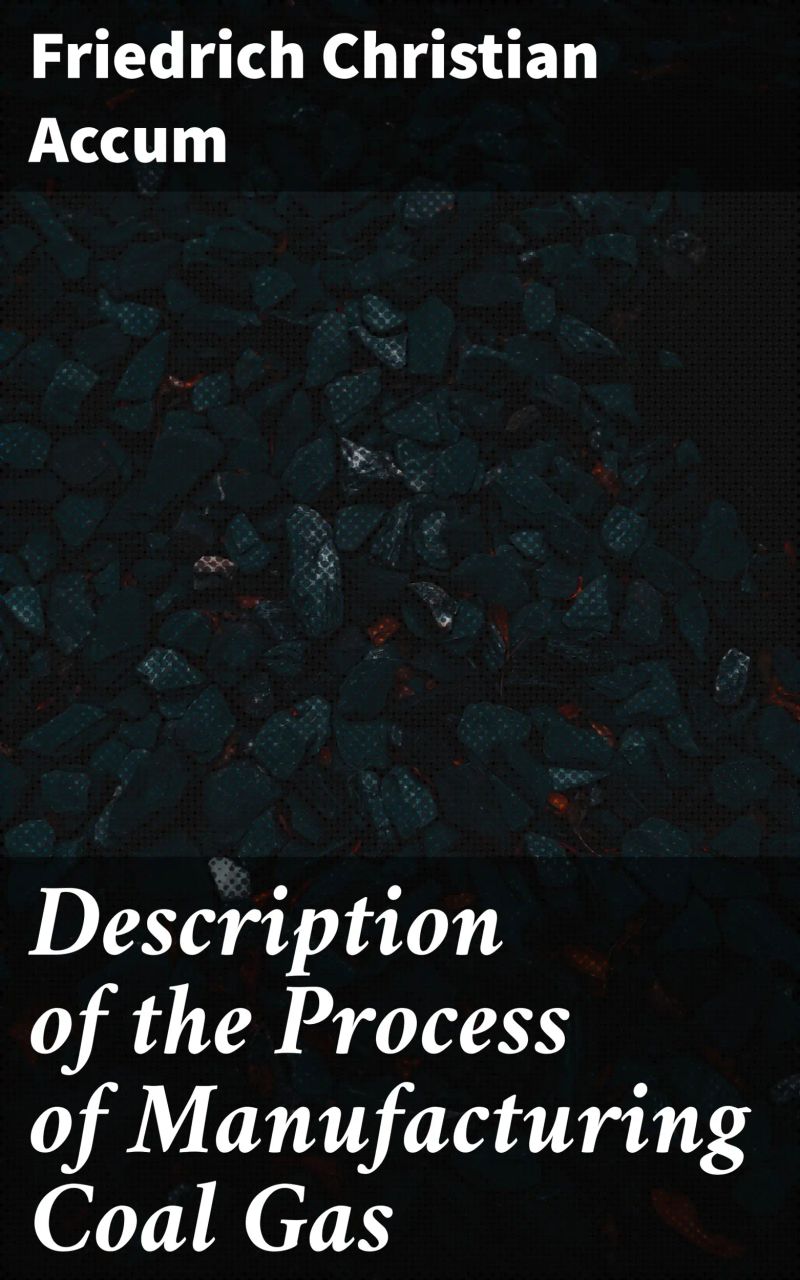
Description of the Process of Manufacturing Coal Gas
For the Lighting of Streets Houses, and Public BuildingsBy Friedrich Christian Accum


Length6h 7m
About this audiobook
In "Description of the Process of Manufacturing Coal Gas," Friedrich Christian Accum presents an exhaustive examination of the emerging technology of coal gas production during the early 19th century. Accum employs a meticulous, didactic scientific style, characterized by precise descriptions and detailed illustrations, which serves both as a practical guide and a manifesto for the gas industry. This pivotal text not only illuminates the chemical processes underlying this innovative method of energy production but also situates coal gas within the broader context of the Industrial Revolution, highlighting its potential impact on urbanization and public infrastructure. Friedrich Christian Accum, a noted chemist and pioneer in the field of gas lighting, was deeply influenced by the scientific advancements of his time. Having fled from Germany due to his liberal views, Accum settled in England, where he dedicated himself to illuminating practical applications of chemistry. His profound interest in the commercial utility of chemical processes and environmental implications of energy sources inspired him to document and promote this transformative technology, positioning him as a prominent advocate for coal gas in the burgeoning industrial landscape. This book is highly recommended for scholars, historians, and practitioners in the fields of chemistry, industrial engineering, and energy studies. By delving into Accum's seminal work, readers will gain crucial insights into the intersection of science and industry in the 19th century, offering a deeper appreciation of the historical significance of coal gas as a precursor to modern energy systems.
Audiobook details
GenreTechnology
Length6 hrs 7 mins
Narrated byListen with 1,000+ voices
FormateBook with Audio
Publish dateNov 5, 2021
LanguageEnglish
Table of contents
1PREFACE.
2ADVERTISEMENT.
3PART I.: General Nature and Advantages of the art of procuring Light, by means of Carburetted Hydrogen, or Coal Gas.
4PART II.: Outline of the new art of procuring light by means of coal gas, and Theory of the production of Gas Lights.
5PART III.: Classification of Pit-coal, and maximum quantity of gas, obtainable from different kinds of Coal.
Show all chaptersShow less
6PART IV.
7Form and dimensions of the Retorts originally employed for manufacturing Coal Gas.
8Application of heat.—Flue Plan originally adopted.
9Report on a course of Operations, made with sets of 66, of 30, of 116, and of 64 retorts, worked on the Flue Plan.
10Process I.
11Process II.
12Oven plan lately adopted.
13Description of the Retort Oven.
14PART V.
15Difference in the quantity of Gas evolved during different periods of the distillatory process, and economical considerations resulting therefrom in the manufacture of Coal Gas.
16Report on a course of Experiments made to ascertain the comparative Economy[17] of manufacturing every week, 857,667 cubic feet of gas, by means of Cylindrical Retorts variously worked.
17Process A.
18Process B.
19Process C.
20PART VI.
21Temperature best adapted for working Cylindrical Retorts.
22Annual Creditor and Debtor Account of manufacturing daily from 50,000 to 102,000 cubic feet of gas at the price which coal bears in the metropolis.—The operation being commenced with new Retorts, and the retorts being left in a fit working state.
23Process I.
24Process II.
25Process A.
26Process B.
27Comparative facility with which the decomposition of different species of Coal is effected.
28PART VII.
29Horizontal Rotary Retorts, lately brought into use for manufacturing coal gas.
30Description of the Horizontal Rotary Retorts at the Royal Mint.[31]
31Action and Management of the Horizontal Rotary Retort.
32Advantages of the method of manufacturing Coal Gas by means of Horizontal Rotary Retorts.
33Directions to workmen, with regard to the management of Horizontal Rotary Retorts.
34PART VIII.
35Purifying Apparatus, or Lime Machine.
36Lime Machine originally employed for the Purification of Coal Gas.
37Lime Machine lately adopted.
38Test Apparatus, for certifying the purity of coal gas, and the proper manner of working the Lime Machine.
39PART IX.
40Gas Holder.
41Gas Holder as originally employed.
42Gas Holder with Governor, or Regulating Gauge, lately brought into use.
43Gas Holder with Governor or Regulating Guage at the Gas Works Chester.
44Gas Holder with Governor or Regulating Guage at the Birmingham Gas Works.
45Revolving Gas Holder at the Westminster Gas Works.
46Rule for finding the capacity of a Revolving Gas Holder of given dimensions.
47Collapsing Gas Holder.
48Rule for finding the capacity of a Collapsing Gas Holder of given dimensions.
49Reciprocating Safety Valve.
50PART X.

Hands of TimeRebecca Struthers8h 8m4.4 (1.3K)$26 · $0.00

Never Lost AgainBill Kilday10h 1m4.4 (805)$29 · $0.00

How the Internet HappenedBrian McCullough13h 28m4.3 (2.7K)$23 · $0.00

Collected Writings of Nikola TeslaNikola Tesla, Thomas Commerford Martin21h 50m4.3 (1.7K)$1 · $0.00
Just AspireAjai Chowdhry9h 13m4.4 (260)$29 · $0.00

The Little Book of AliensAdam Frank8h 20m4.3 (1.3K)$26 · $0.00

The inventions, researches and writings of Nikola Tesla (Annotated)Thomas Commerford Martin16h 59m4.3 (1.3K)$2 · $0.00

KargilV.P. Malik15h 18m4.3 (2K)$24 · $0.00

Experiments with Alternating CurrentsNikola Tesla9h 6m4.3 (874)$1 · $0.00

Fire on the HorizonTom Shroder, John Konrad8h 23m4.3 (858)$26 · $0.00

The Smell of Kerosene (Annotated)National Aeronautics and Space Administration, Donald L. Mallick, Peter W. Merlin11h 32m4.3 (523)$2 · $0.00

The Boy Who Harnessed the WindWilliam Kamkwamba, Bryan Mealer10h 5m4.2 (78.9K)$29 · $0.00

Across the Airless WildsEarl Swift10h 8m4.3 (1.3K)$29 · $0.00

Console WarsBlake J. Harris20h 41m4.2 (13.7K)$46 · $0.00

Improvised Munitions HandbookU.S. Department of Defense4h 49m4.3 (1.6K)$1.99 · $0.00

Escaping GravityLori Garver10h 54m4.2 (2.2K)$20 · $0.00

Wireless WarsJonathan Pelson8h 2m4.3 (418)$20 · $0.00

Let There Be WaterSeth M. Siegel8h 36m4.2 (2.3K)$20 · $0.00

The PerfectionistsSimon Winchester11h 46m4.2 (9.9K)$29 · $0.00

Rethinking NarcissismDr. Craig Malkin6h 7m4.2 (3.4K)$24 · $0.00