
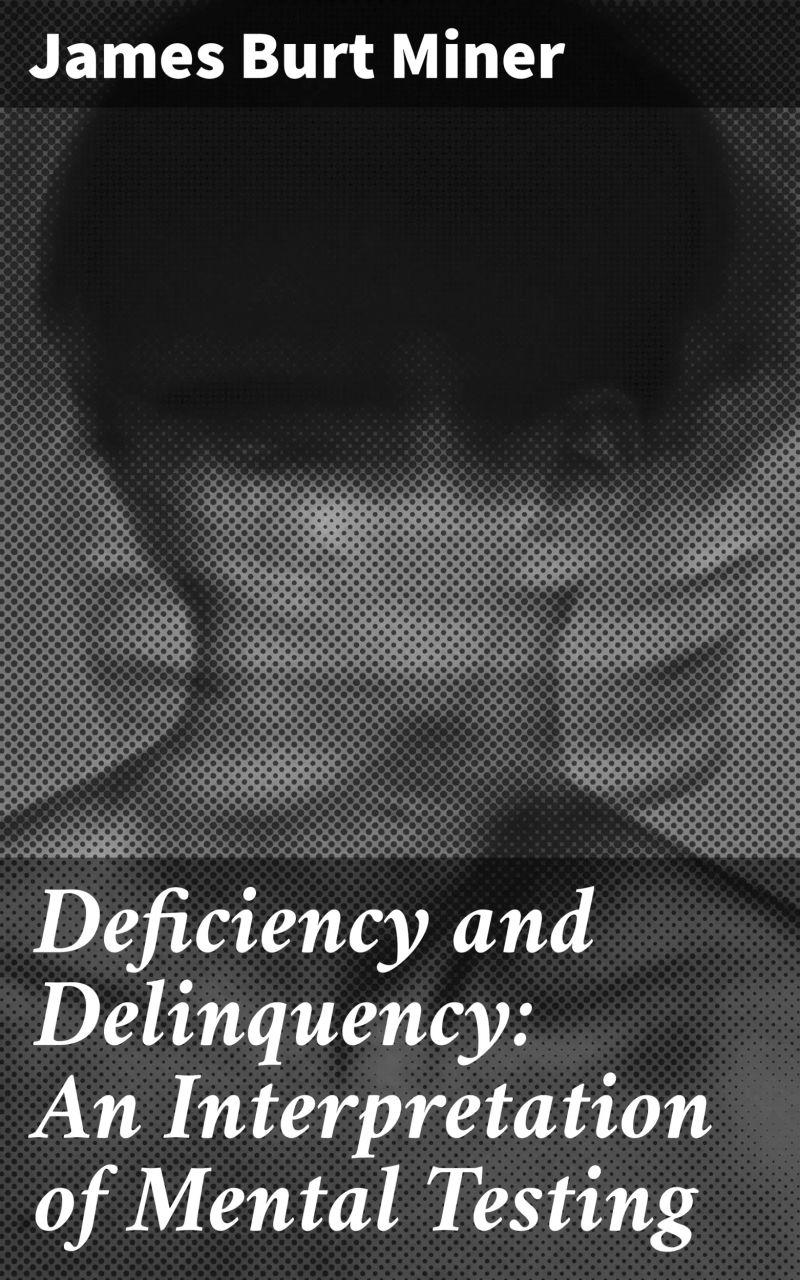
Deficiency and Delinquency: An Interpretation of Mental Testing
Unveiling the Link Between Intelligence and CriminalityBy James Burt Miner


Length10h 11m
About this audiobook
In "Deficiency and Delinquency: An Interpretation of Mental Testing," James Burt Miner presents a meticulously crafted examination of the intersections between mental testing, social behavior, and criminality. This seminal work emerges from the early 20th century discourse on psychology and education, employing a scientific yet accessible literary style that invites both scholarly and public engagement. Miner challenges prevailing notions of intelligence and delinquency by scrutinizing the implications of mental testing practices, arguing that societal labels can often perpetuate cycles of deficiency rather than alleviate them. His work resonates with the concerns of the eugenics movement, while also engaging critically with the potential for testing to inform educational reform and juvenile justice systems. James Burt Miner was a prominent psychologist and educator whose academic pursuits were deeply influenced by the social issues of his time. His professional background, encompassing educational psychology and social work, informed his perspective on mental health and its societal consequences. Miner's experiences with disenfranchised communities illuminated the misguided practices within mental testing, motivating him to advocate for a more humane, equitable understanding of human behavior in the context of education and delinquency. This book is essential reading for anyone invested in the fields of psychology, criminology, and education. It compels readers to reflect on the ethical dimensions of mental testing and the societal implications of labeling individuals based on perceived deficiencies. Miner's insightful critique not only sheds light on historical practices but also prompts vital discussions on contemporary mental health approaches, making it a crucial addition to the libraries of scholars and practitioners alike.
Audiobook details
GenrePsychology
Length10 hrs 11 mins
Narrated byListen with 1,000+ voices
FormateBook with Audio
Publish dateMay 19, 2021
LanguageEnglish
Table of contents
1Deficiency and Delinquency An Interpretation of Mental Testing
2PREFACE
3CHAPTER I. INTRODUCTION
4PART ONE PRACTICAL CONSIDERATIONS
5CHAPTER II. THE FUNCTIONS OF A SCALE IN DIAGNOSIS
Show all chaptersShow less
6A. The Meaning of Intellectual Deficiency.
7B. Forms of Mental Deficiency Not Yet Discoverable by Tests.
8C. Doubtful Intellects Accompanied by Delinquency Presumed Deficient.
9CHAPTER III. THE PERCENTAGE DEFINITION OF INTELLECTUAL DEFICIENCY
10A. The Definition.
11B. The Assumptions of a Quantitative Definition.
12CHAPTER IV. WHAT PERCENTAGE IS FEEBLE-MINDED
13A. Kinds of Social Care Contemplated
14B. Estimates of the School Population Versus the General Population
15C. Desirable Versus Immediately Advisable Social Care
16D. Percentages Suggested to Harmonize the Estimates
17E. Comparison With Important Estimates
18F. The Ability of the Mentally Retarded, Especially Those Receiving Special Training.
19CHAPTER V. ADAPTING THE PERCENTAGE DEFINITION TO THE BINET SCALE
20A. The Border Region for the Mature.
21B. The Border Region for the Immature.
22CHAPTER VI. DELINQUENTS TESTING DEFICIENT
23A. At the Glen Lake Farm School for Boys, Hennepin County, Minnesota.
24B. Comparison of Tested Deficiency Among Typical Groups of Delinquents.
25C. Summary of Tested Deficiency Among Delinquents
26CHAPTER VII. CHECKING THE BINET DIAGNOSIS BY OTHER METHODS
27CHAPTER VIII. SCHOOL RETARDATION AMONG DELINQUENTS
28A. In Minneapolis
29B. School Retardations Among Other Groups of Delinquents
30CHAPTER IX. COMPARISON OF THE SCHOOL TEST AND THE BINET TEST
31A. Practical Uses of the School Test.
32B. Checking Deficiency Among Delinquents by the School Test.
33CHAPTER X. BAD SCHOOL ADJUSTMENT AS A CAUSE OF DELINQUENCY
34CHAPTER XI. DEFICIENCY AS A CAUSE OF DELINQUENCY
35A. The Chances of the Mentally Deficient Becoming Delinquent.
36B. The Correlation of Deficiency and Delinquency.
37C. The Causes of Delinquency.
38CHAPTER XII. SUMMARY AND SUGGESTIONS
39PART TWO THEORETICAL CONSIDERATIONS
40CHAPTER XIII. THE THEORY OF THE MEASUREMENT OF MENTAL DEVELOPMENT
41A. Comparison of Units and Scales for Measuring Individual Differences.
42B. The Curves of Mental Development.
43CHAPTER XIV. QUANTITATIVE DEFINITIONS OF THE BORDERLINE
44A. Different Forms of Quantitative Definitions
45B. Common Characteristics of Quantitative Definitions
46C. Practical Advantages of the Percentage Method
47D. Theoretical Advantage of the Percentage Method with Changes in the Form of the Distributions
48BIBLIOGRAPHY ON TESTED DELINQUENTS[34]: OTHER REFERENCES CITED
49APPENDIX I
50APPENDIX II

What to Make of a LifeJim Collins13h 31m4.4 (794)$33 · $0.00

Black AF HistoryMichael Harriot15h 43m4.7 (14.6K)$33 · $0.00

Bad Fat Black GirlSesali Bowen6h 32m4.7 (2.8K)$24 · $0.00

Invisible StormJason Kander6h 48m4.7 (3.2K)$24 · $0.00

I Am The StormJanice Dean9h4.6 (1.5K)$8 · $0.00

On Democracies and Death CultsDouglas Murray10h 38m4.6 (6.5K)$29 · $0.00

TerraformPropaganda5h 39m4.7 (594)$24 · $0.00

Southern Horrors: Lynch Law in All Its Phases (Annotated)Ida B. Wells-Barnett2h 44m4.6 (1.3K)$2 · $0.00

Hour of the HeartIrvin D. Yalom, Benjamin Yalom8h 19m4.6 (2.3K)$26 · $0.00

Braving the TruthRachel Held Evans11h 31m4.7 (359)$29 · $0.00
Level UpRob Dial7h 42m4.6 (3.3K)$26 · $0.00

As a JewSarah Hurwitz8h 36m4.6 (1.2K)$26 · $0.00

Saint Joan (Annotated)George Bernard Shaw6h 20m4.6 (1.2K)$1.20 · $0.00

Burn the HaystackJennie Young, PhD9h 30m4.6 (543)$29 · $0.00

Woman and the New Race (Annotated)Margaret Sanger6h 30m4.6 (1K)$1.99 · $0.00

Good InsideBecky Kennedy9h 55m4.5 (59.3K)$29 · $0.00

The Mis-Education of the NegroCarter Godwin Woodson5h 4m4.5 (29.4K)$1.20 · $0.00

Du Bois: EssaysW.E.B. Du Bois6h 22m4.6 (1.5K)$1 · $0.00

The North American Indian (Illustrated Edition)Edward S. Curtis, Frederick Webb Hodge5h 59m4.6 (1.4K)$2 · $0.00

Valley of the BirdtailAndrew Stobo Sniderman, Douglas Sanderson10h 1m4.6 (2.4K)$29 · $0.00
You may also like
The Honest Truth About DishonestyDan Ariely8h 36m4.0 (20.9K)$26 · $0.00

An Introduction to the Principles of Morals and LegislationJeremy Bentham12h 37m3.8 (1K)$1 · $0.00
Freakonomics Rev EdSteven D. Levitt, Stephen J. Dubner7h 51m4.1 (961.9K)$7 · $0.00
Think Like a FreakSteven D. Levitt, Stephen J. Dubner7h 5m4.0 (131.9K)$24 · $0.00
The Critique of Practical ReasonImmanuel Kant6h 52m4.0 (23.5K)$3.50 · $0.00

Fundamental Principles of the Metaphysic of Morals Immanuel Kant3h 16m4.0 (48.8K)Free

Critique of Practical Reason (Kritik der praktischen Vernunft)Immanuel Kant6h 50m4.1 (14K)$2 · $0.00

Psychopathia SexualisRichard Freiherr von Krafft-Ebing21h 28m4.0 (853)$2.30

On SuicideWilliam Wynn Westcott5h 41m$1.99 · $0.00
The Quest for Cosmic JusticeThomas Sowell5h 52m$20

Killer LooksZara Stone12h 43m4.2 (135)$23

OKLAHOMA DPS Permit Study Guide-2026 EDITIONLUCAS CRANE9h 52m$10

Criminal Man, According to the Classification of Cesare LombrosoGina Lombroso6h 49m3.6 (19)$1 · $0.00

The Humbugs of the World & The Art of Money GettingP. T. Barnum14h 47m4.4 (12)$1.99 · $0.00
The Criminal & the CommunityJames Devon7h 7m$2 · $0.00

West Virginia Property and Casualty Insurance Exam Review 2026/2027Leopold Wrenfield17h 9m$30

Criminal Psychology, A Manual for Judges, Practitioners, and StudentsHans Gross24h 26m4.1 (91)$2.30

Progressive MoralityThomas Fowler3h 37m$2 · $0.00

Maine Life & Health Insurance Exam Study Guide 2026/2027Corinne Ashbeck17h 59m$27

Credit Repair: Proven Methods to Raise Your Credit Score Faster & Secure Your Financial Future (Learn How to Restore, Repair and Improve Your Credit Report and Protect Yourself From Creditors and Banks Using Federal Laws)Todd Moore1h 15m$3.50 · $0.00