
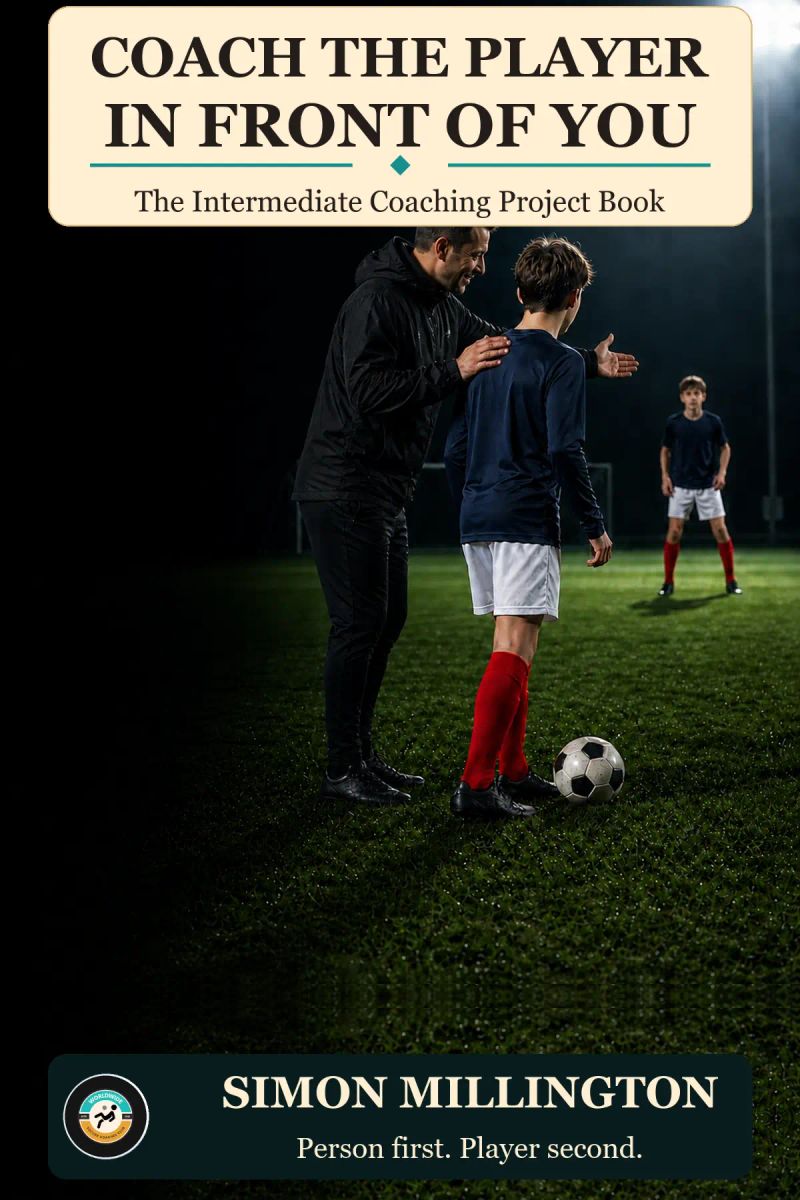
Length5h 43m
About this audiobook
Your best player has stopped being your best player, and nobody has explained why.
They grew four inches over the summer. Their feet arrived before the rest of them. They keep falling over in games they used to dominate.
This is the audiobook for the course content they no longer provide . Ten to fourteen — when the body changes underneath them, when positions start to matter, when they quietly work out where they stand, and when most of the players you lose are lost.
You'll learn:
- How to count what you actually say, and who you say it to.
- What's happening inside a growing body
- The practice spectrum — seventeen ways to shape a session
- Why players leave, why some stay and empty out, and what the difference asks of you.
- The deeper four-corner profiling.
Narrated by Simon Millington. 30+ years on the grass, a UEFA A Licence coach and a coach developer who has taught hundreds of coaches who have gone on to coach thousands of players.
Person first. Player second.
Audiobook details
GenreOther, Education and Learning
Length5 hrs 43 mins
Narrated byRecorded Track
FormatAudiobook
Publish dateSep 6, 2026
LanguageEnglish
Table of contents
1Opening
2Before We Start
3First, thank you
4Why this book exists
5If you’ve read the first one
Show all chaptersShow less
6Who this book is for
7The thread running through all of it
8On reflection — the bit most of us skip
9A note on the research
10The books this one sits between
11Part One. The Coach You Are
12Chapter One. The Coach You Think You Are
13Chapter Two. Your Three Philosophies
14Chapter Three. Your Own Five Cs
15That is Part One. Before we move on, the key messages
16Part Two. Understanding the Player
17Chapter Four. The Four Corners: One Model, Not Four Boxes
18Chapter Five. What They Arrive With
19Chapter Six. Ten to Fourteen: The Body Changes Underneath Them
20Chapter Seven. What Comes Next
21Chapter Eight. The Group You’ve Actually Got
22Part Two, continued. The Social Corner
23Chapter Nine. What Socialisation Actually Means
24Chapter Ten. Making It Real in a Group
25Chapter Eleven. Character, Traits and What’s Actually Yours to Shape
26Chapter Twelve. When the Adults Don’t Line Up
27Chapter Thirteen. Why They Play, and Why They Go
28Part Two, continued. The Psychological Corner
29Chapter Fourteen. Understanding the Motivation of the Player in Front of You
30Chapter Fifteen. Building Confidence
31Chapter Sixteen. Self-Esteem and the Room
32Chapter Seventeen. The Corner This Book Doesn’t Cover
33Chapter Eighteen. Knowing Who’s In Front of You
34That is Part Two. Before we move on, the key messages
35Part Three. How Players Learn
36Chapter Nineteen. Horse and Jockey
37Chapter Twenty. Passive, Facilitator, Controller
38Chapter Twenty-One. Point at the Ball, Not at Their Ankle
39Chapter Twenty-Two. Practice Makes Permanent
40That is Part Three. Before we move on, the key messages
41Part Four. Designing Practice
42Chapter Twenty-Three. Defining the Moment
43Chapter Twenty-Four. The Practice Spectrum
44Chapter Twenty-Five. Build, Develop, Extend
45Chapter Twenty-Six. Practices, Not Drills
46That is Part Four. Before we move on, the key messages
47Part Five. Managing the Group
48Chapter Twenty-Seven. Prevention or Cure
49Chapter Twenty-Eight. Coaching Difference
50Chapter Twenty-Nine. Mistake or Opportunity?
More from Simon Millington

Mere ChristianityC. S. Lewis7h 7m4.4 (519.7K)$24 · $0.00

Her Daily BreadKate Wood12h 57m4.6 (153)$33 · $0.00
The Holy Bible - 1 SamuelKing James2h 13m4.8 (1.6K)$3 · $0.00

The American Standard Bible — The Gospel of MatthewMatthew3h 56m4.7 (3K)$2 · $0.00

Bad Fat Black GirlSesali Bowen6h 32m4.7 (2.8K)$24 · $0.00
The King James Audio Bible New Testament CompleteChristopher Glyn20h 2m4.7 (2.6K)$12 · $0.00

Faiths CheckbookCharles Spurgeon12h 44m4.7 (3.2K)$11 · $0.00
Ten Things I Wish You Knew About Your Child's Mental HealthDr. Billy Garvey4h 53m4.7 (2.4K)$20 · $0.00

Designing Terry Pratchett’s DiscworldPaul Kidby3h 52m4.7 (343)$20 · $0.00
The Chosen Book OneAmanda Jenkins, Kristen Hendricks, Dallas Jenkins3h 8m4.6 (4.9K)$10 · $0.00
The Lives of BrianBrian Johnson9h 45m4.6 (3.5K)$29 · $0.00
Expository Thoughts on the Gospel of LukeJ.C. Ryle27h 13m4.7 (536)$18 · $0.00

CrossroadsKaleb Dahlgren7h 56m4.6 (4.9K)$26 · $0.00

Across the RiverKent Babb11h 40m4.6 (927)$29 · $0.00

Brain Training for RidersAndrea Monsarrat Waldo5h 56m4.7 (550)$19 · $0.00

My Effin' LifeGeddy Lee17h 11m4.6 (13.1K)$40 · $0.00
Kings and PawnsHoward Bryant10h 9m4.6 (678)$29 · $0.00

The Elementia Chronicles #2: The New OrderSean Fay Wolfe11h 17m4.6 (841)$29 · $0.00
The ActsLuke2h 55m4.6 (19.7K)$12 · $0.00

New Testament - Easy NavigationWorld English Bible19h 35m4.6 (1.3K)$1.30 · $0.00

A Brief History of IntelligenceMax S. Bennett12h 18m4.6 (6.6K)$29 · $0.00

HomeschooledStefan Merrill Block7h 10m3.6 (18.5K)$28 · $0.00

WitnessAriel Burger8h 1m4.6 (1.3K)$20 · $0.00

EducationEllen G. White9h 41m4.6 (1.5K)$2 · $0.00

Parents and Children (Annotated)Charlotte Mason9h 23m4.6 (988)$2 · $0.00

Children Under FireJohn Woodrow Cox10h 17m4.5 (1.6K)$29 · $0.00

The State Must ProvideAdam Harris7h 15m4.5 (775)$24 · $0.00

The Call of the Wild and FreeAinsley Arment9h 7m4.4 (21.2K)$29 · $0.00
The Freelance WayRobert Vlach19h 48m4.5 (528)$40 · $0.00

Race to the BottomLuke Rosiak9h 20m4.5 (600)$29 · $0.00

They Came for the SchoolsMike Hixenbaugh9h 5m4.5 (2.6K)$8 · $0.00

Find Me UnafraidKennedy Odede, Jessica Posner11h 11m4.5 (2.7K)$29 · $0.00

Asking for ItKate Harding8h 55m4.4 (5.3K)$20 · $0.00
Defining Moments in Black HistoryDick Gregory7h 37m4.4 (6K)$26 · $0.00

The Emerald Tablets of Thoth the AtlanteanMaurice Doreal3h 4m4.4 (8.8K)$6 · $0.00

Learning AmericaLuma Mufleh6h 37m4.4 (564)$24 · $0.00
Math-ishJo Boaler7h 21m4.4 (588)$24 · $0.00
It Worked For MeColin Powell7h 42m4.3 (9.8K)$26 · $0.00

Little SoldiersLenora Chu11h 30m4.3 (3.1K)$29 · $0.00

Financial FeministTori Dunlap8h 3m4.2 (22.2K)$8 · $0.00
You may also like

Splish, Splash, Splat!Rob Scotton7m4.1 (1.9K)$4 · $0.00

My Weird School: Talent Show Mix-UpDan Gutman7m4.1 (351)$4 · $0.00

Dr. Montessori's Own HandbookMaria Montessori2h 43m4.2 (1.6K)$2.30

Dr. Montessori's Own HandbookMaria Montessori2h 42m4.3 (1.3K)$10 · $0.00

The Good Egg and the Talent ShowJory John6m4.3 (1.9K)$4 · $0.00

YOUR ERRONEOUS ZONESWayne W. Dyer1h 30m4.1 (28.6K)$16 · $0.00

Something Like an AutobiographyAkira Kurosawa9h 35m4.3 (5.9K)$20
Nice TryJosh Gondelman5h 59m4.0 (2K)$24 · $0.00

The NaturalRichard La Ruina5h 34m4.0 (1.2K)$24 · $0.00

Growing Up With Vitiligo, I Was Bullied—Until I Became A BullyRICE media12m$6 · $0.00

The Gathering of Brother HilariusMichael Fairless3h 3m3.8 (228)$2 · $0.00

Bashfulness Cured: Ease and Elegance of Manner Quickly GainedAnonymous58m$2 · $0.00

Making Good on Private Duty: Practical Hints to Graduate NursesHarriet Camp Lounsbery2h 54m$2 · $0.00
Practical School Discipline: Introductory CourseRay Coppock Beery4h 34m$1 · $0.00

Becoming a Tech Lead Without Losing Your Technical EdgeImad Muratspahic3h 50m$11 · $0.00

Why It's Important to Teach Your Child to Be MindfulAurora Brooks1h 10m$3.50 · $0.00
Value-oriented leadershipRainer Krumm1h 34m4.6 (18)$10 · $0.00

People Magnet: The Secrets of How to Never Be Overseen and Be the Center of Any Party (Practical Steps to Cultivate Charisma and Leave a Lasting Impact on Everyone You Meet)James Soule50m$3.50 · $0.00

St. Bernard'sEdward Berdoe9h 47m$2 · $0.00

The Challenge of Choosing the Right CareerSteve Pavlina8m4.1 (12)$4 · $0.00