
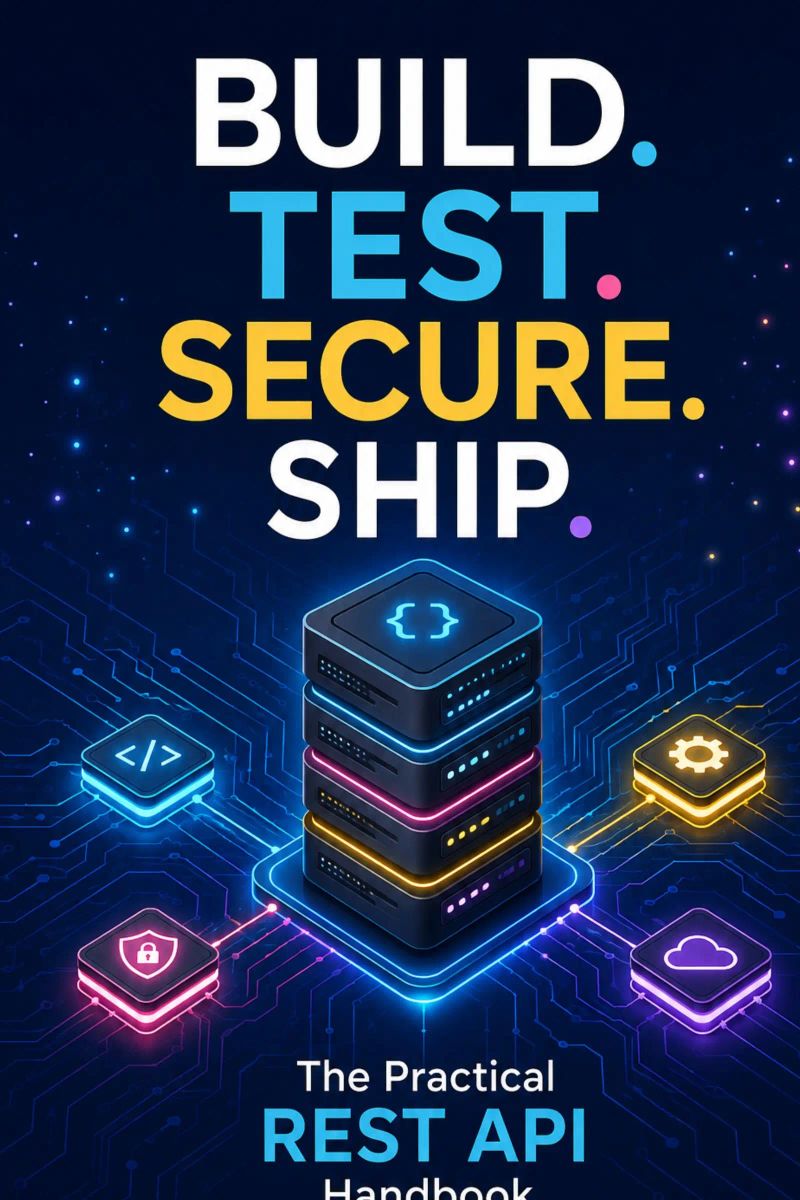
Build. Test. Secure. Ship."
The Practical REST API HandbookBy "Alex Renner


Length9h 49m
About this audiobook
Most API books teach you syntax. This one teaches you why.
Whether you're a self-taught developer building your first backend or an experienced engineer looking to fill in the gaps in your understanding, Build. Test. Secure. Ship. walks you through the complete lifecycle of a real, production-grade REST API — not as a list of rules to memorize, but as a series of reasoned decisions you'll learn to make confidently on your own.
Using a single running example — a full-featured blogging platform built with Node.js, Express, PostgreSQL, and Prisma — this handbook takes you from first principles all the way to a monitored, documented, continuously deployed production system. You'll learn:
• Foundations: What an API actually is, why REST won out over SOAP, GraphQL, and gRPC, and the six architectural constraints that define it
• Build: Resource design, project structure, database schema, full CRUD operations, JWT authentication, and versioning that won't break your existing clients
• Test: Manual testing with Postman and curl, automated testing with Jest, the real difference between unit and integration tests, and how to mock dependencies without losing confidence in your suite
• Secure: HTTPS and CORS done right, OAuth2 explained in plain English, rate limiting, input validation, and the vulnerabilities — SQL injection, mass assignment, insecure direct object references — that quietly sink so many production APIs
• Optimize: Caching at every layer, background job queues, load balancing, and the observability practices that let you actually know what your API is doing at 3 a.m.
• Document & Ship: OpenAPI and Swagger, generated client SDKs, CI/CD pipelines that test and deploy your code automatically, every time
Along the way, you'll study how real companies — Stripe, GitHub, and Twitter — have made these same decisions at scale, including the costly lessons learned when API evolution goes wrong.
The book closes with a full capstone project, applying everything you've learned to build a brand-new feature end-to-end — proof that the reasoning in these pages travels with you, long after the specific code is forgotten.
Clear, practical, and reasoning-forward from the first page to the last, Build. Test. Secure. Ship. isn't just a reference to keep on your shelf — it's the thinking behind every well-built API you'll ever ship.
Audiobook details
GenreTechnology
Length9 hrs 49 mins
Narrated byListen with 1,000+ voices
FormateBook with Audio
Publish dateAug 4, 2026
LanguageEnglish
Table of contents
11
22
33
44
55
Show all chaptersShow less
66
77
88
99
1010
1111
1211.1 Why Scattered Error Handling Breaks Down
1311.2 Express’s Built-In Error-Handling Middleware
1411.3 Operational Errors vs. Programmer Errors
1511.4 A Custom Error Class
1611.5 Refactoring Chapter 9 and 10’s Controllers
1711.6 An Async Wrapper to Eliminate Repetition
1811.7 A Consistent Error Response Shape
1911.8 Handling 404s for Undefined Routes
2011.9 Logging: Seeing What the Client Never Does
2111.10 What Comes Next
2212
2312.1 Why This Deserves Its Own Chapter
2412.2 Revisiting Offset vs. Cursor Pagination
2512.3 Enforcing Sane Limits
2612.4 Filtering: Turning Query Parameters Into a WHERE Clause
2712.5 Sorting: Another Place to Whitelist, Not Trust
2812.6 Wiring It All Together
2912.7 Documenting the Pattern Once
3012.8 What Comes Next
3113
3213.1 The Problem Versioning Solves
3313.2 What Actually Counts as a Breaking Change
3413.3 Where to Put the Version: URL, Header, or Query Parameter
3513.4 Structuring Your Codebase for Multiple Versions
3613.5 Deprecating Old Versions Gracefully
3713.6 When You Do Not Need a New Version at All
3813.7 What Comes Next
3914
4014.1 Why Manual Testing Still Matters
4114.2 curl: The Universal, Scriptable Baseline
4214.3 Scripting Repeatable curl Tests
4314.4 Postman: A Visual, Collaborative Alternative
4414.5 What to Actually Test, Beyond the Happy Path
4514.6 Testing Idempotency Directly
4614.7 A Habit Worth Building Now
4714.8 What Comes Next
4815
4915.1 Why Automated Tests Change How You Work
5015.2 Setting Up Jest

LiftoffEric Berger9h 4m4.6 (9.5K)$29 · $0.00

The Honey BusMeredith May9h 31m4.4 (16.6K)$25 · $0.00

Collected Writings of Nikola TeslaThomas Commerford Martin, Nikola Tesla19h 42m4.4 (2.8K)$1.99 · $0.00

Operation PedestalMax Hastings12h 29m4.4 (5.2K)$29 · $0.00

When the Heavens Went on SaleAshlee Vance18h 20m4.4 (3K)$40 · $0.00

Everybody Has a Podcast (Except You)Justin McElroy, Travis McElroy, Griffin McElroy5h 9m4.3 (2.3K)$24 · $0.00

Hands of TimeRebecca Struthers8h 8m4.4 (1.3K)$26 · $0.00
Never Lost AgainBill Kilday10h 1m4.4 (805)$29 · $0.00
How the Internet HappenedBrian McCullough13h 28m4.3 (2.7K)$23 · $0.00

Collected Writings of Nikola TeslaNikola Tesla, Thomas Commerford Martin21h 50m4.3 (1.7K)$1 · $0.00

Just AspireAjai Chowdhry9h 13m4.4 (260)$29 · $0.00

The Little Book of AliensAdam Frank8h 20m4.3 (1.3K)$26 · $0.00

The inventions, researches and writings of Nikola Tesla (Annotated)Thomas Commerford Martin16h 59m4.3 (1.3K)$2 · $0.00

KargilV.P. Malik15h 18m4.3 (2K)$24 · $0.00
Experiments with Alternating CurrentsNikola Tesla9h 16m4.3 (874)$1.99 · $0.00

Fire on the HorizonTom Shroder, John Konrad8h 23m4.3 (858)$26 · $0.00

The Smell of Kerosene (Annotated)National Aeronautics and Space Administration, Donald L. Mallick, Peter W. Merlin11h 32m4.3 (523)$2 · $0.00

The Boy Who Harnessed the WindWilliam Kamkwamba, Bryan Mealer10h 5m4.2 (78.9K)$29 · $0.00

Across the Airless WildsEarl Swift10h 8m4.3 (1.3K)$29 · $0.00

Console WarsBlake J. Harris20h 41m4.2 (13.7K)$46 · $0.00
You may also like

A History of Video Games in 64 ObjectsWorld Video Game Hall of Fame7h 41m4.1 (477)$26 · $0.00
How the Internet HappenedBrian McCullough13h 28m4.3 (2.7K)$23 · $0.00

The Senior-Friendly Guide to Apple WatchWalter Hemsley3h 40m$15

Fire TV Stick Made SimpleWalter Hemsley4h 15m$8

SharePoint for Beginners Made SimpleRuth Callender4h 20m$15

Smartphones for SeniorsWalter Hemsley3h 38m$5
Outlook Calendar Made SimpleRuth Callender3h 54m$8
Excel VBA for BeginnersRuth Callender4h 3m$8

Home Assistant Made SimpleWalter Hemsley4h 12m$11

Apple TV Made SimpleWalter Hemsley4h 23m$5

Monday.com Made SimpleRuth Callender4h 25m$7
Claude Code for Modern DevelopersLeon Grant8h 21m$6.50 · $0.00

Smart Thermostat Made SimpleWalter Hemsley4h 18m$8

Deserts: Geology and ResourcesA. S. Walker1h 6m$0.99 · $0.00
QuickBooks for Small Business OwnersRuth Callender4h 1m$15

The AI Advantage for Print On DemandMiles Draper4h 20m$8
The AI Advantage for ArchitectsMiles Draper4h 27m$25

The AI Advantage for Travel PlanningMiles Draper4h 30m$8

Learn English: Grammar, Culture and Real Conversation Beyond the TextbookMinea Kapidzic3h 3m$20 · $0.00
THE CLAUDE AI BIBLE FOR BEGINNERSSheldon Caldwell4h 42m$17.50 · $0.00