
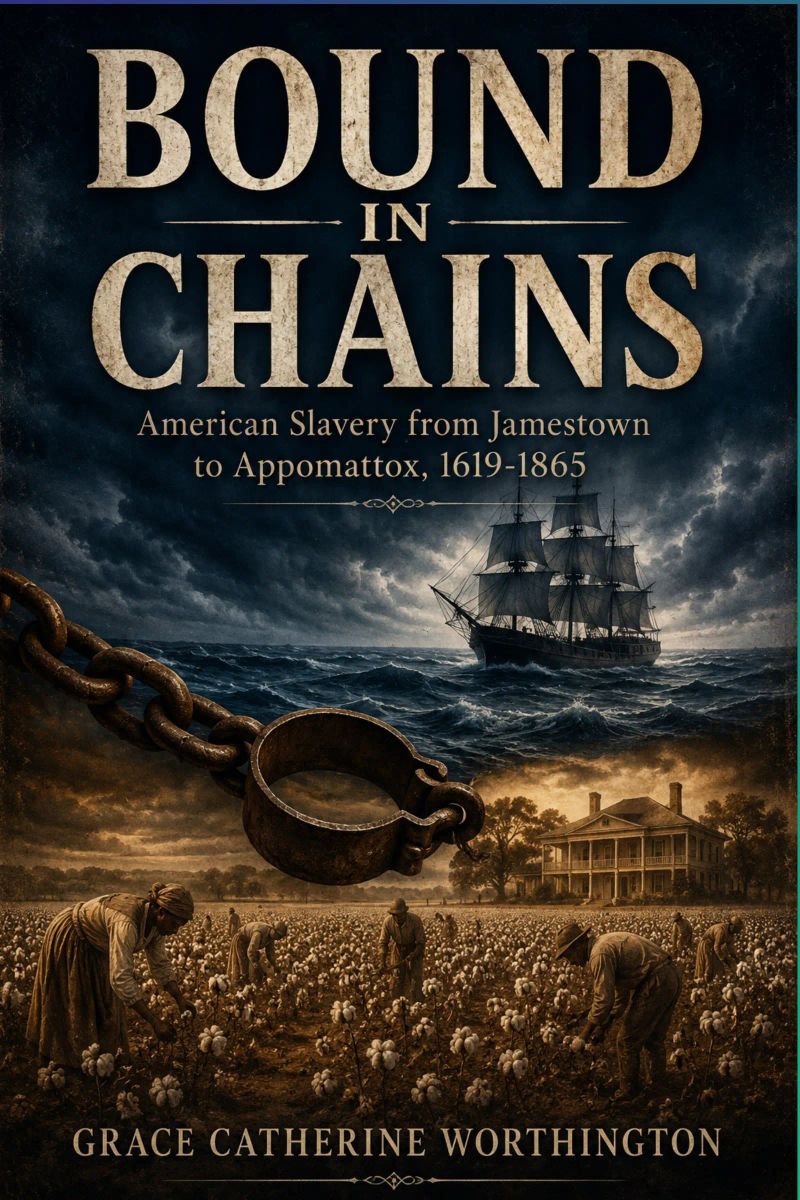
BOUND IN CHAINS
American Slavery from Jamestown to Appomattox, 1619-1865By Grace Catherine Worthington


Length5h 41m
About this audiobook
The definitive narrative history of American slavery — Jamestown 1619 to Appomattox 1865 — Frederick Douglass, Harriet Tubman, Nat Turner, and the complete story of the institution that built a republic and nearly destroyed it.
In August 1619, a Dutch warship arrived at Point Comfort, Virginia, and traded approximately twenty Africans to English colonists. Their legal status was genuinely ambiguous — some, like Anthony Johnson, eventually became free and acquired land. Within a generation that window had closed. Virginia's 1662 law declaring that a child's status followed the mother's transformed enslaved women's children into property, creating the mechanism of hereditary slavery and a legal incentive for the sexual exploitation that was one of slavery's most pervasive horrors.
This is the complete story — how slavery was built through deliberate legislative choices, sustained by a paternalist ideology that Jefferson called "a moral and political depravity" while holding more than a hundred people in bondage, and how Frederick Douglass, Harriet Tubman, William Lloyd Garrison, and 180,000 Black Union soldiers brought it down — and why its consequences have never stopped shaping American life.
Inside this American slavery history book:
• How racial slavery was built in law — the Virginia statutes of the 1660s–1680s that converted ambiguous servitude into hereditary chattel slavery, and why Bacon's Rebellion of 1676 accelerated the shift from white indentured servants to Black slaves (Chapter 3)
• The Middle Passage — 12.5 million Africans transported, mortality rates of 5–25 percent per voyage, the Amistad revolt of 1839, and why approximately 400,000 arrived in the United States while the Caribbean and Brazil received far more (Chapter 2)
• Gabriel, Vesey, and Nat Turner — the blacksmith who planned to march on Richmond, the free carpenter who recruited thousands using Old Testament prophecy, and the preacher whose forty-eight hours killed fifty-five people and produced Virginia's near-vote for gradual emancipation in 1832 (Chapter 10)
• Frederick Douglass's intellectual life — how Thomas Auld's warning that literacy would "forever unfit him to be a slave" became Douglass's blueprint, the 1845 Narrative that sold 11,000 copies in three years, and his 1852 "What to the Slave Is the Fourth of July?" (Chapter 14)
• Harriet Tubman's thirteen missions — why she started on Saturday nights, why she carried a gun, and how she guided the 1863 Combahee River Raid that freed more than 700 people — the largest single liberation of the Civil War (Chapter 15)
American slavery lasted 246 years and killed 620,000 people in the war required to end it. It was built deliberately, through specific legal choices, by specific people acting in their economic interests. Understanding how it was built — and how the ideology that justified it outlasted the institution — is essential to understanding the America it left behind.
For readers of Clint Smith's HOW THE WORD IS PASSED and Isabel Wilkerson's THE WARMTH OF OTHER SUNS.
Audiobook details
GenreHistory
Length5 hrs 41 mins
Narrated byListen with 1,000+ voices
FormateBook with Audio
Publish dateJun 3, 2026
LanguageEnglish
Table of contents
1Introduction
2Prologue: The Middle Passage
3PART ONE: THE ORIGINS AND GROWTH OF AMERICAN SLAVERY (1619-1750)
4Chapter 1: The First Africans — Jamestown, 1619, and the Beginning
5Chapter 2: The Slave Trade — Africa, the Middle Passage, and the Atlantic System
Show all chaptersShow less
6Chapter 3: From Servant to Slave — How Racial Slavery Was Built in Law
7Chapter 4: The Plantation System — Rice, Tobacco, and the Slave Economy
8PART TWO: THE SLAVE SOCIETY (1750-1820)
9Chapter 5: The Cotton Kingdom — Eli Whitney, the Gin, and Slavery's Expansion
10Chapter 6: The Domestic Slave Trade — Selling People from the Upper to the Deep South
11Chapter 7: The Master Class — Planters, Paternalism, and the Ideology of Slavery
12Chapter 8: The Enslaved Community — Family, Religion, and Culture Under Bondage
13PART THREE: RESISTANCE AND CONTROL
14Chapter 9: Everyday Resistance — Slowing Down, Feigning Illness, and Breaking Tools
15Chapter 10: Gabriel's Rebellion, Denmark Vesey, and Nat Turner — Three Uprisings
16Chapter 11: The Slave Patrol — Control, Surveillance, and the Origins of Policing
17Chapter 12: Free Black Communities — The Complicated Freedom of the Non-Enslaved
18PART FOUR: THE ABOLITIONIST CHALLENGE (1820-1860)
19Chapter 13: William Lloyd Garrison and The Liberator — The Radical Abolitionism
20Chapter 14: Frederick Douglass — The Escaped Slave Who Became the Movement's Voice
21Chapter 15: Harriet Tubman and the Underground Railroad — Resistance Made Physical
22Chapter 16: Uncle Tom's Cabin — Literature, Sympathy, and the Antislavery Cause
23PART FIVE: SLAVERY AND THE COMING OF WAR
24Chapter 17: The Compromise of 1850 and the Fugitive Slave Act
25Chapter 18: Kansas-Nebraska and Bleeding Kansas — Slavery in the Territories
26Chapter 19: Dred Scott — The Supreme Court and the Rights of Enslaved People
27Chapter 20: John Brown's Raid — Harpers Ferry and the Road to Disunion
28PART SIX: SLAVERY'S END AND LEGACIES
29Chapter 21: Slavery and the Civil War — Contrabands, Black Soldiers, and Emancipation
30Chapter 22: The Thirteenth Amendment — The Legal End of American Slavery
31Chapter 23: Reconstruction and Its Collapse — The Unfinished Revolution
32Chapter 24: Slavery's Long Shadow — Reparations, Memory, and America's Ongoing Reckoning
33Epilogue: The Freedom That Came
34Acknowledgments
35Selected Bibliography
36About the Author
More from Grace Catherine Worthington

A Brief History of IntelligenceMax S. Bennett12h 18m4.6 (6.6K)$29 · $0.00

MotherlandJulia Ioffe17h 52m4.7 (2.5K)$40 · $0.00

Where Cowards Go to DieBenjamin Sledge8h 42m4.7 (351)$20 · $0.00
RevolutionariesSanjeev Sanyal11h 23m4.6 (2.6K)$29 · $0.00
Days of Love and Rage: A Story of RevolutionAnand Gopal22h 36m4.7 (584)$34 · $0.00

We Crossed a Bridge and It TrembledWendy Pearlman6h4.6 (5.2K)$24 · $0.00

Unbroken Bonds of BattleJohnny Joey Jones8h 31m4.6 (2.6K)$8 · $0.00

The Daughter of AuschwitzTova Friedman, Malcolm Brabant7h 54m4.6 (16.7K)$26 · $0.00

Lily's PromiseLily Ebert, Dov Forman8h 54m4.6 (16.1K)$29 · $0.00
On Democracies and Death CultsDouglas Murray10h 38m4.6 (6.5K)$29 · $0.00

Across the RiverKent Babb11h 40m4.6 (927)$29 · $0.00

Balcony Over Jerusalem: A Middle East Memoir - Israel, Palestine and BeyondJohn Lyons12h 37m4.6 (1.4K)$33 · $0.00
BeyondStephen Walker15h 39m4.6 (3.2K)$33 · $0.00
Kings and PawnsHoward Bryant10h 9m4.6 (678)$29 · $0.00

No EscapeNury Turkel9h 30m4.6 (809)$28 · $0.00
Jubal Stone: U.S. Marshal: Blood Trail To Hell: A Western Adventure NovelCasey Nash3h 42m4.6 (3.2K)$18 · $0.00
Fall and RiseMitchell Zuckoff17h 23m4.6 (9.8K)$40 · $0.00
The SurvivorJosef Lewkowicz, Michael Calvin9h 22m4.6 (2.5K)$29 · $0.00

Always FaithfulThomas Schueman, Zainullah Zaki12h 12m4.6 (977)$29 · $0.00

The State of Society in France Before the Revolution of 1789 (Annotated)Alexis de Tocqueville17h 25m4.6 (1.2K)$2 · $0.00
You may also like
The Life Story of Mary Prince, a West Indian SlaveMary Prince3h 35m4.1 (5.6K)$1.99 · $0.00
This City Is Killing MeJonathan Foiles3h 12m4.2 (293)$15 · $0.00
Read DangerouslyAzar Nafisi8h 29m4.1 (2.8K)$26 · $0.00

Crear en peligroEdwidge Danticat5h 53m4.3 (4.7K)$12 · $0.00
Fifty Years in Chains; or, the Life of an American SlaveCharles Ball11h 21m4.4 (351)$2 · $0.00
A Key to Uncle Tom's Cabin (Summarized Edition)Harriet Beecher Stowe5h 54m4.0 (1.7K)$2

Surviving Schizophrenia, 7th EditionE. Fuller Torrey16h 15m4.2 (1.8K)$40 · $0.00
The Underground Railroad (Annotated)William Still43h 50m4.4 (2.5K)$1.99 · $0.00
The True Story of Mary Prince, a West Indian SlaveMary Prince2h 51m4.1 (5.4K)$2 · $0.00
Twenty-Two Years a Slave and Forty Years a FreemanAustin Steward8h 53m4.2 (255)$1 · $0.00
The JungleUpton Sinclair15h 31m3.9 (184.2K)$2.30
Policing the WombMichele Goodwin13h 15m4.5 (481)$23
Slavery and the Divided NationSantiago Machain4h 26m$19 · $0.00

The House of Bondage (Annotated)Octavia Victoria Rogers Albert4h 12m4.0 (46)$2 · $0.00
After Jesus Before ChristianityErin Vearncombe, Brandon Scott, Hal Taussig, Westar Institute, The10h 53m4.0 (997)$29 · $0.00
A Glance at the Past and Present of the Negro: An AddressRobert H. Terrell46m$1 · $0.00
The Faces Behind the Chains: Thousands of Interviews, Memoirs & Life Stories of Former SlavesAphra Behn, Thomas Clarkson, Daniel Drayton, Louis Hughes, Austin Steward, Ida B. Wells-Barnett, Moses Grandy, William Still, Nat Turner, Henry Bibb, Olaudah Equiano, Sojourner Truth, Mary Prince, Kate Drumgoold, Frederick Douglass, Brantz Mayer, Theodore Canot, Booker T. Washington, Elizabeth Keckley, Charles Ball, Solomon Northup, Josiah Henson, Stephen Smith, Ellen Craft, William Craft, John Gabriel Stedman, Sarah H. Bradford, Lucy A. Delaney, L. S. Thompson, F. G. De Fontaine, Henry Box Brown, John Dixon Long, Harriet Jacobs, Jacob D. Green, Work Projects Administration, Thomas S. Gaines, Willie Lynch, Margaretta Matilda Odell, Joseph Mountain479h 48m$0.99 · $0.00

Place is The PassionDr Bill Williamson4h 52m$12 · $0.00

The School on the Prairie: Carlisle and the War on Native ChildhoodDaniel R. Whitcomb4h 46m$6
The Unchained: Powerful Life Stories of Former SlavesAphra Behn, Thomas Clarkson, Daniel Drayton, Louis Hughes, Austin Steward, Ida B. Wells-Barnett, Moses Grandy, William Still, Nat Turner, Henry Bibb, Olaudah Equiano, Sojourner Truth, Mary Prince, Kate Drumgoold, Frederick Douglass, Brantz Mayer, Theodore Canot, Booker T. Washington, Elizabeth Keckley, Charles Ball, Solomon Northup, Josiah Henson, Stephen Smith, Ellen Craft, William Craft, John Gabriel Stedman, Sarah H. Bradford, Lucy A. Delaney, L. S. Thompson, F. G. De Fontaine, Henry Box Brown, John Dixon Long, Harriet Jacobs, Jacob D. Green, Work Projects Administration, Thomas S. Gaines, Willie Lynch, Margaretta Matilda Odell, Joseph Mountain479h 39m4.5 (48)$0.99 · $0.00